

You search for a restaurant, recognize its name, and order dinner through the website. The payment goes through, so you wait for the delivery update.
Then the restaurant says it never received your order. Before blaming the kitchen or paying again, check which website actually took the money.
Overview
A familiar restaurant name can sit on somebody else’s website
The fake restaurant website scam copies the identity of a genuine restaurant to collect online orders and payments. The real business may have no connection to the checkout.
A recognizable name, menu, or telephone number can make the page feel like the restaurant’s own service. Those details can be copied without the owner’s permission.
The resulting problem isn’t simply slow delivery. Money can be taken through an unauthorized site while the kitchen has neither a valid order nor its payment.
A fraud-reporting service has documented this pattern
Fraudehelpdesk warns about cloned restaurant websites that appear prominently in search results and use real restaurants’ names and contact information.
Its warning describes paid orders that never reach the legitimate restaurant, or appear in a form the owner cannot accept. The money doesn’t reach the restaurant.
Some sites combine the real name with different place names. Finding a familiar business in a search result therefore isn’t enough to establish who runs the ordering page.
The important match is between the business and the payment route
- Check that the restaurant recognizes the website taking the order.
- Compare the address, location, and order details before paying.
- Keep the checkout address and receipt, not just the restaurant’s name.
- Verify a missing order independently before sending another payment.
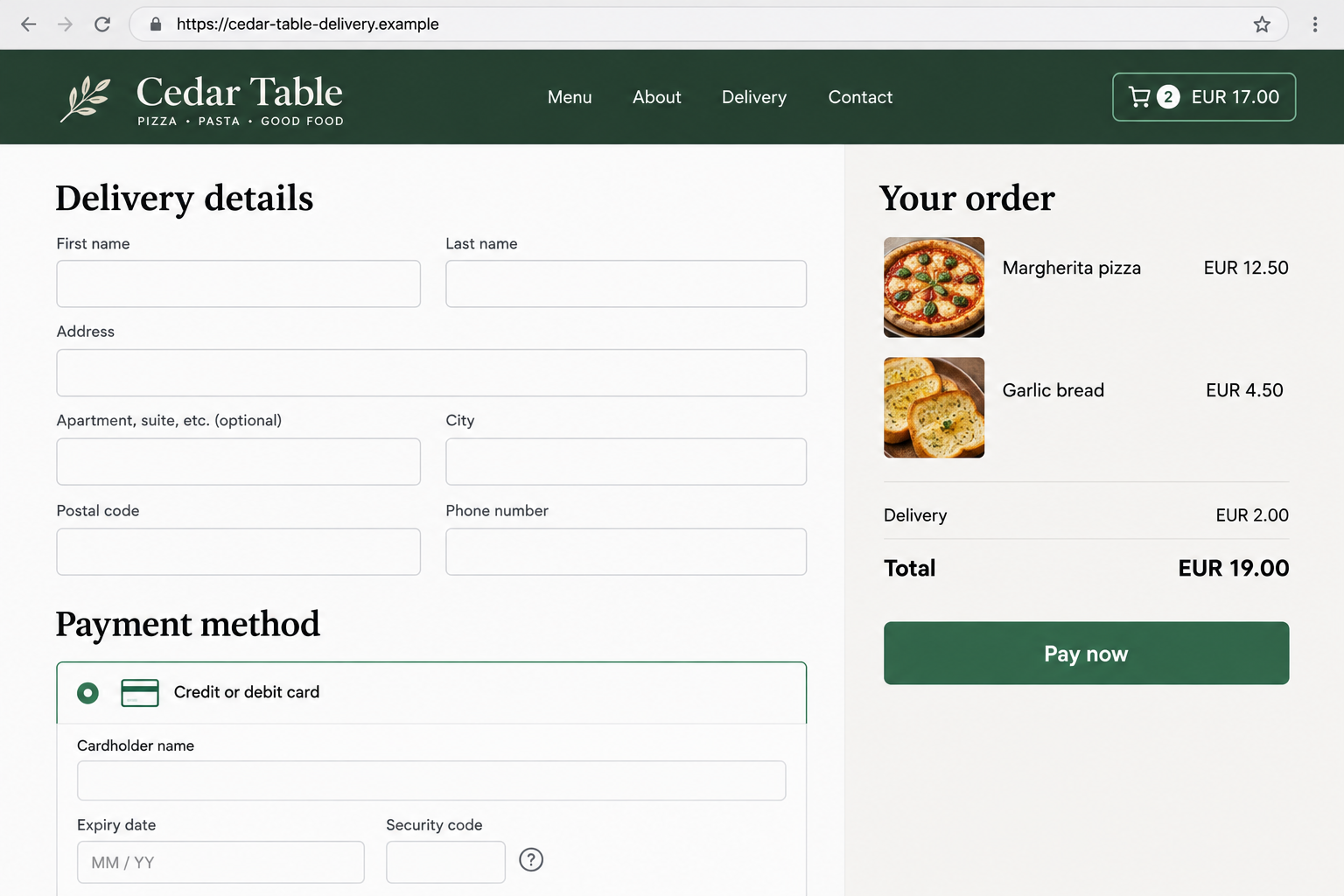
The Cedar Table checkout above is an illustration, using a fictional business and a nonfunctional example address. It is not evidence against a real restaurant.
A late meal alone doesn’t prove fraud. The documented scam involves unauthorized impersonation and diverted payments, which should be distinguished from ordinary delivery or service problems.
Why Ordering Dinner Makes This Easy to Miss
When you’re hungry, a restaurant search often feels like navigation rather than shopping. You think you already know the business and only need its order button.
That changes what you inspect. A familiar menu can receive more attention than the unfamiliar domain carrying it.
A copied telephone number can reinforce the impression. You may recognize the number or confirm that it reaches the real restaurant, without checking the website’s ownership.
For the owner, that creates another problem: customers can call the correct business about money it never received. Staff may be hearing about the copycat for the first time.
Give them the address that took your order, not an accusation about their kitchen. That information can help both sides identify the unauthorized page.
If you run the restaurant being copied, preserve customer reports and the misleading domain. Make your genuine ordering route easy to find through channels you control.
The trick is that a genuine contact detail can appear on a fraudulent page. Its accuracy doesn’t give the rest of that page permission to collect payments.
Search position adds another shortcut. A result near the top may feel like the obvious official site, especially when you are using a small screen.
But appearing prominently does not establish authorization from the business. A page can be easy to find and still be the wrong place to order.
You don’t need to investigate every meal like a major purchase. A brief check that the restaurant endorses the ordering route addresses the specific weakness this scam exploits.
How the Fake Restaurant Website Scam Works
Step 1: A copycat page borrows an established restaurant’s identity
The site uses the genuine business name and enough recognizable information to look plausible. That can include contact details visitors associate with the real restaurant.
The copied identity does much of the persuasion. The customer isn’t being asked to discover an unknown restaurant; they think they’re reaching one they already selected.
Some examples described by Fraudehelpdesk attach different place names to the same real restaurant identity. That can catch people searching by location.
A second location isn’t automatically fraudulent, however. Restaurants do expand and use outside ordering providers. The relevant question is whether the business authorizes this particular page.
Do not publish an accusation based only on a domain you haven’t seen before. Confirm the connection through the restaurant’s established channels first.
Step 2: Search visibility places the copy in the customer’s path
The cloned website can appear high in search results. A user looking for the restaurant’s ordering page may click before comparing addresses.
You might encounter the page among ordinary results or through an advertisement. Check the destination either way; placement doesn’t tell you who owns it.
Neither a search engine’s ranking nor a familiar-looking result title proves that the restaurant owns the checkout. Those are discovery cues, not business verification.
If several sites claim the same restaurant, don’t choose by prominence alone. Compare them with an established contact or a link the restaurant has independently confirmed.
A moment spent checking the route is easier than sorting out two payments after the first site has taken an unauthorized order.
Step 3: A normal-looking menu leads into an unauthorized checkout
The customer chooses food and enters delivery details. This feels routine because online meal orders normally need an address and a way to pay.
That familiarity can conceal the central question: is the restaurant actually connected to the person or system receiving the order?
A menu photo doesn’t answer it. Neither does a familiar brand name at the top of the page or a contact number in the footer.
An order number can also be generated by the false site. It proves that the page recorded something, not that a real kitchen accepted it.
Check unexpected location changes, unusual ordering addresses, or conflicting contact information before submitting payment. Ask the restaurant if its arrangement is unclear.
Step 4: The payment and the real restaurant become separated
In the documented pattern, the customer pays but the money doesn’t reach the legitimate restaurant. The real business may never receive the order at all.
Another described version lets an owner see an order but makes accepting it technically impossible. Seeing some order information is not the same as receiving a valid paid order.
That explains why a restaurant might recognize part of your story and still say it cannot deliver. Don’t assume the kitchen controls the website that took payment.
Keep the receipt and payment descriptor for your provider. They can help distinguish the claimed restaurant from the recipient or payment route recorded in the transaction.
A mismatch is a reason to investigate, not automatic proof of fraud by whichever company name appears on a statement. Payment processors and descriptors can be unfamiliar legitimately.
Step 5: Waiting for delivery delays discovery
The customer may spend time refreshing an order page before contacting the restaurant. A confirmation screen can make the absence of food seem like an ordinary delay.
When the real restaurant says it has no valid order, verify the website rather than paying an extra fee through the same page.
A second payment request could deepen the loss. Conversely, the restaurant may offer to take a genuinely new order through its real service.
Keep those two transactions separate. Decide about a replacement meal only after establishing the legitimate ordering route; don’t describe it as the original website’s refund procedure.
The longer-term problem is evidence. A receipt, saved address, and conversation record are more useful than an order page that may later disappear.
Check the Website Without Turning One Bad Order Into an Accusation
Ask whether the restaurant recognizes that exact address
Give the business the domain, not just the name printed on the page. Staff may recognize their restaurant name while knowing nothing about the site using it.
Use a contact you already know, an established independent listing, or previous genuine correspondence. Avoid letting the suspect checkout choose every source you consult.
Ask a concrete question: does the restaurant authorize orders through that website? A clear answer is more useful than asking whether the whole internet is safe.
Distinguish an ordering partner from an impersonator
A restaurant can legitimately use a third-party ordering provider. Different branding or a payment-processor name is not, by itself, evidence of a scam.
The connection should be confirmable through the actual business. You should also be able to identify the location fulfilling the order and the channel handling a problem.
If those answers conflict, pause the purchase. Don’t resolve the conflict by assuming the cheaper or more prominent website must be official.
Separate fraud from a late delivery
A busy kitchen, an address mistake, a courier delay, or a failed confirmation can all cause real order problems. Investigate those through the legitimate service.
The clone-site warning is different: an unauthorized page borrows a restaurant’s identity and collects money outside the actual ordering relationship.
That distinction protects both customers and businesses. You can dispute a diverted payment without falsely claiming that the genuine restaurant deliberately took your money.
What to Check Before Ordering Again
Save the genuine ordering route once the restaurant confirms it. A verified bookmark reduces the need to choose among lookalike search results next time.
Check the location, too. An apparently familiar restaurant in a different city may be a real branch, a confusing listing, or part of the impersonation.
If paying on collection or delivery is genuinely offered, it can avoid this particular online prepayment trap. It does not make every seller or order automatically trustworthy.
Be cautious about unexpected requests to verify a card through another link after ordering. Confirm any additional payment with the restaurant through the channel you independently established.
Don’t treat small meal costs as unimportant. The payment amount, exposed card information, and delivery details are different aspects of what the false checkout may have received.
At the same time, don’t assume every payment credential was stolen if a payment processor handled it. Tell your provider the actual checkout steps rather than guessing.
What to Do if You Have Fallen Victim to This Scam
-
Confirm the order with the real restaurant. Ask whether it recognizes the exact website and has accepted a paid order under your name.
Explain the discrepancy calmly. The restaurant may also be a target of impersonation and may not control the account that received your payment.
-
Preserve the checkout evidence. Save the complete website address, order confirmation, receipt, amount, time, promised service, and any communication about the missing meal.
Record the payment descriptor as it actually appears. Avoid replacing it in your notes with the restaurant’s name if those details differ.
-
Contact the payment provider promptly. Explain that the site may be impersonating a restaurant that denies authorizing it, and describe what was not delivered.
Ask which fraud-report, dispute, chargeback, or transfer-recovery process applies. Eligibility and outcome depend on the payment method and facts; a refund is not guaranteed.
-
Discuss exposed payment information. Tell your bank or card issuer whether you typed details directly into the site or used a separate payment service.
Ask about replacing or restricting the card where appropriate. Check subsequent activity rather than assuming the original meal price is the maximum possible exposure.
-
Protect any reused account password. If you created an ordering account with a password used elsewhere, change the reused credentials at those other services.
Don’t follow a password-reset link sent by the suspicious restaurant page to repair unrelated accounts. Open each legitimate service independently.
-
Respond to downloads only if they occurred. A page asking for a helper application or unusual permission deserves a separate device-security check.
Malwarebytes can help inspect malicious files. It cannot retrieve an undelivered meal’s payment or establish which merchant received the order.
-
Report the false listing or advertisement. Give the platform the misleading domain and explain the impersonation. Tell the genuine restaurant so it can document the misuse.
AdGuard may reduce some harmful advertising exposure. It doesn’t verify that a restaurant authorized a website or protect every search result.
-
Don’t pay to unlock a refund. Reject additional demands for cancellation, verification, or recovery fees from unverified contacts. Keep legitimate payment-provider discussions separate.
If you warn others, describe the unauthorized website accurately and redact private information. Don’t direct anger at staff who never received your payment.
Frequently Asked Questions
Can a fake ordering site use the real restaurant’s telephone number?
Yes. A genuine contact detail can be copied. Ask the restaurant whether it authorizes the exact website taking payment, not merely whether the number is correct.
Does a top search result prove the restaurant owns the website?
No. Prominent placement is not confirmation of ownership or authorization. Check the ordering route through the restaurant before supplying money or account information.
Is a third-party checkout always suspicious?
No. Legitimate ordering partners exist. The important point is whether the actual restaurant confirms that relationship and recognizes the service handling your order.
What if the restaurant can see my order but cannot accept it?
Fraudehelpdesk describes that possibility in this scam. Ask about the website and payment route; visible order details alone don’t establish that the business received the money.
Does one late delivery mean I found a cloned website?
No. Delays and mistakes happen in legitimate services. The confirmed scam involves unauthorized impersonation and payments outside the restaurant’s genuine ordering arrangement.
Should I place the order again after the restaurant denies receiving it?
Only through a separately verified route if you still want the meal. Preserve the first transaction and raise its recovery with the relevant payment provider.
The Bottom Line
Don’t pay through a restaurant website just because the name, menu, and search result look familiar. Confirm that the real business recognizes the ordering route.
If a clone already took payment, save the evidence and contact your payment provider. The genuine restaurant may be impersonated, not responsible for the missing money.

Join the discussion
0 commentsShare your experience or ask a question about this article.
Discussion
Start the conversation
Have a question or something useful to share? Add the first comment.