

A message claims a Harris County traffic matter needs your attention. The deadline is close, and the payment page looks familiar enough to continue.
Then your card supposedly fails. Before you try another one, stop and look at who is asking you to pay.
Overview
The District Clerk’s name is being used for a false collection
The Harris County District Clerk text scam sends recipients toward a look-alike website to settle an alleged traffic ticket or toll fee.
The real District Clerk’s Office says it has no role in collecting those obligations and does not send text messages requesting payment.
That distinction is more useful than judging whether a county logo looks sharp. The request assigns a job to an office that says it doesn’t perform it.
A failed-payment message can expose more than one card
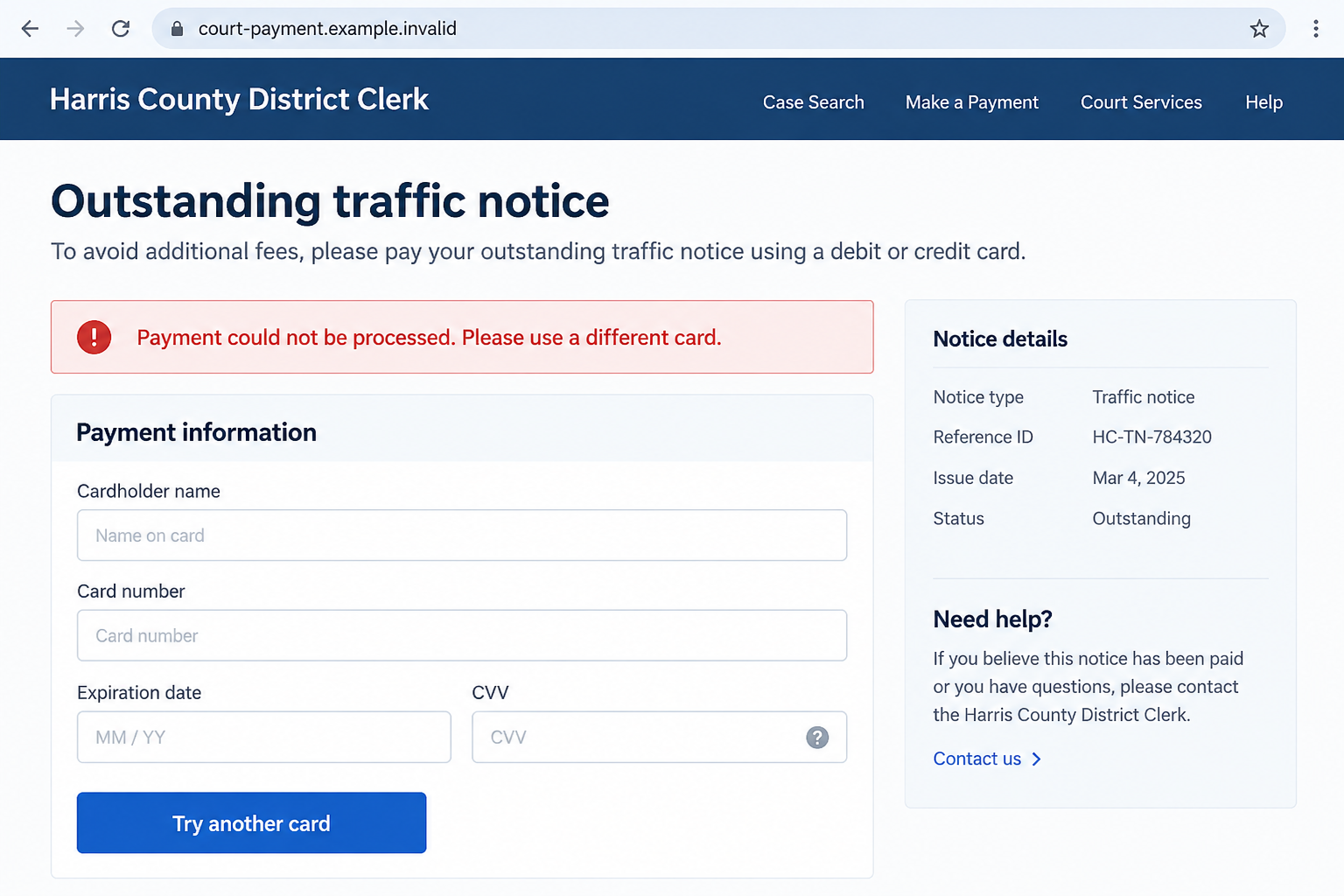
The office’s official scam alert describes fake pages telling recipients their payment failed, then asking them to enter another debit or credit card.
A processing error is not reassurance that the first card was safe. Its details may already have been submitted before the page displayed that message.
The lead image is an illustration of that reported tactic, not a live payment page or a screenshot from an individual recipient.
Other county impersonations need their own checks
Harris County residents can also encounter supposed jury-duty fines and toll notices. Do not assume every message using a county name comes from the same operation.
- District Clerk payment texts misuse the office’s identity and collection role.
- Fake jury calls use a missed-service story and threats to demand money.
- Fraudulent toll messages borrow the name of a real road or tolling organization.
- A professional webpage, local number, or reference code does not establish authenticity.
This guide focuses on the District Clerk payment trap and explains how to separate it from a genuine obligation or a different county-related contact.
Why the Wrong Office Is an Important Clue
Harris County has several offices with different responsibilities. A message can exploit that complexity by using an official title you recognize but do not deal with regularly.
You might remember a recent drive through Houston, a parking issue, or a toll account. The text gives that ordinary uncertainty an alarming explanation.
However, remembering a journey does not authenticate a payment demand. A real trip and a fraudulent message can exist at the same time.
Ask which organization actually handles the alleged charge. Then approach that organization independently, without taking the message’s link as your starting point.
A court-related title is not a universal billing department. The District Clerk’s warning makes that especially clear for traffic violations and toll fees.
Do not send the alleged fine to another account merely because a caller says one office is processing it for another.
If there is a genuine citation, its proper handling matters. Rejecting a fraudulent text should lead you to the correct office, not to ignoring real paperwork.
How the Harris County District Clerk Text Scam Works
Step 1: The text presents a debt as an official county matter
The message introduces an outstanding traffic ticket or toll fee and encourages you to deal with it through a supplied website.
Its wording may suggest that the issue has already been verified. A formal heading can make the message feel like the end of a process.
For the recipient, though, this may be the first mention of the alleged debt. That mismatch deserves attention before any payment decision.
Do not let a deadline substitute for a citation or account you can locate independently. Pressure is not documentation.
A case number can make a generic message appear specific. You still need to verify what it refers to through the appropriate official service.
There is no need to reply to confirm receipt. An unsolicited sender does not get to establish an official procedure just by announcing one.
Keep the message long enough to preserve evidence if necessary. Avoid opening its destination to investigate whether the threat sounds serious.
Step 2: A familiar-looking page takes over the conversation
The link leads to a site designed to resemble the District Clerk’s website. Familiar colors, an office name, and government-style navigation can lower your guard.
Those visual elements are not the same as the court’s actual control of the page. A copied design can sit on an unrelated address.
Read the whole address rather than searching it for a recognizable word. A county name inside a longer hostname does not prove ownership.
An encrypted connection is also not a fraud check. It can protect information while carrying it directly to the wrong recipient.
Do not use a logo, a lock icon, or a functional-looking menu as your deciding test. Each can appear without authenticating the payment request.
The safer comparison starts in a separate session with the office’s independently located website, not by exploring more links inside the suspicious page.
If that real office says it doesn’t collect the described fees, the imitation page cannot make the demand legitimate.
Step 3: The page collects personal and payment information
A supposed payment form may ask for details that feel ordinary during checkout: your name, billing address, card number, expiration date, and security code.
The problem is the recipient. Information that belongs in a genuine payment process becomes exposed when submitted to an impostor.
Do not assume a form is harmless because you haven’t reached its final confirmation screen. You cannot see how an untrusted site handles entered information.
If you typed details but are unsure whether you submitted them, tell your issuer exactly that. Let it decide what protection is appropriate.
Think back through your own visit: did you only view the form, fill it in, or try several cards? Tell the issuer which happened.
A person who only read the text has a different exposure from someone who entered two cards and an account password.
Write down those differences before contacting the bank. Clear details help it act on the right accounts.
Step 4: A false error encourages you to try another card
This is the particularly damaging part of the reported Harris County scheme. The fake page can say a payment failed and ask for different card details.
You may interpret the error as a bank problem or a reason to switch from debit to credit. The page gains another set of payment information.
A rejection message does not prove that no charge occurred, nor does it prove that the first card’s details were discarded.
Check the actual account through your bank’s app. Even an empty transaction list cannot tell you that exposed card details will never be misused later.
If you tried several cards, report every one. Protecting only the card that finally appeared to work leaves the earlier disclosures unresolved.
Do not return to test whether the error repeats. There is nothing useful to establish by giving a suspected phishing form more information.
An issuer can advise about replacement, temporary restrictions, and transaction disputes. The fake payment page cannot provide trustworthy reassurance about any of them.
Step 5: Follow-up contact tries to finish the collection
A related message or caller may offer to help complete the payment. Treat that approach as another unverified contact, even if it mentions your earlier attempt.
Information you entered on the form could make a later conversation sound knowledgeable. Knowledge of that interaction is not proof of official status.
Never read out a one-time bank code to help an unexpected caller fix a declined payment. Ask your bank about the request independently.
A new threat does not create a legitimate debt. Nor does paying once guarantee that the messages will stop.
If you realize the mistake during the process, close the page and contact the affected provider. You do not need a final receipt to report exposure.
Preserve existing messages rather than keeping the conversation alive. An investigator can work with the evidence you already have.
Separate the District Clerk, Jury Office, and Toll Account
Verify the alleged fee with the organization responsible
For a message claiming to be from the District Clerk, open the office’s official website yourself and use its published contact information.
The office’s alert lists its customer service line as 832-927-5800. Confirm current contact details on the official page before using them.
For a toll concern, use the account or statement you already recognize. Do not let a District Clerk-branded page choose your toll-payment destination.
A rental vehicle can complicate who bills for a journey. Use the rental agreement and the company’s established account channels to check that situation separately.
Do not let a jury-duty story bypass the same rule
The District Clerk has also published warnings about impostors demanding money for missed jury service. That is a different hook, not proof the payment text is genuine.
A caller claiming to be a deputy can sound authoritative without being connected to the sheriff’s office. Names and ranks are not identity checks.
If a caller threatens arrest unless you immediately transfer funds, end the conversation and approach the relevant office independently.
You can address an authentic jury question without paying the person who called. Do not confuse cooperation with officials with compliance with a stranger.
Keep real deadlines on a separate track
If you have actual court paperwork, do not discard it because a scam text arrived. Compare it with information from the responsible court.
An unanswered search or a missing online entry may need help from staff. It is not always a complete picture of a legal matter.
A lawyer can advise on a genuine proceeding when needed. A fraud guide cannot decide whether you owe a particular fine or missed a real deadline.
What to Do if You Have Fallen Victim to This Scam
- Stop the payment attempts.
Close the look-alike page. Do not enter a new card, retry the same card, or contact support through the suspicious text.
Keep the original message and any screenshots already available. Do not revisit the form just to produce better evidence.
- Notify every issuer whose card you entered.
Use the issuer’s trusted app or the number printed on the card. Explain that a fake county payment page requested another card after showing an error.
Ask about freezing or replacing exposed cards and reviewing pending charges. Mention each attempt, including any card that supposedly failed.
A temporary lock may be an immediate precaution, but ask the issuer whether it is sufficient. Do not rely on the scam page’s payment status.
- Distinguish a fraudulent payment from other account exposure.
If money left the account, identify the transaction and request the appropriate dispute or recovery process. Describe honestly whether you approved it under false pretenses.
If you entered a reused password, change it on the real service and anywhere else you used it. Review account access and recovery settings.
Sharing card information does not automatically mean every online account was accessed. Concentrate first on the information you actually provided.
- Check any real ticket or toll independently.
Contact the organization responsible through an established website, statement, or official directory. Ask it to verify the underlying obligation, not the fake checkout.
Do not pay the same alleged amount elsewhere until you understand what is genuine. A scammer’s number is not a reliable starting balance.
- Report the impersonation with useful details.
The District Clerk’s warning directs people affected by this scheme to the Harris County Sheriff’s Office at 713-221-6000. Check the official alert for current guidance.
Record the sender, destination address, time, and number of cards entered. You can also report through the FTC’s fraud reporting service.
Keep full card numbers and identity documents out of public reports or comments. Share sensitive evidence only through verified, appropriate channels.
- Address device risks only if the interaction created them.
If the page prompted a download, remote-access installation, or notification permission, review those changes. A payment error alone does not prove your device contains malware.
For possible malicious software exposure, Malwarebytes can help check the device. AdGuard may reduce exposure to malicious advertising; neither tool secures an already exposed card.
Do not buy recovery services from someone who contacts you about the incident. Account and payment recovery should stay with the providers you verified.
Frequently Asked Questions
Does the Harris County District Clerk collect toll fees by text?
No. Its warning says it neither sends payment-request texts nor handles collection of traffic violations or toll fees. Verify a genuine charge with the responsible organization.
Was my first card safe if the page rejected it?
Do not assume so. The reported tactic asks for another card after an apparent failure. Tell the first issuer its card details were entered too.
Does a familiar county website design make the form genuine?
No. Appearance can be copied. Start with the real office’s independently located website and confirm whether it actually handles the payment described.
What if I really have an unpaid toll?
Resolve it through the legitimate toll account or billing organization. A genuine balance does not authenticate an unrelated text or a District Clerk-branded checkout.
Should I replace every card in my wallet?
Tell issuers about the cards you exposed and follow their advice. Unused cards are not automatically compromised merely because you received the message.
Can a scanner recover the payment?
No. Security software addresses relevant device threats, not bank reversals. Contact the payment provider promptly about exposed details and any money already sent.
The Bottom Line
Do not pay through a Harris County District Clerk text scam. The real office does not use these messages to collect traffic tickets or toll fees.
If the fake page rejected a card, protect that card too. Contact every affected issuer, then verify any genuine obligation through its proper channel.

Join the discussion
0 commentsShare your experience or ask a question about this article.
Discussion
Start the conversation
Have a question or something useful to share? Add the first comment.