

An alien-themed token page says there may be an allocation waiting for your wallet. The branding looks familiar, and checking seems like a small step.
Before opening the wallet prompt, look at the address that brought you there. The difference is easy to miss.
Overview
A familiar crypto identity is used to advertise an allocation
The Make Aliens Great Again allocation scam copies the identity of an existing meme-token project. The lure suggests that visitors can check or receive $MAGA tokens.
Reported lookalikes include makealiensgreatagain[.]app and makealiengreatsagain[.]com. The established project address is makealiensgreatagain.com, a different domain from either imitation.
The counterfeit allocation is described as a wallet-draining operation. That accusation belongs to the impersonating pages, not automatically to the project whose identity they copied.
Recognizing the genuine project also does not endorse its token as an investment. A correct website and a worthwhile financial decision are separate questions.
The request matters more than the alien artwork
A landing page can copy a name, colors and theme without controlling the project. The crucial transition is from a displayed allocation to a request inside your wallet.
- Check the entire domain, including the final extension and altered spelling.
- Do not treat a displayed reward as money already belonging to you.
- Read the wallet’s requested action instead of relying on the page’s button label.
- Reject unexplained transfers, approvals or requests for recovery secrets.
Sharing a public address or permitting a basic connection is not the same as authorizing a transfer. Harm depends on the permissions, signatures or secrets actually supplied.
This distinction does not make the counterfeit claim safe. It helps someone who already interacted choose the right recovery action.
The available evidence has clear boundaries
A fresh capture of the reported .app address failed. No wallet was connected, no transaction was signed and no exact malicious request was executed for this guide.
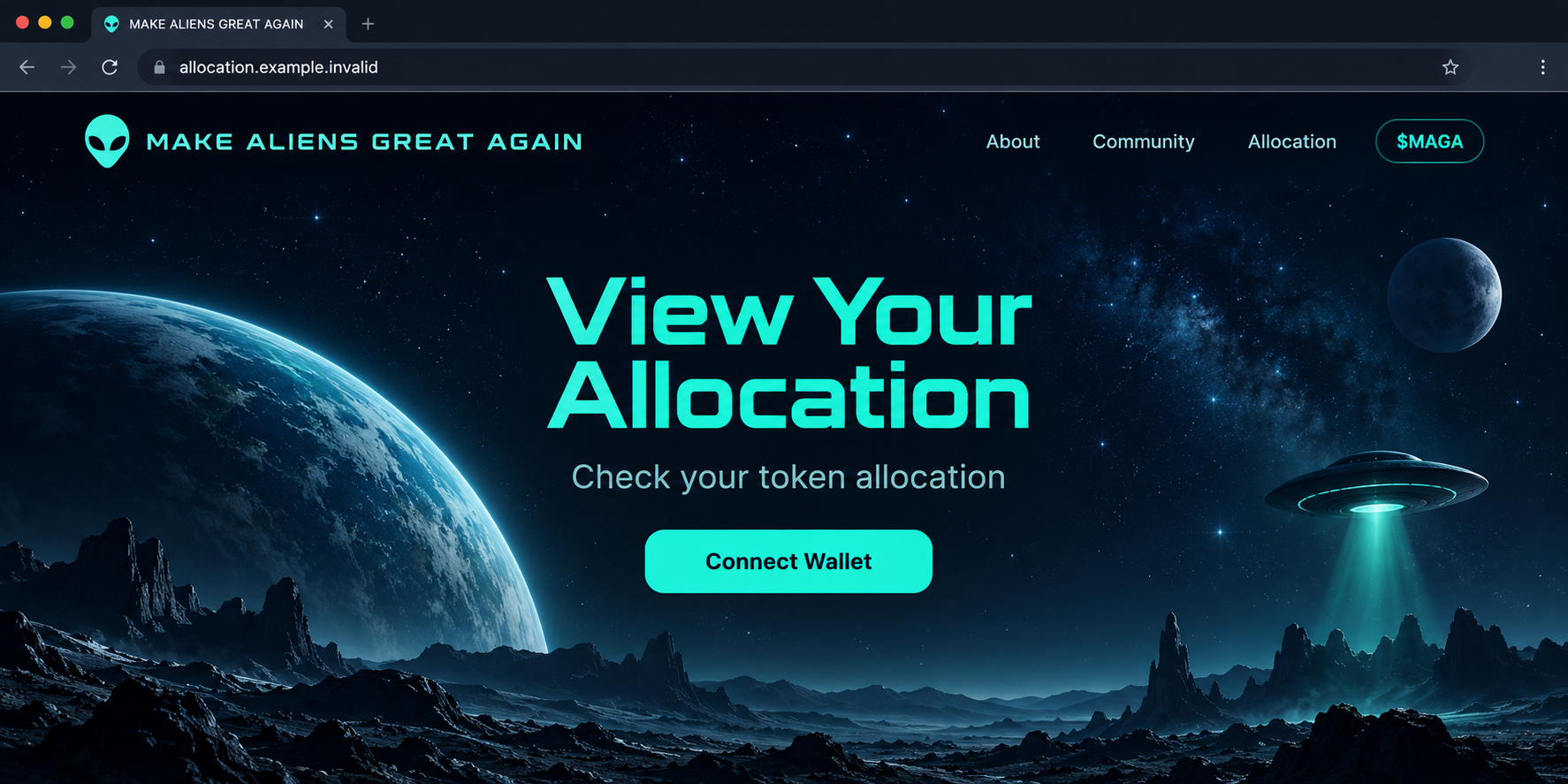
The lead image is original explanatory artwork with a nonfunctional address. It is not a recovered screenshot proving a particular reward balance or transaction.
The warning rests on the reported impersonation and wallet-access lure. It does not establish the operator’s identity, a universal affected blockchain or the result for every visitor.
Do not investigate those gaps by funding an exposed wallet. First determine whether you connected, approved something, transferred assets or disclosed a secret.
Two Domain Changes That Deserve Your Attention
The same name with a different ending
Makealiensgreatagain[.]app keeps the recognizable phrase while changing the domain extension. At a glance, a reader may remember the name and overlook the ending.
A .app address is not inherently fraudulent. The concern is this reported impersonation, not a blanket rule about every site using that extension.
Other projects legitimately own several domains. That possibility does not authenticate an unsolicited allocation link claiming to be one of them.
Follow a project announcement from its independently established site or accounts. Do not accept a new address merely because the page says it is official.
A familiar phrase with rearranged letters
Makealiengreatsagain[.]com is another reported address. Read it carefully: the placement of the letter s differs from the established project name.
Small changes work because readers recognize phrases faster than they inspect individual characters. A narrow mobile address bar can make that problem worse.
Copy the suspicious address into a plain note if necessary, without visiting it again. Compare complete hostnames rather than page titles or search-result labels.
A domain that was unavailable during a later check may have worked earlier. Its disappearance does not validate anything previously signed there.
How the Make Aliens Great Again Allocation Scam Works
Step 1: Present a Token Opportunity That Feels Relevant
The entry point is a supposed allocation, meaning an amount of tokens reserved for an eligible participant. That word makes a promotion sound like a distribution process.
A visitor already familiar with $MAGA may be curious about eligibility. Someone unfamiliar with it may assume the project name and detailed design imply an established opportunity.
The counterfeit page does not need to promise enormous returns to create a reason to interact. Even checking a small possible reward can open the next stage.
Do not infer eligibility from a counter, a claim badge or a congratulatory message. A website can display those before it knows anything meaningful about your wallet.
For any genuine distribution, the eligibility rules and official announcement should be verifiable outside the claim page. An isolated button is not that confirmation.
Step 2: Replace the Project’s Address With a Lookalike
The page borrows the project’s alien-themed identity, moving the reader’s trust from a familiar name to a different domain.
This is where independent navigation matters. A correct name inside the page does not repair an incorrect address above it.
Copied navigation, community labels or social icons may reinforce the impression. Check whether an official channel actually points to the specific allocation, not merely whether icons exist.
Search advertisements and replies under genuine posts are not announcements by the project. Anyone able to post a link may place it near legitimate discussion.
No single promotion channel is established for every victim here. The principle is to verify the destination regardless of whether you found it in search, social media or messaging.
Step 3: Turn Checking Eligibility Into a Wallet Connection
The allocation flow asks the visitor to connect a wallet. That interaction can expose a public account address and allow the site to request additional actions.
A familiar wallet selection menu can appear on both genuine and malicious sites. The presence of your wallet’s name does not certify the page requesting access.
Check which account is selected before continuing anywhere. A wallet holding unrelated savings should not be exposed to experimental claim sites simply because it is convenient.
Even an empty wallet does not make a site trustworthy. Later deposits can matter if an unsafe permission or secret remains usable.
If you connected but declined every further request, disconnect the site and review activity. Do not assume funds left solely because your public address became visible.
Step 4: Disguise a Harmful Authorization as the Claim
A wallet drainer ultimately needs a way to move assets. Depending on the chain and request, that may involve a transfer, spending permission or another actionable authorization.
The label on the website cannot tell you which one the wallet is asking for. Read the wallet’s own details, including assets, destination and permissions.
A signature without an obvious immediate fee is not automatically harmless. Some signed authorizations can be used later, so an unexplained signing request deserves refusal.
The exact payload used by these reported pages was not recovered here. Do not assume a specific contract method or token standard simply from the campaign’s name.
Likewise, there is no evidence that every connected wallet loses everything automatically. The risk should be investigated through the actual requests and transaction history.
Never type a recovery phrase or private key into an allocation page. That would disclose control information, not prove eligibility for a reward.
Step 5: Leave the Victim Facing Real Transactions, Not the Promised Tokens
If an unsafe authorization is used, assets may move away while the page continues to discuss rewards. The promised allocation is not compensation for that transfer.
A website error, a frozen claim button or a remaining balance displayed on the page does not describe the blockchain’s actual state.
Look up the relevant public account using the network’s genuine explorer. Compare asset movement and approvals with what you intended to authorize.
Confirmed blockchain transfers normally cannot be recalled like a card payment. Reporting can still be useful, especially if a receiving exchange can identify a relevant transaction.
Do not send an unlock fee to make the website release an allocation or reverse a drain. That would create another payment without establishing any recovery mechanism.
Work Out Which Kind of Wallet Exposure Occurred
Connection without an approved operation
A basic connection commonly gives the site account visibility and a route to request actions. Remove that connection through your wallet’s own settings.
Then inspect recent activity. An absence of unexplained transactions is reassuring, but check whether you also accepted a separate permission or signed something.
Do not rely on memory of clicking only one button. A website action and a wallet confirmation are different interfaces in the same journey.
Approval or signature accepted
For supported networks, inspect allowances using tools recommended by the wallet provider. Make sure the account, network and token are the ones involved.
MetaMask explains that disconnecting a site does not revoke an existing token approval. Treat those as separate checks.
Its approval-revocation instructions describe relevant tools and network fees. They are not a universal remedy for every blockchain or signature type.
If you cannot interpret a request, consult official wallet support. Share public transaction details when needed, never the phrase or private key.
Recovery information disclosed
A compromised recovery phrase is a more serious problem than one risky application permission. Revoking a contract does not make that phrase secret again.
Arrange a new, independently generated wallet using trusted software or hardware and a clean device. Do not import the exposed phrase and call it a fresh wallet.
Seek qualified help if assets are substantial or automated theft is occurring. Repeatedly adding network fees to an actively drained address can create further loss.
Why the Visible Allocation Is Not a Wallet Balance
A claim page can show an allocation before any token exists in your account. That number is website content, not a confirmed balance on a blockchain.
Even a real token appearing in a wallet does not establish a trustworthy market price or a safe website for interacting with it.
Look at the token contract and network, not just its ticker. Different assets can share short names, including MAGA, without belonging to the same project.
Do not follow an unsolicited token’s embedded link to validate or sell it. That can turn an unexpected asset into another route toward a signing prompt.
If a website asks you to deposit more cryptocurrency before claiming, that is a new financial request. Evaluate it separately rather than treating earlier clicks as a commitment.
Someone who has already spent time checking eligibility may feel close to finishing. That feeling is not evidence that one more approval will produce the promised reward.
Close the page when the required authorization is unclear. Missing an unverified allocation is preferable to exposing assets you already control.
What to Do if You Have Fallen Victim to This Scam
Stop the allocation flow immediately. Reject pending requests and leave the lookalike page. Do not continue because a displayed reward supposedly expires.
Note the domain you used and whether the wallet showed a connection, signature, approval or transfer. This is the starting point for a useful incident record.
Inspect the real account history. Use your wallet and the appropriate network explorer to identify unknown transactions, permissions or asset movements.
Save transaction hashes, public addresses, token names and times. Keep those distinct from balances or messages displayed only on the claim website.
Remove dangerous permissions where applicable. Disconnect the site and separately review allowances through trusted wallet guidance. Check every involved account and network.
A revocation may require a legitimate network fee. Verify the operation itself, and do not pay a person claiming a special charge is needed to activate protection.
Replace exposed wallet secrets. If you shared a seed phrase or private key, plan migration to a genuinely new wallet rather than trusting a new password alone.
Official support can clarify the wallet’s recovery process. No legitimate helper needs your secret phrase in a direct message to assess a public transaction.
Check software only when the incident involved software. An installed wallet impostor, downloaded extension or unexplained recurring redirect deserves device investigation.
Malwarebytes can assist with unwanted software; AdGuard may reduce malicious ad routes. Neither can revoke an on-chain permission or reverse assets already transferred.
The scan guide below addresses that limited device concern. It is not a crypto-recovery service or a substitute for checking authorizations.
Report the loss with usable evidence. Notify the impersonated project through a verified channel and report financial theft to the appropriate authorities.
If an identifiable exchange received funds, contact its official abuse process. Refuse guaranteed-recovery agents and retain the evidence even when immediate reimbursement is unavailable.
Is Your Device Infected? Run a Free Malware Scan
Slow performance, constant pop-ups, or strange behavior? These are classic signs of a malware infection. The fastest way to find out is to scan your device with Malwarebytes Free — one of the most trusted malware removal tools available.
The free version detects and removes the most common threats, including:
- Adware — the cause of those annoying pop-ups
- Browser hijackers — unwanted redirects and changed homepages
- Trojans and spyware — hidden programs stealing your data
- Potentially unwanted programs (PUPs) — software you never asked for
👉 Select your device below — Windows, Mac, or Android — then follow the simple steps to download Malwarebytes, scan your system, and remove any threats it finds. The scan usually takes 5 to 20 minutes.
Run a Malware Scan with Malwarebytes for Windows
Malwarebytes is one of the most popular and trusted anti-malware tools for Windows — and it’s completely free for removing infections. It catches threats that many antivirus programs miss, including adware, browser hijackers, and trojans. Follow the steps below to scan and clean your PC in just a few minutes.
Download Malwarebytes
Click the button below to download the latest version of Malwarebytes for Windows from the official source. The free version is all you need — it will scan your computer and remove adware, browser hijackers, and other malicious software at no cost.
Download MalwarebytesOfficial installer for Windows 11 and 10. Your download starts right away.Want real-time protection? See Malwarebytes Premium Malwarebytes Free for WindowsScans and removes malware at no cost
-
Install Malwarebytes
When the download finishes, open your Downloads folder and double-click the MBSetup file. If Windows shows a User Account Control pop-up, click “Yes” to allow the installation.

Follow the On-Screen Prompts to Install Malwarebytes
The setup wizard will walk you through a few quick screens:
-
Choose where you’re installing the program — “Personal Computer” or “Work Computer” — then click Next.

-
Malwarebytes will now install on your device. This usually takes under a minute.

-
When installation is complete, the “Welcome to Malwarebytes” screen will open automatically.

-
On the final screen, click Open Malwarebytes to launch the program.

-
Enable “Scan for Rootkits”
Before scanning, turn on rootkit detection so Malwarebytes can find even the most hidden threats. Click the Settings gear icon on the left side of the screen.

In the settings menu, find “Scan for rootkits” and click the toggle so it turns blue.

Done? Click “Dashboard” in the left pane to return to the main screen.
Start the Scan
Click the blue Scan button. Malwarebytes will automatically update its virus database and start checking your computer for malware.

-
Wait for the Scan to Finish
The scan checks your entire system for browser hijackers and other malicious programs, so it can take 5 to 20 minutes depending on your computer. Feel free to do something else — just check back occasionally to see the progress.

-
Quarantine the Detected Threats
When the scan is done, you’ll see a list of everything Malwarebytes found — malware, adware, and potentially unwanted programs. Click the “Quarantine” button to remove all of them at once.

Malwarebytes will now remove the malicious files and registry entries and move them safely into quarantine.

-
Restart Your Computer
Some threats can only be fully removed after a reboot. If Malwarebytes asks you to restart, click Yes. Once you’re logged back in, Malwarebytes has finished removing the threats it found.

That’s it — your Windows PC is now clean of trojans, adware, and other malware, and should be back to running smoothly.
If you are still having problems with your computer after completing these instructions, then please follow one of the steps:
- Run a computer scan with ESET Online Scanner
- Ask for help in our Windows Malware Removal Help & Support forum.
Run a Malware Scan with Malwarebytes for Mac
Malwarebytes for Mac is a free on-demand scanner that removes the malware other security software tends to miss — adware, browser hijackers, and unwanted programs included. Cleaning an infected Mac with Malwarebytes has always been completely free, and it’s our go-to recommendation. Follow the steps below to scan and clean your Mac in just a few minutes.
-
Download Malwarebytes for Mac
Click the button below to download the latest version of Malwarebytes for Mac.
Download MalwarebytesOfficial installer for macOS. Your download starts right away.Want real-time protection? See Malwarebytes PremiumMalwarebytes Free for MacScans and removes malware at no cost -
Open the Malwarebytes setup file
When the download finishes, open your Downloads folder and double-click the setup file to begin the installation.

-
Follow the On-Screen Prompts to Install Malwarebytes
The Malwarebytes for Mac Installer will guide you through a few quick screens. Click “Continue” and keep following the prompts until the installation completes.



When the installation is complete, Malwarebytes opens to the Welcome to Malwarebytes screen. Click “Get started“.
-
Select “Personal Computer” or “Work Computer”
Malwarebytes will ask what type of computer you’re installing it on. Click either Personal Computer or Work Computer, whichever applies.

-
Start the Scan
Click the “Scan” button. Malwarebytes will automatically update its detection database and begin checking your Mac for malware.

-
Wait for the Scan to Finish
Malwarebytes will scan your Mac for adware, browser hijackers, and other malicious programs. This can take a few minutes, so feel free to do something else — just check back occasionally to see the progress.

-
Quarantine the Detected Threats
When the scan is done, you’ll see a list of everything Malwarebytes found. Click the “Quarantine” button to remove all the threats at once.

-
Restart Your Mac
Malwarebytes will now remove all the malicious files it found. Some threats can only be fully removed after a reboot — if Malwarebytes asks you to restart, allow it. Once you’re logged back in, your Mac is clean.

That’s it — your Mac is now free of adware, rogue browser extensions, and other potentially harmful software.
If you are still experiencing problems while trying to remove a malicious program from your computer, please ask for help in our Mac Malware Removal Help & Support forum.
Run a Malware Scan with Malwarebytes for Android
Malwarebytes for Android automatically detects and removes dangerous threats like malware and ransomware so you don’t have to worry about your most-used device being compromised. Aggressive detection of adware and potentially unwanted programs keeps your Android phone or tablet running smooth.
-
Download Malwarebytes for Android.
You can download Malwarebytes for Android by clicking the link below.
Get Malwarebytes for AndroidOpens Google Play in a new tab.Want real-time protection? See Malwarebytes Premium for AndroidMalwarebytes for AndroidScans your phone and removes malware at no cost -
Install Malwarebytes for Android on your phone.
In the Google Play Store, tap “Install” to install Malwarebytes for Android on your device.

When the installation process has finished, tap “Open” to begin using Malwarebytes for Android. You can also open Malwarebytes by tapping on its icon in your phone menu or home screen.

-
Follow the on-screen prompts to complete the setup process
When Malwarebytes will open, you will see the Malwarebytes Setup Wizard which will guide you through a series of permissions and other setup options.
This is the first of two screens that explain the difference between the Premium and Free versions. Swipe this screen to continue.
Tap on “Got it” to proceed to the next step.
Malwarebytes for Android will now ask for a set of permissions that are required to scan your device and protect it from malware. Tap on “Give permission” to continue.
Tap on “Allow” to permit Malwarebytes to access the files on your phone.
-
Update database and run a scan with Malwarebytes for Android
You will now be prompted to update the Malwarebytes database and run a full system scan.

Click on “Update database” to update the Malwarebytes for Android definitions to the latest version, then click on “Run full scan” to perform a system scan.

-
Wait for the Malwarebytes scan to complete.
Malwarebytes will now start scanning your phone for adware and other malicious apps. This process can take a few minutes, so we suggest you do something else and periodically check on the status of the scan to see when it is finished.

-
Click on “Remove Selected”.
When the scan has been completed, you will be presented with a screen showing the malware infections that Malwarebytes for Android has detected. To remove the malicious apps that Malwarebytes has found, tap on the “Remove Selected” button.

-
Restart your phone.
Malwarebytes for Android will now remove all the malicious apps that it has found. To complete the malware removal process, Malwarebytes may ask you to restart your device.
That’s it — your Android phone is now clean — no more malicious apps, adware, or browser redirects.
If you are still having problems with your phone after completing these instructions, then please follow one of the steps:
- Restore your phone to factory settings by going to Settings > General management > Reset > Factory data reset.
- Ask for help in our Mobile Malware Removal Help & Support forum.
Stay Protected: Block Ads and Malicious Sites
Now that your device is clean, keep it that way. Most infections start with a malicious ad or a fake download button — so blocking them at the source is your best defense.
We recommend AdGuard, which blocks malicious ads, phishing pages, and dangerous redirects before they can reach you.
👉 Download AdGuard and browse safely
Frequently Asked Questions
Is Make Aliens Great Again itself the scam?
This article concerns counterfeit allocation pages using its identity. It is not an investment assessment of the genuine project or every token using the MAGA ticker.
Which domains are associated with this allocation lure?
The reported examples are makealiensgreatagain[.]app and makealiengreatsagain[.]com. Do not visit them to check eligibility or reconnect a wallet.
Does connecting alone let a site take all my crypto?
Not by itself in a normal basic connection. Transfers depend on additional authority, existing permissions or compromised secrets. Review the specific interaction instead of assuming either outcome.
Is disconnecting enough after an approval?
No. Existing allowances can remain active. Use the correct network’s trusted revocation process, and obtain help if the signature or permission is unclear.
Can I keep using a wallet after sharing its recovery phrase?
Treat the secret as exposed. A new app password does not invalidate it. Arrange a new wallet and safely protect remaining assets.
Can a token allocation fee recover stolen funds?
No reliable recovery follows from paying the counterfeit page. Keep transaction evidence and use official reporting channels instead of sending additional assets to the operator.
The Bottom Line
Do not claim $MAGA through these Make Aliens Great Again lookalikes. Familiar branding cannot justify an unexplained wallet authorization on a different domain.
If you interacted, identify the exact exposure before funding that address again. Review approvals, replace disclosed secrets and report actual transfers without paying a recovery-fee demand.

Join the discussion
0 commentsShare your experience or ask a question about this article.
Discussion
Start the conversation
Have a question or something useful to share? Add the first comment.