

A proposal asks when rewards should be distributed, and your vote supposedly earns allocation points. Choosing a date sounds easier than evaluating another investment offer.
For anyone following a crypto project, that invitation can feel like participation rather than a purchase. It is worth examining what happens before you cast a vote.
Overview
The vote is presented as a PERPL community activity
The PERPL Vote Rewards scam imitates the identity of PERPL, a real crypto trading project. Its voting page is not an authenticated community proposal.
The reported imitation uses app-perpl[.]com. The genuine project’s website is perpl.xyz, which links to its application at app.perpl.xyz.
These addresses are not interchangeable. A hyphenated name on a different registered domain does not become official because it contains the same project name.
This warning concerns the imitation, not an allegation that PERPL runs the fraud. Visiting the genuine project also does not establish that an unrelated rewards offer is legitimate.
A distribution choice becomes a wallet request
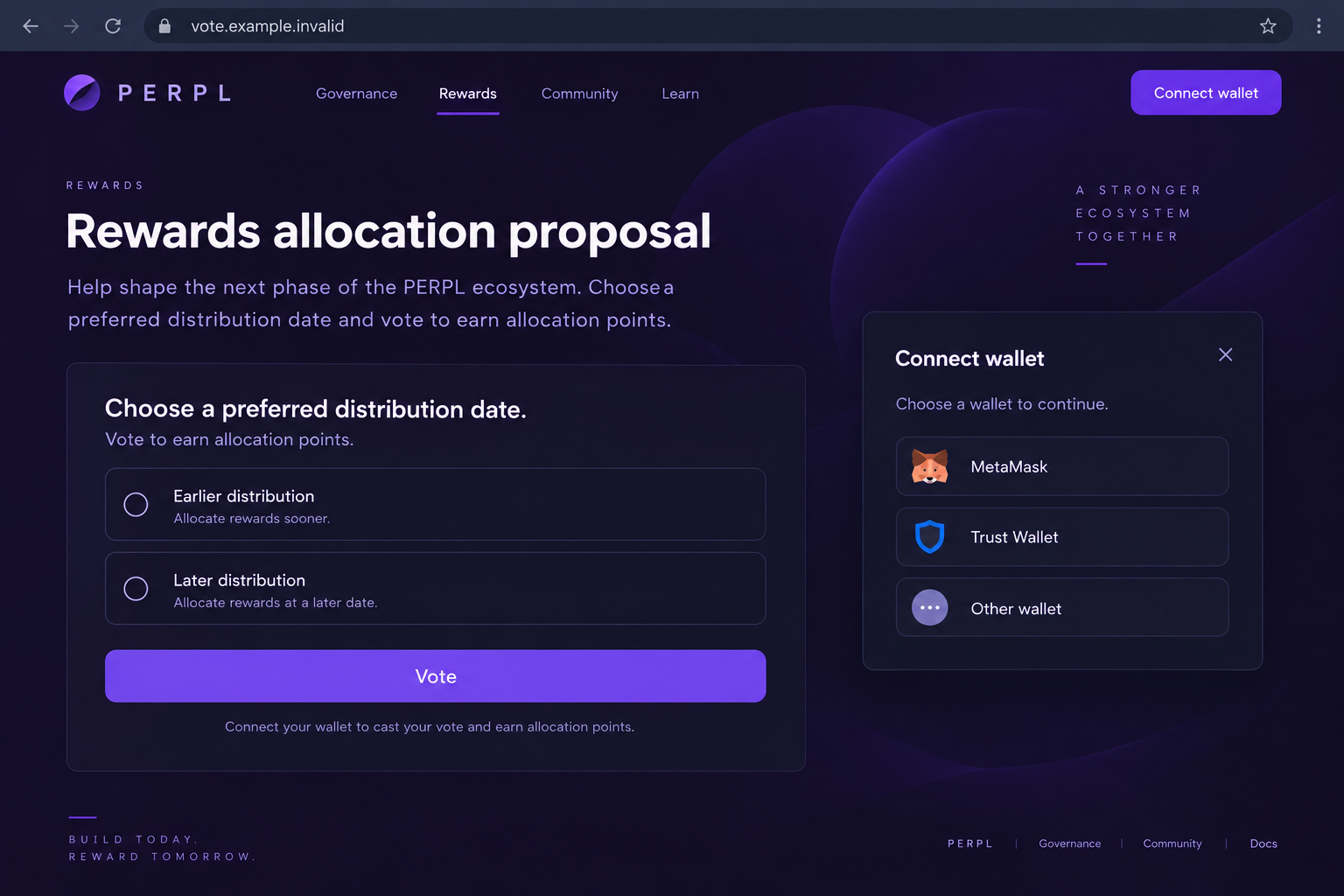
The lure asks visitors to select a rewards distribution date. Allocation points supply the incentive, making a routine preference question appear financially worthwhile.
A wallet-selection interface follows the voting invitation. Familiar options can make the transition feel ordinary to people accustomed to interacting with decentralized applications.
The critical issue is what the wallet subsequently asks you to authorize. A basic connection alone is not permission to transfer every asset.
Dangerous approvals, transactions, or signatures can create that authority. The specific request must be examined instead of treating every wallet interaction as technically identical.
What can be established about this campaign
The reported offer is a brand-impersonation wallet trap. Its promised rewards are not independently verified entitlements, and the unofficial domain should not be used.
The reported host was unavailable during a fresh capture attempt. The lead image illustrates the proposition with fictional details; it is not an original live-page screenshot.
- A community vote is used to make a wallet interaction seem necessary.
- Allocation points imply a future benefit without proving anyone owes you tokens.
- A copied project identity masks a different website address.
- The permission or transaction inside your wallet determines the immediate exposure.
No historic malicious transaction is reconstructed here. The practical warning does not depend on inventing a contract address, a victim balance, or a completed theft.
Why a Rewards Vote Feels Different From an Airdrop
Many crypto users already distrust messages offering a large, immediate payout. A vote changes the framing: you are helping decide something, not demanding free money.
The promise of points makes the action seem modest. You might expect nothing today and still connect because you hope participation will count later.
That delay can reduce scrutiny. There is no impressive balance to challenge, only a small task that appears to help your standing in a community.
For example, choosing between earlier and later distribution dates feels administrative. Neither choice tells you whether the next wallet request grants control over tokens.
A professional interface reinforces the mismatch. Navigation labels, reward cards, and familiar wallet logos can all be assembled without access to the genuine project’s systems.
The fake proposal needs to borrow the project’s reputation, not its infrastructure. Readers should verify the campaign through the project’s established channels before discussing its benefits.
Being an existing user does not authenticate a new message. Public activity can reveal that someone uses a project, and a generic invitation may reach unrelated wallets.
Equally, declining an unverified vote is not forfeiting a verified entitlement. The page has not established that the points exist or belong to you.
How the PERPL Vote Rewards Scam Works
Step 1: The imitation turns project familiarity into a voting invitation
The visitor encounters a page organized around PERPL rewards and a supposed distribution proposal. Familiar branding supplies the context that the operator has not earned.
You may recognize the name before inspecting the domain. That recognition is useful to the fraud because the request initially appears consistent with community participation.
The reported proposition links voting to allocation points. It gives someone who does not care about the distribution date a separate reason to continue.
Where you encountered the link matters for reporting, but it does not authenticate the page. A repost from a compromised community account can still be fraudulent.
Step 2: A simple choice encourages you to complete the task
The page presents a date preference rather than a complicated financial decision. Selecting an option can make the remaining wallet step feel like finishing something already started.
At this stage, nothing about the preference explains why the site should receive spending authority. A vote’s purpose and a contract’s permissions are different questions.
The visitor may focus on choosing the better date, leaving the site’s legitimacy unexamined. Both choices can lead into the same authorization workflow.
Do not let an apparently harmless first screen vouch for the next one. Evaluate a wallet request on its own terms, even after selecting an option.
Step 3: Wallet selection lends the page a familiar interface
The imitation offers recognizable wallet options. Seeing a wallet you already use can make the page resemble other applications you have visited safely.
A listed wallet provider is not necessarily endorsing the website. Sites can display wallet names and icons without being approved by those companies.
A connection request may disclose a public address and permit the application to request further actions. It is not equivalent to sharing your recovery words.
Nevertheless, do not continue through an unofficial page simply because the first connection prompt seems limited. The workflow may be designed to introduce a stronger request afterward.
Step 4: A subsequent authorization can enable the actual loss
Token approvals may let a specified contract spend particular assets. Some signatures can also carry financial authority, depending on their format and the application.
A transaction might instead transfer funds directly. The wallet’s displayed network, recipient, asset, amount, and requested permissions are therefore more important than the page’s vote label.
The exact historic payload in this campaign is not established here. Do not assume it used one particular approval method or affected every asset on every network.
Reject requests you cannot explain. If the apparent purpose is a date preference, an unlimited token allowance or unexplained transfer deserves immediate refusal.
A wallet warning about unreadable signing data should not be dismissed as a voting requirement. Ask what authority the message conveys before approving it.
If no reliable explanation exists, decline. Trying a second wallet can repeat the same exposure rather than diagnose why the first request seemed questionable.
Step 5: The rewards story distracts from reviewing what was authorized
A completed voting animation can suggest that everything went as planned. The person waits for points while an accepted permission remains the important event.
Promises of later distribution also provide a reason not to question a missing reward. The date story can continue even when no genuine allocation exists.
After a questionable interaction, review the wallet records rather than checking the fake page’s dashboard. A displayed success message is controlled by the website operator.
If an authorization was harmful, disconnecting afterward does not necessarily revoke it. Deal with the actual permission on the relevant network through verified guidance.
Connection, Approval, and Recovery Words Are Different Risks
Connecting does not automatically approve token spending
Distinguishing these actions helps people respond proportionately. A person who merely exposed a public address should not be told their private keys were necessarily stolen.
Remove the unwanted connection through the wallet’s settings. Then inspect whether anything else was signed or submitted, including requests that appeared before the final page changed.
Do not use the imitation’s own disconnect button as proof of safety. The wallet and blockchain records provide independent information about your actions.
Revoking an allowance is not the same as closing a tab
MetaMask’s token-approval guidance explains that removing a site connection and revoking contract permissions are separate operations.
Revocation generally requires an on-chain transaction and a network fee. Use an independently verified tool that supports the network and asset involved.
Do not assume a checker covering several major networks also supports every network you used. An empty result on the wrong chain is not a clean bill of health.
A disclosed recovery phrase requires a different response
A recovery phrase or private key can give an attacker control that ordinary approval revocation cannot remove. Changing a website password does not replace wallet secrets.
If secrets were disclosed, seek verified guidance for a wallet created with fresh secrets on trusted equipment. Consider whether other accounts derived from those secrets are affected.
Do not deposit funds into a suspected compromised account to test it. Automated theft is possible in exposed-key situations, though it is not established for every encounter here.
What to Do if You Have Fallen Victim to This Scam
-
Stop using the imitation. Close the vote page and reject any pending wallet requests. Do not return to collect points or follow a promised repair procedure.
Use the wallet’s own controls to remove the unwanted connection. Keep a note of the domain and the approximate interaction time.
-
List the actions you actually completed. Distinguish connection, a signed message, token approval, transfer, and disclosure of wallet secrets.
If you are unsure, inspect activity through the wallet and the appropriate block explorer. Never give a stranger your recovery phrase to interpret a transaction.
-
Review permissions on the correct network. Identify the asset and spender associated with an unwanted allowance. Follow your wallet provider’s verified revocation instructions.
Revocation cannot undo transfers already completed. Check supported networks before trusting a permission-checking tool, and expect legitimate transaction fees rather than a special recovery payment.
-
Act urgently if wallet secrets were exposed. Use trusted equipment and a newly created wallet with fresh secrets, following guidance from the genuine provider.
Assess all accounts controlled by the exposed material. A new browser password or a disconnected website does not remove someone else’s copy of the secret.
-
Preserve transaction evidence. Save transaction hashes, relevant addresses, network names, screenshots of approved requests, and the original invitation.
Keep recovery phrases, private keys, and sensitive account details out of shared screenshots. Public transaction records can help investigators without revealing additional authority.
-
Report through independently verified channels. Alert the genuine project about the impersonation and notify the wallet provider or exchange when relevant.
If stolen assets reached a service you can identify, supply the transaction evidence promptly. A report may assist investigation but cannot guarantee a freeze or refund.
-
Watch for another recovery approach. Reject anyone promising reversal after an upfront fee, wallet validation deposit, or secret-word submission.
Someone can know your loss from public blockchain activity. That knowledge does not prove they are an investigator, wallet employee, or authorized recovery specialist.
Verify Future Community Proposals Before Opening Your Wallet
Start with a project address you have already verified, not a search advertisement for the reward. Follow its published application link when an action is genuinely required.
Then look for the actual proposal announcement. A real community discussion should connect the task, its purpose, and its access route without relying on the imitation’s claims.
Do not confuse a look-alike social account with that verification. Check established account history and links through the genuine project rather than a display name alone.
Separating everyday spending from substantial holdings can reduce some exposure, but it does not make harmful permissions safe. Never use a limited-balance wallet as permission to ignore requests.
When a vote appears unexpectedly, there is no obligation to act while a timer runs. Participation pressure should not substitute for a clear explanation of wallet authority.
Keep software and wallet extensions current through official update channels. Install no “voting extension” or “reward fix” merely because an unofficial proposal says it is necessary.
Frequently Asked Questions
Is PERPL itself the scam described here?
No. This report concerns an unofficial vote impersonating the project. It does not accuse the genuine service of operating that page.
Is app-perpl.com the same as app.perpl.xyz?
No. They are different domains. The genuine project website links to app.perpl.xyz; the reported imitation used the hyphenated .com address.
Will connecting alone let a website empty every wallet?
Not as a universal rule. Transfers require relevant authority, such as a dangerous approval, transaction, signature, or exposed secret. Review what actually happened.
Can disconnecting revoke a token allowance?
Disconnecting and revoking are different actions. Review and revoke an inappropriate allowance through verified tools on the network where it was granted.
Are the promised allocation points real?
This imitation does not establish a genuine reward entitlement. Confirm any legitimate proposal through the project’s verified channels, not the fake vote dashboard.
Can someone recover stolen crypto for an advance payment?
Be extremely cautious. A guaranteed recovery promise, required deposit, or request for wallet secrets is a serious warning sign of another fraud.
The Bottom Line
Do not vote through the PERPL imitation. Its copied identity and allocation story are not a reason to authorize an unexplained wallet request.
If you interacted, respond to the actual exposure: connection, permission, transfer, or disclosed secrets. Use independent wallet records and verified recovery guidance, not the rewards page.








