

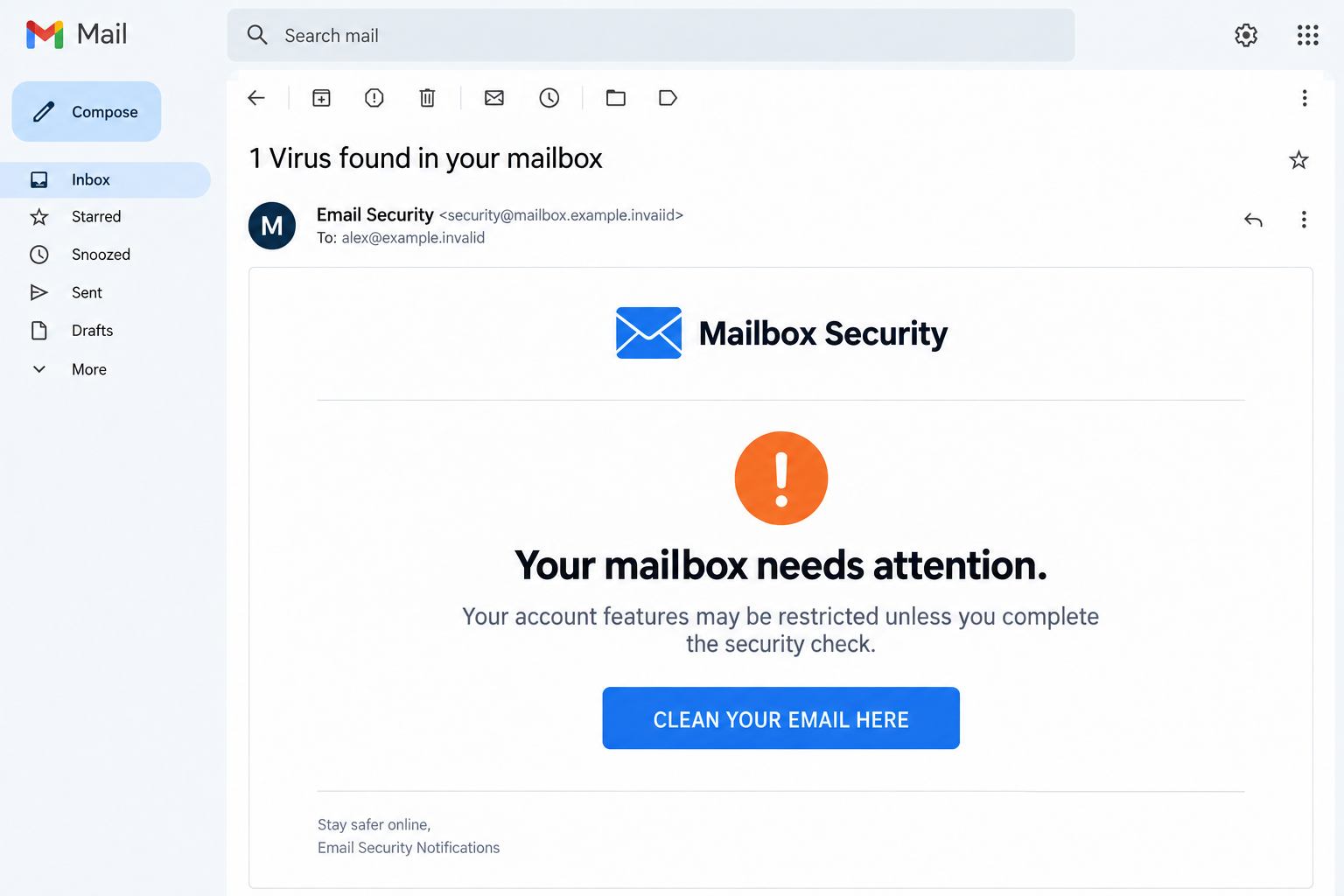
A one-line warning says a virus has been found in your mailbox. The button promises a quick cleanup before your account’s features are restricted.
It sounds like the kind of problem you should fix immediately. But before you touch that button, there is an important question to ask.
Overview
The warning claims your inbox needs cleaning
The Virus Found In Your Mailbox email scam uses a security problem to create an account task. Its reported subject includes the recipient’s address.
The message claims one virus is present and threatens reduced account functionality. That statement is part of the lure, not a genuine scan result.
There is no need to accept the warning’s diagnosis to investigate safely. Your existing email provider and trusted security software are separate sources of information.
A suspicious email can contain a harmful attachment. That real possibility does not make this unsolicited cleanup request authentic.
The supposed cleanup asks for the mailbox password
The message sends readers to a counterfeit sign-in page. Reported versions change their appearance to resemble the email service associated with the targeted address.
The campaign has been associated with content hosted under eu2.contabostorage[.]com. That is a hosting endpoint, not proof that the infrastructure provider operates the fraud.
An exact live object path is not available here. Do not treat the entire storage domain, or unrelated files hosted there, as this specific phishing page.
The credential request matters more than the hosting label. Your account password would be going to an unverified page rather than a trusted cleanup process.
How to interpret your own encounter
Receiving the email does not demonstrate that your device contains malware. Entering a password on the imitation page creates a different problem: possible account access.
The lead illustration uses fictional details to show the lure. It is not an original inbox capture or evidence of a completed security scan.
- The warning gives a virus count without identifying a verifiable infected message or file.
- Account restrictions supply pressure to follow the cleanup link.
- The next screen requests the password for the account it claims to protect.
- Provider logos and a familiar email address can be copied without access to your mailbox.
Do not log in through the alert. Check account security using the route you normally trust, and respond according to what you actually shared or ran.
A Mailbox Warning Is Not a Diagnosis of Your Computer
The email blends two ideas: dangerous messages in an inbox and malicious software on a device. They can be related, but they are not interchangeable.
An email provider might filter an attachment or place a message in quarantine. That does not mean a website can clean Windows by collecting your Gmail password.
Likewise, a desktop antivirus detection should identify an item or activity in its own trusted interface. An unsolicited email’s alarming wording cannot stand in for that result.
Imagine finding an unexpected invoice in your inbox. You can report or delete it without granting another website permission to read all your messages.
The scam’s button tries to skip that distinction. It makes account access seem like the necessary first step toward cleaning a vaguely described threat.
If your provider really has restricted a feature, confirm through its normal settings or support. A genuine problem still does not authenticate an unrelated email link.
Google’s phishing guidance advises checking suspicious requests independently rather than entering a password after following a questionable message link.
That is a useful rule here because it works before you know whether the warning is false. Verification should not require handing the warning’s sender your credentials.
How the Virus Found In Your Mailbox Scam Works
Step 1: A small virus count makes the problem feel manageable
A warning about one detected problem suggests a quick fix. You are not being asked to investigate a complex incident, only to clear something apparently identified.
The number can make the alert seem generated by a real security system. It still needs evidence connecting it to a specific event in your account.
Look for a message identifier, attachment name, or notification visible in the provider portal. Do not invent those missing details on the sender’s behalf.
The warning’s confidence is not proof of its accuracy. Anyone composing an email can write a count and attach an official-looking security label.
Step 2: The threat of restrictions pushes you toward the button
The email suggests your account will lose functionality if you do not complete the cleaning task. That pressure is especially effective when you depend on incoming work.
You may fear missing a client reply or a password-reset message. The supposed cure is placed immediately beside the consequence you want to avoid.
At this point, the sender has not established control over your mailbox. It has only asserted that a problem exists and provided its own solution.
Pause the proposed solution rather than your whole account. Open the email service separately and check whether its own interface reports an issue.
Step 3: An unfamiliar page borrows your provider’s appearance
After the cleanup link, a familiar-looking sign-in screen can make the change in destination easy to overlook. The branding suggests continuity where none is established.
Reported versions tailor the page to the targeted address. A Gmail-style screen for a Gmail user makes the request feel less random.
That personalization does not require a mailbox breach. A link can carry the destination address, and an email address often reveals which service someone uses.
On mobile, tap carefully to inspect the full browser address if already on the page. Do not press its login button to obtain more information.
Step 4: “Cleaning” becomes disclosure of a secret
The password is what the page is after. It is not removing an infected attachment by asking you to type the credential that unlocks your inbox.
A spinning indicator or a sign-in error can prolong the interaction. You might try another password, exposing more than the first account’s credential.
Stop if you recognize that the address is wrong. You do not need to finish submitting a form before treating information entered there as potentially exposed.
Whether a particular page transmits while you type depends on its implementation. Avoid relying on an unpressed final button as a guarantee of safety.
Step 5: Stolen access can turn into quiet mailbox misuse
If the attacker gains entry, the consequences need not be immediately visible. Reading messages or adding a forwarding rule may not interrupt ordinary email delivery.
Sent messages can be copied into convincing requests to your contacts. Recovery emails can reveal which other services are connected to the compromised address.
These are reasons to inspect an exposed account, not claims that every victim experienced all those actions. Use account records to determine what happened.
A functioning inbox therefore is reassuring about availability, not conclusive about privacy. Protecting it requires more than seeing that new messages still arrive.
Check the Warning Without Giving It Your Password
Use the provider’s real security area
Open a saved bookmark or the genuine mail application. For Google accounts, navigate to account security and review recent events and devices.
Compare any event with when you interacted with the email. An unfamiliar sign-in warrants investigation, while an absent warning does not require the sender’s cleanup.
A work mailbox may use security tools that are not visible to employees. Ask IT whether the organization generated the alert and how genuine quarantine notices arrive.
Ask what exactly was detected
A useful warning lets a responsible administrator identify the affected message or file. Broad threats without a verifiable item are poor grounds for entering credentials.
Do not forward suspicious attachments to coworkers asking them to test the file. Preserve them only in the manner your security team requests.
If a detection appears in trusted antivirus software, follow that product’s guidance. Do not switch to a download advertised by the suspicious email.
Keep the account and device questions separate
A phishing form can steal a password without installing a program. Conversely, an executed file can compromise a device even if you never filled in a form.
That separation prevents two common mistakes: assuming a clean antivirus scan restores stolen credentials, or reinstalling a computer when only an email was received.
Describe the actual interaction when requesting help. The actions you remember are more useful than the scary label the email assigned to the incident.
Include any code you approved without sharing the code itself. A support team needs to know whether authentication was completed, not to receive your secrets.
What to Do if You Have Fallen Victim to This Scam
Leave the fake cleanup page. Do not submit more information or approve a security prompt associated with its login attempt.
If you only received the email, report it as phishing and remove it. The sender’s virus claim alone is not grounds for wiping your device.
Secure the affected mailbox promptly. If a password was entered, change it through the genuine service. Use another trusted device when software compromise is also suspected.
Avoid small variations of the old password. Any other account using that credential needs its own replacement, rather than sharing the same new one.
Inspect continuing access. Review signed-in devices, third-party access, forwarding, filters, recovery information, and any unexpected authentication methods.
The Google account recovery checklist helps Gmail users examine these areas. Follow your own provider’s equivalent instructions for another mailbox.
Bring work incidents to IT. Give administrators the email and an honest timeline. They can inspect business account activity and revoke sessions or suspicious permissions.
Do not delay because you are embarrassed. An early report may prevent a compromised account from reaching clients or exposing shared company documents.
Check possible software exposure separately. Run a trusted Malwarebytes scan if you executed an unexpected download, opened a risky attachment, or encounter unexplained device behavior.
AdGuard provides another layer against deceptive advertising and known unsafe destinations. Keep browser protections enabled; a blocked page is not an invitation to bypass them.
Review sensitive messages and related accounts. Look for password resets, invoice changes, financial correspondence, or files that an intruder could have accessed.
If a payment was redirected or financial information was shared, contact the appropriate bank through its verified contact route. Explain the specific exposure.
Save evidence before losing it. Preserve the original message, destination address, and relevant account alerts. Keep passwords and authentication codes out of screenshots.
Use your mail service’s reporting option. For business email, coordinate evidence handling with the security team rather than repeatedly forwarding the lure around the office.
Watch for follow-up approaches. An attacker may pose as security support after the initial message. Reject requests for another password, payment, or remote control.
Ask genuine support what action is needed through a contact route you choose independently. Someone knowing the first email’s wording has not authenticated themselves.
Is Your Device Infected? Run a Free Malware Scan
Slow performance, constant pop-ups, or strange behavior? These are classic signs of a malware infection. The fastest way to find out is to scan your device with Malwarebytes Free — one of the most trusted malware removal tools available.
The free version detects and removes the most common threats, including:
- Adware — the cause of those annoying pop-ups
- Browser hijackers — unwanted redirects and changed homepages
- Trojans and spyware — hidden programs stealing your data
- Potentially unwanted programs (PUPs) — software you never asked for
👉 Select your device below — Windows, Mac, or Android — then follow the simple steps to download Malwarebytes, scan your system, and remove any threats it finds. The scan usually takes 5 to 20 minutes.
Run a Malware Scan with Malwarebytes for Windows
Malwarebytes is one of the most popular and trusted anti-malware tools for Windows — and it’s completely free for removing infections. It catches threats that many antivirus programs miss, including adware, browser hijackers, and trojans. Follow the steps below to scan and clean your PC in just a few minutes.
Download Malwarebytes
Click the button below to download the latest version of Malwarebytes for Windows from the official source. The free version is all you need — it will scan your computer and remove adware, browser hijackers, and other malicious software at no cost.
Download MalwarebytesOfficial installer for Windows 11 and 10. Your download starts right away.Want real-time protection? See Malwarebytes Premium Malwarebytes Free for WindowsScans and removes malware at no cost
-
Install Malwarebytes
When the download finishes, open your Downloads folder and double-click the MBSetup file. If Windows shows a User Account Control pop-up, click “Yes” to allow the installation.
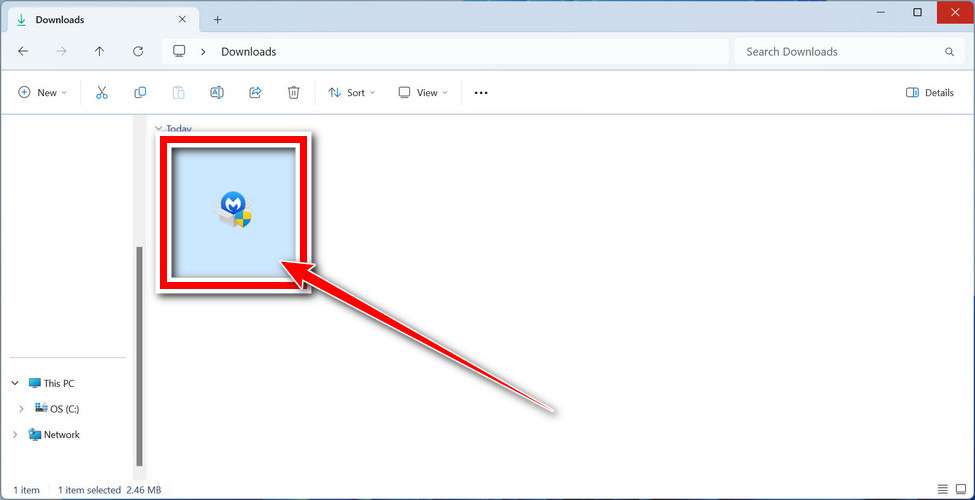
Follow the On-Screen Prompts to Install Malwarebytes
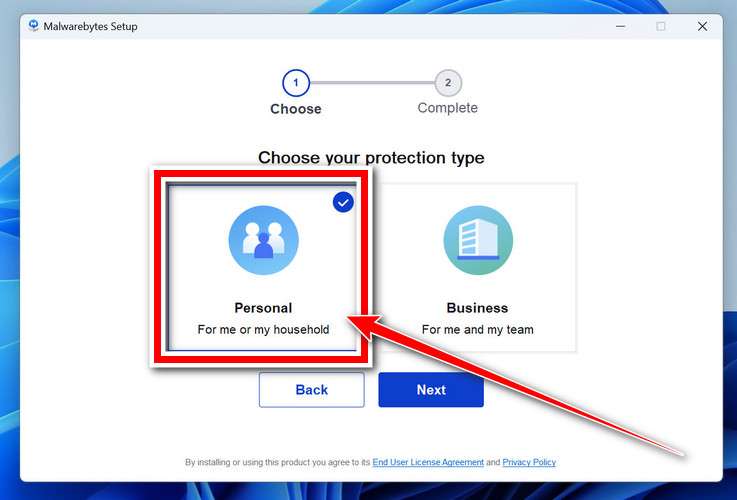
The setup wizard will walk you through a few quick screens:
-
Choose where you’re installing the program — “Personal Computer” or “Work Computer” — then click Next.
-
Malwarebytes will now install on your device. This usually takes under a minute.

-
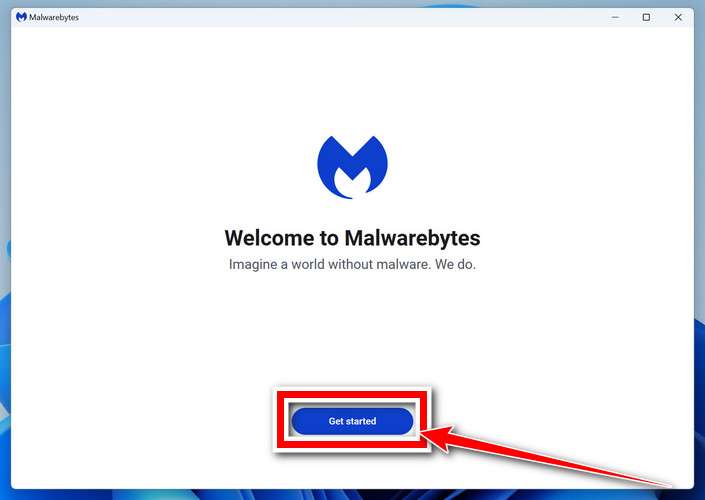
When installation is complete, the “Welcome to Malwarebytes” screen will open automatically.
-
On the final screen, click Open Malwarebytes to launch the program.

-
Enable “Scan for Rootkits”
Before scanning, turn on rootkit detection so Malwarebytes can find even the most hidden threats. Click the Settings gear icon on the left side of the screen.
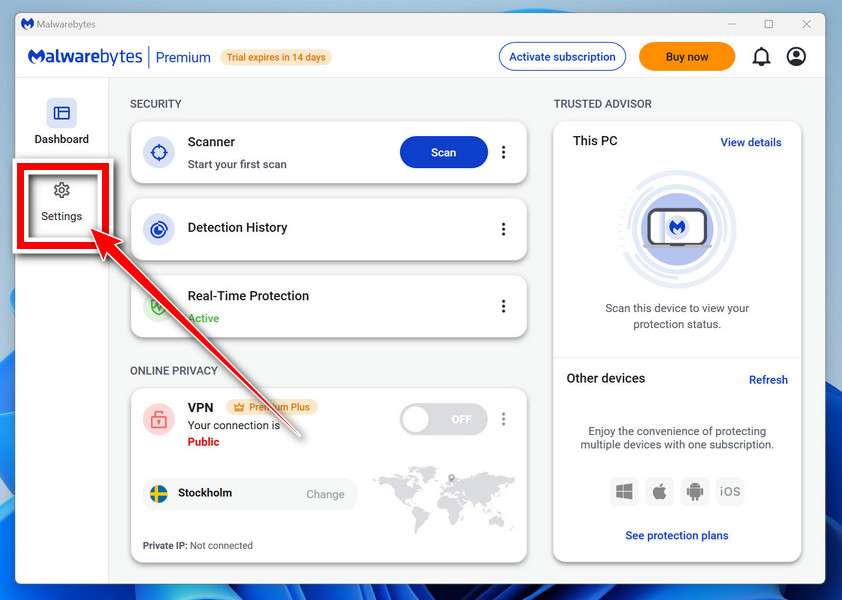
In the settings menu, find “Scan for rootkits” and click the toggle so it turns blue.

Done? Click “Dashboard” in the left pane to return to the main screen.
Start the Scan
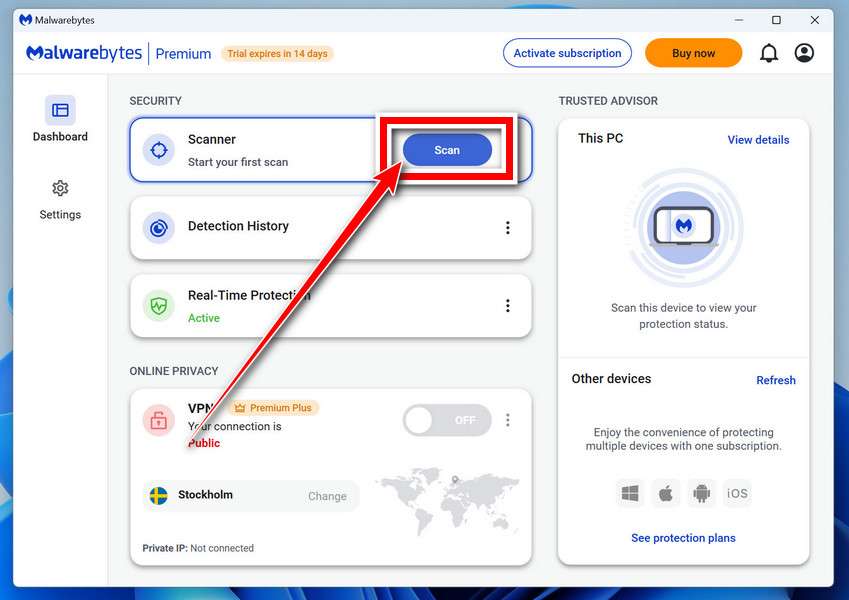
Click the blue Scan button. Malwarebytes will automatically update its virus database and start checking your computer for malware.
-
Wait for the Scan to Finish
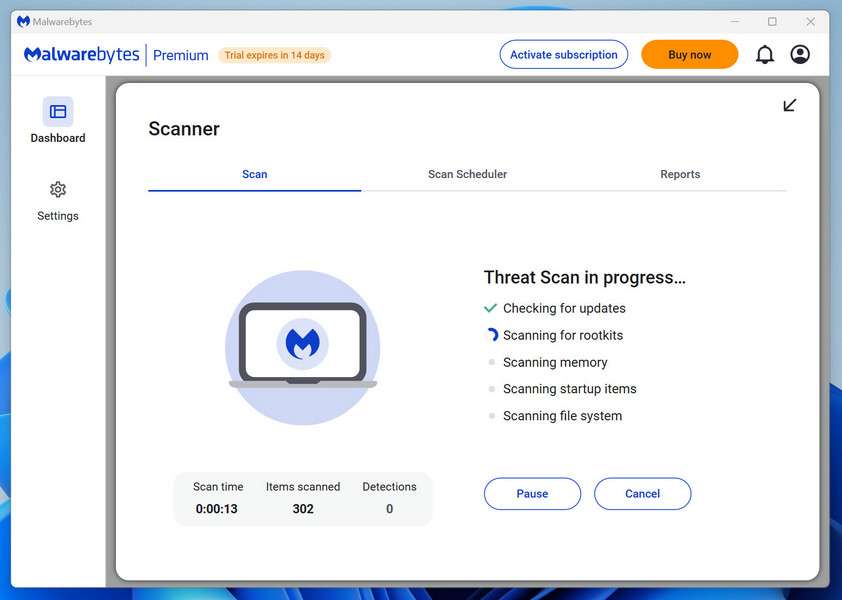
The scan checks your entire system for browser hijackers and other malicious programs, so it can take 5 to 20 minutes depending on your computer. Feel free to do something else — just check back occasionally to see the progress.
-
Quarantine the Detected Threats
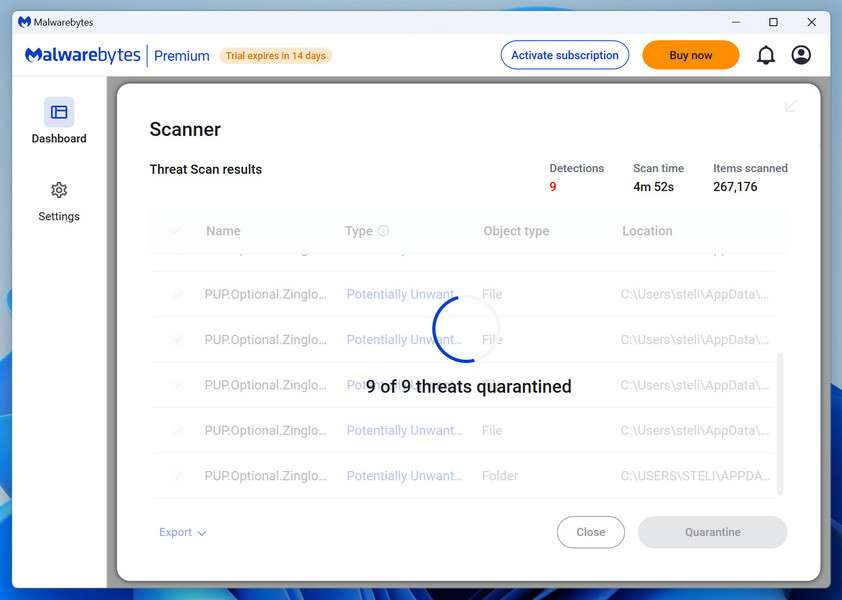
When the scan is done, you’ll see a list of everything Malwarebytes found — malware, adware, and potentially unwanted programs. Click the “Quarantine” button to remove all of them at once.
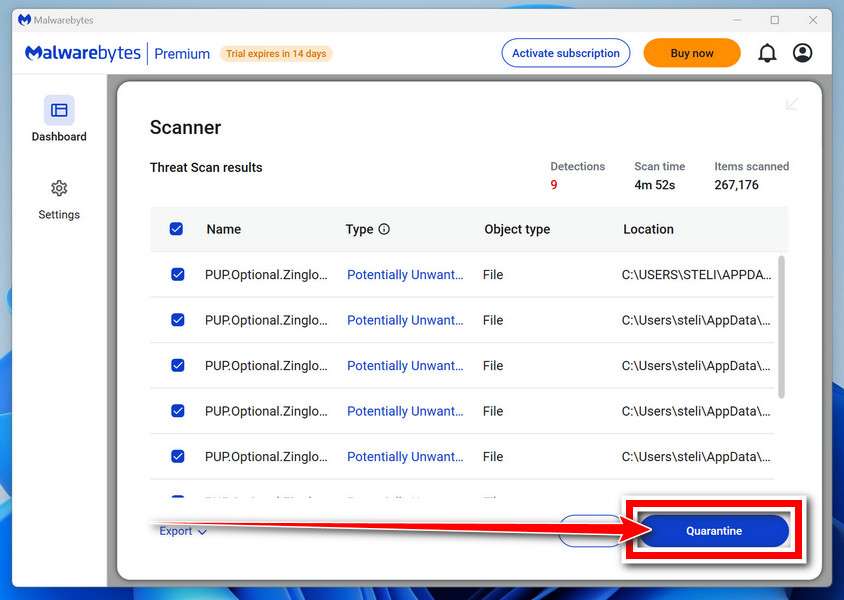
Malwarebytes will now remove the malicious files and registry entries and move them safely into quarantine.
-
Restart Your Computer
Some threats can only be fully removed after a reboot. If Malwarebytes asks you to restart, click Yes. Once you’re logged back in, Malwarebytes has finished removing the threats it found.
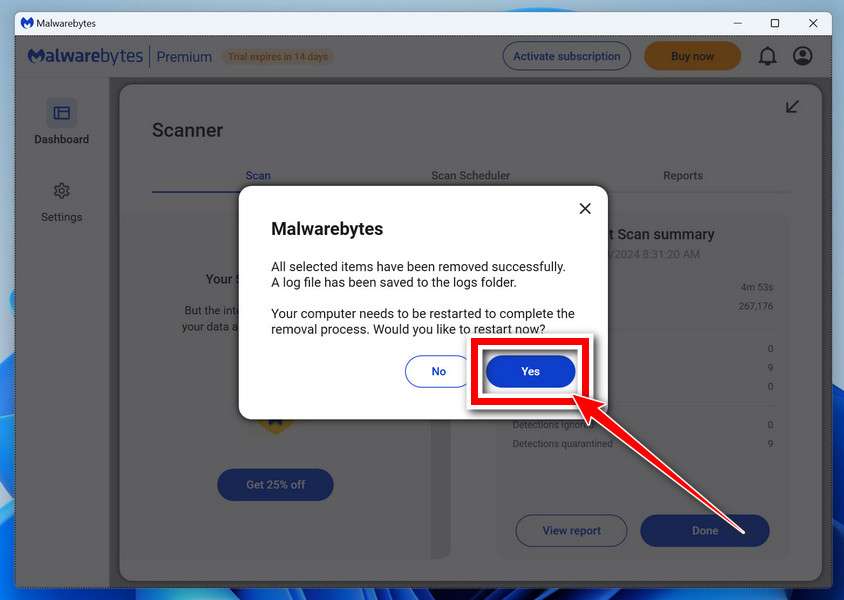
That’s it — your Windows PC is now clean of trojans, adware, and other malware, and should be back to running smoothly.
If you are still having problems with your computer after completing these instructions, then please follow one of the steps:
- Run a computer scan with ESET Online Scanner
- Ask for help in our Windows Malware Removal Help & Support forum.
Run a Malware Scan with Malwarebytes for Mac
Malwarebytes for Mac is a free on-demand scanner that removes the malware other security software tends to miss — adware, browser hijackers, and unwanted programs included. Cleaning an infected Mac with Malwarebytes has always been completely free, and it’s our go-to recommendation. Follow the steps below to scan and clean your Mac in just a few minutes.
-
Download Malwarebytes for Mac
Click the button below to download the latest version of Malwarebytes for Mac.
Download MalwarebytesOfficial installer for macOS. Your download starts right away.Want real-time protection? See Malwarebytes PremiumMalwarebytes Free for MacScans and removes malware at no cost -
Open the Malwarebytes setup file
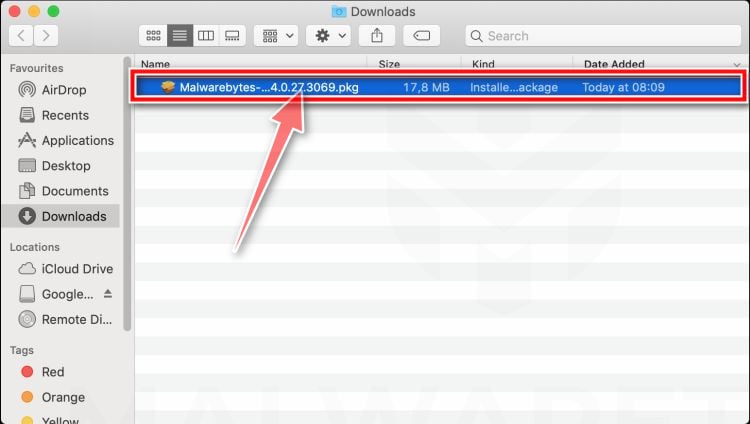
When the download finishes, open your Downloads folder and double-click the setup file to begin the installation.
-
Follow the On-Screen Prompts to Install Malwarebytes
The Malwarebytes for Mac Installer will guide you through a few quick screens. Click “Continue” and keep following the prompts until the installation completes.
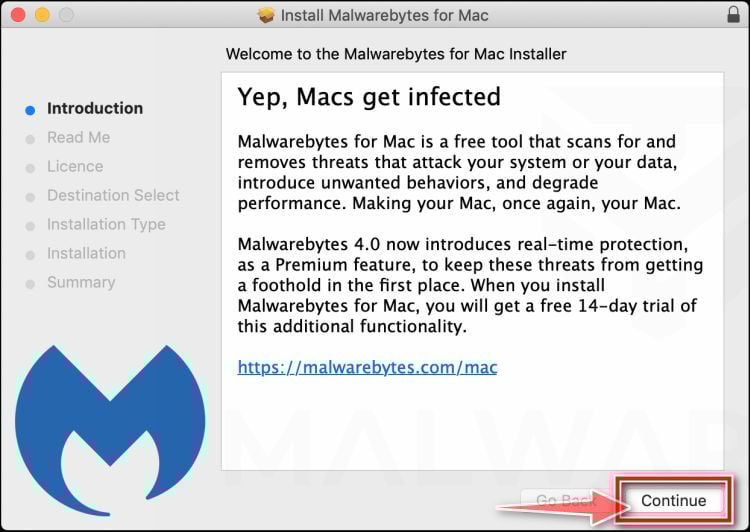
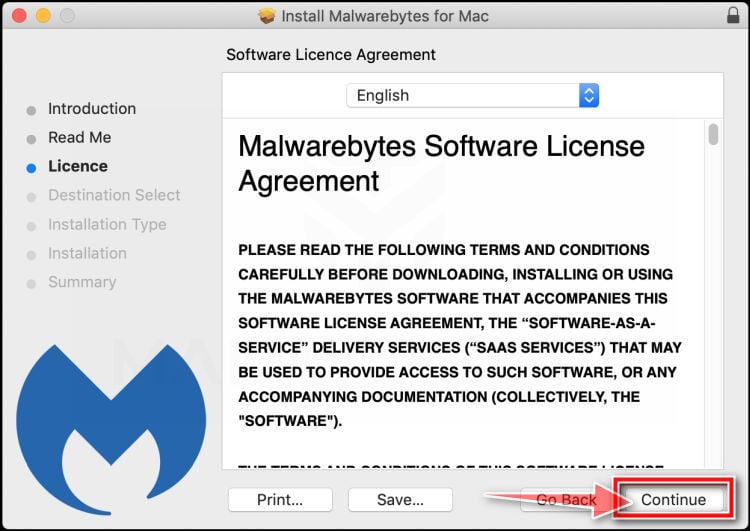
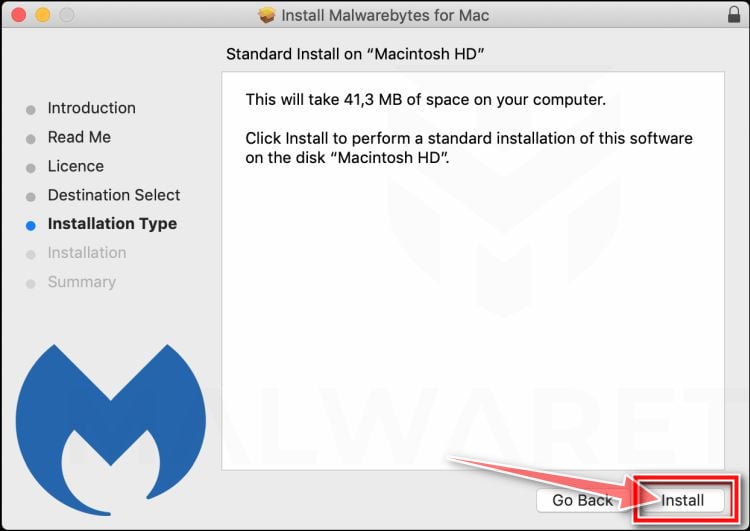
When the installation is complete, Malwarebytes opens to the Welcome to Malwarebytes screen. Click “Get started“.
-
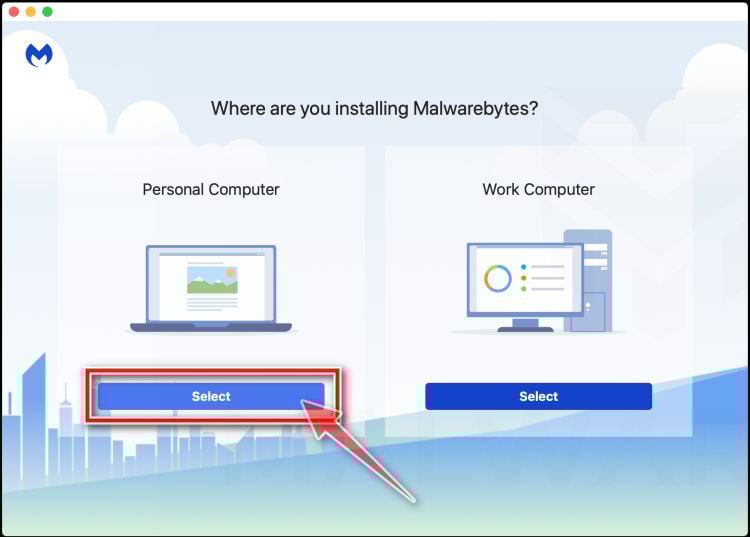
Select “Personal Computer” or “Work Computer”
Malwarebytes will ask what type of computer you’re installing it on. Click either Personal Computer or Work Computer, whichever applies.
-
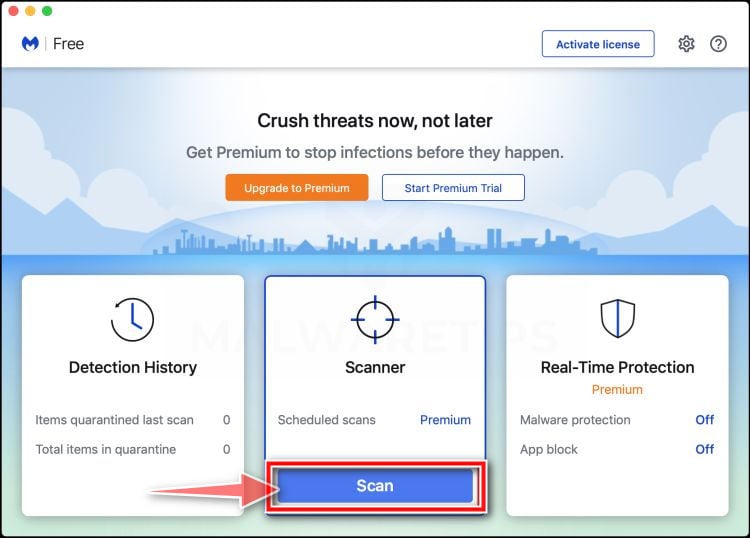
Start the Scan
Click the “Scan” button. Malwarebytes will automatically update its detection database and begin checking your Mac for malware.
-
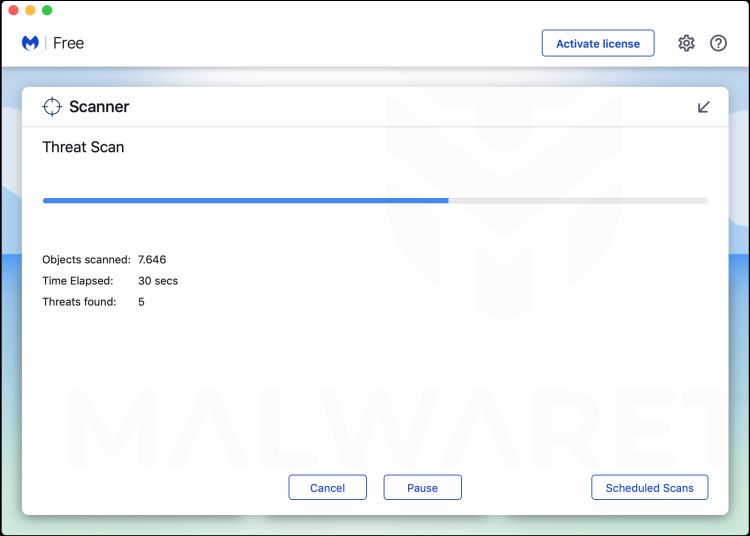
Wait for the Scan to Finish
Malwarebytes will scan your Mac for adware, browser hijackers, and other malicious programs. This can take a few minutes, so feel free to do something else — just check back occasionally to see the progress.
-
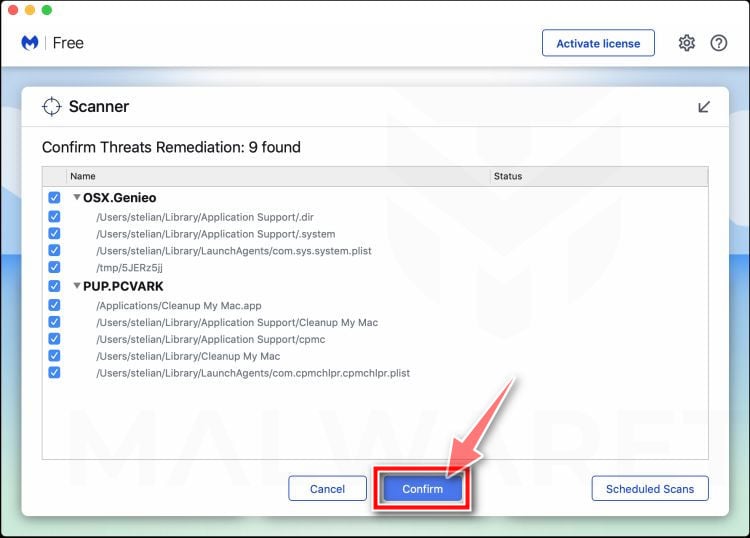
Quarantine the Detected Threats
When the scan is done, you’ll see a list of everything Malwarebytes found. Click the “Quarantine” button to remove all the threats at once.
-
Restart Your Mac
Malwarebytes will now remove all the malicious files it found. Some threats can only be fully removed after a reboot — if Malwarebytes asks you to restart, allow it. Once you’re logged back in, your Mac is clean.
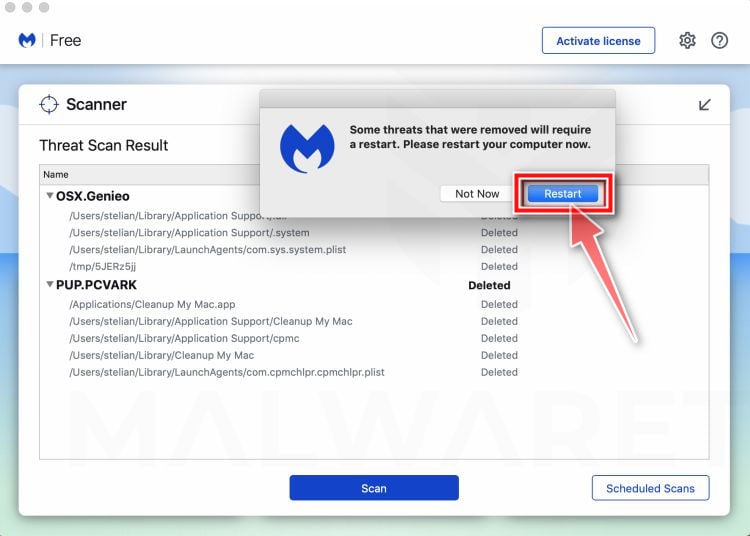
That’s it — your Mac is now free of adware, rogue browser extensions, and other potentially harmful software.
If you are still experiencing problems while trying to remove a malicious program from your computer, please ask for help in our Mac Malware Removal Help & Support forum.
Run a Malware Scan with Malwarebytes for Android
Malwarebytes for Android automatically detects and removes dangerous threats like malware and ransomware so you don’t have to worry about your most-used device being compromised. Aggressive detection of adware and potentially unwanted programs keeps your Android phone or tablet running smooth.
-
Download Malwarebytes for Android.
You can download Malwarebytes for Android by clicking the link below.
Get Malwarebytes for AndroidOpens Google Play in a new tab.Want real-time protection? See Malwarebytes Premium for AndroidMalwarebytes for AndroidScans your phone and removes malware at no cost -
Install Malwarebytes for Android on your phone.
In the Google Play Store, tap “Install” to install Malwarebytes for Android on your device.

When the installation process has finished, tap “Open” to begin using Malwarebytes for Android. You can also open Malwarebytes by tapping on its icon in your phone menu or home screen.

-
Follow the on-screen prompts to complete the setup process
When Malwarebytes will open, you will see the Malwarebytes Setup Wizard which will guide you through a series of permissions and other setup options.
This is the first of two screens that explain the difference between the Premium and Free versions. Swipe this screen to continue.
Tap on “Got it” to proceed to the next step.
Malwarebytes for Android will now ask for a set of permissions that are required to scan your device and protect it from malware. Tap on “Give permission” to continue.
Tap on “Allow” to permit Malwarebytes to access the files on your phone.
-
Update database and run a scan with Malwarebytes for Android
You will now be prompted to update the Malwarebytes database and run a full system scan.

Click on “Update database” to update the Malwarebytes for Android definitions to the latest version, then click on “Run full scan” to perform a system scan.

-
Wait for the Malwarebytes scan to complete.
Malwarebytes will now start scanning your phone for adware and other malicious apps. This process can take a few minutes, so we suggest you do something else and periodically check on the status of the scan to see when it is finished.

-
Click on “Remove Selected”.
When the scan has been completed, you will be presented with a screen showing the malware infections that Malwarebytes for Android has detected. To remove the malicious apps that Malwarebytes has found, tap on the “Remove Selected” button.

-
Restart your phone.
Malwarebytes for Android will now remove all the malicious apps that it has found. To complete the malware removal process, Malwarebytes may ask you to restart your device.
That’s it — your Android phone is now clean — no more malicious apps, adware, or browser redirects.
If you are still having problems with your phone after completing these instructions, then please follow one of the steps:
- Restore your phone to factory settings by going to Settings > General management > Reset > Factory data reset.
- Ask for help in our Mobile Malware Removal Help & Support forum.
Stay Protected: Block Ads and Malicious Sites
Now that your device is clean, keep it that way. Most infections start with a malicious ad or a fake download button — so blocking them at the source is your best defense.
We recommend AdGuard, which blocks malicious ads, phishing pages, and dangerous redirects before they can reach you.
👉 Download AdGuard and browse safely
Make the Next Warning Easier to Judge
You should not have to become a security analyst to read your inbox. A small separation between messages and account administration removes much of this lure’s leverage.
Keep a bookmark for your provider’s security settings. When an alert arrives, that bookmark gives you a safer starting point than the alert’s own button.
For shared family computers, explain that an email password and a local antivirus scan do different jobs. Neither should be supplied to a random cleanup page.
If your organization sends quarantine notices, ask how to recognize their legitimate route. Verify examples through IT, rather than memorizing colors that can be copied.
Turn on strong account authentication where available. Review recovery contacts when setting it up so help does not depend on an address you no longer control.
Finally, keep software updates routine. A rushed warning should not become the reason you install a security program from an unfamiliar website.
Frequently Asked Questions
Does this email prove there is a virus in my inbox?
No. The claim is part of the phishing message. Verify any actual security event through your provider or trusted security software.
Why does the linked screen look like Gmail?
Imitating the targeted provider makes a password request feel familiar. A copied Gmail design does not turn the website into Google’s authentication service.
Is Contabo responsible for the warning?
The reported hosting endpoint does not establish provider participation. The specific deceptive page is the concern, not every customer using that infrastructure.
Can an antivirus scan recover my email password?
No. A scan addresses possible device threats. Account recovery requires changing exposed credentials and checking sessions, settings, and other access routes.
What if my mail still works after I entered the password?
Availability does not establish that the account remained private. Complete its security checks even if incoming and outgoing messages appear normal.
Should I click the cleanup button to see what it does?
No. You can verify the warning through the genuine provider without entering the sender’s workflow. Do not experiment with a form asking for secrets.
The Bottom Line
Ignore this email’s cleanup button. Its unverified password request is not a safe way to remove a virus or preserve mailbox access.
If you shared credentials, recover the account through your real provider. Investigate device infection separately if downloads or other risky actions were involved.








