


A surprise token allocation can feel like found money, especially when the page appears to know the language of snapshots, eligibility, and claim deadlines.
The Extended $EXT Allocation Scam uses that excitement to place a dangerous wallet request in front of visitors. The supposed reward can instead expose crypto assets to theft.
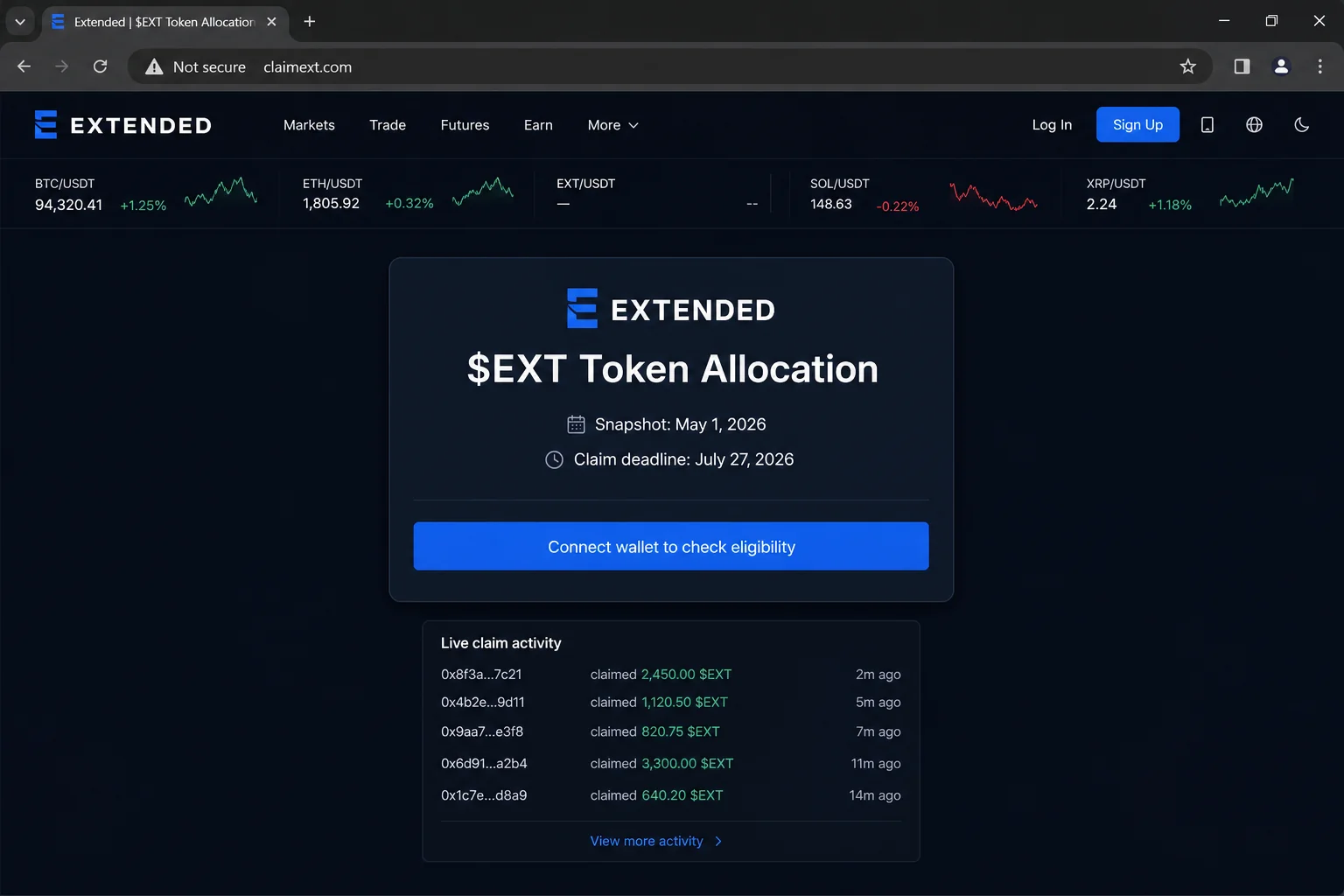
The observed page appeared at claimext[.]com and copied the look of the legitimate Extended trading platform. It advertised an $EXT allocation tied to a May 1, 2026 snapshot.
A July 27, 2026 deadline added urgency, while a live activity panel displayed wallets supposedly receiving tokens. Those details were designed to make the offer feel active and widely trusted.
The central button asked visitors to connect a wallet to check eligibility. That request was not a harmless account lookup and could lead to a malicious signature or token approval.
Overview
The reward page is an imitation, not an official Extended claim
Extended is a real crypto trading project, which gives the impersonation a credible foundation. The scam domain is separate from Extended’s official extended.exchange website.
A polished interface cannot establish ownership. Criminals routinely copy logos, navigation labels, market tickers, colors, and product language from genuine services within hours.
- The fake address uses claimext[.]com rather than the project’s recognized official domain.
- The page promises a token allocation before showing any verifiable claim contract details.
- A countdown and claim deadline encourage action before independent confirmation.
- Simulated wallet activity creates social proof without proving that any transfer occurred.
Wallet connection is the gateway to the theft attempt
Connecting a wallet normally reveals its public address to a site. The greater danger begins when the page requests a signature, contract interaction, or spending permission.
A deceptive approval may authorize an attacker-controlled contract to move selected tokens. A signature can also approve an order whose practical effect is hidden behind technical text.
- A connection prompt identifies the wallet but does not make the website trustworthy.
- An unlimited token allowance can remain usable until it is revoked on-chain.
- A signature may create an authorization even when the wallet shows no immediate network fee.
- A transaction preview should name the contract, asset, amount, and permission being granted.
The campaign relies on urgency, familiarity, and crypto jargon
Snapshot dates and allocation language are familiar to anyone who has joined a points program or early trading campaign. The scam borrows those conventions to reduce suspicion.
Victims may arrive through social posts, search ads, compromised websites, direct messages, or popups. The referring account can be fake or hijacked from a real person.
- A limited claim window makes delaying feel costly.
- A familiar brand reduces the urge to inspect the full domain.
- Large displayed allocations encourage visitors to imagine an immediate gain.
- A wallet counter suggests that hundreds of other users already approved the request.
Why the Fake $EXT Allocation Looks Convincing
Real projects teach users to expect eligibility checks
Crypto projects often reward early users, liquidity providers, traders, or community members. An eligibility checker therefore fits a pattern many wallet owners have seen before.
That familiarity is exactly what the operator exploits. A plausible campaign format should never substitute for confirmation through the project’s independently located channels.
The design resembles a functioning exchange
The fake page includes trading navigation, token pairs, price movements, login controls, and brand styling. These decorative features have no connection to the claim’s authenticity.
Most visitors focus on the centered allocation card rather than testing the surrounding controls. A copied shell can therefore provide credibility without needing a real trading backend.
A deadline turns caution into fear of missing out
The page says the opportunity ends on a specific date. A visitor who believes tokens may expire can view verification as a delay that risks losing money.
Legitimate deadlines do exist, but an urgent clock does not prove a claim. Confirm the announcement from a known bookmark before allowing any wallet interaction.
What a Crypto Wallet Drainer Can Do
Token approvals can outlive the browser session
An allowance is recorded on a blockchain, not merely inside the web page. Closing the tab or disconnecting the site does not necessarily remove that permission.
If the approval gives broad spending authority, the receiving contract may transfer tokens later. The victim might not connect the loss with the earlier allocation page.
Signatures can hide the important consequence
Some requests appear as human-readable messages rather than ordinary transfers. They can still authorize marketplace orders, permits, or other operations that an attacker later executes.
Never assume a gasless signature is harmless. Read the requesting origin and decoded action, then reject anything that is vague, unlimited, or unrelated to the expected task.
Different assets may face different risks
A malicious contract may target ERC-20 tokens, NFTs, or approvals connected to a specific network. Native assets can be stolen through direct transfers or crafted transaction calls.
The visible wallet balance does not reveal every authorization already granted. Reviewing current allowances is essential after interacting with an untrusted claim page.
How the Extended $EXT Allocation Scam Works
Step 1: The operator creates a lookalike Extended website
The campaign begins with a standalone domain that contains the project name or a claim-related phrase. Copied branding makes the address seem like a dedicated campaign site.
The operator recreates familiar market panels and navigation around a prominent allocation card. Visual accuracy is easier to copy than ownership, security, or a legitimate contract.
Step 2: Traffic is directed toward the fake allocation
Links may spread through ads, official-post replies, Telegram, Discord, email, or hacked profiles. Search ads can also promote an imitation.
The surrounding message usually promises eligibility, bonus tokens, or an expiring reward. It avoids explaining why the recipient qualified because curiosity brings the visitor to the page.
- A newly created social account may copy the project’s logo and biography.
- A compromised influencer profile can make the same link appear more credible.
- A shortened URL may conceal the destination until the browser opens it.
Step 3: The page displays a snapshot and a closing date
The observed lure names May 1, 2026 as the snapshot and July 27, 2026 as the claim deadline. Specific dates make the campaign sound administratively planned.
A live activity feed lists abbreviated addresses and token amounts. Those entries can be fabricated locally and should not be mistaken for blockchain evidence.
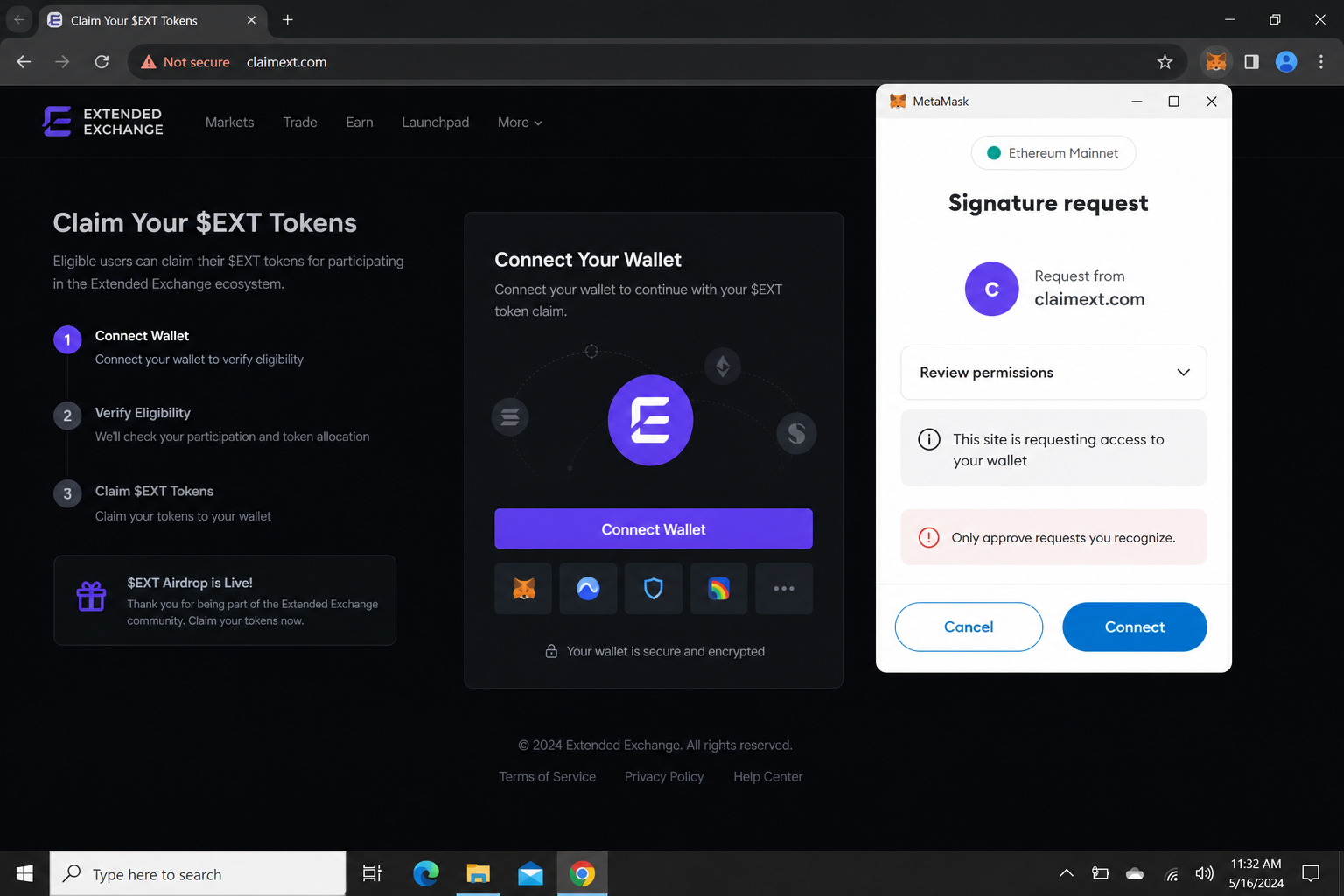
Step 4: The visitor selects the wallet connection button
The page says a connection is needed to check eligibility. This framing encourages the visitor to treat the request as read-only before the actual permissions are shown.
A wallet extension then identifies the requesting origin. The domain remains the strongest warning because it does not belong to the legitimate Extended service.
Step 5: A deceptive approval or signature is presented
The next prompt can vary by wallet, network, and campaign version. It may request token access, a contract call, a message signature, or a direct transaction.
Technical labels can obscure the effect. The visitor may believe confirmation proves eligibility when it actually grants authority to an unknown spender.
- Reject requests that mention unlimited allowances or unfamiliar spender addresses.
- Do not approve a contract simply because the transaction value displays $0.
- Treat blind-signing warnings as a reason to stop, not a routine obstacle.
Step 6: The attacker attempts to transfer valuable assets
Once usable authority exists, automated scripts can identify tokens and NFTs worth taking. Transfers may happen quickly, before the victim understands what the confirmation allowed.
Some operators wait, prioritize high-value wallets, or use several destination addresses. On-chain transfers are normally irreversible, which limits recovery options.
Step 7: The site and promotion are replaced when exposed
A fraudulent domain may disappear after browsers, hosts, or security providers block it. The same page can return under a new address with another token name.
Removing one site does not cancel permissions already granted. Anyone who interacted must inspect the wallet rather than assuming the campaign’s disappearance ended the risk.
Company, Address, and Fulfillment Checks
Extended is a legitimate trading project
The authentic Extended platform operates from extended.exchange and provides self-custodial trading services. Its real existence is what makes the imitation believable.
The scam should not be treated as evidence that the legitimate project created the fraudulent page. Brand impersonation can target any recognizable crypto service.
The observed claim domain is unrelated
The $EXT allocation page appeared at claimext[.]com. A brand name inside a separate domain does not create an official relationship with the company being copied.
Read domains from right to left and identify the registered portion. Extra words such as claim, reward, secure, or allocation can be chosen by anyone.
Public wallet counters are not independent verification
The page says hundreds of wallets have participated, but a number displayed by the same site proves nothing. It may be random, fixed, or increased by a simple script.
Reliable verification requires an independently obtained announcement and contract. Explorer activity must match that published contract, not the page’s address.
Official channels should be reached independently
Open a saved bookmark or type the recognized company address yourself. Then check its documentation, verified social account, or in-app notices for the exact campaign.
Do not use a social reply or search advertisement as the only route. Impersonators often position their links beside genuine announcements where users already expect news.
Warning Signs That Reveal the Fake Extended Claim
The domain does not match the official service
The unrelated claim domain is the clearest warning. Copied logos and HTTPS cannot turn it into Extended’s official website.
Check the address before connecting. Mobile browsers may shorten it, so tap the address bar and inspect the entire hostname without following another link.
- The campaign appears only through unsolicited promotions or replies.
- The site offers no independently verifiable contract announcement.
- The wallet request does more than reveal a public address.
- The page treats a rushed confirmation as the only eligibility check.
The requested action is broader than the stated purpose
Checking a public address can be performed without permission to spend its tokens. A request for allowances or contract execution is disproportionate to a simple eligibility lookup.
A legitimate claim may require a transaction, but its contract, network, amount, and purpose should be publicly documented. An unexplained spender is not acceptable.
How to Check a Token Claim Safely
Start from a known official address
Use a bookmark created before the promotion. Otherwise, compare official documentation and verified accounts before opening any claim interface.
A genuine announcement should identify eligibility rules, supported networks, timing, and the contract. Major omissions are more important than professional graphics.
Use a separate low-value wallet for experimentation
A wallet holding long-term assets should not be the first account connected to an unfamiliar decentralized application. Segmentation limits what one mistake can expose.
A secondary wallet is not permission to approve blindly. It simply reduces the possible impact while you verify contract behavior and transaction previews.
Decode every request before confirming
Modern wallets and explorers can translate contract calls into readable actions. Confirm the token, spender, amount, network, and destination before signing.
If the wallet cannot explain the request, stop. Moving to another wallet interface does not make an unknown contract safer.
Possible Consequences of Approving the Request
Tokens and NFTs may leave without another warning
A valid allowance lets the approved spender call the token contract later. The next transfer can occur without reopening the original claim page.
Stolen assets may pass through several addresses or swapping services. This movement makes voluntary recovery difficult even when the transfers remain visible publicly.
The same wallet may attract follow-up scams
Public blockchain activity can reveal that an address interacted with a malicious contract. Fraudsters may then send fake recovery offers, support messages, or replacement claims.
Anyone promising guaranteed recovery for an advance payment, seed phrase, or wallet synchronization should be treated as another attacker.
What to Do if You Have Fallen Victim to This Scam
- Disconnect the suspicious site inside the wallet interface, but understand that disconnection alone does not cancel blockchain approvals already recorded for claimext[.]com.
- Use a reputable allowance checker for the correct network and revoke unfamiliar token or NFT permissions. Confirm revocation transactions from a clean, independently opened service.
- If a seed phrase or private key was entered anywhere, create a new wallet on a clean device and move remaining assets immediately. Never reuse the exposed recovery phrase.
- Review recent transactions, signatures, permits, and connected applications. Record transaction hashes, spender contracts, destination addresses, screenshots, and the fraudulent URL before it disappears.
- Contact the wallet provider, exchange, or marketplace through its official support route. They cannot reverse most on-chain transfers, but they may flag destination accounts or guide containment.
- Report the address and domain to the hosting provider, browser safety services, relevant blockchain explorers, and local cybercrime authorities. Include evidence without sharing private keys.
- Scan the device with Malwarebytes if a file, extension, or application was installed during the interaction. Remove unknown browser extensions and update the browser and operating system.
- Install AdGuard or another reputable content blocker to reduce malicious advertising and known scam redirects. A blocker adds protection but cannot replace careful wallet approval review.
Is Your Device Infected? Run a Free Malware Scan
Slow performance, constant pop-ups, or strange behavior? These are classic signs of a malware infection. A quick way to check is to scan your device with Malwarebytes Free, one of the most trusted malware removal tools available. If you only visited a scam page and didn’t download or install anything, this scan is optional.
The free version detects and removes the most common threats, including:
- Adware — the cause of those annoying pop-ups
- Browser hijackers — unwanted redirects and changed homepages
- Trojans and spyware — hidden programs stealing your data
- Potentially unwanted programs (PUPs) — software you never asked for
👉 Select your device below — Windows, Mac, or Android — then follow the simple steps to download Malwarebytes, scan your system, and remove any threats it finds. The scan usually takes 5 to 20 minutes.
Run a Malware Scan with Malwarebytes for Windows
Malwarebytes is one of the most popular and trusted anti-malware tools for Windows — and it’s completely free for removing infections. It catches threats that many antivirus programs miss, including adware, browser hijackers, and trojans. Follow the steps below to scan your PC and remove what Malwarebytes finds.
Download Malwarebytes
Click the button below to download the latest version of Malwarebytes for Windows from the official source. The free version is all you need — it will scan your computer and remove adware, browser hijackers, and other malicious software at no cost.
Download MalwarebytesOfficial installer for Windows 11 and 10. Your download starts right away.Want real-time protection? See Malwarebytes Premium Malwarebytes Free for WindowsScans and removes malware at no cost
-
Install Malwarebytes
When the download finishes, open your Downloads folder and double-click the MBSetup file. If Windows shows a User Account Control pop-up, click “Yes” to allow the installation.

Follow the On-Screen Prompts to Install Malwarebytes
The setup wizard will walk you through a few quick screens:
-
Choose where you’re installing the program — “Personal Computer” or “Work Computer” — then click Next.

-
Malwarebytes will now install on your device. This usually takes under a minute.

-
When installation is complete, the “Welcome to Malwarebytes” screen will open automatically.

-
On the final screen, click Open Malwarebytes to launch the program.

-
Optional: Check for rootkits with a Custom Scan
You don’t need to change any settings for a normal scan. The standard Threat Scan in the next step is enough for most problems, so you can go straight to it.
If you also want to check for rootkits, use a Custom Scan. In current versions of Malwarebytes, rootkit scanning is only available there:
- On the Scanner tile, click the three-dot menu and select Advanced Scan.
- Choose Custom Scan. In its options, check Scan for rootkits.
- Select your system drive (usually C:\) as the location to scan, then start the scan. It takes longer than a Threat Scan.
- When it finishes, review and quarantine the results as described in the steps below.
Rootkit scanning isn’t available on Windows devices with ARM processors.
Start the Scan
Click the blue Scan button. Malwarebytes will automatically update its virus database and start checking your computer for malware.

-
Wait for the Scan to Finish
The scan checks your entire system for browser hijackers and other malicious programs, so it can take 5 to 20 minutes depending on your computer. Feel free to do something else — just check back occasionally to see the progress.

-
Quarantine the Detected Threats
When the scan is done, you’ll see a list of everything Malwarebytes found — malware, adware, and potentially unwanted programs. Click the “Quarantine” button to remove all of them at once.

Malwarebytes will now remove the malicious files and registry entries and move them safely into quarantine.

-
Restart Your Computer
Some threats can only be fully removed after a reboot. If Malwarebytes asks you to restart, click Yes. Once you’re logged back in, Malwarebytes has finished removing the threats it found.

When the scan is done, check whether the problems you noticed have stopped. If they continue, see the options below.
If you are still having problems with your computer after completing these instructions, then please follow one of the steps:
- Run a computer scan with ESET Online Scanner
- Ask for help in our Windows Malware Removal Help & Support forum.
Run a Malware Scan with Malwarebytes for Mac
Malwarebytes for Mac is a free on-demand scanner that removes the malware other security software tends to miss — adware, browser hijackers, and unwanted programs included. Cleaning an infected Mac with Malwarebytes has always been completely free, and it’s our go-to recommendation. Follow the steps below to scan your Mac and remove what Malwarebytes finds.
-
Download Malwarebytes for Mac
Click the button below to download the latest version of Malwarebytes for Mac.
Download MalwarebytesOfficial installer for macOS. Your download starts right away.Want real-time protection? See Malwarebytes PremiumMalwarebytes Free for MacScans and removes malware at no cost -
Open the Malwarebytes setup file
When the download finishes, open your Downloads folder and double-click the setup file to begin the installation.

-
Follow the On-Screen Prompts to Install Malwarebytes
The Malwarebytes for Mac Installer will guide you through a few quick screens. Click “Continue” and keep following the prompts until the installation completes.



When the installation is complete, Malwarebytes opens to the Welcome to Malwarebytes screen. Click “Get started“.
Malwarebytes needs Full Disk Access to check your whole Mac. When it asks, open System Settings > Privacy & Security > Full Disk Access, turn on Malwarebytes (it may be listed as Malwarebytes Protection), and confirm with your password or Touch ID. Then return to Malwarebytes. On macOS Monterey and earlier, this setting is in System Preferences > Security & Privacy > Privacy.
-
Select “Personal Computer” or “Work Computer”
Malwarebytes will ask what type of computer you’re installing it on. Click either Personal Computer or Work Computer, whichever applies.

-
Start the Scan
Click the “Scan” button. Malwarebytes will automatically update its detection database and begin checking your Mac for malware.

-
Wait for the Scan to Finish
Malwarebytes will scan your Mac for adware, browser hijackers, and other malicious programs. This can take a few minutes, so feel free to do something else — just check back occasionally to see the progress.

-
Quarantine the Detected Threats
When the scan is done, you’ll see a list of everything Malwarebytes found. Click the “Quarantine” button to remove all the threats at once.

-
Restart Your Mac
Malwarebytes will now remove all the malicious files it found. Some threats can only be fully removed after a reboot — if Malwarebytes asks you to restart, allow it. Once you’re logged back in, check whether the problems you noticed have stopped. If they come back, save the scan report and ask for help in our forum.

If the problems you noticed continue after the scan, see the options below.
If you are still experiencing problems while trying to remove a malicious program from your computer, please ask for help in our Mac Malware Removal Help & Support forum.
Run a Malware Scan with Malwarebytes for Android
Malwarebytes for Android scans your phone or tablet for malware, adware, and potentially unwanted apps. The free version scans only when you start a scan. Real-time protection, which checks apps automatically, is part of the paid Premium version.
-
Download Malwarebytes for Android.
You can download Malwarebytes for Android by clicking the link below.
Get Malwarebytes for AndroidOpens Google Play in a new tab.Want real-time protection? See Malwarebytes Premium for AndroidMalwarebytes for AndroidScans your phone and removes malware at no cost -
Install Malwarebytes for Android on your phone.
In the Google Play Store, tap “Install” to install Malwarebytes for Android on your device.

When the installation process has finished, tap “Open” to begin using Malwarebytes for Android. You can also open Malwarebytes by tapping on its icon in your phone menu or home screen.

-
Follow the on-screen prompts to complete the setup process
When Malwarebytes opens, it walks you through a short setup. Tap Get started and follow the prompts. If you see an offer for a trial or a paid plan, read it before you accept. You can skip it and keep using the free scanner.
Malwarebytes will ask for permission to access the files on your phone so it can scan them. Tap Allow, or turn on the permission in the Android screen that opens, then return to Malwarebytes.
-
Run a scan with Malwarebytes for Android
On the main screen, tap Scan now. In some versions, you open the menu, tap Scanner, and then tap Run a scan.
-
Wait for the Malwarebytes scan to complete.
Malwarebytes will now start scanning your phone for adware and other malicious apps. This process can take a few minutes, so we suggest you do something else and periodically check on the status of the scan to see when it is finished.

-
Remove the detected apps.
When the scan has been completed, you will see a list of the threats that Malwarebytes for Android has detected. Next to each detected item, tap the menu icon (three dots), then choose to uninstall the app or delete the file. Android then asks you to confirm. Tap OK or Uninstall to remove the app.
-
Restart your phone.
When the detected apps are removed, restart your phone if Malwarebytes asks you to. Then check whether the problems you noticed have stopped.
If the problems you noticed continue after the scan, see the options below.
If you are still having problems with your phone after completing these instructions, then please follow one of the steps:
- Ask for help in our Mobile Malware Removal Help & Support forum.
- Only as a last resort, reset your phone to factory settings. Read the warning below first.
- Back up your photos, videos, files, and messages, for example to your Google account or a computer.
- Make sure you know your Google account email and password. The phone asks for them after the reset. If you changed the password recently, Google recommends waiting 24 hours before you reset.
- On a Samsung phone, also make sure you know your Samsung account password.
- If you use an authenticator app for two-step verification, move your accounts to another device or save your backup codes first.
Stay Protected: Block Ads and Malicious Sites
No scan can prove a device is completely clean, so it helps to block threats before they reach you. Most infections start with a malicious ad or a fake download button — so blocking them at the source is your best defense.
We recommend AdGuard, which blocks malicious ads, phishing pages, and dangerous redirects before they can reach you.
👉 Download AdGuard and browse safely
Frequently Asked Questions
Is the Extended $EXT Allocation Scam connected to the real Extended platform?
No evidence from the observed domain establishes that relationship. The scam copies Extended branding, while the legitimate service uses its recognized extended.exchange address.
Can connecting a wallet alone drain it?
A basic connection generally exposes a public address, but the page may immediately request a harmful signature or approval. Read and reject every unexpected follow-up prompt.
Does a $0 transaction mean the request is safe?
No. A transaction can display $0 while granting token access, calling a contract, or creating an authorization that enables a later transfer.
Will disconnecting claimext[.]com remove its permissions?
Not necessarily. Disconnecting ends the browser session, while on-chain allowances remain until revoked through a valid blockchain transaction.
Can stolen cryptocurrency be reversed?
Blockchain transfers are usually final. Rapid reporting may help an exchange freeze deposited assets, but nobody can honestly promise guaranteed recovery.
How should a real $EXT campaign be verified?
Reach Extended through a known official address and compare its announcement, eligibility rules, supported network, and published contract before connecting any wallet.
The Bottom Line
The Extended $EXT Allocation Scam turns an attractive reward into a wallet trap. Its copied interface, dates, and activity feed only persuade.
Ignore claimext[.]com and verify promotions through Extended’s recognized channels. If you approved something, revoke permissions and protect remaining assets now.

Join the discussion
0 commentsShare your experience or ask a question about this article.
Community experiences
Did this happen to you?
Your experience could help someone recognize the same scam. Submit a private report for our team to review.
I experienced this tooReports are reviewed before publication. Sharing publicly is always your choice.
Discussion
Start the conversation
Have a question or something useful to share? Add the first comment.