

Your inbox is working, then a notice says the webmail application is about to disappear. Suddenly, an ordinary workday comes with an unexpected deadline.
The requested update looks small. Understanding what it would actually change is worth a moment before you continue.
Overview
The shutdown threat hides inside an update request
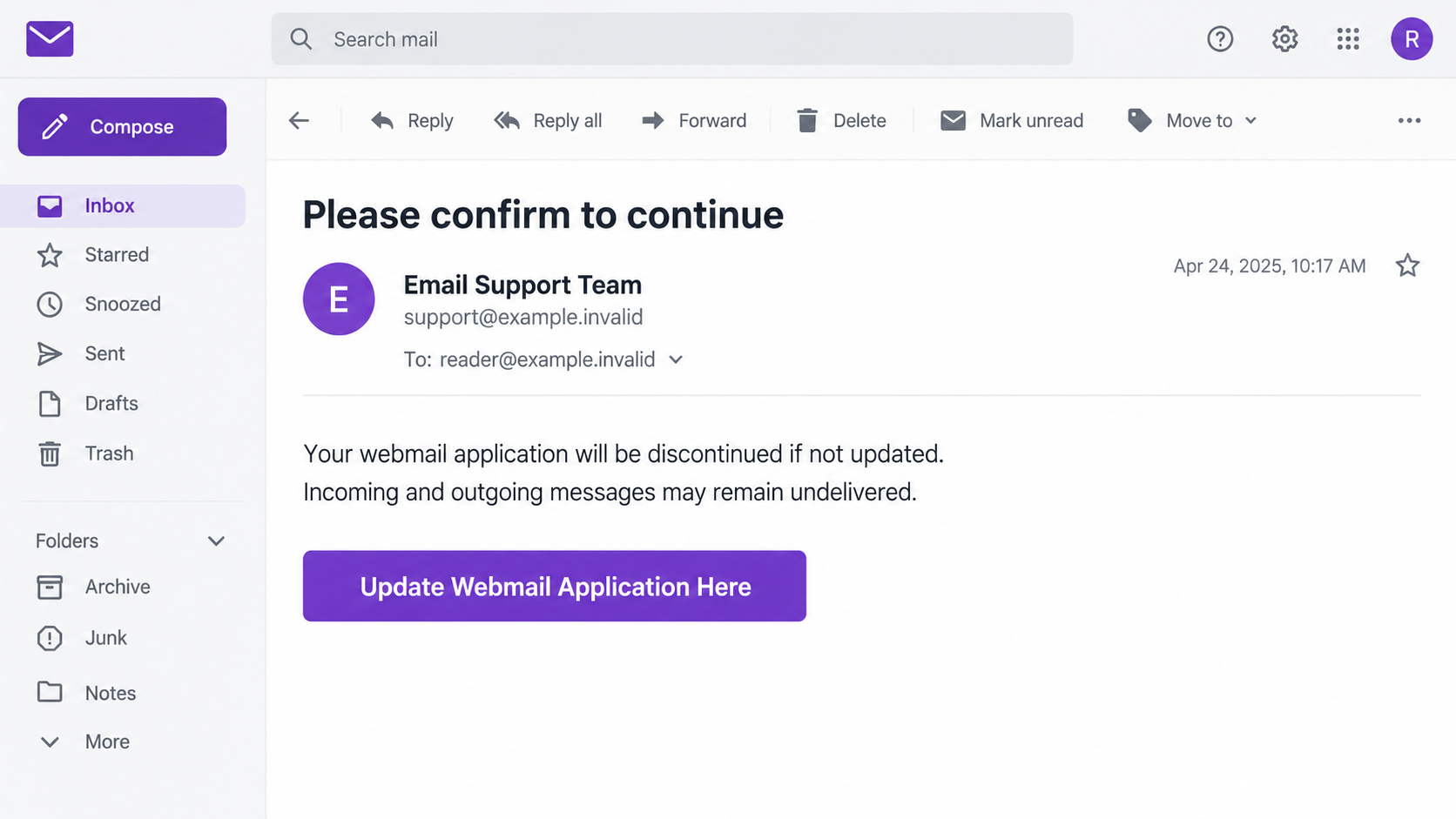
The Webmail application discontinued email scam claims that your mail service needs an urgent application update. Otherwise, incoming and outgoing messages supposedly will not arrive.
The reported notice signs itself Email Support Team. Its prominent update button directs the recipient toward a counterfeit webmail sign-in rather than an authenticated maintenance process.
The purpose is to obtain mailbox credentials. Entering an email address and password would give the operator information that may be used to attempt account access.
There is no identified universal webmail provider behind this generic notice. The word webmail describes accessing email in a browser, not one company responsible for every inbox.
Details that make this version recognizable
The message asks the recipient to confirm continuation, then warns about mail becoming pending or undelivered. It treats clicking its button as the way to preserve service.
- A generic support identity presents the warning.
- The claimed problem concerns discontinuation, not an ordinary new-message notification.
- The proposed fix is a link labeled Update Webmail Application Here.
- The next stage seeks an email address and password.
Not every legitimate application change is fraudulent. What makes this notice dangerous is the untrusted route used to obtain your sign-in details.
A real provider or administrator can explain an upgrade through a contact or control panel you already know. You do not need this email’s permission to ask.
The practical limits of the reported sample
The original recipient’s email and a working destination were not available for independent login testing. No particular mail platform, attacker location or malware family is established.
The illustration is an invented example of the update pitch. Its addresses, date and layout are not recovered details from someone’s mailbox.
The warning applies to the credential request. It does not mean your actual inbox is scheduled for deletion, or that reading the message has installed malware.
If you already interacted, identify exactly what happened next. A disclosed password, an approved sign-in and a downloaded program call for different responses.
Why an Application Update Is a Convincing Pretext
Email has become background infrastructure. People notice it most when it stops working, especially when invoices, appointments or customer messages depend on it.
The scam borrows that dependence. Its warning encourages you to prevent tomorrow’s disruption with one quick action today.
It also blends different technical ideas. An application version, a mailbox account and delivery between mail servers are related, but they are not interchangeable.
A browser-based mail application may be maintained by a hosting company or workplace administrator. Updating that server software usually is not accomplished by submitting credentials to an emailed form.
A separately installed mail app may need an official update. That should come through its trusted update mechanism or the developer’s known distribution channel.
Some legitimate changes require users to sign in again or follow migration instructions. Confirming them independently is still the sensible response.
Ask which application is changing, who operates it, what action is required and where the announcement appears outside the suspicious message.
An administrator should be able to answer those questions without first asking you to use an unfamiliar page. A vague support signature cannot substitute for that explanation.
How the Webmail Application Discontinued Email Scam Works
Step 1: Turn Routine Email Access Into an Urgent Problem
The message introduces the possibility that you will lose dependable mail service. It does not need to demonstrate an existing fault for that possibility to feel disruptive.
You might already be waiting for a reply. The warning gives an ordinary delay an alarming explanation, even though the two events may be unrelated.
That mental connection is the opening. Once you accept the email as the cause of an inbox problem, its update link starts looking like useful help.
Before following that logic, test the original premise. Can you open your normal mailbox? Does the administrator’s genuine status page show a relevant incident or planned migration?
A functioning inbox does not prove every maintenance notice false. It simply means this message has not demonstrated the failure it wants you to fear.
For workplace accounts, do not attempt repairs on your own because a stranger’s email says the service is changing. Give the notice to your normal support team.
Step 2: Use a Generic Support Signature to Avoid Specifics
Email Support Team sounds official without naming the organization responsible for your account. That flexibility lets a broad message appear relevant to many different domains.
The notice may display your address or a domain-specific greeting. Those visible details are not secret and do not authenticate the sender.
A privacy link, legal footer or unmonitored-mailbox statement adds familiar administrative texture. It still does not explain why this team controls your mail application.
Instead of replying, look up the provider using your hosting agreement, workplace directory or an established bookmark. Keep the verification route separate from the suspect notice.
If your business uses a reseller, the administrator may not share the same brand as the application screen. Ask the person who actually manages the service.
Do not assume that a Roundcube-like page means Roundcube sent the message. Application styling can be copied without access to the real hosting account.
Step 3: Replace Maintenance With a Password Form
The update button is the bridge from the story to the credential request. The reported landing page imitates webmail login and asks for the mailbox password.
That is a very different action from installing a verified update. You are providing a secret to whatever server receives the form.
A prefilled email address can make the page feel connected to your account. It may simply have been supplied in the link or collected earlier.
An apparently successful sign-in, a failed-password message or a redirect cannot confirm where your credentials went. Do not submit them twice to troubleshoot.
Close the page and check the real mailbox independently. If a form received your password, respond to the disclosure even when the real mailbox still works.
Attackers do not have to change a password immediately to benefit from access. Quiet observation can be more valuable than locking the owner out.
Step 4: Exploit the Mailbox’s Role in Other Accounts
Control of email may expose stored correspondence, contacts and password-reset messages. For a business mailbox, it can also reveal invoices and ongoing supplier conversations.
An intruder could send messages that appear to come from you. A familiar thread may then be used to request altered payment instructions or another colleague’s credentials.
These are consequences to investigate if access occurred, not capabilities proved merely by receiving the discontinuation notice.
The same applies to forwarding rules and connected apps. They are worth checking because they can preserve access, not because every victim necessarily has a malicious rule.
Reusing the mailbox password elsewhere widens the exposure. Identify those accounts and replace the reused secret without waiting for a second warning.
A device scan alone cannot remove a server-side forwarding rule or revoke a cloud session. Recovery has to include the actual mail service.
Check Delivery Problems Without Following the Update Link
Use an independent message test
If you suspect a real outage, send a simple non-sensitive test through your usual mailbox to another account you control. Note any delivery error.
A delay is not automatically a security incident. Filters, recipient settings, temporary outages and address mistakes can also affect delivery.
Give your administrator the precise error and time. Avoid repeatedly changing mail settings based on instructions from the warning email.
Check the provider’s own announcements
Navigate to the provider through a known address. Review its account dashboard, service notices or workplace announcements for the claimed application change.
Do not use the suspicious email’s unsubscribe or legal links as an alternate route. They are part of the same unverified message.
If a genuine migration is underway, request the official procedure. You can follow that procedure without trusting the counterfeit notice or preserving its deadline.
Escalate changes affecting shared mailboxes
A shared address may have several users and recovery contacts. Tell the responsible administrator before changing access in a way that could lock colleagues out.
Business mail also deserves a check for newly added delegates, automated rules and altered recovery information. Record findings rather than deleting unexplained settings blindly.
For Google accounts, the official compromised-account guide explains activity, security settings and suspicious mailbox changes. Other providers have their own controls.
What to Tell Your Mail Administrator
You do not have to diagnose the attack before asking for help. A short, factual timeline gives the administrator more to work with than an alarming conclusion.
Start with the time the notice arrived and the address it targeted. Include whether that address is personal, shared or used for customer correspondence.
Then explain the interaction in order: opened the link, saw a form, entered a password, accepted a notification or downloaded a file.
Do not include your current password in the report. The team needs to know that a secret was disclosed, not receive another copy of it.
If you entered a different password first, say so. Both attempted values may have been exposed even when the page rejected one.
Ask the administrator to check account logs around that period. An unfamiliar location alone can have benign explanations, while a new forwarding rule may require immediate attention.
For customer-facing mail, explain whether invoices or payment instructions were accessible. That lets the business decide which conversations need confirmation through another channel.
Also mention any genuine outage you were troubleshooting before the email arrived. A real service fault and a phishing attempt can occur at the same time.
Keep a record of what was reset, which sessions were revoked and what remains under review. That prevents colleagues from assuming everything was resolved by one password change.
If access has been lost entirely, use the provider’s official recovery route. Avoid search advertisements or direct messages offering privileged access to a mailbox for a fee.
What to Do if You Have Fallen Victim to This Scam
Separate the message from your real support process. Stop using its links. Report it through your email app or forward it to your established security contact.
Record the subject, sender address and time. If nothing else happened, there is no reason to announce that the mailbox or computer is definitely compromised.
Change a disclosed mailbox password through the genuine provider. Use another trusted device if you also installed software from the page.
Choose a unique replacement. Update the same password on unrelated accounts where it was reused, giving priority to accounts holding sensitive correspondence or financial access.
End unauthorized access, not just the old password. Review sign-ins, active sessions, recovery options, forwarding, filters, delegates and connected applications.
Ask your administrator to revoke suspicious sessions or permissions. Keep copies of unfamiliar rules before removal if the team needs them for investigation.
Check what was sent from your mailbox. Review sent items, deleted messages and conversations around the time of the suspected access.
If fraudulent requests went to customers or coworkers, warn affected people through a reliable alternative channel. Name the false instruction so they know what to disregard.
Investigate any program or extension you installed. Disconnect a device showing active suspicious behavior and consult your workplace team before changing it.
For a personal device with software exposure, Malwarebytes can help detect unwanted programs. AdGuard can limit risky advertising, but neither tool repairs mailbox permissions.
Use the following scan guidance only for the device side of the incident. Do not postpone credential recovery while waiting for a scan.
Follow up on affected transactions and recovery notices. Verify supplier bank-detail changes and password-reset emails that arrived during the intrusion window.
Contact the relevant institution directly if money or another account was affected. A restored inbox does not automatically reverse changes made elsewhere.
Is Your Device Infected? Run a Free Malware Scan
Slow performance, constant pop-ups, or strange behavior? These are classic signs of a malware infection. The fastest way to find out is to scan your device with Malwarebytes Free — one of the most trusted malware removal tools available.
The free version detects and removes the most common threats, including:
- Adware — the cause of those annoying pop-ups
- Browser hijackers — unwanted redirects and changed homepages
- Trojans and spyware — hidden programs stealing your data
- Potentially unwanted programs (PUPs) — software you never asked for
👉 Select your device below — Windows, Mac, or Android — then follow the simple steps to download Malwarebytes, scan your system, and remove any threats it finds. The scan usually takes 5 to 20 minutes.
Run a Malware Scan with Malwarebytes for Windows
Malwarebytes is one of the most popular and trusted anti-malware tools for Windows — and it’s completely free for removing infections. It catches threats that many antivirus programs miss, including adware, browser hijackers, and trojans. Follow the steps below to scan and clean your PC in just a few minutes.
Download Malwarebytes
Click the button below to download the latest version of Malwarebytes for Windows from the official source. The free version is all you need — it will scan your computer and remove adware, browser hijackers, and other malicious software at no cost.
Download MalwarebytesOfficial installer for Windows 11 and 10. Your download starts right away.Want real-time protection? See Malwarebytes Premium Malwarebytes Free for WindowsScans and removes malware at no cost
-
Install Malwarebytes
When the download finishes, open your Downloads folder and double-click the MBSetup file. If Windows shows a User Account Control pop-up, click “Yes” to allow the installation.

Follow the On-Screen Prompts to Install Malwarebytes
The setup wizard will walk you through a few quick screens:
-
Choose where you’re installing the program — “Personal Computer” or “Work Computer” — then click Next.

-
Malwarebytes will now install on your device. This usually takes under a minute.

-
When installation is complete, the “Welcome to Malwarebytes” screen will open automatically.

-
On the final screen, click Open Malwarebytes to launch the program.

-
Enable “Scan for Rootkits”
Before scanning, turn on rootkit detection so Malwarebytes can find even the most hidden threats. Click the Settings gear icon on the left side of the screen.

In the settings menu, find “Scan for rootkits” and click the toggle so it turns blue.

Done? Click “Dashboard” in the left pane to return to the main screen.
Start the Scan
Click the blue Scan button. Malwarebytes will automatically update its virus database and start checking your computer for malware.

-
Wait for the Scan to Finish
The scan checks your entire system for browser hijackers and other malicious programs, so it can take 5 to 20 minutes depending on your computer. Feel free to do something else — just check back occasionally to see the progress.

-
Quarantine the Detected Threats
When the scan is done, you’ll see a list of everything Malwarebytes found — malware, adware, and potentially unwanted programs. Click the “Quarantine” button to remove all of them at once.

Malwarebytes will now remove the malicious files and registry entries and move them safely into quarantine.

-
Restart Your Computer
Some threats can only be fully removed after a reboot. If Malwarebytes asks you to restart, click Yes. Once you’re logged back in, Malwarebytes has finished removing the threats it found.

That’s it — your Windows PC is now clean of trojans, adware, and other malware, and should be back to running smoothly.
If you are still having problems with your computer after completing these instructions, then please follow one of the steps:
- Run a computer scan with ESET Online Scanner
- Ask for help in our Windows Malware Removal Help & Support forum.
Run a Malware Scan with Malwarebytes for Mac
Malwarebytes for Mac is a free on-demand scanner that removes the malware other security software tends to miss — adware, browser hijackers, and unwanted programs included. Cleaning an infected Mac with Malwarebytes has always been completely free, and it’s our go-to recommendation. Follow the steps below to scan and clean your Mac in just a few minutes.
-
Download Malwarebytes for Mac
Click the button below to download the latest version of Malwarebytes for Mac.
Download MalwarebytesOfficial installer for macOS. Your download starts right away.Want real-time protection? See Malwarebytes PremiumMalwarebytes Free for MacScans and removes malware at no cost -
Open the Malwarebytes setup file
When the download finishes, open your Downloads folder and double-click the setup file to begin the installation.

-
Follow the On-Screen Prompts to Install Malwarebytes
The Malwarebytes for Mac Installer will guide you through a few quick screens. Click “Continue” and keep following the prompts until the installation completes.



When the installation is complete, Malwarebytes opens to the Welcome to Malwarebytes screen. Click “Get started“.
-
Select “Personal Computer” or “Work Computer”
Malwarebytes will ask what type of computer you’re installing it on. Click either Personal Computer or Work Computer, whichever applies.

-
Start the Scan
Click the “Scan” button. Malwarebytes will automatically update its detection database and begin checking your Mac for malware.

-
Wait for the Scan to Finish
Malwarebytes will scan your Mac for adware, browser hijackers, and other malicious programs. This can take a few minutes, so feel free to do something else — just check back occasionally to see the progress.

-
Quarantine the Detected Threats
When the scan is done, you’ll see a list of everything Malwarebytes found. Click the “Quarantine” button to remove all the threats at once.

-
Restart Your Mac
Malwarebytes will now remove all the malicious files it found. Some threats can only be fully removed after a reboot — if Malwarebytes asks you to restart, allow it. Once you’re logged back in, your Mac is clean.

That’s it — your Mac is now free of adware, rogue browser extensions, and other potentially harmful software.
If you are still experiencing problems while trying to remove a malicious program from your computer, please ask for help in our Mac Malware Removal Help & Support forum.
Run a Malware Scan with Malwarebytes for Android
Malwarebytes for Android automatically detects and removes dangerous threats like malware and ransomware so you don’t have to worry about your most-used device being compromised. Aggressive detection of adware and potentially unwanted programs keeps your Android phone or tablet running smooth.
-
Download Malwarebytes for Android.
You can download Malwarebytes for Android by clicking the link below.
Get Malwarebytes for AndroidOpens Google Play in a new tab.Want real-time protection? See Malwarebytes Premium for AndroidMalwarebytes for AndroidScans your phone and removes malware at no cost -
Install Malwarebytes for Android on your phone.
In the Google Play Store, tap “Install” to install Malwarebytes for Android on your device.

When the installation process has finished, tap “Open” to begin using Malwarebytes for Android. You can also open Malwarebytes by tapping on its icon in your phone menu or home screen.

-
Follow the on-screen prompts to complete the setup process
When Malwarebytes will open, you will see the Malwarebytes Setup Wizard which will guide you through a series of permissions and other setup options.
This is the first of two screens that explain the difference between the Premium and Free versions. Swipe this screen to continue.
Tap on “Got it” to proceed to the next step.
Malwarebytes for Android will now ask for a set of permissions that are required to scan your device and protect it from malware. Tap on “Give permission” to continue.
Tap on “Allow” to permit Malwarebytes to access the files on your phone.
-
Update database and run a scan with Malwarebytes for Android
You will now be prompted to update the Malwarebytes database and run a full system scan.

Click on “Update database” to update the Malwarebytes for Android definitions to the latest version, then click on “Run full scan” to perform a system scan.

-
Wait for the Malwarebytes scan to complete.
Malwarebytes will now start scanning your phone for adware and other malicious apps. This process can take a few minutes, so we suggest you do something else and periodically check on the status of the scan to see when it is finished.

-
Click on “Remove Selected”.
When the scan has been completed, you will be presented with a screen showing the malware infections that Malwarebytes for Android has detected. To remove the malicious apps that Malwarebytes has found, tap on the “Remove Selected” button.

-
Restart your phone.
Malwarebytes for Android will now remove all the malicious apps that it has found. To complete the malware removal process, Malwarebytes may ask you to restart your device.
That’s it — your Android phone is now clean — no more malicious apps, adware, or browser redirects.
If you are still having problems with your phone after completing these instructions, then please follow one of the steps:
- Restore your phone to factory settings by going to Settings > General management > Reset > Factory data reset.
- Ask for help in our Mobile Malware Removal Help & Support forum.
Stay Protected: Block Ads and Malicious Sites
Now that your device is clean, keep it that way. Most infections start with a malicious ad or a fake download button — so blocking them at the source is your best defense.
We recommend AdGuard, which blocks malicious ads, phishing pages, and dangerous redirects before they can reach you.
👉 Download AdGuard and browse safely
Frequently Asked Questions
Is the discontinuation notice an official webmail update?
The described message is a phishing attempt. Ask your actual provider or workplace administrator whether any update is required, using a contact you already trust.
Will my mail stop unless I click the button?
The email’s claim does not establish an outage or deadline. Check normal mailbox access and official service notices rather than accepting the warning as a technical diagnosis.
Does webmail mean one particular email company?
No. Many providers and organizations offer browser-based email. A generic support label therefore cannot identify who legitimately administers your account.
What if the page already knew my email address?
A prefilled address is not authentication. It may be included in a link. The page still needs independent verification before it receives any password.
Is changing the password enough after phishing?
It is an important start. Also inspect sessions, recovery settings and mailbox rules, because access or forwarding may persist through other mechanisms.
Can a scan restore messages an attacker deleted?
No. Recovery of mailbox contents depends on the provider’s tools, retention and backups. Ask the administrator promptly, without confusing device cleanup with email restoration.
The Bottom Line
Do not use this discontinuation message to update webmail. Its support story funnels a service concern into an untrusted password request.
If you responded, secure the real mailbox and review its access settings. Let your actual administrator handle any genuine application change through the established service.

Join the discussion
0 commentsShare your experience or ask a question about this article.
Discussion
Start the conversation
Have a question or something useful to share? Add the first comment.