

The caller sounds calm at first. Then they mention Mecklenburg County, a missed jury summons, and a problem that supposedly cannot wait.
Before you explain where you’ve been or reach for your wallet, take a moment. The next part of that conversation deserves a closer look.
Overview
The caller borrows the authority of a real courthouse
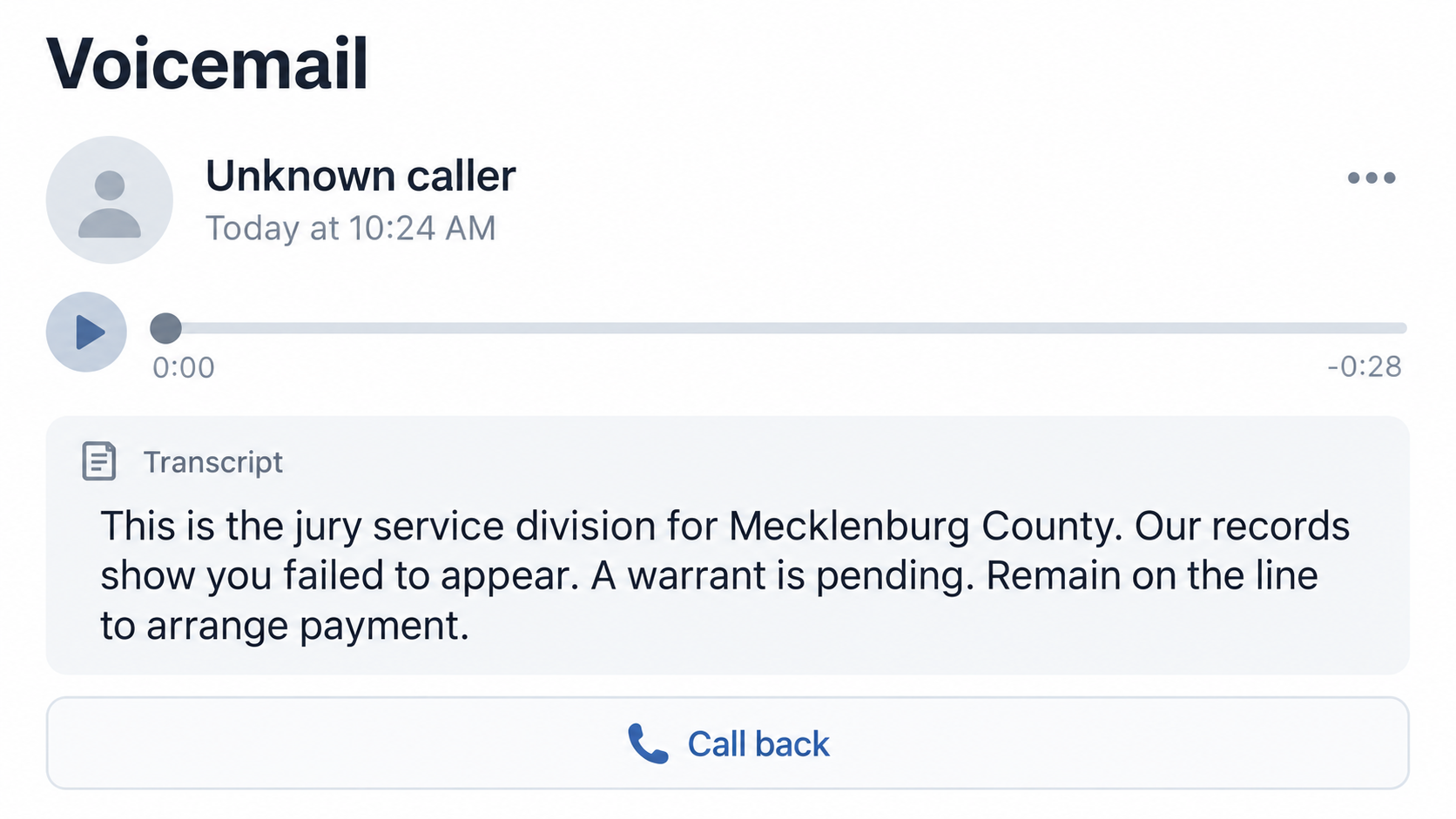
The Mecklenburg County jury duty scam involves someone pretending to represent the court or law enforcement. They claim you missed service and must resolve it immediately.
These callers are not collecting a legitimate fine on behalf of the county. They are using the possibility of arrest to push a payment or disclosure.
The image above illustrates that approach. It is not a recording, transcript, or notice supplied by an actual recipient.
Local officials have warned about the payment threats
Mecklenburg County has described reports involving calls, texts, and emails about failure to appear. The demands can mention substantial fines or a supposed arrest warrant.
North Carolina’s courts also warn that impersonators may know a resident’s name and address, name real officials, and imitate a courthouse telephone number.
Those details can make the conversation unnerving. They do not turn the person speaking into a deputy, clerk, or jury coordinator.
The demand matters more than the polished introduction
Watch for a combination of official-sounding language and an instruction that keeps you from checking the story yourself:
- A claim that you ignored a jury summons you do not remember receiving.
- A threat that officers will arrest you unless you pay during the conversation.
- A request for gift card codes, a transfer, cryptocurrency, or sensitive financial details.
- An insistence that ending the call will make the situation worse.
- A caller ID or official’s name offered as the only proof of identity.
You do not have to prove the caller is lying while they are still on the line. You can end the conversation and verify independently.
Why a Missed Summons Is Such an Effective Story
Most people understand that jury service is important without knowing every part of the process. That gap gives an impostor room to sound convincing.
Maybe you recently moved, travel frequently, or share a mailbox. A claim about an overlooked letter can feel plausible even when you have done nothing wrong.
The caller may allow you to explain, then use your explanation to keep the story moving. An address change becomes their reason for the missing summons.
That does not mean they accessed a private court file. Information you volunteer can supply the missing pieces of their account.
The conversation also turns a vague fear into a simple choice: pay now or face trouble. The apparent simplicity is part of the pressure.
Real questions about jury service deserve a real answer from Jury Management, not a rushed arrangement with whoever called you.
Being worried is understandable. You are allowed to pause without agreeing that the caller’s accusation is true.
How the Mecklenburg County Jury Duty Scam Works
Step 1: An unexpected message introduces a supposed legal problem
The approach may start with a live call, a voicemail, or a written message. The common hook is an alleged failure to report for jury service.
A professional tone makes the message feel procedural rather than suspicious. The caller can sound as though they are simply working through a list.
They may mention the courthouse or sheriff’s office before explaining anything you can check. Familiar local references give the story an early sense of legitimacy.
Notice what is missing: an independently verified connection between that person and your actual jury record.
A reference number does not fill that gap by itself. Anyone can read a sequence of numbers or place one on a document.
If the caller asks you to confirm your address or birth date, you do not need to help them complete their introduction.
Write down what they claimed, if you can do so safely, but avoid turning the call into an exchange of personal information.
Step 2: Local names and caller ID make the claim feel personal
An impostor might use a real official’s name. Looking up that name and finding an actual employee does not authenticate the voice using it.
The same applies to a telephone display. Caller ID can be manipulated, so a familiar number is not reliable proof of who initiated the call.
This is why calling the displayed number back is not the same as selecting a contact from the court’s official directory.
Choose the route yourself. Do not let the person making the demand decide which office, website, or extension will supposedly verify it.
A message containing your address may feel especially convincing. However, knowing where you live does not establish authority to collect a court payment.
You also do not have to solve how they obtained that detail before protecting yourself. Verification comes first; speculation about the source can wait.
When you reach Jury Management, explain what the caller alleged. Don’t describe an arrest warrant as real simply because the stranger said one existed.
Step 3: A threat of arrest replaces ordinary questions
The conversation becomes more urgent when the caller claims that officers are preparing to act, or that this is your last chance to cooperate.
At that point, you may focus on avoiding embarrassment at home or work rather than checking whether the demand makes sense.
Mecklenburg’s warning specifically rejects telephone threats of arrest for failing to appear. A payment demand attached to that threat is not legitimate jury administration.
Some fraudulent contacts happen when courthouse offices are closed. The inability to reach someone immediately can make the caller’s instructions feel like the only option.
It isn’t. You can stop the contact and use the published office channels when they are available.
Do not drive to a location supplied by the caller or continue a conversation while operating a vehicle. Get somewhere safe before dealing with it.
If someone presents an immediate physical threat, seek appropriate emergency help. An online warning article cannot assess your surroundings.
Step 4: Paying becomes the supposed way out
The request may be framed as a fine, a bond, or a temporary payment. Changing the label does not establish that the obligation exists.
Gift card numbers, wire transfers, and cryptocurrency feature in official warnings about this type of fraud. The specific method can vary between contacts.
A promise that the money will be returned later can make an unusual request easier to accept. A caller’s promise is not a refund arrangement.
If you are asked to buy cards, keep the codes private. Possessing the plastic does not protect the balance after someone else obtains its redemption details.
For transfers, the relevant question is who will actually receive the funds, not what government title the caller gives themselves.
Never treat a screenshot of a badge, a receipt, or an apparent warrant as a reason to bypass independent verification.
Do not send a small amount as a test. A test payment still gives a stranger money and may encourage further demands.
Step 5: The caller tries to keep control after you hesitate
Questioning the demand may bring a softer explanation or a sharper threat. Either response can keep you engaged with the same unverified person.
They might tell you that another official will join the conversation. A handoff arranged by the caller is not an independent confirmation.
You may also hear that discussing the matter will interfere with an investigation. Do not let an unsolicited caller isolate you from trusted help.
Once you pay or share information, additional requests are possible. There is no reliable point at which complying makes a fraudulent demand safe.
Ending contact interrupts that pressure. It also gives your bank, card issuer, or a trusted person room to help you think clearly.
Save useful evidence without continuing the exchange to collect more. You are not responsible for investigating the caller yourself.
Blocking the contact may reduce interruptions, but a different number can appear later. Keep the verification rule, not just a blacklist.
How to Check Your Jury Status Without Following the Caller
Start with the county’s jury-service contact information
The county’s jury-service warning lists Jury Management at 877-649-7133. Confirm the current contact information on that official page before calling.
Explain that an unsolicited caller claimed you missed jury service. Ask which office can check that issue and what information it actually needs.
Do not provide the caller’s payment instructions as though they were an approved procedure. Describe them as part of a suspicious contact.
If you have a genuine summons, compare it with the information the office supplies. Do not send a copy to the person who threatened you.
Understand what official mail does and does not establish
The county says North Carolina jury summonses and failure-to-appear notices arrive by first-class mail at a home or post office box.
That is useful context for this particular threat. It is not permission to ignore a real letter or assume every other court communication is fraudulent.
A copied logo on a letter is not conclusive either. If something seems wrong, use the court directory rather than the contact printed on it.
When you have an existing case or genuine missed obligation, ask court staff about the correct process. Obtain legal advice when your circumstances require it.
Give yourself a reliable way to stop
You can say you will contact the office independently and end the call. You do not owe the caller a debate, an apology, or further details.
If a family member is frightened, sit with them while they locate the official directory. Calm company can help break the pressure without blaming them.
A useful household rule is simple: nobody purchases gift cards or sends cryptocurrency because an unexpected caller threatens arrest.
Agree on that rule before the next call arrives. It is easier to follow a decision already made than invent one under stress.
What to Do if You Have Fallen Victim to This Scam
- Stop dealing with the supposed official.
End the call and stop responding to related messages. Do not pay an additional amount to cancel a warrant, release a refund, or close the matter.
Tell someone you trust what happened. Practical support is more useful than keeping the incident secret because you feel embarrassed.
- Ask the payment provider to intervene immediately.
For a card charge, contact the issuer through its app or the number on the card. For a wire or bank transfer, call your bank.
Explain the false jury-duty threat, identify the transaction, and ask whether it can be stopped, recalled, or disputed. Recovery depends on the payment and circumstances.
If you shared gift card codes, contact the card’s issuing company with the receipt and card details. Keep those details out of public comments.
- Protect the information you disclosed.
List exactly what you supplied: an address, identification number, bank information, password, or security code. Different disclosures need different responses.
Tell the bank about exposed financial details. If identity documents or a Social Security number were involved, use IdentityTheft.gov for a tailored recovery plan.
Changing an unrelated password will not retrieve a transfer. Focus on the accounts and information that were actually exposed.
- Preserve a clear record of the contact.
Keep voicemail files, messages, callback numbers, payment receipts, and any documents the caller sent. Note the time and the identity they claimed.
Separate what the caller said from what you later verified. That distinction helps a bank investigator or police officer understand the sequence.
Do not post unredacted notices online. Your address, account information, and transaction references can become another source of exposure.
- Confirm the jury question and report the impersonation.
Contact Jury Management through the court directory. Separately report the fraud to local law enforcement and the North Carolina Department of Justice.
A complaint can also be submitted through ReportFraud.ftc.gov. Include the payment method and any destination details you retained.
A report does not automatically reverse a transaction. Keep working directly with the provider handling your payment.
- Be prepared for a second approach.
Someone may later claim they can recover the money or resolve the supposed court problem for an upfront charge. Treat that contact as unverified too.
Do not let them reuse the first incident to establish credibility. A person knowing about your loss is not proof they can recover it.
If you only heard the call and disclosed nothing, payment recovery and identity-theft measures may not be necessary. Verify the concern, then block the contact.
Frequently Asked Questions
Does the Mecklenburg County Sheriff’s Office call to demand jury fines?
The sheriff’s office warns that it does not call residents demanding money for missed jury service. Do not pay someone threatening arrest during an unexpected call.
What if the caller has my correct name and address?
Those details can make the approach convincing, but they do not authenticate it. Let Jury Management check your status through an independently chosen contact route.
Can the courthouse number appear on a scam call?
Yes. A manipulated caller ID can display a legitimate number. Use the published court directory yourself instead of treating the incoming display as identification.
Should I ignore a genuine jury summons after receiving this call?
No. Handle real jury obligations through the court. Rejecting an impostor’s demand and responding to an authentic summons are entirely compatible.
Do I need security software because I answered?
Answering a call alone is not evidence of malware. Account protection or device cleanup depends on whether you shared credentials, opened something risky, or installed software.
Can I get money back after paying?
Ask the relevant payment provider immediately. Some transactions may be recoverable, but neither a police report nor a promise from a caller guarantees reimbursement.
The Bottom Line
Do not pay a Mecklenburg County jury duty scam caller to avoid arrest. End the contact and check the alleged obligation with Jury Management independently.
If money or sensitive details have already changed hands, contact the affected provider now. Preserve the evidence and report the impersonation without sending another payment.

Join the discussion
0 commentsShare your experience or ask a question about this article.
Discussion
Start the conversation
Have a question or something useful to share? Add the first comment.