

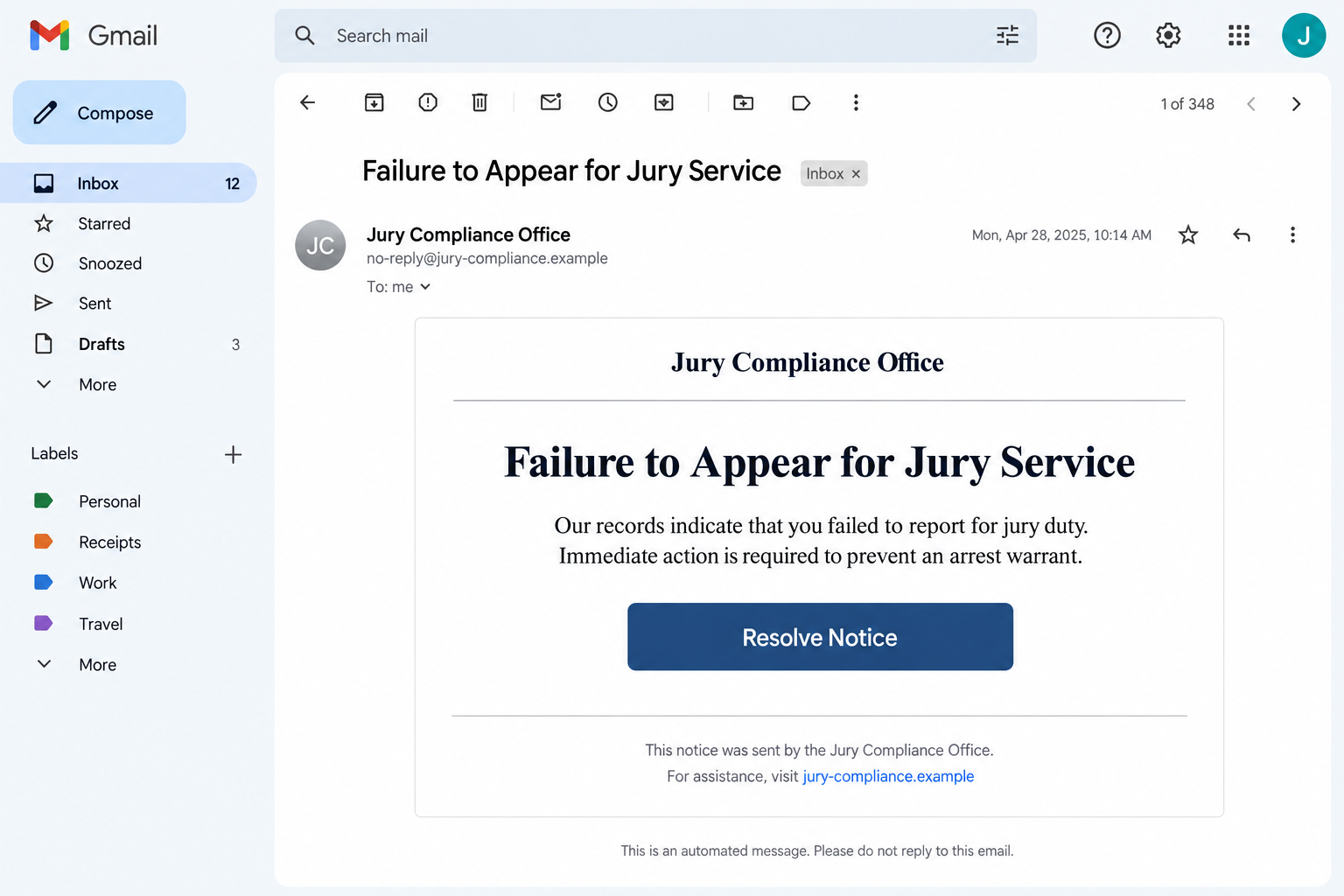
A message says you failed to report for jury duty. It names a judge or court official, warns that the matter is already serious, and makes it sound as though arrest can be avoided only if you respond now.
The missed jury duty text scam turns a real civic obligation into a private payment demand. The pressure feels immediate, but the court’s own warning gives you a safer way to judge what is happening.
Overview
The message claims that a court deadline has already passed
The U.S. District Court for the District of Maine issued a jury scam alert on September 9, 2026. It said fraudulent texts and emails were telling recipients they had failed to report for jury duty.
The messages falsely used the name of “Judge Nye” or other court officials. The court stated plainly that the messages were not from the court.
This is confirmed impersonation, not a disagreement about a legitimate fine. The scammer borrows the authority of a real court and real public servants, then invents an urgent private route for resolving the claim.
The arrest threat and payment demand expose the scheme
The District of Maine says the court will never send a text or email threatening arrest or demanding payment for missed jury service. Those two elements are not normal collection procedures dressed in unusual language. They contradict the court’s stated practice.
Older jury scams often moved from a call to gift cards or other difficult-to-reverse payments. The September warning does not specify one required payment method for every text or email, so this article does not assume that all versions use the same route.
Whatever the method, an unsolicited sender cannot create a valid court resolution by placing a judge’s name above a button. A copied name, case number, or courthouse address is not proof.
A genuine jury matter can be checked outside the message
The court publishes its Jury Office information and explains how federal jury contact works. Prospective jurors are initially contacted through formal mail, not through a surprise text or email threatening arrest and requesting money.
If you have genuine concerns, leave the message and use the contact details on the official court website. Do not call a number inside the threat, even if caller identification or a signature appears to match a government office.
- The message says you already missed jury service.
- It threatens arrest, prosecution, or a warrant.
- It uses a judge or officer’s real name as proof.
- It asks for payment or confidential information outside court.
- It discourages you from hanging up or checking independently.
Why a Jury Duty Threat Feels So Difficult to Ignore
Many people know that ignoring a real summons can have consequences, but they do not know the exact procedure that comes first. That gap lets a scammer present an invented emergency as though the legal process is already far advanced.
The target may also worry that a summons went to an old address or was lost in the mail. The scammer does not need evidence that this happened. The possibility makes the accusation feel personal.
Using a real judge’s name adds another layer of credibility. Names, titles, office addresses, and court calendars are public. Copying them into an email does not require access to a case.
The threat can become more elaborate when someone replies. A caller may pose as a deputy, clerk, supervisor, or payment officer. Each transfer is designed to look like another department confirming the same story.
Stop measuring legitimacy by the number of people involved. Several voices can belong to the same fraud, and one person can change roles during a call.
A real official will not object to independent verification. Pressure to stay on the line, use only the contact details inside the message, or avoid calling the clerk shows that the sender needs to control what you learn next.
Do not let a correct name, address, judge’s name, or court location change that rule. Much of that information is public and can be copied from official websites into a fraudulent notice.
What Real Federal Jury Contact Looks Like
The District of Maine’s jury information explains that initial contact for federal jury service is made through formal written correspondence sent by U.S. Mail. That mailing may direct a prospective juror to a secure online questionnaire.
The court does use an eJuror system, but the existence of a real online service does not validate a link in an unsolicited message. Begin from the court’s official homepage and follow its published instructions.
The court also says federal courts do not require people to provide confidential information by telephone or email, do not request credit card numbers, and do not call to collect a fine for failure to appear.
A fine would not be imposed by a stranger on the phone. The court explains that any such consequence would be imposed by a judge in a court session with the summoned juror present.
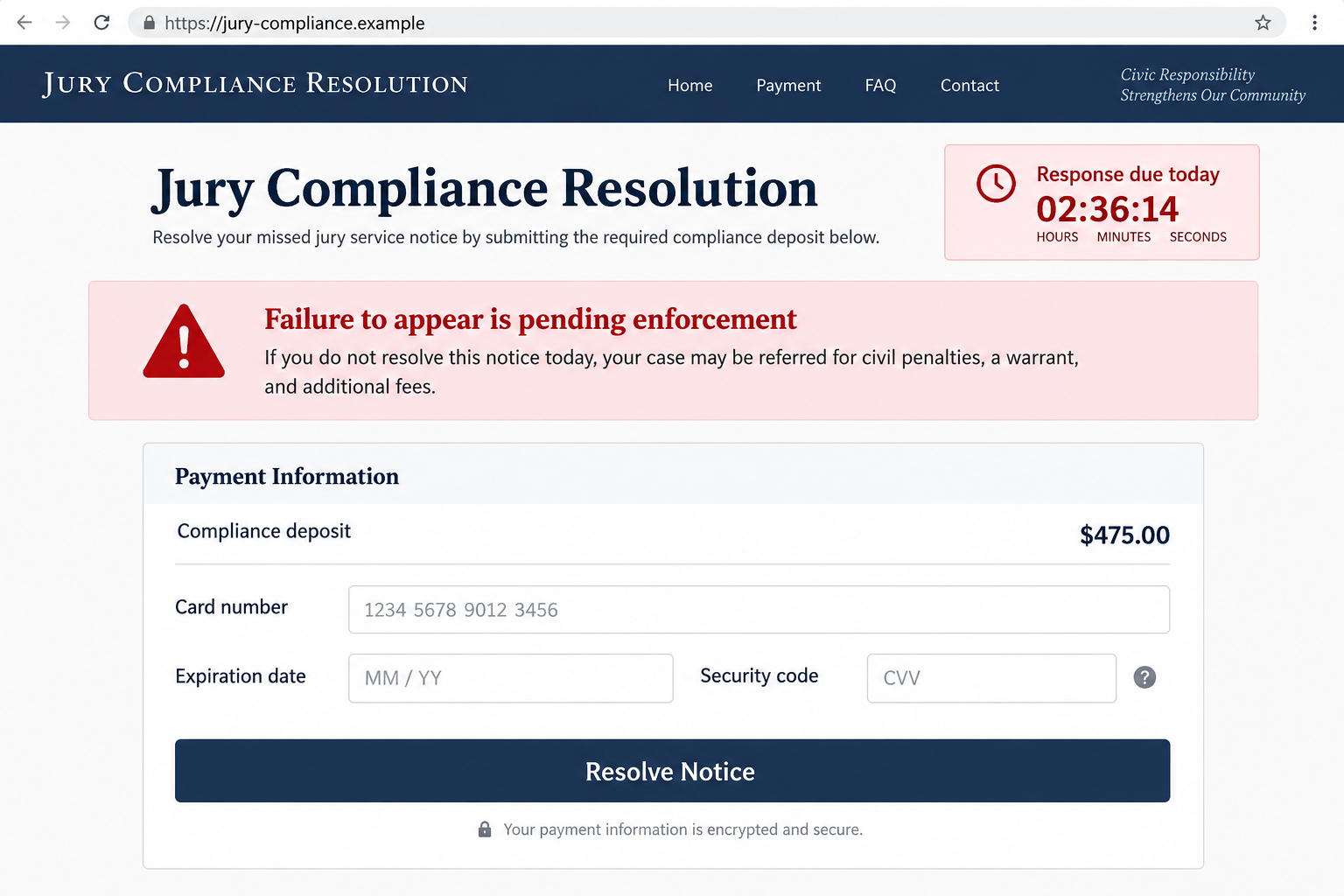
The reconstructed payment page below uses a fictional domain. It illustrates the contradiction between a court-sounding demand and an unverified payment route; it is not a copy of a live court website.
How the Missed Jury Duty Text Scam Works
Step 1: A surprise accusation creates immediate fear
The first message says you failed to appear or did not answer a jury notice. It treats that allegation as settled, even though you have not confirmed that a summons exists.
A case or badge number may be included to make the conversation feel documented. Write it down if you want to report it, but do not treat a reference invented by the sender as a court record.
The safest first move is to stop. An actual court matter can be checked after you leave the message.
Step 2: A real official’s name makes the threat look researched
The Maine warning specifically says messages falsely use the name of Judge Nye or other court officials. Public names can be inserted into a template and sent to many recipients.
Do not call a number merely because an online search shows that the named person exists. Search for the court itself, open the official domain, and use its listed Jury Office contact.
A sender may also spoof a government phone number. The number displayed on your screen does not prove where the call originated.
Step 3: The sender turns legal fear into a private deadline
The message warns that a warrant, arrest, or prosecution will follow unless you cooperate immediately. The deadline is designed to keep you from reaching someone who can contradict the story.
A scammer may tell you not to disconnect, not to tell anyone, or not to visit a courthouse because doing so would trigger the warrant. Those instructions protect the scam, not you.
Hang up. A genuine agency does not lose authority because you verify its request through a published number.
Step 4: Payment is presented as a temporary legal solution
The sender may describe the money as a fine, bond, citation, or refundable deposit. Changing the label does not turn the transaction into a court payment.
Gift cards, cryptocurrency, cash deposits, wire transfers, and payment apps are especially dangerous when demanded by an unsolicited caller. The September alert does not say every case uses those methods, so focus on the unauthorized demand itself.
Do not pay a small amount to buy time. A first payment can be followed by another supposed charge for clearing the warrant or confirming your identity.
Step 5: Personal details are used to sustain the impersonation
The scammer may ask for a Social Security number, date of birth, address, or identification document. Those requests can be framed as locating the summons or verifying that the warrant belongs to you.
Providing information does not prove innocence and does not create a valid court record. It gives the impersonator more material for follow-up fraud.
If the caller already knows personal details, assume only that the information came from somewhere. It does not establish that the caller is a clerk, judge, or law enforcement officer.
Company and Court Identity Checks Before You Respond
The court exists, but the message is unauthorized
The U.S. District Court for the District of Maine is real. Its own alert states that the threatening texts and emails are not from the court.
Report the sender as an impersonator. Do not describe the real judge or court as the scammer simply because their names were misused.
A courthouse address is easy to copy
Physical addresses, official titles, and office hours are published online. A signature containing accurate public information still does not authenticate the sender.
Likewise, a website can display a courthouse image or seal-like graphic without being operated by the judiciary. Check the complete domain and begin from an official court page.
Jury support should be reached independently
The District of Maine publishes Jury Office contacts for its divisions. Obtain current details from med.uscourts.gov rather than from the alleged violation notice.
Ask whether there is a record connected to you. You do not need to send a payment, read a card number, or remain on a threatening call while the clerk checks.
A real summons has a traceable court record
A legitimate jury process begins with formal correspondence and provides instructions that can be verified with the court. A screenshot or payment receipt created by a scammer is not that record.
If you genuinely missed a notice, follow the court’s instructions. Discovering a scam message does not authorize you to ignore real mail or a verified obligation.
What to Do if You Have Fallen Victim to This Scam
-
End the conversation and do not make another payment. Hang up or stop replying. A final fee, refund code, or cancellation payment will not turn the caller into a court official.
If the person says disconnecting will trigger arrest, treat that as pressure. Call the real court separately after the line is closed.
-
Contact the payment provider immediately. Tell the bank, card issuer, wire service, payment app, or cryptocurrency platform that the transaction resulted from government impersonation. Ask what can be frozen, recalled, or disputed.
Recovery is not assured, especially for cash-like payments, but speed matters. Do not pay a private recovery agent who promises guaranteed results.
-
Protect identity information you disclosed. Change exposed passwords from a trusted device and replace them anywhere they were reused. Review recovery addresses, active sessions, and authentication settings.
If you shared a Social Security number or identity document, use the official identity theft recovery resources for your location and consider appropriate credit protections.
-
Preserve the threat and verify the court claim. Save the original message, email headers, sender, call log, voicemail, payment instructions, receipts, and names used. Do not edit screenshots in a way that removes dates or addresses.
Contact the District of Maine Jury Office through its official site if the message named that court. Explain that you received the September-style missed-jury threat.
-
Report the impersonation. The court directs recipients to the Federal Trade Commission at ReportFraud.ftc.gov. Report financial loss to local law enforcement and follow any instructions from your payment provider.
Give investigators facts, not guesses about who sent it. The message, destination, payment trail, and timing are more useful than confronting the scammer.
-
Check devices only when the message caused a download. Clicking does not by itself prove an infection. If you installed a file, browser extension, remote support program, or profile, disconnect the device and seek help.
Malwarebytes can scan supported personal devices for malicious software. AdGuard can block some known scam domains and deceptive ads. Neither cancels a payment or verifies a court case.
Frequently Asked Questions
Has the District of Maine confirmed this jury scam?
Yes. Its September 9, 2026 alert describes fraudulent texts and emails claiming recipients failed to report for jury duty and says the messages are not from the court.
Will a federal court text me and threaten arrest?
The District of Maine says the court will never send a text or email threatening arrest or demanding payment for missed jury service.
Does using a real judge’s name prove the message?
No. The alert specifically says scammers falsely used Judge Nye’s name or other court officials’ names. Verify the matter with the court through its official website.
What if I really lost a jury summons?
Call the Jury Office using a number from the official court site. A possible lost letter does not make a threatening text or private payment demand legitimate.
Can I pay the fine now and dispute it later?
Do not pay the sender. The court says it does not demand money this way. Paying can create a loss and invite additional demands without resolving any genuine jury matter.
Is the payment page shown here a real court site?
No. It is a non-functional illustration with a fictional domain. It demonstrates a possible payment pretext without reproducing a live criminal destination.
The Bottom Line
The missed jury duty text scam begins with a frightening claim and uses a real court’s authority to keep you inside the scammer’s private process. The District of Maine has confirmed that these threatening messages are fraudulent.
Leave the message, contact the court through its published website, and never pay to prevent an arrest described by an unsolicited text, email, or call.








