

A Wayne County deputy calls about jury duty you don’t remember missing. He knows your name, sounds confident, and says the situation needs attention today.
Before you start searching for a misplaced summons, take a breath. What happens next matters more than the name showing on your screen.
Overview
The caller borrows a real Michigan agency’s authority
The Wayne County sheriff scam involves someone impersonating a deputy and claiming that missed jury service or an outstanding warrant requires immediate payment.
The real Wayne County Sheriff’s Office in Michigan warns about callers using employee names, apparent agency phone numbers, and personal information to sound convincing.
This isn’t a dispute over an ordinary invoice. The caller uses the possibility of arrest to turn an unexpected conversation into a payment demand.
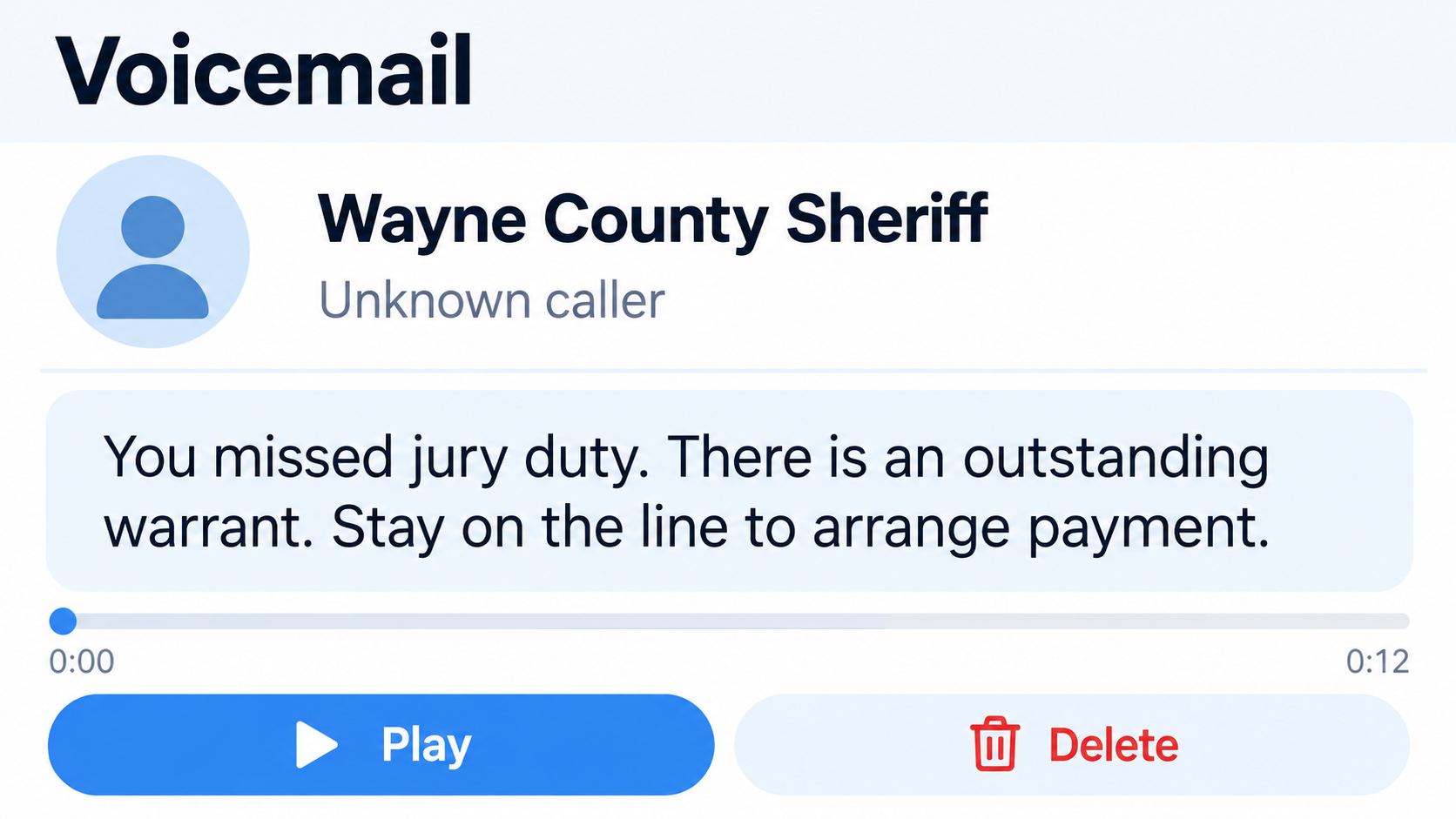
The interface above illustrates that approach. It is not a recording or an authentic voicemail from a particular recipient.
A supposed bond turns cooperation into a financial risk
The agency’s warning describes requests involving cryptocurrency, debit card information, and Apple Pay. The method can change without making the underlying demand legitimate.
Watch for a conversation that combines several of these details:
- An accusation that you failed to appear for jury service.
- A deputy’s name, rank, or badge number offered as identification.
- A claim that paying now will prevent an arrest.
- Pressure to provide additional personal or financial information.
- A callback number supplied by the person demanding payment.
A credible voice doesn’t fix those problems. Neither does finding an employee with the same name on a government website.
The real court provides a separate way to check
Michigan’s Third Circuit Court also warns about these calls. Its guidance identifies fake supervisors, persistent callbacks, and threatened bonds as tactics used against potential jurors.
The court says it does not telephone people to demand money or threaten jail over missed jury duty. Verify any genuine concern through independently located court contacts.
A scam call doesn’t prove you have no unrelated court obligation. It means the caller hasn’t earned your trust or the right to collect anything.
How the Wayne County Sheriff Scam Works
Step 1: An unexpected call sounds like official business
The opening is designed to interrupt your day with something difficult to dismiss. A law-enforcement title makes an unfamiliar caller feel more important than ordinary spam.
You may initially stay on the line simply to understand what happened. That is a normal reaction, especially when the caller begins calmly.
A displayed local number can reinforce the impression. However, caller ID identifies what your screen was sent, not who is physically speaking.
Calling that displayed number back isn’t a reliable investigation either. Locate the agency’s contact information separately before beginning a new conversation.
Step 2: Familiar details make the accusation feel personal
The impersonator may already know your name or other basic details. The real sheriff’s warning specifically describes requests to verify information or provide more.
Knowing something about you is not the same as accessing a court file. Public records and information available elsewhere can make an unsolicited call sound targeted.
Don’t fill the gaps for the caller. Giving your birth date, financial details, or other identifiers supplies information that the opening may not have contained.
You don’t need to work out where every detail came from before ending the call. Independent verification is still the appropriate next step.
Step 3: A missed summons becomes an alleged emergency
The story shifts toward something you supposedly failed to do. Perhaps a jury notice was lost, overlooked, or sent to an address you no longer use.
That explanation encourages self-doubt. Instead of questioning the caller, you start trying to reconstruct your mail and remember whether you made a mistake.
The threatened warrant raises the stakes. Now the conversation isn’t about checking a schedule; it’s about avoiding an immediate consequence described by a stranger.
There may be legitimate procedures for addressing missed service. A threatening phone demand is not a substitute for checking those procedures with the actual court.
Step 4: Another supposed official reinforces the story
A second voice may appear to confirm the first person’s account. The Third Circuit warning identifies simulated transfers to supervisors or departments as a credibility tactic.
Different voices don’t necessarily mean different organizations. If the first caller controls the handoff, the entire exchange remains inside the same unverified conversation.
A rank, case reference, or badge number can also sound reassuring. These details are claims you were given, not credentials you independently authenticated.
Don’t accept a transfer as your verification call. End the connection and reach the court or sheriff through a contact you found yourself.
Step 5: Payment is presented as the way out
The impersonator presents payment as the way to fix your situation. Calling it a bond or fine makes handing over money sound like following a procedure.
This distinction matters emotionally. You aren’t expecting a reward; you’re trying to prevent something frightening from happening to you or someone you love.
The sheriff’s official scam warning makes the boundary clear: the office does not ask for money over the phone.
Don’t send a smaller amount as a compromise. A partial payment still reaches the person whose authority you have not established.
Step 6: Pressure continues until you break contact
If you hesitate, the demand may become more insistent. The court warns that impersonators can repeatedly call or harass someone they believe might comply.
Further conversation can also produce new excuses. A failed transfer may be described as an additional problem, rather than a reason to stop.
You aren’t required to win an argument or persuade the caller to admit anything. End the exchange, keep useful evidence, and speak with verified contacts.
If calls continue after you block one number, record that pattern for your report. A changing number doesn’t make the next demand a fresh legal obligation.
Checking a Wayne County Jury-Duty Claim Safely
Separate Michigan from other counties with the same name
Several states have a Wayne County. This warning concerns the Michigan sheriff and Third Circuit Court, not every agency sharing that county name.
Check the state and institution before calling. A correct-looking search result for another jurisdiction won’t establish what happened in your own case.
For Michigan, start with the Third Circuit Court’s official scam guidance. Use its navigation to find the appropriate court service.
Ask about the underlying summons or obligation. Don’t ask an employee to approve a transfer that an unknown caller has already arranged.
Check the demand, not just the employee’s name
Searching a name can confirm that an employee exists. It cannot show that the caller is that employee or that the instructions came from the agency.
The same applies to an address. A real courthouse location can be copied into a message without connecting the sender to that building.
When you reach the real office, describe the demand and the contact method. Those details are more useful than a name alone.
Don’t provide banking credentials or payment codes to demonstrate that you’re cooperating. Checking a summons doesn’t require surrendering control of a financial account.
Don’t confuse legitimate reminders with threatening collections
Courts can provide legitimate administrative communications and reminder services. The meaningful warning here is the unsolicited demand for payment backed by arrest threats.
If you genuinely have jury paperwork, keep it and verify its instructions independently. Don’t discard an authentic summons simply because a scammer also contacted you.
For uncertain legal questions, ask the responsible court or a qualified attorney. A general scam article cannot determine your individual court status.
If a Family Member Is Still Following the Caller
Someone frightened by an alleged warrant may be reluctant to stop. Begin by helping them pause, rather than arguing about whether they should have believed it.
Ask what the caller wants them to do next. A planned withdrawal or transfer gives you a concrete action to interrupt before debating the entire story.
Offer to locate the real sheriff or court contact together. Keep that separate from a conference call arranged by the person demanding money.
If you’re at a bank with them, explain the impersonation concern privately to staff. Don’t let the threatening caller narrate the transaction through the speakerphone.
Help list what has already happened: conversation only, shared information, an unfinished payment, or a completed transfer. That list makes the response less overwhelming.
Respect their privacy while preserving evidence. You can assist without posting the voicemail publicly or sharing their financial records with an unfamiliar recovery service.
Afterward, agree on a simple household rule: unexpected legal-payment demands get an independent check before anyone transfers money. The rule should support them, not assign blame.
What to Do if You Have Fallen Victim to This Scam
-
Stop communicating before making another payment.
Hang up, pause any unfinished transfer, and don’t use a payment request the caller sent. Tell a trusted person what happened.
If someone is waiting while you travel or withdraw money, step away from the instructions. Ask bank or store staff for help privately.
You don’t owe the caller an explanation. A threat that you must remain available is another reason to move the conversation outside their control.
-
Contact the provider that handled your money.
Use your bank’s app, card, or independently located support page. Explain that someone impersonated law enforcement and identify the exact transaction.
For a card payment, ask about blocking further use and disputing the charge. For a transfer, ask immediately whether cancellation or recovery is possible.
Be accurate about whether you initiated the transaction. Different circumstances require different investigations, and a refund cannot be promised.
-
Report cryptocurrency or payment-app transfers promptly.
Keep the transaction identifier, receiving address or account, amount, and time. Contact the exchange, kiosk operator, or payment service through its real support channel.
Don’t send a second payment to release the first. A claimed reversal, investigation fee, or account upgrade may simply continue the loss.
The FTC’s recovery guidance explains why contacting the relevant payment company quickly matters, even when reversal is uncertain.
-
Protect whichever information you disclosed.
Tell your card issuer if you read out card details, even if no charge has appeared. Ask whether replacement is appropriate.
If you shared a financial login, change it through the real service and ask about unknown sessions or account changes.
For exposed Social Security information or identity misuse, use IdentityTheft.gov to build a response plan, including relevant credit-protection steps.
-
Preserve evidence without continuing the conversation.
Save existing voicemails, texts, screenshots, receipts, and transaction records. Note what the caller claimed and whether a second person joined the call.
Keep the displayed number and callback number separately. Caller ID may be spoofed, so don’t publicly accuse the apparent number’s owner.
You don’t need to call again to collect more proof. Evidence you already have is more useful than risking another pressured exchange.
-
Report the impersonation to the correct agency.
The WCSO warning lists dispatch at 313-224-0414 for reports. Confirm that number on the official page before using it.
You can also submit the details through ReportFraud.ftc.gov and report internet-enabled financial losses to IC3.
Provide sensitive records only through verified channels. Public comments shouldn’t contain full financial numbers, identity documents, or your home address.
-
Check any actual summons separately.
If the story left you worried about jury service, reach the court independently. Explain that an impersonator contacted you and ask how to verify your status.
Keep authentic correspondence and follow genuine court instructions. Reporting a scam doesn’t automatically resolve an unrelated case or missed appointment.
Write down who you reached and any reference number. That gives you a dependable record if another threatening caller returns to the same story.
-
Expect follow-up pressure, not a paid rescue.
Someone may later claim to recover the money, investigate the caller, or remove your name from a list. An upfront payment adds another risk.
Deal with your financial provider and verified authorities instead. Let household members know about the impersonation so a second call doesn’t catch them unprepared.
Simply answering a telephone call is not evidence that malware entered your device. Concentrate on the money, information, or access you actually exposed.
Frequently Asked Questions
Is a call displaying the Wayne County sheriff’s number genuine?
Not necessarily. Caller ID can be falsified. End the call and independently locate the agency’s contact before asking it to verify the claim.
Does a real deputy’s name prove who called?
No. The sheriff specifically warns that impersonators use real employee names. A directory match doesn’t authenticate the speaker or authorize a payment.
Will paying a caller settle missed jury service?
Do not use that arrangement. The sheriff and Third Circuit warn against telephone collection demands. Verify any actual obligation directly with the responsible court.
What if a supposed supervisor confirmed everything?
A transfer inside the original call isn’t independent verification. The court identifies fake supervisors as a tactic; start a separate call using official contact information.
Should I return the voicemail to investigate?
Don’t return it through the supplied callback number. Save the recording and approach the agency separately if the claim concerns you.
Can I recover money already sent?
Recovery depends on the payment and timing. Contact the payment provider immediately, preserve transaction details, and avoid anyone demanding another fee to recover the loss.
The Bottom Line
Don’t pay a caller in the Wayne County sheriff scam. A name, badge number, or familiar caller ID cannot turn an arrest threat into legitimate collection.
End the call and verify jury concerns independently. If money or account details changed hands, contact the relevant financial provider immediately and report the impersonation.

Join the discussion
0 commentsShare your experience or ask a question about this article.
Discussion
Start the conversation
Have a question or something useful to share? Add the first comment.