

When someone you care about is in jail, an unexpected call offering a way to bring them home can feel impossible to ignore.
Before following that caller’s instructions, there is one question worth slowing down for: who is actually on the other end?
Overview
What the Franklin County sheriff scam involves
The Franklin County sheriff scam discussed here targets families and friends of people held in the Franklin County Jail in Ohio.
A caller claims official authority and offers release through a program or arrangement requiring immediate payment. The claimed role makes the demand sound procedural.
The real sheriff’s office is not running this scheme. An impostor is borrowing its authority to make the payment request sound official.
What officials have confirmed
The Franklin County Sheriff’s Office warning published October 28, 2026 describes callers promising release through diversion, probation, or electronic monitoring.
Officials say the callers seek immediate payment and may use public arrest or court information to sound credible. Knowing a real case detail is not authentication.
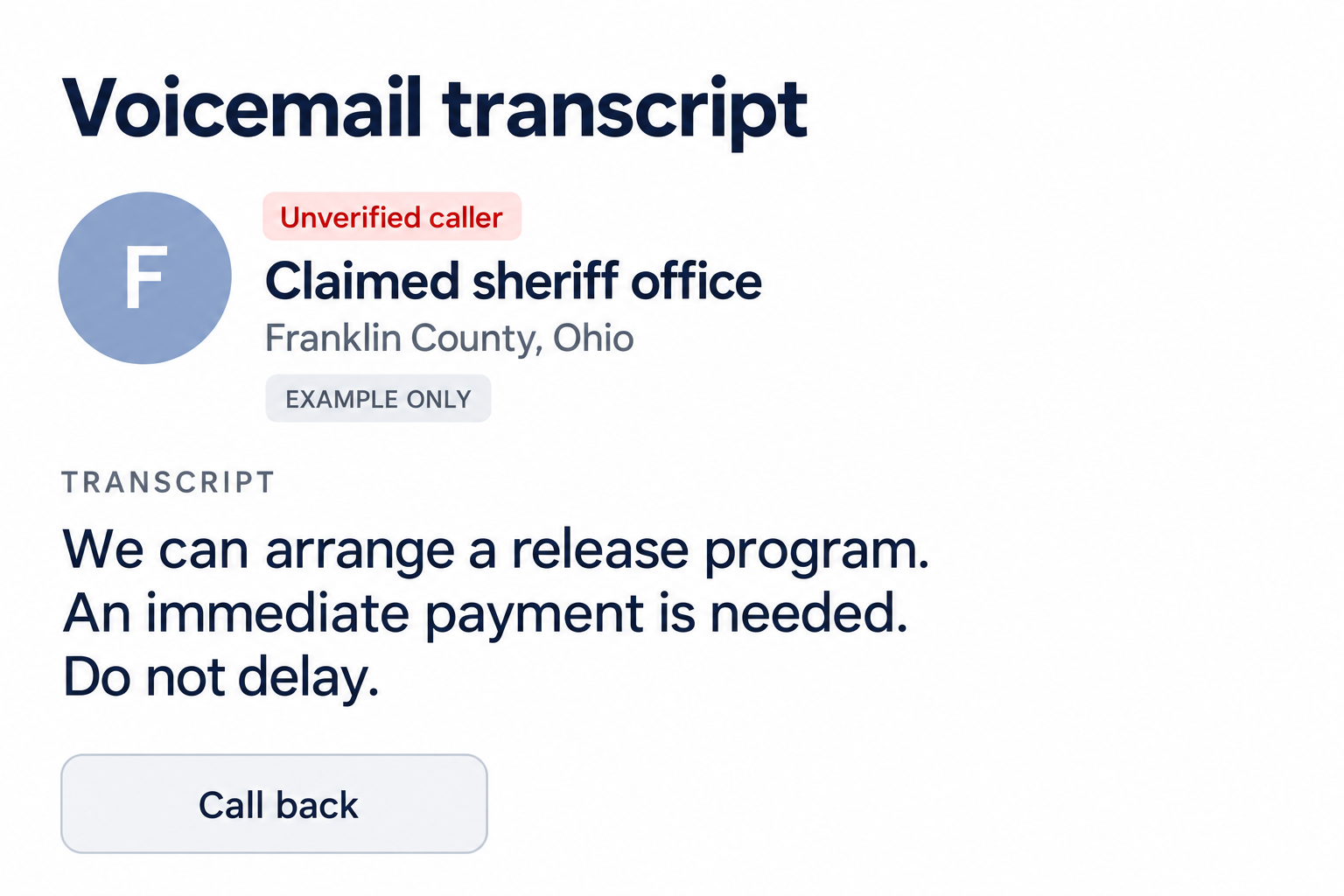
The image above is a generated voicemail illustration, not a recording or transcript from an identified victim. It contains no working contact information.
The warning signs to keep in mind
The strongest warning is the combination of an unsolicited release offer and a demand to pay through the caller’s instructions before checking independently.
- A supposed official offers a fast release arrangement over an unexpected call.
- Payment is presented as urgent, leaving little time to verify the offer.
- The request involves gift cards, prepaid cards, wire transfers, or financial details.
- The caller treats knowledge about an arrest as proof of official authority.
Legitimate bonds, fines, and fees can exist. Their existence does not make a stranger’s payment route legitimate or mean that paying will secure release.
How the Scam Works
Step 1: A real arrest makes the approach believable
The scam can start with something that is genuinely happening: a relative or friend has been arrested, and the family is trying to understand the process.
That setting gives the caller an advantage. The recipient may be tired, worried, unfamiliar with jail procedures, and eager for a practical next step.
Public information can supply enough detail to make the contact feel personal. A correct name or charge does not mean the caller accessed confidential jail systems.
Ask yourself what the detail actually proves. It may show only that the person knows something publicly available, not that they can change custody arrangements.
Step 2: The caller borrows an official role
The caller presents themselves as someone entitled to discuss release. Their tone and vocabulary may make the demand sound like routine administrative business.
You do not have to debate the role while staying on the line. A title spoken over the phone is still an unverified claim.
Caller ID is not enough either. A familiar agency name or number on the display does not establish who placed that particular call.
Take any name, office, and callback information as evidence to preserve, not instructions you must follow. Find the office’s real contact route separately.
Step 3: A release program supplies the hopeful explanation
The documented pitch offers release through diversion, probation, or an electronic-monitoring arrangement. These terms sound connected to real criminal-justice processes.
The fraud lies in using those terms to sell an unverified immediate release. Hearing a familiar legal phrase does not establish eligibility or an approved order.
For a worried family, the offer can change the question from “Is this real?” to “How quickly can I arrange the money?”
That shift is the point. Slow down before making financial decisions, even if the person describes the payment as the last remaining administrative step.
Step 4: The caller attaches an urgent payment demand
The promised arrangement becomes conditional on following the caller’s payment instructions. The sheriff’s warning identifies gift cards, prepaid cards, wires, and requests for financial information.
These requests are not made safe by calling the payment a processing fee, monitoring cost, or release charge. The label does not authenticate its recipient.
Do not read card codes aloud, send photographs of them, or disclose account access information to keep the conversation moving. Those actions create additional exposure.
The legitimate question is who is authorized to collect what payment through which official channel. The caller cannot verify their own answer to that question.
Step 5: Family concern substitutes for independent confirmation
A family member may hesitate to end the call because they fear delaying release. That concern is understandable, but it does not make the instructions reliable.
Ending the conversation gives you room to check the situation. You do not need the caller’s permission to contact the jail, court, or a known attorney.
If money has already been sent, a further demand does not become trustworthy because you made the first payment. Stop and verify before sending anything else.
Do not try to settle the entire case over that call. Check what is actually happening with custody and payments through the real office.
How to Verify a Jail-Release Claim
Use contact information obtained outside the call
Start from the official sheriff’s website linked above. Locate the relevant jail or office contact there rather than calling back the number the stranger supplied.
Explain that an unsolicited caller offered a release arrangement and requested money. Ask how the claimed instruction can be checked through official records or staff.
Do not ask the suspicious caller to transfer you to a supervisor as your only verification. Another person in the same conversation is not an independent check.
If you already work with an attorney, contact them using the details you normally use. Send them the caller’s exact claims without assuming those claims are true.
Separate custody information from payment authority
An official custody record can help establish that a person is held. It does not prove that a caller discussing that person is a sheriff’s employee.
Records may also require clarification or updating. Do not make a release decision from an unfamiliar lookup page or a screenshot sent by the caller.
Ask separately whether an actual order or approved process exists and how any legitimate payment must be handled. Keep written confirmation when it is available.
Be careful with the word “guaranteed.” A stranger’s assurance that a payment will produce release is not a substitute for the proper legal process.
Make a family plan before another call arrives
Choose one family member to keep a record of verified contacts and instructions. That reduces confusion when several people receive calls about the same person.
Share a simple rule: no one sends money based only on an incoming call. Check the request through a known official contact first.
Where possible, compare information with the incarcerated person’s established communication route or attorney. Do not treat an inability to reach them immediately as proof of the caller’s story.
A plan is especially helpful when relatives live in different places. It prevents urgency from turning separate fragments of information into apparent confirmation.
Prepare a short set of verification questions
When you reach the real office, explain the offer in plain language. Ask which office would actually handle the claimed program or arrangement.
Then ask how to confirm that any payment instruction relates to the person’s real case. A general description of jail procedures may not answer that question.
If staff cannot discuss particular details with you, ask what authorized route is available. Do not treat privacy limits as confirmation of the stranger’s story.
Keep the name of the office you contacted, the date, and any reference supplied. That record can help other relatives avoid repeating an unverified instruction.
If an attorney needs to clarify eligibility or a court order, let that happen before making financial promises. A caller’s urgency does not resolve legal uncertainty.
You can also ask how to submit the suspicious voicemail or payment instructions securely. Do not put a relative’s case information into a public comment thread.
These questions are for independently contacted staff, not the impostor. Asking the caller to answer them would leave the same person controlling both claim and confirmation.
What to Do if You Have Fallen Victim to This Scam
-
Stop communicating and stop further payments. End the call, preserve any voicemail, and avoid returning to the number supplied by the impersonator.
Tell other relatives that the release demand is unverified. Someone else may otherwise pay while you are investigating what happened.
-
Contact the payment provider immediately. Explain the fraud and ask whether a transfer can be stopped, recalled, disputed, or otherwise investigated.
For gift or prepaid cards, retain the card and receipt and contact the issuer. Report which codes were disclosed; do not assume remaining funds are protected.
The FTC’s recovery advice explains options by payment type. Acting quickly helps, but reimbursement is not guaranteed.
-
Verify the actual jail and court situation independently. Use the official sheriff’s website or your attorney’s established contact information.
Ask whether the caller’s release claim or payment instruction has any legitimate basis. Do not ignore real court obligations merely because a separate scam contacted you.
-
Document the conversation while you remember it. Record dates, displayed numbers, claimed names, program descriptions, payment destinations, and the amount sent.
Keep original receipts, messages, and voicemails. A screenshot is useful, but retaining the underlying message can preserve details that the screenshot misses.
-
Report the impersonation to the appropriate authorities. Tell the real sheriff’s office that its identity was used and follow its reporting instructions.
Report financial loss to the relevant law-enforcement agency as well. Give the facts you know without filling gaps with guesses about the caller’s location or identity.
-
Respond to information exposure. If you provided account details, ask the financial institution what needs replacing, restricting, or monitoring.
If sensitive identity information was shared, use IdentityTheft.gov to build an appropriate recovery plan. Payment recovery and identity protection are separate tasks.
-
Be cautious about recovery offers. A person promising to retrieve the funds or solve the release problem for another advance payment needs independent verification.
Do not grant account access or send more money because someone knows the original incident. Knowledge of the loss does not establish legitimate authority.
What This Warning Does Not Mean
Not every jail-related payment is fraudulent
Bonds, court costs, and other lawful payments can be part of a real case. This article does not determine what any particular person owes.
The warning concerns an unsolicited impersonator promising release in exchange for an urgent payment. Verify the authority and process rather than relying on a blanket rule.
If a real official confirms an obligation, ask for the official payment procedure. A genuine obligation does not make an unrelated caller’s collection method valid.
A believable case detail is not secret proof
Families often assume that only officials could know about a recent arrest. Public records can make that assumption unsafe, even when the details are accurate.
Do not test the caller by supplying additional personal information and waiting for agreement. That can give an impostor more material for later conversations.
Instead, take the claim to the real office. Independent verification protects you without requiring a technical investigation into where the caller obtained the information.
There is no reason to install software for this call
This documented scheme is about impersonation and payment pressure, not a proven device infection. A security scan cannot determine whether a jail-release fee is legitimate.
If your only exposure was the conversation, focus on payments, personal information, and verification. Additional device cleanup depends on what you actually downloaded or allowed.
Keep the response proportionate. Buying a product or hiring an unsolicited recovery service is not a prerequisite for reporting the call or asking official questions.
Frequently Asked Questions
Why would a scammer know my relative is in jail?
The sheriff’s warning says public arrest or court records can supply details. Correct information about a person does not establish that the caller represents the office.
Is a caller ID showing the sheriff’s office enough?
No. Do not authenticate an incoming call from its display alone. Obtain the official contact independently and explain the specific request you received.
Can real release arrangements involve fees?
Legitimate obligations can exist, but the applicable court or official office must confirm the process. This scam warning does not decide an individual’s legal or payment requirements.
What if the caller promises an ankle-monitor release?
Electronic monitoring is specifically mentioned in the official warning. Check any claimed arrangement through the jail, court, or an established attorney before paying.
Should I tell other family members?
Yes. Explain that the caller’s authority is unverified and agree not to send money without an independent check. Coordinate evidence rather than making separate payments.
Can I recover a payment already sent?
Ask the provider immediately about available options. The answer depends on the payment method and circumstances; neither a caller nor a recovery service can guarantee reimbursement.
The Bottom Line
A stranger’s urgent offer to arrange a Franklin County jail release is not something to settle through an unsolicited call or its payment instructions.
Hang up and check with the real office or a known attorney. If you paid, contact the payment provider promptly and preserve the evidence.

Join the discussion
0 commentsShare your experience or ask a question about this article.
Discussion
Start the conversation
Have a question or something useful to share? Add the first comment.