

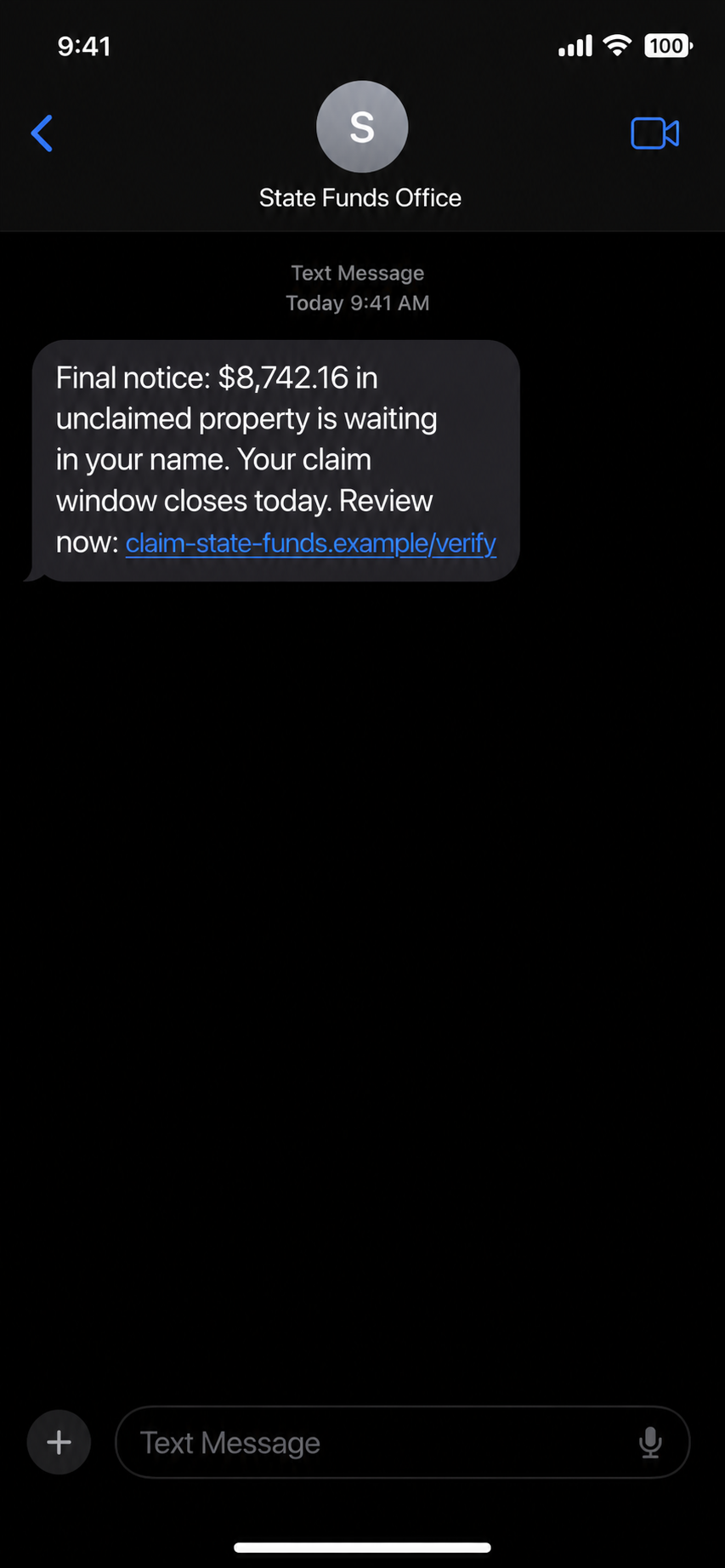
The message arrives with a surprisingly precise amount. It says thousands in forgotten property have been matched to your name, but the claim window is about to close.
Fake unclaimed money texts turn a real government program into a private deadline. The amount is meant to feel personal, even though the message was built for mass delivery.
Unclaimed property does exist. States return forgotten bank balances, uncashed checks, insurance proceeds, deposits, and other assets to their owners.
That true detail is what makes the message work. The scammer does not need to invent an impossible program. The scammer only needs to impersonate the search process.
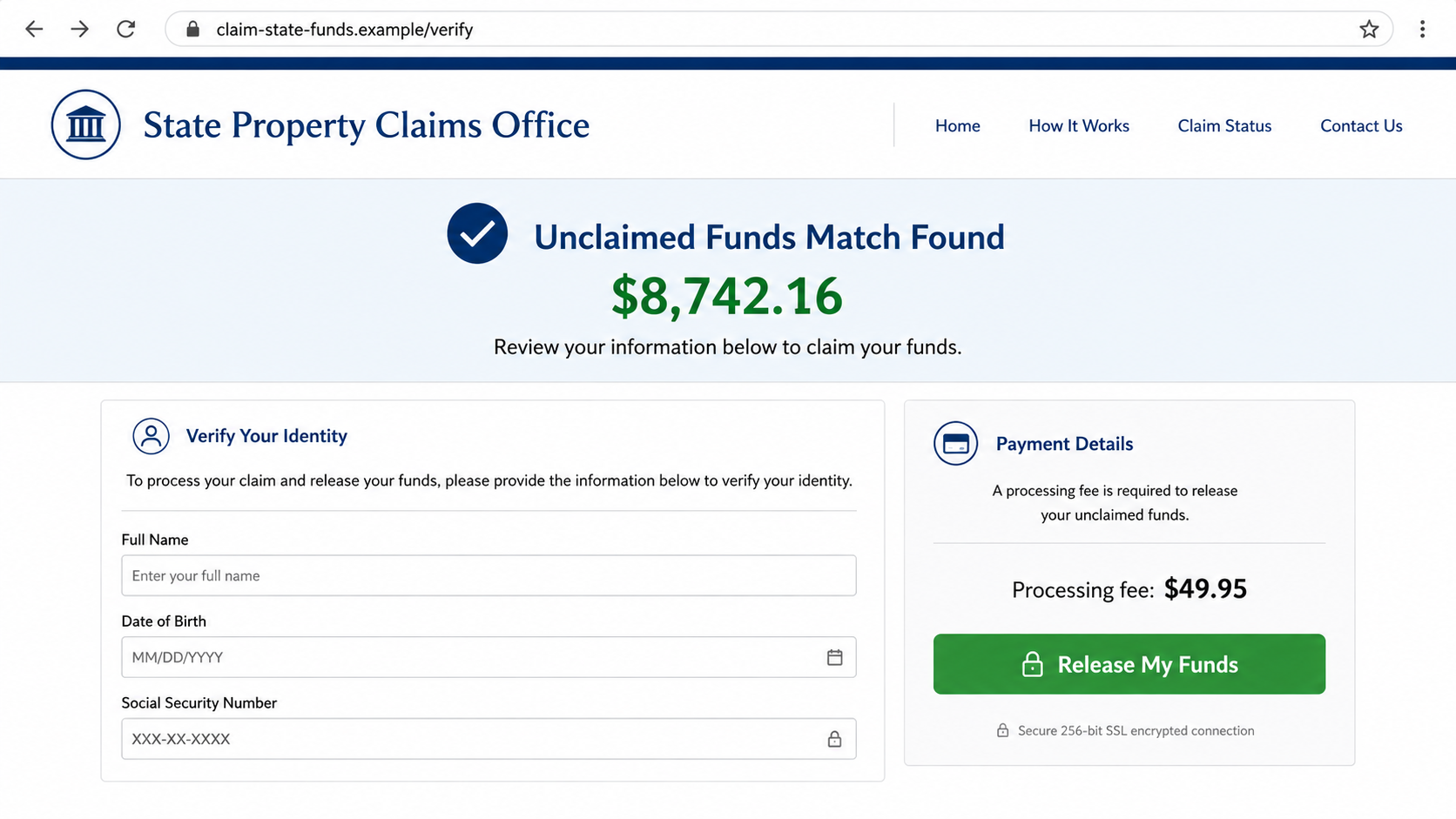
The link can ask for identity details first and reveal a processing fee later. Some versions reverse that order and demand payment before showing any credible record.
Overview
A real public service is used as the cover story
State unclaimed-property programs hold assets that businesses could not return to their owners. Searching the official state database is free, and a legitimate claim begins through the state office responsible for that property.
The FTC warned in March 2026 about unexpected calls and texts that promise thousands in unclaimed property. The alert identifies the urgent deadline, personal-information request, and upfront processing fee as scam signs.
The message supplies certainty before doing a real search
A mass text may state that $8,742 or another exact amount is waiting. It may use a fake agency name, reference number, or claim extension to make the match look completed.
Common claims include:
- funds were located under your name;
- the claim period ends today;
- an agency extended the deadline just for you;
- a small fee will release a much larger balance;
- identity information is required to view the record;
- a representative can complete the claim by phone.
The real objective is payment or usable identity data
The fee can be the immediate theft. The form may also collect a Social Security number, date of birth, address, bank details, card data, and a copy of identification.
Those details can support account takeover and identity fraud long after the small processing charge is forgotten.
How Real Unclaimed Property Searches Actually Begin
Businesses transfer unclaimed property to a state after a legally defined dormancy period. The state then publishes records and provides a claim process.
The property might be associated with a previous address, old employer, closed bank account, insurance policy, utility deposit, or uncashed payment.
You do not need a cold caller to discover it. The National Association of Unclaimed Property Administrators maintains a directory of official state search pages.
Each state controls its own process. Documentation requirements vary, but the search itself is free. A genuine state office does not create a private one-day deadline through an unexpected text.
Some legitimate businesses offer to help owners locate property for a fee. That does not make every finder dishonest. It also does not make an unsolicited government impersonation safe.
The scam described here is the message that pretends an official match is complete, pressures the recipient, and requests money or sensitive data through an unverified channel.
How the Fake Unclaimed Money Texts Scam Works
Step 1: A mass sender chooses a believable amount
The amount must be large enough to create excitement but ordinary enough to seem possible. It may include cents or a claim number to imitate a database record.
The text rarely explains which bank, employer, insurer, or previous address produced the property.
Step 2: A fake agency name creates authority
Names such as State Funds Office or Property Claims Department sound official without identifying a real office. The sender may add a government-style seal or flag to the landing page.
Generic authority is useful because the same template can be sent across several states.
Step 3: The deadline prevents an independent search
The message says the window closes today, the file will be returned, or a special extension is about to expire.
A recipient who pauses long enough to search the official state database may discover that the private deadline does not exist.
Step 4: The link collects identity information
The page requests a name, birth date, Social Security number, previous address, or identification document. It may claim these are needed to reveal the property.
A real claim can require proof of identity, but that information belongs on a verified state website reached independently.
Step 5: A small fee is framed as the final obstacle
The victim is told to pay $29.95, $49.95, or another modest amount for processing, certification, insurance, or release.
The contrast is intentional. A $49.95 fee appears trivial next to a promised balance of several thousand.
Step 6: The payment creates additional opportunities
The card may be charged once, tested with other amounts, or used for later unauthorized purchases. The victim can also receive follow-up requests for tax, transfer, or legal fees.
If the first payment succeeds, another caller may claim the file is larger than expected and needs one final payment.
Company, Address, and Fulfillment Checks
The agency name must exist outside the message
Search the state government’s official website and identify the office that administers unclaimed property. Do not use the link or phone number in the text.
A name that sounds official but has no matching state page is not enough.
The domain should lead back to a government directory
Use the official state link listed through unclaimed.org or the state’s own website. A new commercial domain containing claim, state, funds, or property can still be privately controlled.
HTTPS and a padlock do not verify government ownership.
Support should explain the underlying property
A legitimate record identifies the reporting holder, relevant address, property type, or other details allowed by state law.
A caller who cannot name the state program but knows only the promised amount is working from a script, not an official file.
The fee reveals the scam’s business model
The FTC states that government will not call or text and ask for payment to search for unclaimed funds. State programs do not need gift cards, crypto, payment-app transfers, or card details to reveal a public search result.
Do not let a small fee borrow credibility from a large promised balance.
Warning Signs in an Unclaimed Property Message
- The contact is unexpected and arrives by text or cold call.
- The sender uses a generic government-sounding name.
- A precise amount appears without the original property holder.
- The claim supposedly expires within hours.
- The link uses a commercial or recently created domain.
- The form asks for a full Social Security number before showing a record.
- A processing, insurance, transfer, or release fee is required.
- The sender wants payment through crypto, gift cards, wire, or an app.
A real property record will still exist after you close the text and search the official database yourself. Urgency belongs to the scammer, not the asset.
The Follow-Up Fees Can Be More Expensive Than the First
The first processing fee is often sized to feel harmless. Once the victim pays, the sender knows three useful things: the number is active, the promise worked, and the payment method accepted the charge.
A second message may announce that the property was successfully verified but is larger than expected. The new amount creates a reason for a tax, bond, insurance payment, or transfer certificate.
Another version claims the first card payment failed while still placing an authorization or charge. The victim is asked to try a different card, which exposes another account.
The caller may also shift from card payment to crypto, gift cards, wire transfer, or a payment app. Those methods reduce the chance of recovery and should end the conversation.
Typical follow-up demands include:
- a state certification fee;
- tax withholding before release;
- identity insurance or fraud protection;
- overnight document shipping;
- a bond for an unusually large claim;
- a refund fee after the victim complains.
None of these payments turns the text into an official claim. Verify the property through the state, not through the person who already took the first fee.
The identity form can create a second wave. A victim may receive fake bank alerts, loan offers, government calls, or recovery messages that reuse the same personal details.
Specific information does not prove the new caller is legitimate. It may prove only that the original list was sold or shared.
How to Document the Scam Without Reopening It
Take screenshots of the message, sender number, amount, and visible link. Copy the URL as text if that can be done without loading it again.
Save the card descriptor, payment receipt, emails, and any claimed agency name. Record what information was entered, including partial identifiers.
If the page already disappeared, keep the browser history and time of access. The missing site is consistent with disposable phishing infrastructure and does not weaken the payment dispute.
When reporting, separate the fake text from any genuine property later found in the state database. That prevents the scammer from using a real match as retroactive proof.
Check the message details for more than the displayed sender name. Save the actual phone number, email address, time, and any conversation that followed.
If the sender called, write down the agency name, callback number, payment instructions, and claims about the deadline. Do not call again simply to obtain more evidence.
For card payments, record both the name shown at checkout and the descriptor that reached the statement. A mismatch can help the issuer connect the charge to the deceptive page.
If identification was uploaded, note whether it showed a signature, license number, address, or machine-readable barcode. That determines which identity protections deserve priority.
Tell close relatives about the incident immediately if the scammer knows family details. Follow-up callers may use those details to pose as an investigator, bank employee, or state official.
Finally, watch postal mail as well as online accounts. Stolen identity information can be used to open credit, redirect correspondence, or submit applications that do not create an immediate email alert.
What to Do if You Have Fallen Victim to This Scam
- Stop paying and stop replying. Do not send a second fee to release, insure, or refund the first payment. Block the number after saving screenshots and the full destination URL.
- Contact the payment provider. Call the card issuer or bank using a verified number. Describe the transaction as fraud, request a reversal, and replace the card if its details were entered on the fake page.
- Protect exposed identity information. If you submitted a Social Security number, birth date, or identification document, place a credit freeze or fraud alert and follow the recovery plan at IdentityTheft.gov.
- Secure affected accounts. Change any password entered on the site. If bank login details or a one-time code were shared, contact the bank immediately and end online sessions.
- Check for unwanted software. If the link downloaded a file or requested an extension, run a full Malwarebytes scan. Remove unfamiliar browser add-ons and notification permissions.
- Block future scam destinations. AdGuard can help block many known malicious advertising and phishing domains. It cannot validate a claim, so continue using the official state directory.
- Report the campaign. Forward suspicious texts to 7726, report them through your phone’s junk option, and file a report with the FTC. Include the number, URL, amount, and payment instructions.
- Search for real property separately. Use unclaimed.org to reach the official state office. Finding a genuine record does not validate the text or create a reason to pay the sender.
Frequently Asked Questions
Is unclaimed property itself real?
Yes. States hold abandoned financial property and provide official search and claim processes. The existence of that program is what makes the impersonation believable.
Will a state office text me about thousands waiting?
The FTC warns that state unclaimed-property programs will not send unexpected text alerts asking you to click and pay. Verify any record through the state’s official website.
Do I have to pay to search for unclaimed funds?
No. Official state searches are free. Some private finders offer paid assistance, but an upfront fee demanded by a supposed government text is a scam sign.
Why does the text show an exact amount?
Precision makes a mass message feel tied to a real record. Without the original holder and a match in the official database, the amount is only part of the lure.
What if the website has a government seal?
Images and seals can be copied. Verify the hostname and reach the state office through a known government directory instead of trusting the page design.
Can I still have real unclaimed property after receiving a scam text?
Yes. Search independently through the official state program. A genuine match belongs to the government process and does not make the sender or its fee legitimate.
The Bottom Line
Fake unclaimed money texts borrow a real public program, add an invented deadline, and turn a promised windfall into a request for identity data or an upfront release fee.
Do not use the message link. Search the official state database for free, and remember that legitimate property does not disappear because you refused to pay a stranger today.

Join the discussion
0 commentsShare your experience or ask a question about this article.
Discussion
Start the conversation
Have a question or something useful to share? Add the first comment.