

A relative is in custody, and every unfamiliar phone call feels important. Someone says they can explain what needs to happen next.
They know the name and where the person is being held. For a worried family, an inmate release fee scam can arrive at an especially vulnerable moment.
Overview
A real arrest can support a false payment demand
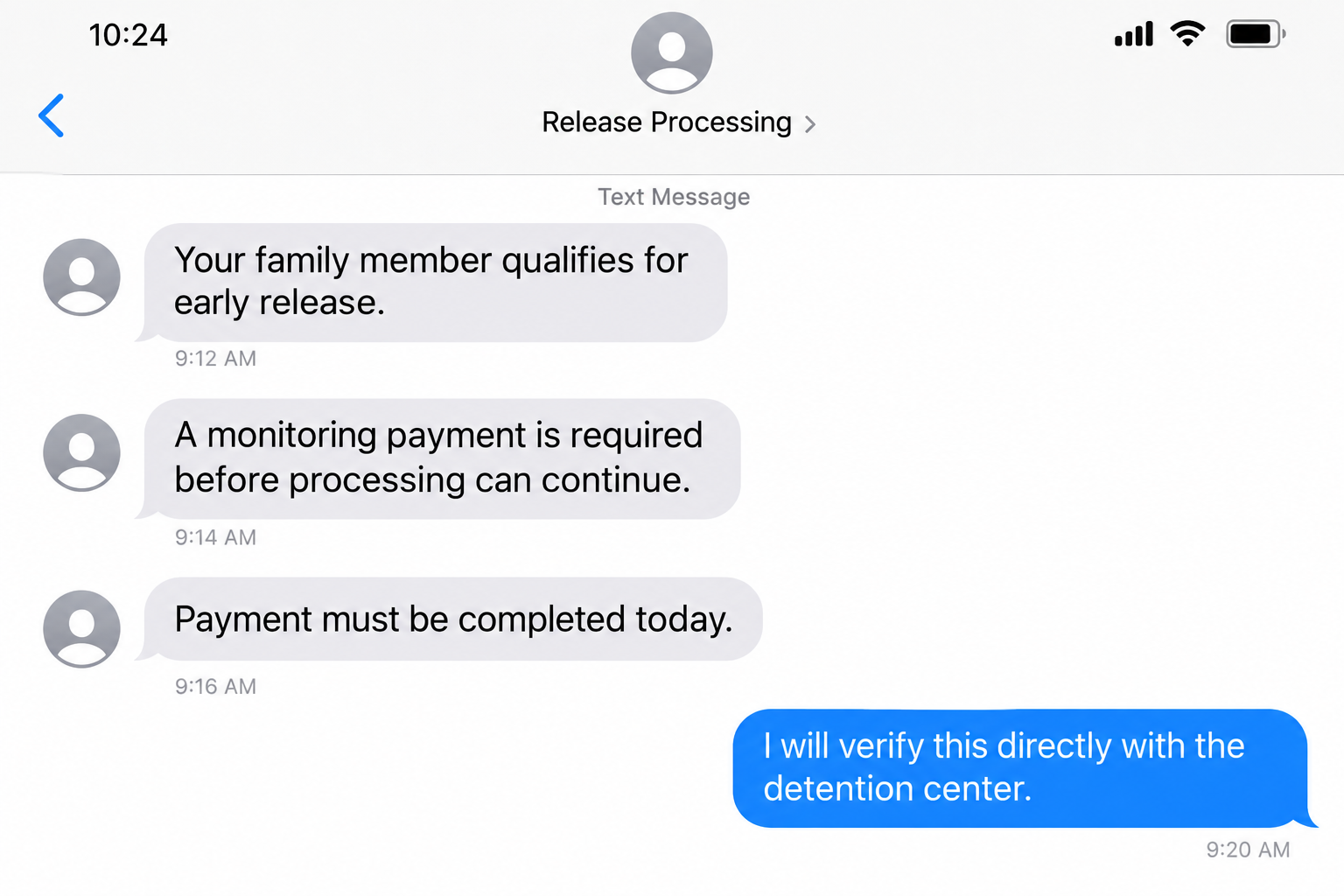
The inmate release fee scam uses an actual custody situation to make an invented charge believable. The caller pretends to have authority over release, bond, or monitoring.
They may claim that paying immediately will get your relative home, preserve a special opportunity, or resolve an outstanding obligation after release.
Knowing that the arrest happened does not verify the fee. The custody record and the caller’s authority are separate questions.
Public booking information can supply names and case details. Information that sounds private may be available without the caller working for the jail.
Corrections officials have warned about both versions
The Georgia Department of Corrections warned about fraudulent calls demanding extra bond money after release and payments allegedly required before an incarcerated person’s release.
The callers claimed connections to a sheriff’s office, probation, or parole. Officials advised families to withhold information and money and independently contact the relevant agency.
That warning establishes a documented impersonation scheme. It does not mean every correctional-service call or legitimate court-related payment is fraudulent.
Verify the obligation, recipient, and payment route
Local procedures differ. A genuine requirement should be confirmable through the facility, court, attorney, or appropriately verified bond provider handling the case.
Before any payment, establish:
- Which actual agency or authorized company is requesting it?
- What order, agreement, or case record explains the charge?
- Who receives the money, and through which approved channel?
- Does the amount match the independently confirmed requirement?
- What receipt or account record will document the transaction?
An unexpected caller who insists that there is no time for those checks is giving you a reason to stop, not a reason to hurry.
Why This Is Different From an Invented Family Emergency
In a familiar grandparent scam, the criminal invents an arrest or accident. Contacting the relative can expose the story because the person is safe elsewhere.
Here, the family may already know about the arrest. Confirming that fact can make the caller seem credible even though it does not authenticate the payment.
You may also be unable to reach your relative directly. That makes the promise of a quick release particularly difficult to dismiss.
The scammer exploits uncertainty about a system many people rarely encounter. Terms such as bond, monitoring, processing, and supervision can sound interchangeable when you are anxious.
They are not interchangeable obligations. A caller cannot create a valid fee simply by attaching an official-sounding name to it.
The safest response is to check the exact claim with someone responsible for the actual case. A lawyer or verified facility representative can explain what is required.
Do not blame yourself for wanting to help. The scheme is designed around that instinct, and taking a moment to verify is part of helping.
How the Inmate Release Fee Scam Works
Step 1: The caller builds a story around a real person
A name, custody location, booking date, or other public detail gives the conversation a believable starting point. The caller may ask you to confirm additional information.
Do not fill in gaps for them. You can note their claims without providing your relative’s full history, your address, or other family members’ contact details.
The first useful test is not whether they know something true. It is whether the responsible agency independently confirms their role and request.
A wrong detail is a warning, but correct details are not clearance. Treat the whole contact as unverified until you reach the real institution yourself.
Step 2: An official role makes the request feel compulsory
The person may claim to represent corrections, a sheriff, probation, parole, or a release-processing office. A badge number or case reference can reinforce the performance.
Phone displays can add another layer of reassurance. The FTC warns that impersonators can falsify caller ID, including names or numbers associated with organizations you recognize.
Writing down the claimed name can help later, but it does not validate the speaker. Ask the genuine agency about the request through its published contact route.
Step 3: The supposed opportunity depends on an immediate fee
The caller introduces a payment as the last obstacle between your relative and release. A monitoring charge or additional bond demand can sound like a procedural detail.
They may imply that delay will mean another night in custody. The emotional pressure is strongest when you believe the outcome rests entirely on your decision.
Remember that an urgent claim is still a claim. Ask the attorney or court whether the release condition exists and who is authorized to collect it.
If the person has already been released, do not assume a later demand is genuine because the caller mentions that release accurately.
Step 4: The payment instructions lead away from verified channels
A texted link, payment-app account, cryptocurrency request, or gift-card instruction can move money to the criminal while the conversation stays focused on your relative.
A familiar payment app does not make the recipient official. Nor does a checkout page establish that the underlying fee belongs to the court.
Check the payee and purpose separately. Do not send a small test payment to establish trust; successful delivery only proves that somebody can receive your money.
For a legitimate bond company, verify licensing where required and contact the business independently. Do not rely on a caller’s photograph of a license.
Step 5: The family is discouraged from checking elsewhere
The caller may keep you talking, insist another office cannot help, or describe verification as something that will delay release.
That pressure prevents the conversation from reaching a person who knows the real procedure. It can also stop relatives from comparing contradictory versions of the story.
End the call. A brief pause to contact the actual facility is safer than trying to investigate while the person demanding money controls the conversation.
If another relative received a similar call, compare the amount, payee, and explanation. Do not let separate family members make separate payments without coordination.
Step 6: Another invented obstacle can follow payment
Once money is sent, the caller can claim it covered only part of the process. A second fee may be described as necessary to release the first payment.
Do not continue because you have already committed money. A promised refund or release is not verified by another demand from the same contact.
Save the existing records and call the payment provider. Tell the real agency that its name is being used and ask about your relative’s actual position.
Check the Jail, Court, Attorney, and Payee
Find the institution through its official website
Use the relevant government website or a contact you already established with the case. Avoid sponsored search results offering urgent inmate assistance.
Search listings can include private services with similar language. Read who operates the page before entering personal details or choosing a phone number.
If you reach the wrong department, ask the verified institution to direct you internally. Do not return to the original caller for a replacement number.
Ask about the specific release condition
Explain that someone requested money and give the claimed purpose. Ask whether that requirement exists for the person and case involved.
A general answer that the facility accepts payments is not enough. Confirm this amount, this recipient, and this particular obligation.
If staff cannot discuss details with you, ask how an authorized person or attorney can obtain confirmation. Do not interpret privacy limits as support for the caller’s story.
Keep routine communication accounts separate
Jails may use legitimate third-party services for phone calls, messaging, visitation, or account funding. Paying one of those services is not automatically a release payment.
A caller who blends a familiar communication provider with an invented bond obligation is relying on that confusion. Verify each service for its actual purpose.
Find approved providers through the correctional facility’s own information. A genuine company’s name copied into a message does not make the message genuine.
A Family Plan That Reduces Pressure
Choose one trusted person to coordinate case-related calls and payment questions. That person can keep a record while others concentrate on practical support.
Share verified contact details privately with relatives who may receive calls. Agree that nobody will send an unexpected fee before checking with the coordinator.
This is particularly helpful when family members live in different places. A scammer can exploit time zones and assume you will not compare notes quickly.
Keep a simple record with the case reference, verified agency contacts, attorney information, and confirmed payment instructions. Do not include passwords or unnecessary identity documents.
When a new request arrives, record what changed. A difference in recipient or purpose should be explained through an official contact before any funds move.
Keep confirmed receipts with that record too. They help prevent a later caller from charging again for an obligation your family has already addressed.
If someone feels embarrassed about having spoken to the caller, encourage them to share what happened anyway. Early information is more useful than silence.
The goal is not to become an expert in local criminal procedure overnight. It is to stop an outsider from becoming your only source of information.
What to Do If You Received or Paid a Release-Fee Demand
-
Stop the payment conversation. Hang up and refuse further transfers, including a purported correction or refund-processing fee. Do not provide additional identity information.
If the caller threatens consequences, preserve the message and report the threat. Do not negotiate over whether the payment amount can be reduced.
-
Verify the real custody or release situation. Contact the jail, court, or attorney using information obtained independently. Explain the specific demand you received.
Ask how legitimate payments are handled for that case. Make sure any genuine outstanding obligation is addressed through the proper recipient rather than ignored.
-
Notify the company that moved the money. Contact your bank, card issuer, transfer service, or payment app immediately and identify the transaction as connected to fraud.
Ask whether it can be stopped, recalled, or disputed. Keep the reference number and any reporting deadline; recovery is not guaranteed.
-
Save payment and communication records. Keep messages, caller-ID screenshots, receipts, account names, links, dates, and the exact explanation given for the fee.
For gift cards, retain the card and receipt. For cryptocurrency, preserve the transaction identifier and destination address for the exchange or investigators.
-
Tell the agency being impersonated and warn relatives. Share the caller’s claimed role and payment method with the real institution or local police.
U.S. readers can also report through ReportFraud.ftc.gov. Tell family members enough to recognize the approach without circulating unnecessary private case details.
-
Address any information you disclosed. Tell your financial institution if card details or account access were shared. Change exposed credentials through the real service.
If identity information was involved, use IdentityTheft.gov for situation-specific recovery guidance. A stolen identity document needs a different response from merely answering a call.
-
Check a suspicious download if one was involved. A text or phone call alone does not prove device infection. Review what you actually opened or installed.
If the caller persuaded you to install software, our Malwarebytes scanning guide can help with device checks alongside account recovery.
-
Reject paid recovery promises. Someone offering to retrieve the fee for another advance payment may be continuing the deception under a new name.
Continue through the payment provider and verified authorities. Do not give an unsolicited recovery agent remote access, banking codes, or more money.
Frequently Asked Questions
How does the caller know my relative is in custody?
Booking records and other public information may reveal an arrest. Knowing a true detail does not prove the caller works for the facility or can collect money.
Is every bail or monitoring fee fraudulent?
No. Legitimate obligations depend on the case and jurisdiction. Verify the specific requirement and collection method with the actual court, facility, attorney, or authorized provider.
Can the sheriff’s real number appear on a scam call?
Yes. Caller ID can be falsified. Find the agency independently and contact it yourself rather than relying on the displayed number or the caller’s callback instructions.
What if the person has already been released?
Fraudulent additional bond demands can target families after release too. Ask the responsible agency whether the claimed remaining obligation actually exists.
Does paying a legitimate inmate phone provider secure release?
No. Communication services and release conditions serve different purposes. Use the facility’s official information to confirm what any particular account or payment covers.
Should I keep speaking to gather evidence?
No. Save what you already have and end contact. You do not need another conversation to report the demand or ask your payment provider for help.
The Bottom Line
Do not pay an unsolicited caller to secure a relative’s release. The inmate release fee scam can use a real arrest while inventing the payment obligation.
Confirm the exact requirement through the jail, court, or attorney. If money was sent, contact the payment provider promptly and warn relatives before another demand arrives.








