

A caller claiming to be a Harris County deputy says there’s a problem with jury service. Then a document arrives that makes the conversation feel serious.
You might be ready to explain yourself before you’ve even checked who called. Slow the conversation down before following the next instruction.
Overview
The real sheriff is warning about the impersonation
The Harris County sheriff scam uses fake deputies, supposed arrest warrants, and demands for cash or bail money to frighten residents into paying.
Harris County’s real Sheriff’s Office in Texas describes callers using personal details, invented badge numbers, and counterfeit paperwork. Those props are part of the deception.
This isn’t a warning about the real Sheriff’s Office. The problem is a caller borrowing its name to demand money.
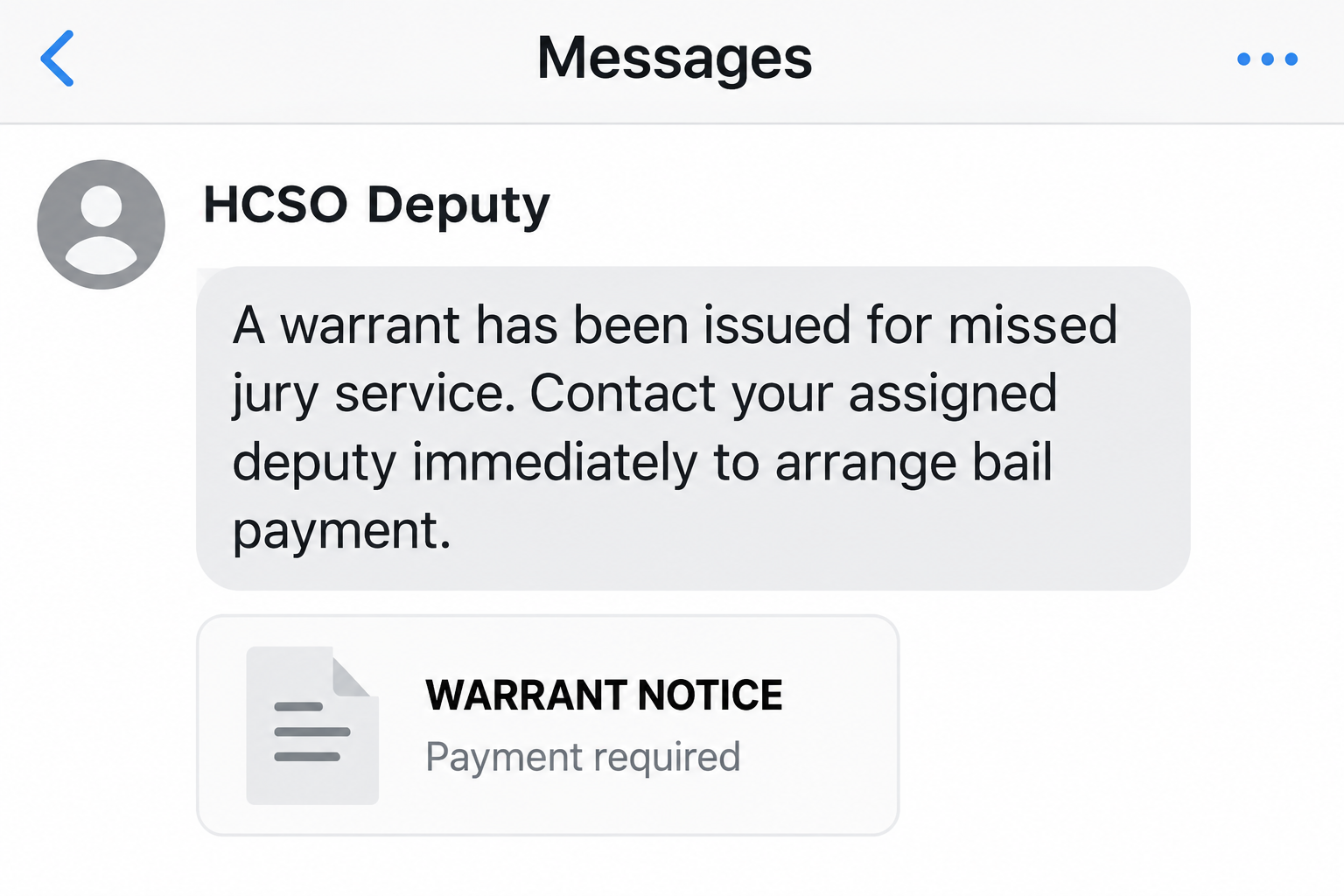
The image above is an illustrative message interface. It isn’t an original victim’s conversation or a genuine warrant.
A document doesn’t authorize a payment
A warning on a screen can feel more convincing than a voice. An attached document gives you something to read while the caller explains the supposed consequences.
However, the document and the caller may come from the same unverified source. One cannot independently confirm the other.
The strongest warning signs concern what you’re being told to do:
- Pay immediately to prevent a claimed arrest.
- Accept a badge number as sufficient identification.
- Trust paperwork sent during an unsolicited collection call.
- Provide financial information to someone whose authority you haven’t confirmed.
- Follow the caller’s verification route instead of contacting the agency independently.
HCSO says it doesn’t demand cash or bail payments over the phone. That boundary matters more than how polished the document looks.
Texas HCSO is not the only agency using those initials
This article concerns Harris County, Texas. Other sheriff’s offices use HCSO too, so the initials alone don’t tell you which jurisdiction supposedly contacted you.
The Harris County agency’s scam alert directs suspicious-call recipients to hang up and independently call its non-emergency number, 713-221-6000.
A real court matter deserves proper attention. It does not justify letting an unsolicited caller choose how you verify it or where you send money.
How the Harris County Sheriff Scam Works
Step 1: The caller introduces an alarming legal problem
The conversation begins with an authority figure, not an obvious sales pitch. Someone presents himself as a deputy dealing with your alleged failure to comply.
Missed jury service is an effective hook because many people don’t know its procedures. You may wonder whether a notice went missing.
The pressure comes from that uncertainty. You want to clear up a possible mistake, and the caller positions himself as the person who can help.
Before explaining your side, check who you’re speaking with. A stranger introducing himself as a deputy hasn’t yet given you a reason to trust him.
Step 2: Personal information supplies a false sense of proof
HCSO’s warning notes that impersonators can use real personal information. Hearing a familiar detail may make it seem as though the caller has official records.
But a correct detail doesn’t reveal how it was obtained. It also doesn’t authenticate the next thing the stranger says.
Don’t confirm additional identifiers simply to show that you are the intended person. Your Social Security number and financial information should stay out of this conversation.
If the caller asks you to correct an address or other detail, don’t become the source of a more complete profile.
Step 3: A badge number and paperwork dress up the threat
The impersonator may provide a badge number or send a document claiming a warrant exists. The sheriff specifically identifies those techniques in its alert.
This adds several things to process at once: a title, an accusation, a reference, and a payment instruction. Looking official becomes a shortcut around verification.
Don’t try to authenticate a warrant by comparing fonts, seals, or signatures while a stranger waits on the telephone. Appearance alone cannot establish its validity.
Instead, save what was sent and ask the actual agency how to verify the underlying claim. Use a contact outside the message.
Step 4: Payment becomes the supposed solution
The frightening news is paired with a way out. Paying is described as resolving the warrant, arranging bail, or preventing an immediate consequence.
That pairing is the trap. The person who introduced the problem also controls the proposed solution and wants you to act before getting another opinion.
The amount doesn’t determine authenticity. A demand that sounds affordable is still unverified, and a large demand isn’t made legitimate by a detailed explanation.
HCSO’s position is direct: it will not demand cash or bail over the phone. Don’t negotiate a payment under that pressure.
Step 5: The conversation tries to become your only reference point
A threatening caller benefits when you keep listening instead of independently checking. Every new objection creates another opportunity for an explanation that keeps you engaged.
They may claim that delay will make things worse. In the broader jury-duty impersonation pattern, the FTC warns about threats tied to hanging up.
You don’t have to remain in that conversation to protect your legal position. Disconnecting from an unverified caller lets you reach the real institution.
If you are already at a bank or preparing a transfer, pause. Explain the impersonation concern to the financial institution before money leaves.
Step 6: One payment can lead to another request
Once you have paid, another demand may follow. Treat claimed processing problems, additional penalties, or recovery charges as new requests requiring independent scrutiny.
Sending more doesn’t establish that the first transaction was legitimate. It can simply increase what you have lost.
Don’t keep communicating in the hope of obtaining a refund from the impersonator. Contact the financial service involved and preserve the original instructions.
Not every target reaches the payment stage. Your response should fit what happened, whether you only answered, shared information, or transferred money.
Checking the Caller and the Alleged Warrant
Use the Harris County contact, not a convenient callback
The number printed on a suspicious document is part of that document. Calling it may return you to the same people who sent it.
Find the Sheriff’s Office independently and check the non-emergency contact on its website. Its current scam warning lists 713-221-6000.
Explain that someone demanded payment while claiming to be a deputy. Ask how to verify any genuine matter and how to report the impersonation.
Don’t use an emergency line for a routine verification question. If someone physically threatens you or an immediate danger develops, seek emergency assistance.
Ask the appropriate court about actual jury service
If you have authentic jury correspondence, locate the responsible court through an official directory. Use that route rather than payment instructions supplied during the call.
Keep your question specific: was there an actual summons or obligation, and what is the legitimate process for addressing it?
Don’t assume the threatening caller’s proposed amount appears in any real record. Even a genuine appointment doesn’t authenticate an unrelated demand for money.
This is practical fraud prevention, not a ruling on your case. A court or qualified lawyer can address your individual legal circumstances.
Don’t let real details excuse the payment method
A genuine address, employee name, or public telephone number can be copied. Finding one correct item doesn’t validate everything attached to it.
The same applies to a message sent after the call. It may repeat the earlier story precisely because both contacts came from the impersonator.
What matters is reaching a real institution independently and confirming the request through its established process. Keep the threatening caller out of that verification.
Why This Is Different From an Ordinary County Payment
Harris County has real courts, real jury obligations, and legitimate payment processes. The scam warning isn’t permission to ignore authentic notices or genuine deadlines.
The problem is the substitute process: an unexpected deputy demands money under threat of arrest and supplies the instructions himself.
Other fraud messages borrow the District Clerk’s name to request traffic or toll payments. This sheriff-call scheme instead centers on a supposed warrant or bail demand.
Those stories can resemble one another without being the same verified matter. Check the actual institution involved, rather than assuming one county office handles every allegation.
The local jury-impersonation pattern also predates the latest messages. Historical warnings establish its history, not a new loss total or the identity of today’s callers.
What to Do if You Have Fallen Victim to This Scam
-
Break the connection and halt anything unfinished.
End the call before discussing more details. If a transfer hasn’t completed, cancel it through the financial service rather than asking the caller for permission.
Ask someone you trust to sit with you while you work through the next steps. Fear makes it harder to assess a second urgent message.
Don’t travel to a meeting or hand over money based on the caller’s instructions. Raise any immediate physical safety concern with real law enforcement.
-
Tell your bank or payment service exactly what occurred.
Describe the law-enforcement impersonation, when you paid, and how the money moved. Provide the recipient details and transaction reference that you actually have.
Ask whether a pending payment can be stopped, recalled, or investigated. Recovery options vary, so don’t delay while trying to collect perfect evidence.
If you used a card, report both the charge and the exposed card information. Follow the issuer’s instructions about replacing the card or restricting further use.
-
Use the right route for non-card payments.
For a payment app, open its genuine support channel and report the transfer. A username supplied by the caller isn’t a support contact.
For cryptocurrency, preserve the wallet destination and transaction hash. Ask the exchange or kiosk provider about its fraud procedure without sending additional funds.
For gift cards, contact the issuer and keep the card and receipt. The FTC’s payment-specific advice explains these different response routes.
-
Record the document and the caller’s claims.
Save the attachment, message thread, voicemail, and payment instructions already received. Note the claimed deputy name, badge number, and alleged offense.
Keep an unedited private copy for investigators. If you discuss the scam publicly, hide your identifiers and any financial or personal information.
Don’t forward an attachment to friends as a way to warn them. A description or redacted image avoids spreading an unknown file.
-
Report through the real Harris County agency.
Consult HCSO’s official scam page for its current reporting guidance. The published non-emergency number is 713-221-6000; independently confirm it before dialing.
The sheriff also directs people who paid to contact their banks and report through the FTC’s fraud reporting service.
Internet-enabled financial theft can additionally be reported to the FBI’s Internet Crime Complaint Center. A report doesn’t guarantee reimbursement.
-
Secure the specific information or access you exposed.
If you disclosed an account password, change it on that service’s real website. Review unfamiliar sign-ins and ask the provider about ending unauthorized sessions.
If Social Security or other high-risk identity information was exposed, follow a personalized plan at IdentityTheft.gov.
Receiving a counterfeit document doesn’t automatically mean identity theft occurred. Document what you shared so protection measures address the real exposure.
-
Handle suspicious files or software as a separate issue.
A telephone payment scam doesn’t automatically infect a device. Additional cleanup becomes relevant if you opened a risky file, installed software, or permitted remote access.
For that exposure, Malwarebytes can help check for malicious software. AdGuard may reduce encounters with malicious advertising while browsing.
Neither product reverses a transfer or authenticates a warrant. Remote-access exposure also needs account review and assistance from the relevant financial providers.
-
Keep later contact outside the original story.
A person claiming to be an investigator, refund agent, or another deputy may approach you afterward. Don’t pay a recovery fee or share another code.
Verify that person’s organization using contact information you locate independently. A detailed description of your loss is not proof that the new caller is legitimate.
Check authentic jury concerns through the court as well. Resolving the impersonation and dealing with a real summons are separate tasks.
Frequently Asked Questions
Does HCSO demand bail money by telephone?
The Harris County Sheriff’s Office says it never demands cash or bail payments over the phone. Treat that demand as an impersonation warning and contact the agency independently.
What if the caller sends a warrant document?
The agency specifically warns about counterfeit documents. Preserve it without following its payment instructions, then verify the underlying allegation through the actual agency.
Can a caller know my details without being a deputy?
Yes. Correct personal information doesn’t authenticate a speaker. Don’t provide more information merely because the caller already knows your name or another detail.
Which HCSO does this warning concern?
Harris County, Texas. Other agencies share those initials, so confirm the county and state before using any contact information or interpreting a warning.
Should I ignore an actual jury summons now?
No. Keep legitimate paperwork and verify its instructions with the responsible court. Rejecting a threatening payment call doesn’t remove genuine court obligations.
Does opening a message mean my phone was hacked?
Not by itself. Identify whether you shared credentials, sent money, opened files, installed software, or allowed access; those actions determine the relevant response.
The Bottom Line
Refuse the payment demand in the Harris County sheriff scam. HCSO warns that fake deputies use personal details and counterfeit paperwork to sell a false escape from arrest.
Disconnect and check with the real agency. If you already paid, act through your financial provider immediately, retain the evidence, and report the impersonation.

Join the discussion
0 commentsShare your experience or ask a question about this article.
Discussion
Start the conversation
Have a question or something useful to share? Add the first comment.