


You find a promising deal, hesitate over the seller, then notice hundreds of glowing reviews. Suddenly, the purchase feels much easier to justify.
Fake review scams exploit that reassuring moment. Before letting a star rating settle your doubts, look at what those reviews actually tell you.
Overview
The customer experience is what gets fabricated
A fake review presents an experience that did not happen, or misrepresents what happened. The deception matters because another shopper treats that account as independent evidence.
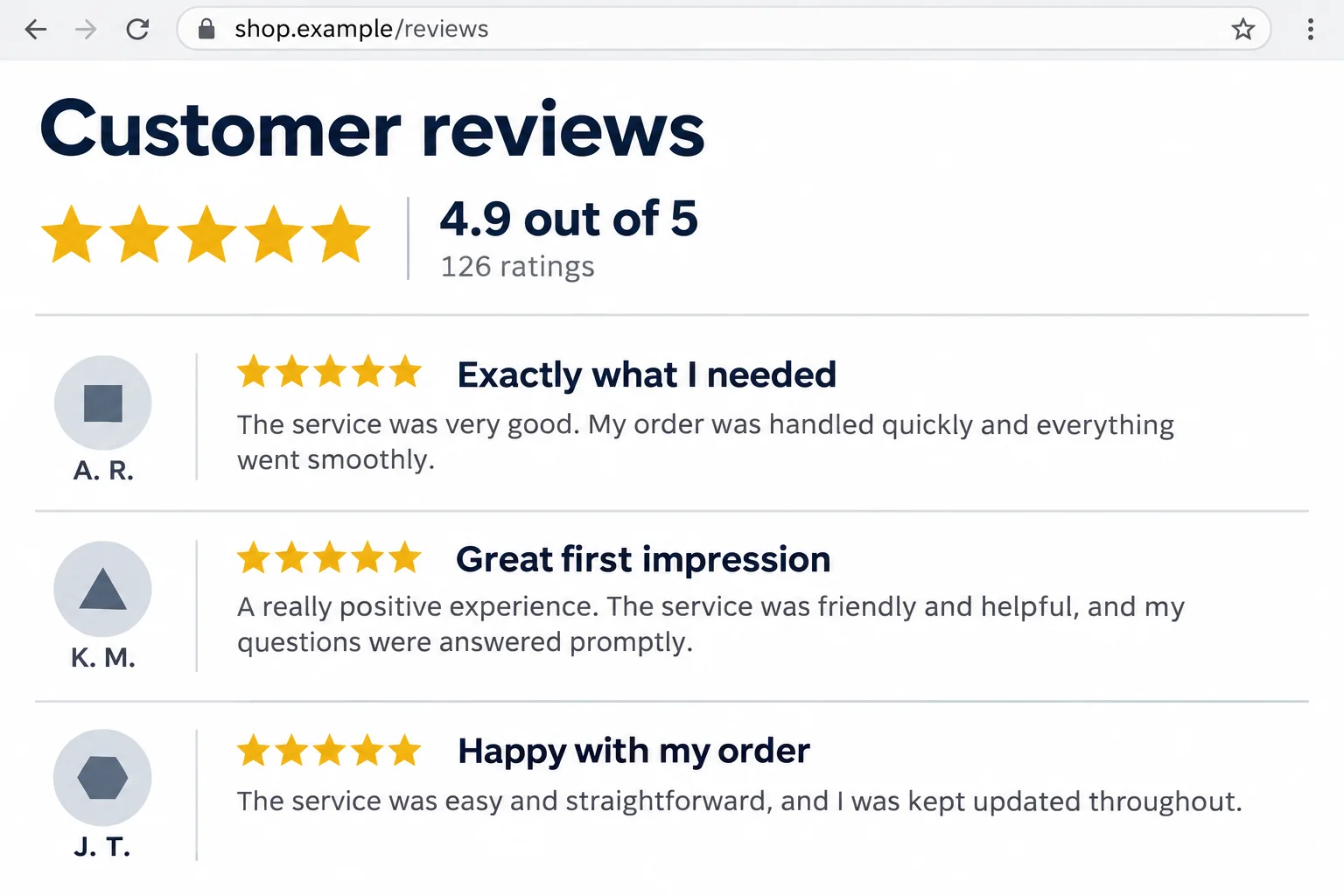
The illustrated review panel above shows the familiar presentation: stars, initials, and encouraging comments. None of those design elements can establish that someone received the advertised product.
Manufactured feedback can promote a poor offer, make an unfamiliar store look established, or unfairly damage a competing business. Positive ratings are only one version.
A human writer can produce a false testimonial, while a genuine customer can write awkwardly. The question is the underlying experience, not how polished the paragraph sounds.
A reassuring score can hide the problem you care about
You might want to know whether a coat fits, a subscription renews, or a return address is practical. A cheerful comment about ordering answers none of those questions.
That gap is especially important when reviews appear beside a countdown or checkout button. The rating can replace the careful check you were about to make.
Do not treat a high average as permission to ignore unclear charges, missing specifications, or conflicting refund terms. The seller still needs to explain the purchase.
Keep the review, the seller, and the order separate
Use feedback as one part of a buying decision, then verify the details that determine your actual risk:
- Match the reviewed business to the exact website and seller taking payment.
- Look for relevant experiences after delivery, use, cancellation, or a return.
- Read the full package price and any recurring billing terms separately.
- Keep the offer and order confirmation, not just a screenshot of the star score.
If those checks expose a material contradiction, do not order through that offer. More praise does not resolve a missing answer about your money.
Why Bought Reviews Are More Than Harmless Marketing
Advertising is supposed to persuade you. Customer feedback carries a different promise: someone outside the sales pitch has tried the experience and is telling you about it.
When a business buys that apparent independence, it changes the information available to everyone considering the same purchase. The payment is hidden inside what looks like ordinary advice.
The FTC’s review-rule guidance specifically addresses businesses creating or buying false reviews, review brokers, and incentives conditioned on positive or negative ratings.
That does not make every incentive identical. An invitation to give honest feedback differs from an offer that requires praise before you receive the reward.
Platform rules can be stricter. Google Maps prohibits incentivized reviews, including rewards offered for changing or removing a negative review.
For a shopper, the practical question is simple: was the reviewer free to describe the real outcome, or was a favorable story part of the bargain?
How Fake Review Scams Work
Step 1: The rating supplies trust before the seller earns it
A shopper arrives with an unresolved concern. Perhaps the price seems unusually low, the business is unfamiliar, or the advertisement makes a bold performance claim.
A large review count offers an appealing shortcut. Instead of checking the merchant, the shopper assumes that so many satisfied customers cannot all be mistaken.
This is where a manipulated reputation becomes useful to the seller. It can lower resistance without improving the product, delivery arrangements, or support.
Even a real platform logo can be misleading when it appears only as a picture. Follow the genuine profile independently and check whether its business details match.
Step 2: Manufactured praise changes the apparent balance
False feedback can be written by invented customers or by people describing an experience they never had. An existing account does not make an invented experience genuine.
Consider a hypothetical example. Ten genuine three-star ratings produce a three-star average. Add 40 fabricated five-star ratings, and the displayed average becomes 4.6.
The service has not improved in that calculation. Only the information surrounding it has changed, making the original dissatisfaction less visible within the larger total.
Numbers are not the whole problem, either. A convincing account of an easy refund may reassure someone more than another unexplained five-star rating.
That is why the substance matters. A review claiming a successful return can influence a buyer who is specifically worried about being stuck with an unsuitable item.
Step 3: The negative experiences become harder to find
A stream of favorable posts can push older complaints further down a page. Sorting by relevance or highest rating can make the imbalance less obvious.
There is also a difference between resolving a complaint and making it disappear. A refund can fix an order without requiring the customer to invent a happier history.
A disappearing review alone does not prove suppression. Platforms may remove policy violations, and reviewers may edit or delete their own posts.
If a seller makes a remedy conditional on changing your account of events, save that request. It tells you more than guessing why somebody else’s comment vanished.
Step 4: Familiar badges and fluent writing discourage further checks
A purchase-related label can add useful context, but it does not turn a review into a product inspection. Read what experience the label actually supports.
Trustpilot, for example, explains different review labels. It also distinguishes paid business tools from buying a higher TrustScore or favorable moderation.
Do not confuse a platform’s paid invitation service with a broker selling fabricated praise. They are different activities and need different evidence.
Writing style is another unreliable shortcut. AI can produce fluent text, but fluency cannot tell you whether an order arrived or a reviewer used the product.
Likewise, spelling mistakes do not make a complaint honest. Focus on the claim being made, the relevant details, and whether other records help support it.
Step 5: The shopper pays before checking the actual offer
The manipulated reputation has done its job when the buyer stops investigating. A reassuring score now stands in for the specifications, total price, or return conditions.
The purchase may expose a completely separate problem: an unsuitable product, a missing delivery, or billing that differs from what the buyer expected.
Those outcomes need their own evidence. A disappointing order does not automatically establish that its reviews were bought, just as genuine reviews cannot guarantee a satisfactory order.
If something goes wrong, pursue the transaction itself. What was promised, what was charged, and what was delivered are the useful starting points for a remedy.
Read for the Decision You Actually Need to Make
Look beyond the first impression
A comment posted immediately after checkout may describe a smooth payment process. It cannot yet describe durability, long-term results, or how the seller handles a return.
For clothing, seek details about sizing, fabric, and the return experience. For a device, look for the model, setup, actual function, and limitations.
For a subscription, the important experience may happen at cancellation. A welcome discount and an easy sign-up say little about later charges.
Compare the exact business, not just the name
A review profile for a similarly named store does not authenticate the website in your browser. Compare the domain, listed contacts, and business description.
Product variants matter, too. Feedback about an earlier model or another package may be honest but irrelevant to the item now being advertised.
When the seller’s widget and the external profile show different counts, inspect the explanation and links. A mismatch deserves checking, not an automatic criminal accusation.
Use patterns without treating them as a verdict
Repeated wording, sudden bursts, and vague praise can justify a closer look. None is a reliable standalone test for identifying a particular fake reviewer.
The FTC’s consumer guidance warns that appearance alone may not distinguish real feedback from deceptive feedback, including fake reviews with less-than-perfect ratings.
Compare accounts of the issue that matters to you. Several detailed descriptions of the same return obstacle are more useful than counting how often people say excellent.
Keep conflicting accounts in view. Different customers can have different outcomes, and a good experience does not erase a documented problem affecting another buyer.
When a Refund Depends on Posting Praise
Be especially wary when an offer shifts from fixing your order to controlling your review. A request for honest feedback should leave room for an honest answer.
Suppose a seller asks you to post a five-star review before releasing a promised refund. That creates another dependency instead of resolving the original purchase problem.
Keep the message and ask for the remedy in writing without changing the facts of your experience. Do not post a false claim to satisfy the condition.
You can update an honest review when circumstances change. Explain that the refund arrived, for example, rather than replacing the history with a claim that nothing went wrong.
If someone offers payment for reviewing products you have never used, decline. A small reward does not make an invented recommendation useful or fair to the next customer.
What to Do if You Have Fallen Victim to This Scam
-
Preserve the recommendation and the transaction
Save the review URL, visible date, relevant text, profile name, and the product page that influenced your decision. Keep the order confirmation and payment record separately.
Capture the specific claim you relied on. A statement about easy returns is more useful than a cropped star rating when the dispute concerns a refused return.
Do not publish your receipt, address, card details, or private correspondence unredacted. Keep complete records for the platform, payment provider, or appropriate authority.
-
Ask the seller for the remedy your order needs
Describe the actual problem: non-delivery, the wrong item, an unwanted renewal, or a product materially different from its description. State the requested resolution clearly.
Use the contact channel tied to your original order. Keep copies of your request, any authorization, the return destination, and the seller’s response.
A complaint about manipulated reviews and a refund request are separate matters. Do not wait for a platform investigation before asking about a time-sensitive return.
-
Contact the payment provider before its deadline passes
If the merchant will not resolve the problem, contact the bank, card issuer, or payment service used for the purchase. Ask about the applicable dispute process.
Explain accurately whether you authorized the purchase. A card payment you made for undelivered goods is not the same issue as a transaction you never authorized.
Provide the promised terms, your order evidence, and the attempted resolution. Ask which documents and deadlines apply; do not assume a favorable review screenshot guarantees reimbursement.
-
Report the suspected manipulation through the real platform
Open the review service directly, find the relevant review or business profile, and use its reporting process. Identify the specific policy concern rather than reporting every positive comment.
Attach supporting material where permitted, such as a seller’s request for five stars in exchange for money. Separate what you witnessed from what you suspect.
Use official platform support, not a private account promising paid removal. Never hand over your review-account password to someone offering to investigate.
-
Correct any false feedback you were encouraged to leave
If you posted something inaccurate, use your account to remove it or correct it. Describe your own experience, including any later resolution, without repeating the seller’s script.
Save evidence of the incentive before making changes. Report threats or pressure to the platform, and avoid publishing personal information about individual staff members.
-
Report the conduct without paying for a recovery promise
In the US, report suspected deceptive business practices at ReportFraud.ftc.gov. Include the exact seller, website, transaction, and evidence connecting the review to the offer.
The FTC also provides payment-specific recovery guidance. Reporting does not replace contacting your payment provider or guarantee an individual refund.
Do not pay someone who guarantees they can recover your purchase price or erase a review for an advance fee. That can turn one problem into another loss.
Frequently Asked Questions
Does a five-star rating mean a business is trustworthy?
No. A rating summarizes submitted feedback, not a guarantee about the seller. Check the relevant experiences, exact business identity, purchase terms, and unresolved problems.
Are all paid or incentivized reviews fake?
No. The experience, conditions, and disclosures matter, and platform policies differ. Invented experiences and rewards conditioned on favorable ratings are not ordinary independent customer feedback.
Can I identify an AI-written review by reading it?
Not reliably. Smooth wording or awkward phrasing cannot establish who wrote it or whether the experience happened. Avoid accusing individual reviewers based on style alone.
Does a verified label prove the product works?
No. Read the platform’s definition of that label. A purchase-related check is not a laboratory test, a durability assessment, or a guarantee about another customer’s order.
Does removing a negative review prove the seller cheated?
No. Reviews can disappear for several legitimate reasons. Preserve any direct pressure, promised payment, or refund condition instead of inferring manipulation from disappearance alone.
Will reporting fake reviews get my money back?
Not automatically. Report the review separately, and pursue the order problem with the merchant and payment provider. Keep their return and dispute deadlines in view.
The Bottom Line
Do not buy on the strength of a star score alone, and do not trade an invented positive review for a reward or refund.
If the offer contradicts its own promises, leave it. If you already paid, document the actual order problem and seek a remedy before the relevant deadline.

Join the discussion
0 commentsShare your experience or ask a question about this article.
Discussion
Start the conversation
Have a question or something useful to share? Add the first comment.