


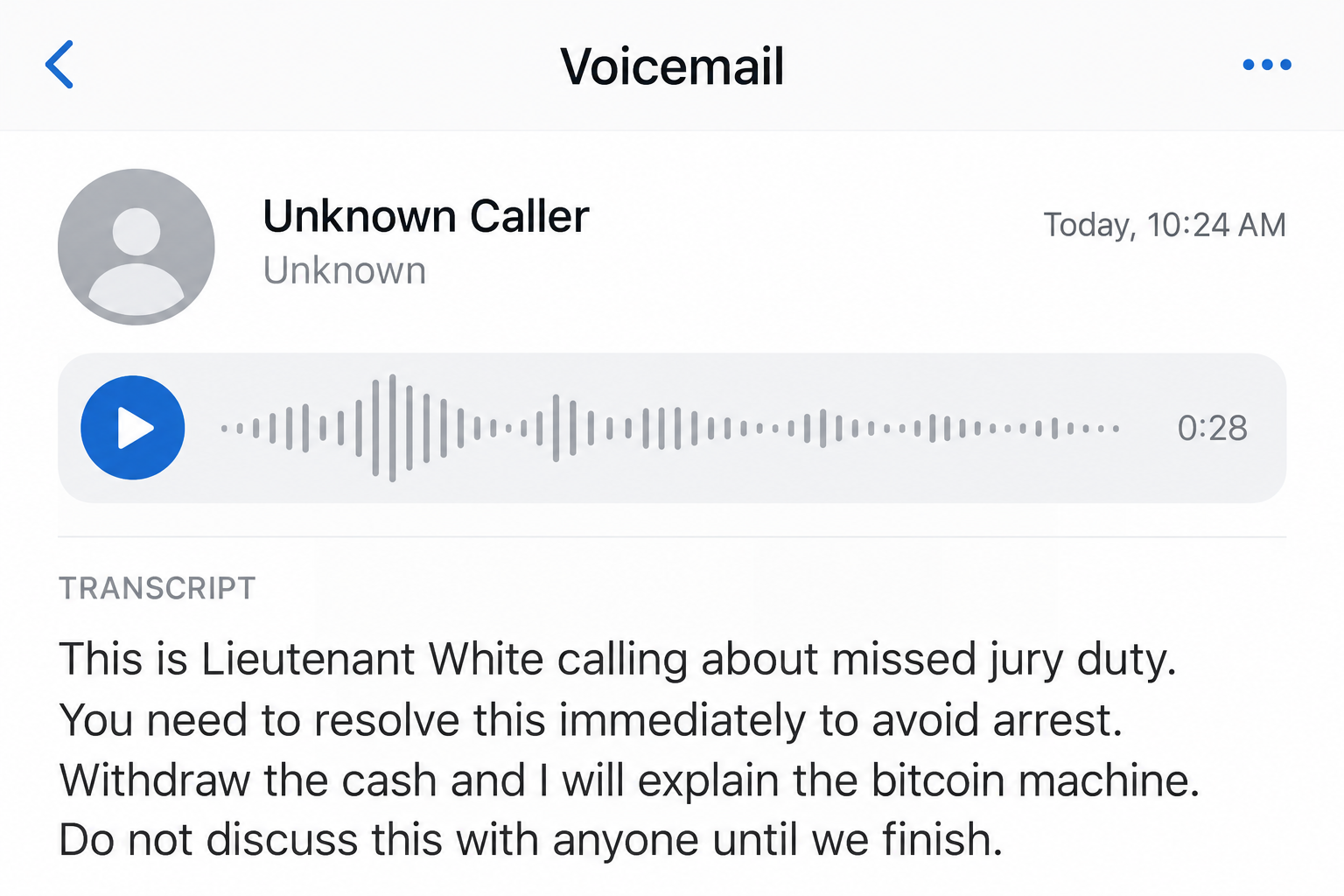
A voicemail mentions missed jury duty and a lieutenant from the sheriff’s office. Suddenly, an ordinary day carries the possibility of arrest.
The caller offers a way to settle things, provided you act immediately. What happens between that first threat and the proposed payment deserves a careful look.
Overview
The caller turns a civic duty into a financial emergency
The Multnomah sheriff phone scam claims you missed jury service and must pay to avoid arrest. A supposed official then directs the payment process.
This is a telephone impersonation campaign, distinct from fraudulent court texts that send recipients toward a QR code or payment website.
The live conversation gives the scammer room to answer objections, keep you occupied, and make each new instruction sound like part of an official procedure.
The sheriff’s office has documented the deception
MCSO reported a $40,000 loss after a caller posing as “Lieutenant White” demanded a fine for missed jury duty.
The resident made two $20,000 cash withdrawals and used a bitcoin machine. A deputy later encountered him still speaking with the suspected scammer.
The amount describes that reported incident, not a standard fee or a loss suffered by every target. The warning identifies the demand as impersonation.
The payment instruction is the stopping point
MCSO says legitimate law enforcement does not demand telephone payment to resolve a warrant, avoid arrest, or settle a criminal matter.
- End a call that links immediate payment to avoiding arrest.
- Do not withdraw cash or use a cryptocurrency kiosk at the caller’s direction.
- Verify alleged court obligations through independently obtained official contacts.
- Bring a trusted person into the conversation before moving money.
- If payment already happened, contact the actual bank and kiosk operator promptly.
Why the Call Can Follow You All the Way to a Machine
A jury-duty threat is persuasive because most people take court obligations seriously. You may worry that a summons went to an old address or was overlooked.
The caller doesn’t need to prove that explanation. Your own attempt to make sense of the accusation can supply a reason to believe it.
Once you accept the emergency, getting money may feel like solving it. A trip to the bank becomes a practical errand rather than another chance to question.
That is why a pause helps. It separates the desire to handle a real responsibility from the stranger’s claimed authority to demand money.
The voicemail illustration uses composite wording to show the pressure. It is not an authentic recording, a verbatim transcript, or evidence of a real lieutenant’s involvement.
How the Multnomah Sheriff Phone Scam Works
Step 1: An official-sounding identity makes you listen
A rank and local agency name give an unknown caller a plausible introduction. The listener may focus on the alleged mistake before checking the person making it.
A badge number or confident explanation doesn’t independently establish employment. Those details arrive from the same contact whose identity needs checking.
If the call goes to voicemail, don’t assume the offered callback number is safer. It can connect you to the same operation with a different greeting.
Find the sheriff’s office yourself and describe the contact. You can investigate a claim without confirming your address, bank, or daily movements to its sender.
Step 2: Missed jury duty becomes a threat of immediate arrest
The accusation combines something plausible with something frightening. You may have heard about jury service, but know little about how a real missed summons is handled.
The caller fills that knowledge gap with their own procedure. They decide how urgent the matter is and what you supposedly must do next.
Don’t argue about whether you received a summons while remaining in that process. End the call and ask the actual court about any genuine obligation.
A real legal matter deserves accurate information. Following an unknown caller’s payment instructions doesn’t verify or resolve that matter.
Step 3: Staying on the call crowds out other advice
Secrecy and continuous instructions can leave the caller as the only person interpreting the emergency. A family conversation or bank question becomes an interruption to avoid.
That arrangement benefits the impersonator. Someone outside the call can ask the simple question you have been discouraged from asking: why does this require bitcoin?
If a caller tells you not to discuss a payment with relatives or bank staff, stop. Don’t let their warning define who is allowed to help.
You can end a threatening conversation without winning an argument. You don’t owe the caller an explanation of whom you plan to contact afterward.
Step 4: Cash is converted into a cryptocurrency payment
A bitcoin machine can look like a familiar ATM, but it serves a different purpose. Feeding it cash may purchase cryptocurrency for a specified destination.
When that destination is controlled by someone else, depositing money does not make it a protected court payment or a temporary bank hold.
Don’t enter a wallet address, scan a code, or continue a kiosk transaction to check where it leads. That may be the transfer itself.
If you are standing at the machine now, stop and step away. Contact a trusted person and independently verify the alleged obligation before inserting any more cash.
Step 5: The demand consumes money while the original claim remains unverified
The caller may reassure you after a payment, but that doesn’t confirm any court case was resolved. Check the alleged case directly with the real court.
Don’t send another amount to finish the process, correct a reference, or release a promised refund. Verify any new request outside the original conversation.
Once a transfer is suspected to be fraudulent, preserve its receipt and contact the provider. Returning to the caller for cancellation gives them another opportunity to pressure you.
The Number, the Rank, and the Machine Prove Different Things
A local caller ID isn’t an agency credential
A displayed local number can make the call feel geographically plausible. Caller ID alone cannot establish who actually placed it.
Typing the displayed number into a search engine may locate the genuine agency it imitates. That still doesn’t authenticate the incoming connection.
Use an official agency website to start a fresh call. Avoid relying on a message’s supplied directory, transferred line, or screenshot of supposed identification.
A claimed lieutenant is still an unverified person
The reported “Lieutenant White” name belongs to the impersonation claim. It should not be treated as an accusation against a real employee with that name.
A genuine name can be copied just as easily as an invented one can be used. Finding a matching employee online would not validate a payment demand.
Ask the agency to verify the contact and its purpose through its own procedures. You don’t need to research an officer’s private details yourself.
A real kiosk doesn’t authenticate the person directing its use
The machine’s existence is separate from the caller’s authority. A functioning financial service can still be used to send money to a criminal.
Read warnings at the kiosk and listen to bank staff who raise concerns. Instructions from the caller to ignore those safeguards are another reason to stop.
Buying cryptocurrency on someone’s orders doesn’t preserve cash for you. Treat the destination and transaction as consequential, even if the caller labels the payment refundable.
Helping Someone Who Is Still Taking Instructions
Start by interrupting the payment rather than criticizing the person. Fear can make a forceful lecture sound like another threat to handle.
Ask them to pause, leave the machine, and speak privately with you. A calm statement that the agency can be checked independently gives them another route.
Don’t try to debate the supposed deputy on speakerphone. That gives the caller a chance to adapt the story and keep directing the conversation.
If they are traveling to a bank or store, ask for their current safe location. Help them reach familiar support without sharing their whereabouts with the stranger.
Once the call ends, write down the sequence together. Expect imperfect recall; the useful details are the payment route, timing, and information actually disclosed.
For relatives who may receive similar threats, agree that anyone can ask for a pause before moving money. Make that agreement supportive rather than punitive.
A person who feels ashamed may hide a second contact. Keeping the conversation open helps them report another demand before it becomes another payment.
What to Do if You Have Fallen Victim to This Scam
-
End the call and stop pending payments. Don’t keep the caller connected while contacting a bank, relative, or official agency.
If cash is still in your possession, put the transaction on hold. If money is already inside the kiosk, stop adding more and seek the operator’s official support.
Don’t confront a suspected caller or travel to meet them. If you feel in immediate danger, use the appropriate emergency services route.
-
Contact the cryptocurrency kiosk operator immediately. Use support details independently confirmed through the operator’s genuine website or the machine’s official identification.
Provide the receipt, transaction time, location, amount, and transaction identifier through a verified support channel. Explain that a law-enforcement impersonator directed the payment.
Ask whether a transaction can be stopped, flagged, or refunded under applicable procedures. Cryptocurrency recovery is difficult and cannot be guaranteed.
The FTC’s payment recovery guidance recommends contacting the actual cryptocurrency exchange or ATM operator after a fraudulent transfer.
-
Notify your own bank about the loss. Explain the cash withdrawals and the deception accurately, even if you personally authorized the withdrawal.
A bank cash withdrawal and a later cryptocurrency payment are separate events. Give staff the full sequence rather than describing everything as one unauthorized card charge.
Ask about protecting accounts, suspicious upcoming transfers, and any available fraud assistance. Save the case number and the bank’s instructions for follow-up.
-
Report the impersonation to real law enforcement. Find MCSO’s contact through its official website, or contact your local agency if you live elsewhere.
Preserve the voicemail, numbers, messages, receipts, wallet information, and any caller instructions. Investigators may need the original records rather than a shortened retelling.
Keep financial details private. Posting a receipt publicly can expose information useful to further impersonators without helping the organization handling your case.
-
Check the genuine jury-duty question separately. Contact the appropriate court using independently located details if you believe you might have a real summons.
Explain that a fraudulent caller raised the issue. Ask how the court verifies an obligation and communicates its actual procedures.
Don’t ignore authentic paperwork because a scammer mentioned the court. The fake demand and any genuine responsibility need to be handled through different channels.
-
Protect information you gave the caller. Change any exposed account password through its real service and review relevant account access.
If you disclosed sensitive identity information, use IdentityTheft.gov to identify suitable protective or recovery steps.
A name and phone number exposure differs from supplying an identity document or banking credentials. Write down the details so you can respond proportionately.
-
Arrange practical support for the next few days. Ask a trusted person to help organize reports and review suspicious follow-up calls.
You may receive a new claim that an investigator needs a fee or verification transfer. Confirm the contact through the organization already handling your report.
No unsolicited recovery agent can guarantee a return of cryptocurrency. Paying an advance fee can turn the original loss into another scam.
-
Keep a concise incident file. Store provider case numbers, submitted evidence, transaction details, and the dates of follow-up conversations in one private place.
Note which organization requested each action and how you verified it. This makes it easier to recognize a new caller recycling the same incident details.
Review the outcome with your household when things are calmer. A shared plan for pausing future payment requests can help without taking away anyone’s independence.
Frequently Asked Questions
Is a bitcoin payment required to avoid arrest for missed jury duty?
Do not follow that demand. MCSO says legitimate law enforcement does not require telephone payments to resolve warrants, avoid arrest, or settle criminal matters.
Does the reported $40,000 amount apply to every call?
No. It describes one loss reported in the sheriff’s warning. There is no legitimate standard fine established by that scam demand.
Does “Lieutenant White” identify the real person responsible?
No. It was the identity claimed by the caller. A name or rank alone cannot establish who operated the impersonation.
Is this the same as the Multnomah court QR-code text?
No. This warning concerns live calls, a missed-jury allegation, cash withdrawals, and a bitcoin machine. Court-text payment links are a separate route.
Can a cryptocurrency payment always be reversed?
No. Contact the actual kiosk operator immediately to ask about available options, but do not accept anyone’s guarantee of recovery.
Should a relative argue with the supposed deputy?
Help the person pause and end the call instead. Verify through the real agency, keeping the caller out of that conversation.
The Bottom Line
Don’t pay a supposed Multnomah deputy through a bitcoin machine to avoid arrest. The documented caller used a jury-duty threat to obtain money.
End the conversation and verify through the actual court or sheriff. If money moved, contact the operator and bank promptly, preserve receipts, and report the impersonation.

Join the discussion
0 commentsShare your experience or ask a question about this article.
Discussion
Start the conversation
Have a question or something useful to share? Add the first comment.