

A caller mentions the Hillsborough County Sheriff’s Office, then says a deputy needs to speak with you. The handoff sounds routine. The conversation soon feels anything but.
Before you explain yourself or agree to follow instructions, take a breath. There are a few details in this approach worth slowing down for.
Overview
The caller is borrowing HCSO’s authority
The HCSO phone scam targets Tampa-area residents with an invented law-enforcement problem. An impostor uses the agency’s identity to make an immediate money demand sound compulsory.
This is not the sheriff’s office collecting a payment. The real agency warns residents not to pay callers who threaten arrest or direct them to withdraw money.
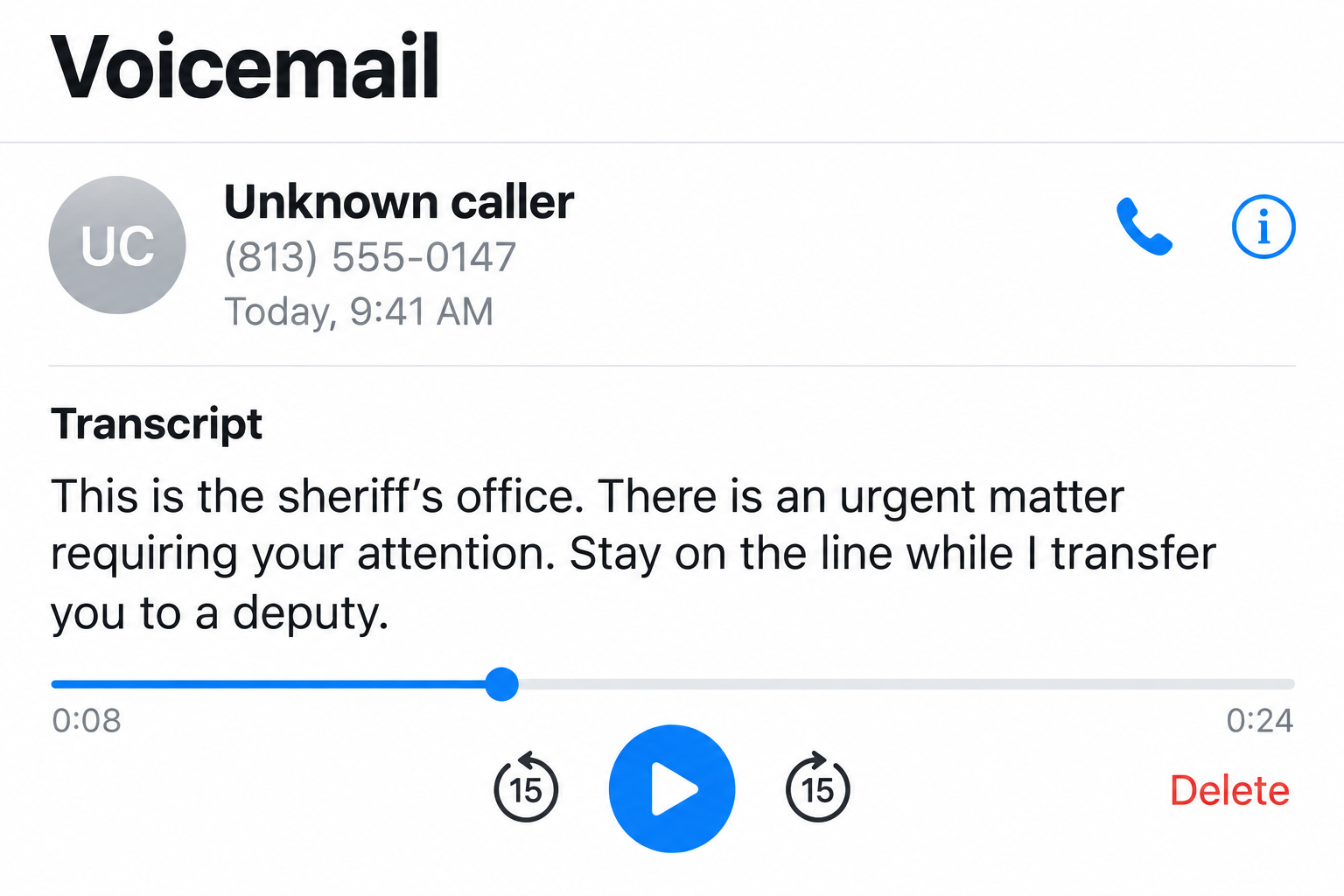
The voicemail illustration uses fictional details to show the opening approach. It isn’t an actual recipient’s recording, a verified transcript, or a number investigators identified.
A recent Tampa incident shows how the pressure escalates
HCSO’s October 19, 2026 warning describes a resident transferred between supposed employees, kept talking, and directed toward a gas-station ATM. The business owner intervened.
That account confirms a specific local incident. It doesn’t identify every number used, establish a payment amount, or mean every reported variation happened to that resident.
A call that begins with a deputy can still end with a stranger directing your cash withdrawal. Pay attention to that change in the request.
Watch for instructions that prevent an independent check
- An apparent employee transfers you to a second voice presented as a deputy or supervisor.
- You’re warned about a warrant, missed court obligation, or an urgent family situation.
- The caller insists you remain connected while visiting a bank or ATM.
- Payment is presented as the way to avoid an immediate consequence.
- You cannot choose your own contact route without being pressured to continue.
HCSO’s official warning tells residents to disconnect and verify independently. Its listed non-emergency reporting number is 813-247-8200.
Why a Transfer Can Make a Fake Call Feel Official
When you call a real organization, being transferred often means you’ve reached the right department. An unexpected caller can imitate that familiar experience.
The first voice introduces the agency. The second appears to confirm the first. You hear what sounds like agreement between two people with different responsibilities.
But both voices are part of the same incoming contact. Neither has been authenticated just because the other person introduced them.
Think about what an independent check would involve instead: ending the call, finding the official directory yourself, and starting a separate conversation.
A badge number doesn’t change that distinction. It gives you something to mention when contacting the real agency, not a reason to surrender control of the call.
Nor does a caller’s knowledge of your neighborhood prove access to a police file. The safe response doesn’t depend on discovering where that information came from.
You can take the alleged problem seriously without accepting the person delivering it. That leaves room to check a genuine concern while rejecting a stranger’s payment instructions.
How the HCSO Phone Scam Works
Step 1: An official-sounding introduction gets your attention
The approach starts with someone claiming a connection to HCSO. A local agency name makes the call harder to dismiss than an unfamiliar business pitch.
You may expect a routine administrative question, so you stay long enough to hear the explanation. That’s the opening the caller needs.
Don’t confirm personal details to help an unknown person establish their story. You haven’t yet verified that they’re entitled to ask.
If you’re busy, tired, or distracted, you can simply stop. A stranger’s urgency doesn’t oblige you to investigate while juggling something else.
Step 2: A supposed deputy supplies a second layer of credibility
A transfer changes the tone from an introduction to what sounds like a formal case discussion. The new speaker may appear more senior or better informed.
You haven’t left the original conversation. The people making the demand also arranged the transfer, so the second voice isn’t an independent check.
Even a professional hold message would only show that the caller can play a recording. It wouldn’t establish an employment relationship with HCSO.
Ask yourself whether you’ve reached the agency independently. If not, keep the identities unverified and end the conversation before money or sensitive information becomes involved.
Step 3: A legal or family concern becomes an immediate emergency
The story can involve an alleged warrant, missed jury service, or trouble involving a relative. HCSO identifies these as recurring impersonation themes.
The details vary, but the pressure has the same direction: stop checking and start complying. A serious-sounding consequence makes even an unusual request feel urgent.
A family emergency adds another layer. You’re thinking about someone else’s safety, which can make the caller’s directions feel like practical help.
Contact the relative or another trusted family member yourself. Don’t use a replacement number the caller supplies as your only way to check.
If there is a genuine immediate threat to someone’s safety, seek emergency assistance. That’s separate from paying an unsolicited caller to resolve their story.
Step 4: Staying connected becomes part of the instructions
Now the caller wants you to remain on the phone while acting. That can mean finding a bank, approaching an ATM, or preparing another payment.
The conversation occupies the time you might otherwise use to consult a friend or notice that the process makes little sense.
It can also make you feel as though stopping halfway would create a new problem. You aren’t required to complete an instruction just because you started following it.
Stop somewhere safe before using your phone. Don’t drive around searching for a payment location while a stranger directs your attention.
In the reported Tampa incident, an outside observer interrupted the process. You can create that interruption yourself by ending the call and speaking to someone you trust.
Step 5: Money is presented as the solution
The supposed official attaches a payment to the alleged emergency. They may describe it as a fine, a necessary transfer, or another way to settle things immediately.
Read the payment instructions as a separate request. Who receives the money, and why would an incoming caller control where you send it?
Cash withdrawals, gift card codes, and wire transfers create different recovery problems. None becomes an authentic law-enforcement procedure because the speaker calls themselves a deputy.
The FTC’s local law-enforcement impersonation alert describes similar pressure involving payment apps and cryptocurrency. Those are broader variations, not established details of the Tampa incident.
Don’t send a small amount to see whether the demand is real. A smaller payment doesn’t authenticate the person receiving it.
Step 6: Further contact keeps the supposed problem alive
If you hesitate or pay, another message may bring a revised explanation. There might be an additional step, a correction, or a person claiming to resolve the situation.
Knowing about the earlier conversation isn’t proof of a new caller’s legitimacy. Information can remain with the same operation or reach another dishonest contact.
Return to your independently selected agency and payment provider. Don’t let a follow-up call reopen the decision about whether to send more money.
Save existing messages without staying involved to gather extra evidence. Protecting yourself is more important than getting the caller to confess.
Check the Claim Without Following the Caller
Choose a new route to the real office
Find HCSO through its official website, not an advertisement, a message link, or a telephone number read aloud by the supposed deputy.
Explain that someone claimed to represent the agency and describe the concern. Let the genuine office tell you which department can address it.
Keep your wording precise: a caller alleged there was a warrant. You aren’t confirming that a warrant exists by reporting what they said.
Don’t dismiss genuine court mail or an existing legal obligation because you’ve encountered a scam. Handle authentic matters through the appropriate office or a qualified lawyer.
Separate caller ID from identification
An incoming display is not an identity check. Number spoofing can make a call appear connected to an organization that never placed it.
Searching the displayed number and finding a real agency doesn’t verify the connection. The display may be the very element being imitated.
Use the official contact information to begin your own call. Don’t accept the scammer’s offer to transfer you to a supervisor as an equivalent step.
Bring another person into the decision
If you’re frightened, tell someone nearby what the caller is requesting. Describe the actual action, such as withdrawing cash, rather than only the claimed emergency.
A bank employee or store worker may notice warning signs you missed. Listen to that interruption instead of treating it as an obstacle to cooperation.
If you’re helping a relative, avoid blaming them for answering. Ask whether money has moved, what information was shared, and whether they are somewhere safe.
Agree on an easy household rule: no unexpected caller gets to keep someone connected while directing a payment. Verification happens after the conversation ends.
What to Do if You Have Fallen Victim to This Scam
- End the instructions and get somewhere safe.
Hang up before making another withdrawal or transfer. If you’re at a counter or ATM, stop the transaction and tell a staff member you’re receiving suspicious instructions.
You don’t need to call back to announce your decision. Block further contact after saving the messages you already have.
- Contact whoever handled the payment.
Tell your bank or payment service that an impostor used a law-enforcement threat to obtain money. Ask whether the transaction can be stopped or recalled.
For gift cards, contact the issuing company promptly and retain the receipt. If cash went to a person, preserve any collection or delivery details for investigators.
The FTC’s payment-method warning explains why these routes make recovery difficult. Ask for help anyway; difficulty is not a reason to delay reporting.
- Secure the accounts actually exposed.
List what you shared, including passwords, banking details, identification information, and verification codes. Tell the affected institution exactly which items were disclosed.
Use its trusted app or website to restore access. Don’t use a recovery link sent by someone claiming to work on this same case.
If identity information was involved, visit IdentityTheft.gov for a recovery plan. Answering the telephone alone doesn’t establish identity theft.
- Keep a useful, private incident record.
Retain voicemail, caller details, timestamps, receipts, account references, and messages. Record when the money moved and what the caller claimed it would accomplish.
Keep original files when possible. Redact sensitive details from anything you share publicly, including receipts that reveal account or redemption information.
- Report the impersonation through genuine channels.
Contact HCSO using its official non-emergency route. Include the transfer between supposed employees and any instruction to remain connected during a withdrawal.
You can also report the approach at ReportFraud.ftc.gov. A complaint helps document the fraud but doesn’t itself cancel a payment.
- Reject paid recovery promises.
Be suspicious of anyone who appears later offering guaranteed recovery for a fee. Don’t pay another stranger to remove the first stranger’s supposed legal problem.
The FTC’s recovery scam guidance explains how a prior loss can become the hook for another demand. Keep working with your bank and real investigators.
Helping Someone Who Is Still on the Call
Start with a simple practical question: has the person independently contacted the office they believe is calling? A caller-arranged transfer doesn’t count.
Offer to stay with them while they disconnect and locate the correct number. This gives them a next step instead of only a warning.
If the caller invokes a relative’s emergency, help reach that relative through a saved contact. Don’t accept the caller’s claim that speaking privately is forbidden.
Avoid grabbing a phone, confronting a suspected collector, or creating a physical argument. Ask staff or genuine law enforcement for help when safety is uncertain.
Once immediate pressure has stopped, work through payments and disclosures one at a time. A clear sequence is more useful than demanding the whole story at once.
Frequently Asked Questions
Does HCSO call people to collect money to avoid arrest?
HCSO says it won’t make these collection demands. An unexpected caller insisting you pay to resolve a warrant should not receive money or financial information.
Does being transferred to a deputy prove the call is genuine?
No. A transfer organized within an unverified incoming call adds another voice, not independent authentication. Contact the agency through a route you select yourself.
What if the sheriff’s office number appears on my screen?
Caller ID can be spoofed. Use contact information from the official agency website rather than relying on the displayed number or a callback instruction.
Should I ignore a real legal issue after receiving a scam call?
No. Verify genuine obligations with the responsible court or agency. Rejecting an impostor’s payment demand doesn’t replace handling authentic correspondence or obtaining legal advice.
Do I need a malware scan because I answered?
Not just for answering. Device checks become relevant if you installed something or granted access. A cash demand primarily requires payment and information protection.
Can a report guarantee that my money comes back?
No. Recovery depends on the transaction and how quickly the provider can respond. Report promptly, preserve records, and don’t trust someone promising a guaranteed refund.
The Bottom Line
Do not pay an HCSO phone scam caller or remain connected while withdrawing cash. A supposed deputy’s transfer and an urgent legal story don’t authenticate a demand.
Disconnect and check directly with the real agency. If you already sent money, contact the payment provider immediately and report the impersonation through HCSO’s genuine channels.

Join the discussion
0 commentsShare your experience or ask a question about this article.
Discussion
Start the conversation
Have a question or something useful to share? Add the first comment.