

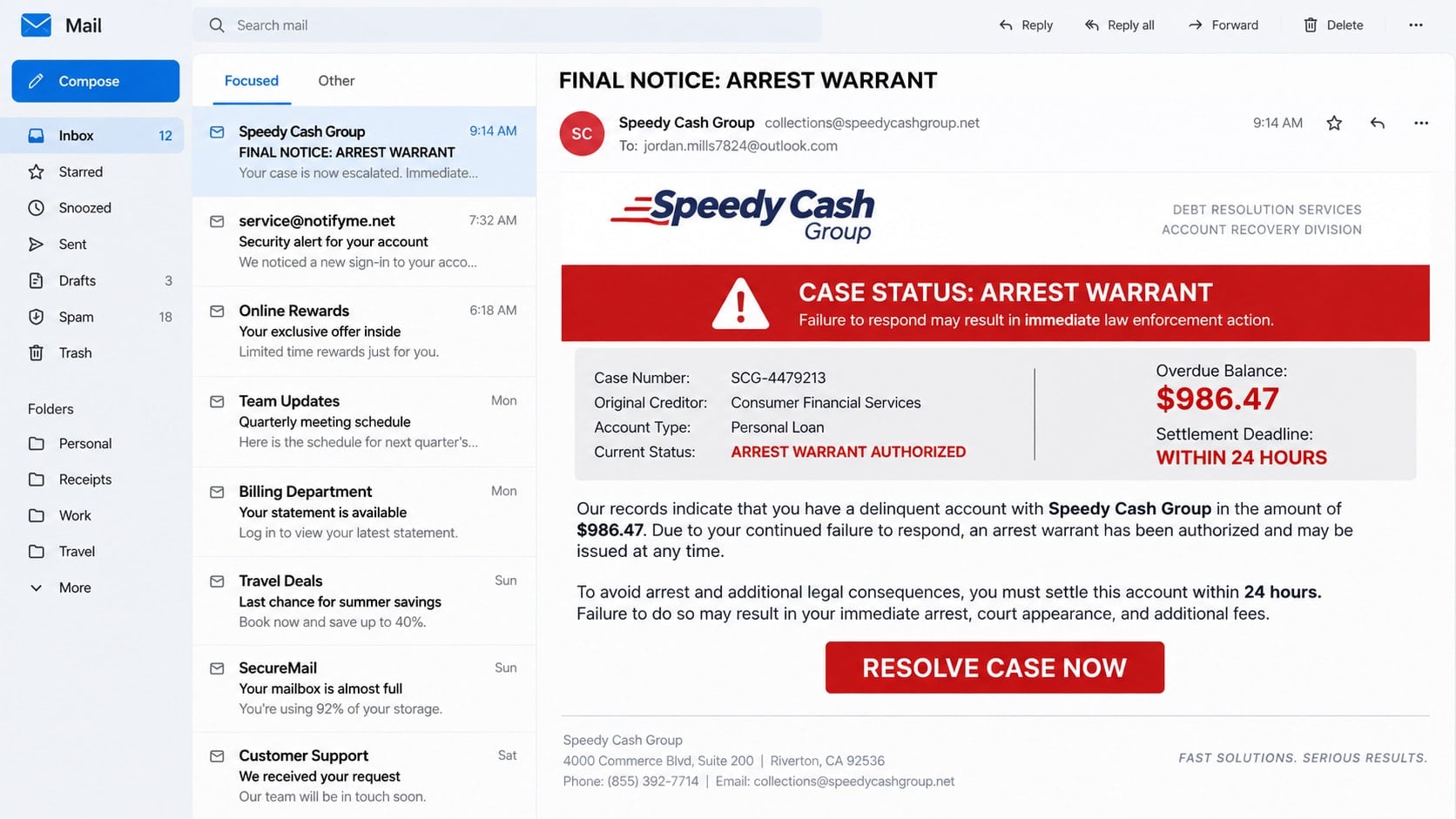
The message lands with the kind of subject line that can make your stomach drop: a debt is overdue, a case has been escalated, and an arrest warrant is supposedly waiting for approval.
That fear is exactly what the Speedy Cash Group arrest warrant scam is built to create. The email is not a shortcut through the legal system. It is a pressure tactic designed to make you pay before you have time to verify a single claim.
Overview
The email impersonates a lender or debt collection office
The Speedy Cash Group arrest warrant scam is a fake debt collection campaign. Criminals send emails or text messages that borrow the name of a payday lender, legal department, recovery unit, or court processing office.
The message may mention Speedy Cash, Cash Advance USA, a “consumer finance division,” or another official-sounding creditor. A familiar company name does not prove the sender works for that company. In many cases, the real business has no connection to the message at all.
A threat of arrest turns an unverifiable balance into an emergency
The scam claims a loan was ignored and that criminal charges, wage garnishment, a lawsuit, or an arrest warrant will follow unless the recipient pays immediately. It may include a case number, a deadline, and a settlement figure to make the demand look documented.
Ordinary consumer debt is a civil matter. A legitimate collector cannot have someone arrested simply because a bill was not paid. The FTC warns that threats of immediate arrest are a major sign of abusive or fake debt collection.
The real objective is money, identity data, or both
The first email may ask only for a reply. Once the recipient engages, the person behind it begins collecting details and inventing fees. The target can be told to buy gift cards, send cryptocurrency, make a wire transfer, or submit card details through a fake settlement page.
A typical campaign can lead to several forms of harm:
- Money is sent for a debt that does not exist or does not belong to the recipient.
- Card and bank information is captured on a fraudulent payment page.
- Names, addresses, Social Security numbers, and employment details are harvested.
- Email credentials are stolen through a fake document or case portal.
- Victims who pay are targeted again with additional court, tax, or recovery fees.
Why the Threat Can Feel Believable
A debt message does not need to be perfectly written to be frightening. Many people have used short-term credit, compared loan offers online, or had an old account transferred between companies. Scammers exploit that uncertainty. They do not need to know a real balance if they can make the recipient wonder whether one exists.
Some campaigns use information from data breaches, lead-generation forms, or public records. A message that includes a full name, old address, employer, or the last digits of a phone number can look researched. Those details still do not establish that the debt is valid.
The paperwork is theater. Case numbers, seals, legal phrases, and threatening signatures can be created in minutes. A genuine court document is delivered through a formal legal process. It does not become authentic because an email places “FINAL NOTICE” above a red button.
The scammers also mix civil and criminal language. They may claim that unpaid debt is “bank fraud,” that a warrant has been “downloaded,” or that police will arrive after a countdown expires. The wording is designed to overwhelm the reader, not explain a real legal proceeding.
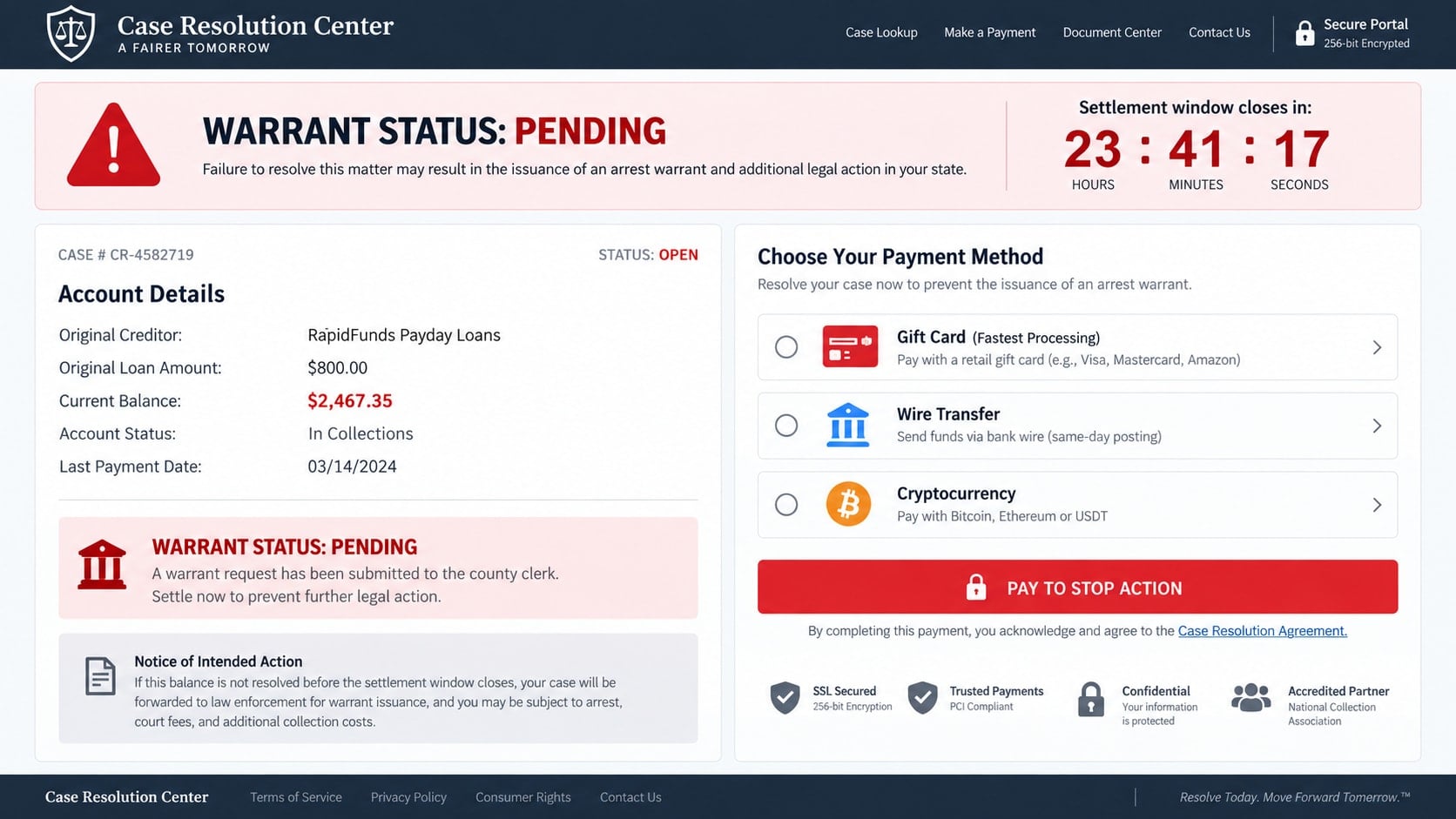
Another persuasive detail is the discounted settlement. An alleged $2,467 balance might suddenly become $640 if paid today. The sharp reduction creates urgency and makes payment feel like the least painful escape, even though neither figure can be verified.
How the Speedy Cash Group Arrest Warrant Scam Works
Step 1: The scammer sends a final legal warning
The campaign often begins with an email titled “Final Notification,” “Notice of Litigation,” “Arrest Warrant,” or “Court Summons.” The body alleges that a payday loan or cash advance has remained unpaid despite repeated attempts to collect it.
The recipient may never have heard of the account. The scammer expects fear to fill that gap. People who once applied for a loan, even unsuccessfully, may assume the message relates to an old application.
Step 2: A deadline removes time for independent checking
The message claims that payment is required within 24 or 72 hours. It may warn that the recipient’s employer will be contacted, wages will be seized, or police will be sent to an address on file.
Real disputes leave a paper trail and allow verification. The scam deadline exists to prevent that. If the recipient calls a creditor, speaks with a lawyer, or searches the supposed case number, the story can collapse before any money changes hands.
Some versions insist that the recipient must keep the matter confidential. That instruction isolates the target from family members who might recognize the fraud and from financial institutions that could block a suspicious payment.
Step 3: The reply opens a controlled conversation
If the recipient responds, the scammer acts like a case manager or legal officer. They may ask for a phone number, date of birth, employer, address, or partial Social Security number under the pretense of locating the file.
Every answer helps refine the next message. When a victim corrects an address or confirms a former lender, the criminal can repeat that detail later as if it came from an official record.
Step 4: A fabricated case portal displays a balance
The victim may receive a link to a payment or document portal. It can display the same case number used in the email, a countdown, a status such as “warrant pending,” and a reduced settlement amount.
These pages are built for persuasion, not legal accuracy. Encryption icons, generic security seals, and a padlock in the browser only show that a connection is encrypted. They do not prove that the operator is a court, law firm, lender, or licensed collector.
Step 5: The scammer demands a difficult-to-reverse payment
Gift cards, cryptocurrency, wire transfers, payment apps, and prepaid debit cards are common choices because they are fast and difficult to recover. A fake agent may remain on the phone while the victim travels to a store or completes the transfer.
If a card payment is offered, the page may capture the number, expiration date, security code, billing address, and a one-time code. The criminal can then attempt other transactions even if the fake settlement payment appears to fail.
Step 6: Payment triggers another invented obstacle
Paying rarely ends the contact. The scammer can claim that a court filing fee, release certificate, tax, attorney charge, or final processing fee is still outstanding. Each payment proves that the victim can be pressured again.
The criminal may also sell the victim’s contact details to other fraudsters. Weeks later, someone posing as a government investigator or recovery specialist may offer to retrieve the lost money for another upfront fee.
Identity, Contact, and Payment Checks
Ask for written validation before discussing payment
A real collector should be able to provide validation information that identifies the creditor, the amount, and the consumer’s rights. Do not supply missing details so the sender can build a better file. Ask the collector to state what it already claims to know.
The Consumer Financial Protection Bureau explains that collectors must provide information that helps a consumer determine whether a debt is theirs. A threat is not validation.
Contact the named company through a separate channel
Do not use the phone number, reply address, or link in the warning. Find the company’s official website independently, use a number on an old statement, or check a credit report through an authorized service.
Ask whether the account exists and whether it was assigned to the company that contacted you. A legitimate creditor can confirm its collection partners without asking for a gift card or cryptocurrency transfer.
Check court claims with the court itself
If an email names a court, county, docket, or case number, search the court’s official website or call the clerk using a number from a government domain. Do not rely on a link or clerk number printed in the email.
A real lawsuit is not resolved through an anonymous payment wallet. Formal documents identify the parties, jurisdiction, filing date, and procedures for responding. Vague phrases about a warrant “being downloaded” are not substitutes for a case record.
Examine how the sender wants to be paid
No legitimate court or collector needs retail gift card numbers to stop an arrest. Cryptocurrency sent to a private wallet and wires to an unrelated person are equally serious warning signs.
Card payment alone does not make a demand safe. Confirm the debt and the collector before entering details anywhere. If the sender refuses written validation or says verification will cancel a settlement, end the conversation.
Warning Signs in the Fake Arrest Warrant Message
The exact wording changes, but the pressure pattern remains recognizable. Watch for several signs appearing together:
- The message arrives unexpectedly and provides no verifiable account history.
- It threatens arrest, criminal charges, deportation, or police action over ordinary debt.
- A case number is shown, but no official court and jurisdiction can confirm it.
- The sender uses a free email address or a domain unrelated to the named lender.
- The balance changes dramatically if payment is made the same day.
- The recipient is told not to contact a lawyer, bank, employer, or family member.
- Payment is requested through gift cards, cryptocurrency, wire, or a payment app.
- The supposed collector will not send a proper validation notice by mail.
- The message asks the recipient to provide the personal details it should already have.
- Legal terms are mixed together in ways that do not describe a coherent process.
One awkward sentence is not proof of fraud, and polished writing is not proof of legitimacy. The decisive questions are whether the debt can be independently validated, whether the sender can be verified, and whether the payment request follows lawful collection practices.
What to Do if You Have Fallen Victim to This Scam
- Stop all contact and do not send another payment. Save the email, text messages, phone numbers, payment instructions, receipts, wallet addresses, and screenshots. Then block the sender. Do not pay a supposed final fee to release a refund or close the case.
- Call the bank or payment provider immediately. Explain that the transaction resulted from an impersonation and fake debt collection scam. Ask whether a card can be frozen, a wire recalled, a payment-app transfer disputed, or a gift card balance stopped before it is redeemed.
- Secure any account used during the conversation. Change the password from a clean device if you entered it on a linked page. Use a unique password, turn on multi-factor authentication, sign out other sessions, and review recovery email addresses and phone numbers for unauthorized changes.
- Protect the personal information you disclosed. If the scammer received a Social Security number, date of birth, driver’s license, or banking information, visit IdentityTheft.gov for a tailored recovery plan. Consider a credit freeze with all three major credit bureaus.
- Scan devices used to open files or install support software. A reply alone does not infect a device, but attachments, downloads, and remote-access programs can. Run a full scan with trusted security software such as Malwarebytes, remove tools you did not intentionally install, and inspect browser extensions and startup apps.
- Block the malicious site and future redirects. An ad and tracker blocker such as AdGuard can reduce exposure to known phishing domains and malicious advertising. It is an extra layer, not a replacement for verifying debt through official channels.
- Report the collector and the payment route. File a report at ReportFraud.ftc.gov. You can also submit a complaint to the CFPB and notify the real company whose name was misused. Include the sender address, domain, wallet, phone number, and payment recipient.
- Watch for recovery and follow-up scams. Anyone who guarantees they can recover the money for an upfront charge may be targeting the victim list from the first fraud. Share evidence with the bank, law enforcement, or a licensed attorney, not an unsolicited “recovery agent.”
Frequently Asked Questions
Can Speedy Cash or a debt collector have me arrested for not paying?
You cannot be arrested simply for failing to pay an ordinary consumer debt. A creditor may use a lawful civil process, but a collector cannot create a criminal warrant by email or cancel one in exchange for a gift card. Never ignore genuine court papers, but verify them directly with the named court.
What if the email contains my real name and old address?
Personal details can come from data breaches, public records, marketing lists, or earlier loan inquiries. Their presence makes the message more persuasive, but it does not validate the debt or the sender. Ask for written validation without confirming additional information.
Should I reply to say that the debt is not mine?
Replying confirms that the address is active and opens a channel for more pressure. If you believe a legitimate collector may be involved, contact the creditor independently and use a formal written dispute process. Do not debate the claim through the contact details in the threatening email.
Is a court case number proof that the warning is real?
No. Anyone can type a convincing sequence of letters and numbers into a template. Verify the case through the official court system using contact information you found independently. If the court cannot locate it, do not trust a portal controlled by the sender.
Can I recover money sent by gift card, wire, or cryptocurrency?
Recovery is difficult, but speed matters. Contact the gift card issuer, bank, exchange, or payment service immediately and ask for its fraud team. Preserve receipts and transaction identifiers. Do not pay a third party that promises guaranteed recovery.
Does opening the email mean my device is infected?
Usually not. The greater risks begin when a recipient opens an attachment, enables content, downloads a program, enters credentials, or grants remote access. Delete the message after preserving evidence, and scan the device if you interacted with anything beyond reading it.
The Bottom Line
The Speedy Cash Group arrest warrant scam turns an unverified debt into a manufactured legal emergency. Its case numbers, deadlines, and settlement buttons are designed to create fear, not prove that a debt or warrant exists.
Do not pay to make the threat disappear. Verify the creditor, collector, and court through independent channels, insist on written validation, and treat any demand for gift cards, cryptocurrency, or secrecy as a reason to stop immediately.








