

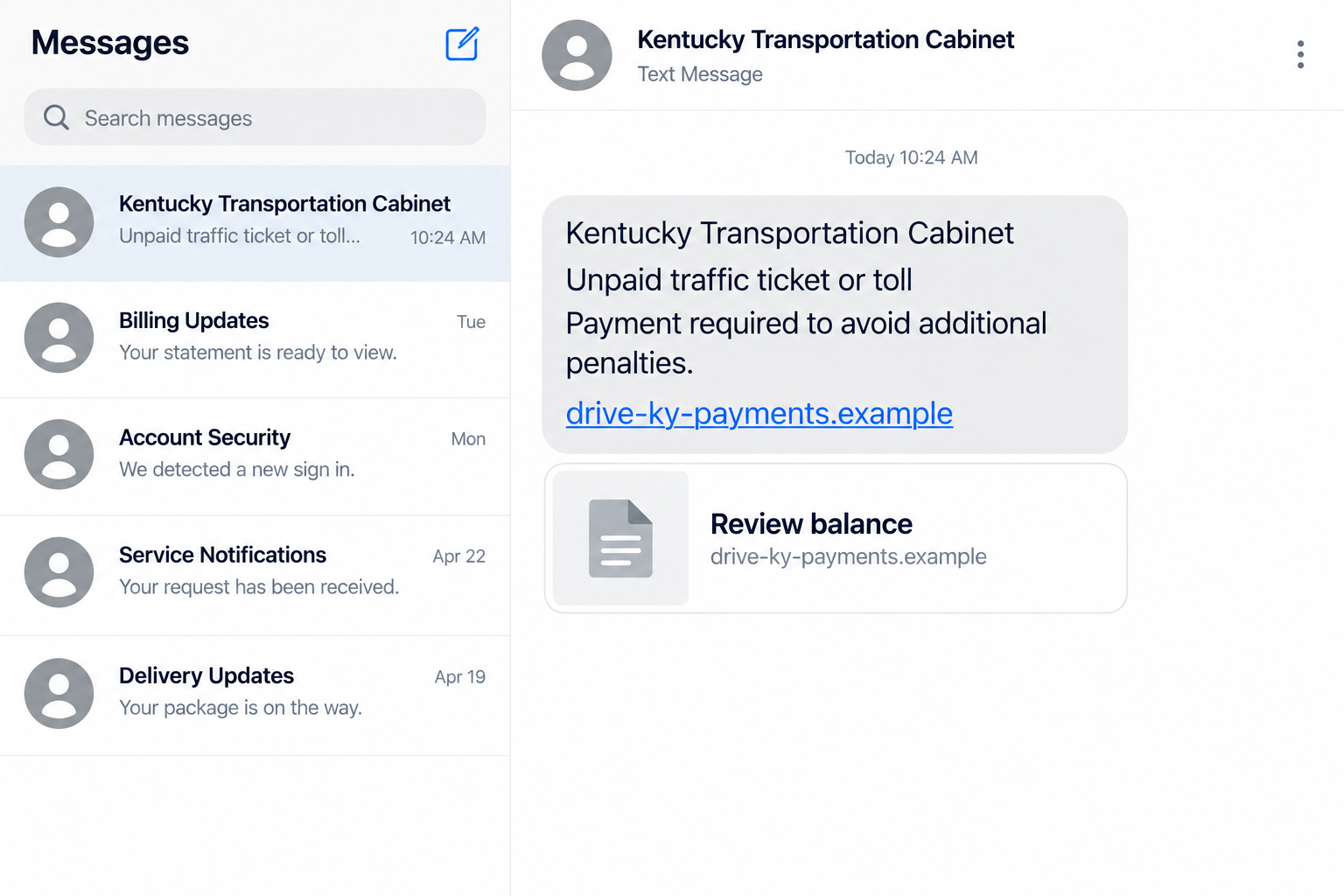
A Kentucky Transportation Cabinet text says a traffic ticket or toll needs payment. The link looks familiar enough to make you wonder whether you overlooked a bill.
Then comes the warning about penalties. Before treating the message as another driving-related chore, check who is actually supposed to collect the money.
Overview
The demand claims authority the sender has not earned
The Kentucky Transportation Cabinet text scam uses KYTC’s name to demand traffic-ticket or toll payments through an unexpected link.
The warning on Kentucky’s official DRIVE website is direct: these messages are scams. KYTC does not collect traffic tickets or tolling fees.
That mismatch matters more than whether the wording sounds professional. A familiar agency name cannot authorize a payment process the agency says is not its own.
A familiar-looking link can still lead elsewhere
KYTC has also warned about fraudulent toll texts using addresses resembling its licensing website. Seeing “drive” or “ky” in a link is not sufficient authentication.
The illustration shows this kind of payment lure with a fictional destination. It does not reproduce a live text, actual account, or functioning payment page.
A recipient’s exact wording may differ. The central pattern is an unexpected KYTC-branded demand that tells you to open its link to settle a charge.
Real Kentucky obligations need their own checks
Kentucky does have real tolls and traffic cases. Rejecting a fraudulent text does not mean that every separate bill or citation can be ignored.
- Check licensing matters through DRIVE, reached independently.
- Use the Kentucky Court of Justice for court-related questions.
- For RiverLink bridge charges, access your actual RiverLink account.
- Ask your financial provider for help if the message collected payment details.
The cabinet, a court, and a toll operator are different organizations. A text that blends their roles should not become your guide to any of them.
The Three Questions That Untangle the Message
Is this about a license, a citation, or a bridge charge?
A licensing renewal is not the same transaction as resolving a traffic citation. Neither automatically belongs to the party that bills a particular toll crossing.
Write down what the message actually alleges. If it cannot distinguish a ticket from a toll, you have even less reason to submit a card.
You do not need to decide every legal question yourself. The point is to choose the proper official office before giving anyone payment information.
Who can independently confirm the obligation?
For a genuine court matter, start with the Kentucky Court of Justice and its county clerk information.
If the issue concerns a RiverLink crossing, use RiverLink’s official site. It identifies its service area as Louisville and Southern Indiana.
For other roads or jurisdictions, find the operator that actually manages the charge. Do not send an unfamiliar text to a random payment service for interpretation.
Did you reach that office without the text?
A link titled “verify account” can lead to the same destination as “pay now.” Changing the button label does not create an independent check.
Instead, use a known bookmark, a prior genuine statement, or an official agency page you opened yourself. Keep the message outside that process.
A correct-looking logo or page heading is weaker evidence than a route established by the real organization. Treat visual similarity as something to examine, not approval.
How the Kentucky Transportation Cabinet Text Scam Works
Step 1: A driving-related debt appears unexpectedly
The text introduces a charge you may not recognize. It may describe unpaid tolls, a ticket, or a violation associated with your driving record.
This is an effective interruption because road charges can be easy to forget. A driver may remember a journey without remembering every payment connected to it.
That uncertainty should prompt an account check, not acceptance of the sender. A plausible subject does not establish that the sender has your actual records.
If you have never driven the relevant route, that is useful context. But people who have used it should still verify the demand outside the message.
Step 2: The cabinet’s name makes payment sound official
KYTC is a real government organization, and DRIVE is a real state service. The scam benefits when their familiarity carries over to an unrelated collection demand.
The current cabinet warning says it does not collect these traffic-ticket or tolling fees. You should not have to supply financial details to test that statement.
A recipient may see licensing language alongside penalties for an alleged debt. Combining those subjects can make the sender seem able to control your driving status.
Do not assume that power from a sentence in a text. Check an actual licensing concern with the relevant official service.
Step 3: Extra fees or penalties make delay feel expensive
The earlier KYTC toll warning describes messages claiming that fees will follow unless payment happens immediately. The pressure makes a quick transaction feel like saving money.
A person may decide a modest payment is easier than disputing a charge. That calculation ignores the risk of giving an unknown website reusable financial information.
Separate the displayed amount from the information requested. A small bill can lead to a form asking for a complete card number and identifying details.
Even if a real obligation exists, a stranger cannot establish its deadline simply by threatening you. Confirm the date through the organization responsible for it.
Step 4: A lookalike address supplies the payment route
The link looks like a government service at a glance. On a small screen, it is easy to notice familiar words and miss the rest.
A name containing “drive.ky.gov” is not necessarily that website. A longer address can place those words somewhere that does not identify the site’s real owner.
Do not try to fix the suspicious link by removing letters or guessing which part is legitimate. Open the known official website separately.
If the page has a padlock, remember its limited meaning. An encrypted connection says nothing about whether the person receiving your details works for Kentucky.
Some genuine services use external providers linked from official pages. The safe test is how you reached that provider, not a blanket rule about every non-government domain.
Step 5: A supposed settlement leaves the real issue unresolved
A dishonest payment destination may obtain card or identity information without settling anything. A confirmation screen is not evidence that an actual agency received a payment.
If another prompt asks for a second card, additional verification, or an extra fee, leave. Do not keep submitting information to finish an increasingly doubtful transaction.
Check your own financial records with your bank. If there is also a genuine citation or toll balance, investigate that separately with its actual issuer.
The official alerts do not identify one technical payload or identical page for every text. Merely receiving a message is not proof of malware infection.
RiverLink and Court Payments Are Not KYTC Collection Texts
RiverLink provides electronic tolling for specific bridges around Louisville and Southern Indiana. Its existence is one reason a Kentucky toll story can sound believable.
The operator itself warns about impersonation messages. Its advice is to check directly at RiverLink.com instead of opening the unsolicited payment link.
Use an existing statement or your independently accessed account to compare the vehicle, crossing, and bill. Avoid entering those details into a page chosen by the sender.
Do not turn the KYTC warning into “Kentucky has no tolls” or “real unpaid balances never have consequences.” Neither conclusion follows.
Similarly, the Court of Justice provides genuine court-payment services. A verified court case belongs in that system, with instructions from the proper clerk.
Some official court services can send reminders connected to an established payment arrangement. That is different from an unsolicited KYTC demand for toll or ticket money.
If you are concerned about a real court date, contact the office handling that case. Do not treat this article as permission to disregard verified instructions.
What to Do if You Have Fallen Victim to This Scam
-
Make a record without revisiting the destination. Preserve the text, sender identifier, displayed web address, and any payment confirmation already available.
Note whether you only read the message, opened its page, entered data, or installed something. This distinction helps avoid unnecessary panic and missed protective steps.
Do not submit a test payment or revisit the page to gather a better screenshot. Existing messages and banking records are useful evidence.
-
Call the financial provider through a trusted route. Explain that a text impersonating Kentucky’s transportation agency led you to a suspected fraudulent payment page.
If you entered a card, ask whether it should be blocked and replaced. Review completed and pending transactions, and report anything you do not recognize.
If you knowingly approved a transfer, describe the deception accurately. Ask about available recall or dispute options without assuming the provider can reverse everything.
-
Protect any login or identity information involved. Reset a disclosed password through the legitimate account, not through a correction link in a follow-up text.
For reused credentials, secure the other affected services too. Check recovery contacts, unfamiliar sessions, and changes you did not request.
Use IdentityTheft.gov if sensitive identity information was misused or exposed. Choose steps that match the information you actually supplied.
-
Verify the underlying driving issue with its proper owner. Use DRIVE for licensing questions, court resources for citations, or the actual toll operator for a bill.
Ask for the real reference number, payment history, and deadline where relevant. Keep a record of who confirmed the answer.
Do not pay twice through different unofficial services because you are unsure whether the first attempt worked. Resolve the record before authorizing another transaction.
-
Review the device if you followed instructions beyond payment. Check unexpected downloads and permissions, especially if the site asked you to install a supposed payment helper.
A scan with Malwarebytes may be useful after software installation or suspicious behavior. It cannot remove a charge from your statement.
AdGuard offers an additional filtering layer for some harmful sites and advertisements. It does not make an unfamiliar payment request safe.
If you only received the message and did nothing else, reporting and removing it is more proportionate than assuming your entire device is compromised.
-
Report the message through the appropriate channels. KYTC’s warning identifies 7726 for carrier spam reports and federal fraud-reporting options.
You can report internet-enabled financial fraud at IC3.gov and describe the message to your own provider. Include the visible destination and transaction references.
After preserving evidence, block the contact and delete the lure. Be suspicious of anyone who then offers guaranteed recovery for a fresh payment.
A Practical Check for Families and Shared Vehicles
If several people use the same car, ask about an actual journey without forwarding the live payment link. A family member’s trip may explain a real bill.
It does not explain why KYTC would collect it through an unexpected text. Continue checking the operator even if the travel details seem plausible.
For a rental vehicle, consult the rental company’s independently located support and your agreement. A rental-related fee and a fake state text may be separate matters.
A workplace vehicle may require checking with the person who manages toll accounts. Do not give company card details to a link simply to make an alert disappear.
Keep legitimate receipts from the actual operator when resolving a shared-vehicle question. They help distinguish a settled bill from a second, unrelated demand.
If someone else manages the account, ask them to check it directly. Do not request their password or forward a banking code to the text sender.
For a vehicle you no longer own, use the relevant agency’s verified process to review its records. The unexpected text is not an authorized ownership-update form.
Frequently Asked Questions
Does KYTC collect traffic tickets or toll fees through these texts?
No. Its official DRIVE warning identifies the demands as scams and states that KYTC does not collect traffic tickets or tolling fees.
Does Kentucky have genuine toll roads or bridges?
Yes. RiverLink serves tolled bridges in the Louisville and Southern Indiana area. Verify any balance with the actual operator instead of the KYTC-branded text.
What if the address includes drive.ky.gov?
Familiar words within a longer address are not enough. Leave the text and open the real DRIVE website independently rather than experimenting with the supplied link.
Can a real court send a payment reminder?
Some established court-payment services offer reminders. That does not validate an unexpected KYTC collection demand. Check the particular case and arrangement with the appropriate clerk.
Should I pay a small amount to avoid possible penalties?
Not through this message. Verify a real obligation first. The payment form can expose more valuable information than the amount displayed on the screen.
What if I entered my card but the page reported an error?
Tell your issuer about the exposure anyway. A failed-looking page does not prove that your card details were discarded or that no transaction can follow.
The Bottom Line
Do not use the Kentucky Transportation Cabinet text’s collection link. KYTC says it does not collect the ticket and toll fees these messages demand.
Check any real obligation with the correct court or operator. If the text already obtained financial information, speak to your provider before trying another payment.

Join the discussion
0 commentsShare your experience or ask a question about this article.
Discussion
Start the conversation
Have a question or something useful to share? Add the first comment.