

A text says an unresolved citation requires a San Diego court appearance or immediate payment. Or a caller says a court problem must be settled in cash.
Both approaches can sound more credible when they mention a real courthouse. Before choosing a payment method, check the person deciding how you must pay.
Overview
The real court’s identity is being misused
The San Diego Superior Court scam covers impersonation messages and calls, not the legitimate court. A recognizable court name is being used to support false payment demands.
The court has warned about invented traffic-citation notices, spoofed calls, and demands involving cash handoffs. A genuine building or telephone number can appear within a deceptive story.
Do not assume the court authorized a message because the notice looks formal or a caller knows where the courthouse is.
The payment instruction is a crucial part of the deception
Some approaches tell recipients to pay through a fraudulent link. Others try to arrange a meeting with a supposed official to deliver money.
The court’s published warning explains its legitimate correspondence and payment practices, including limited opt-in electronic service.
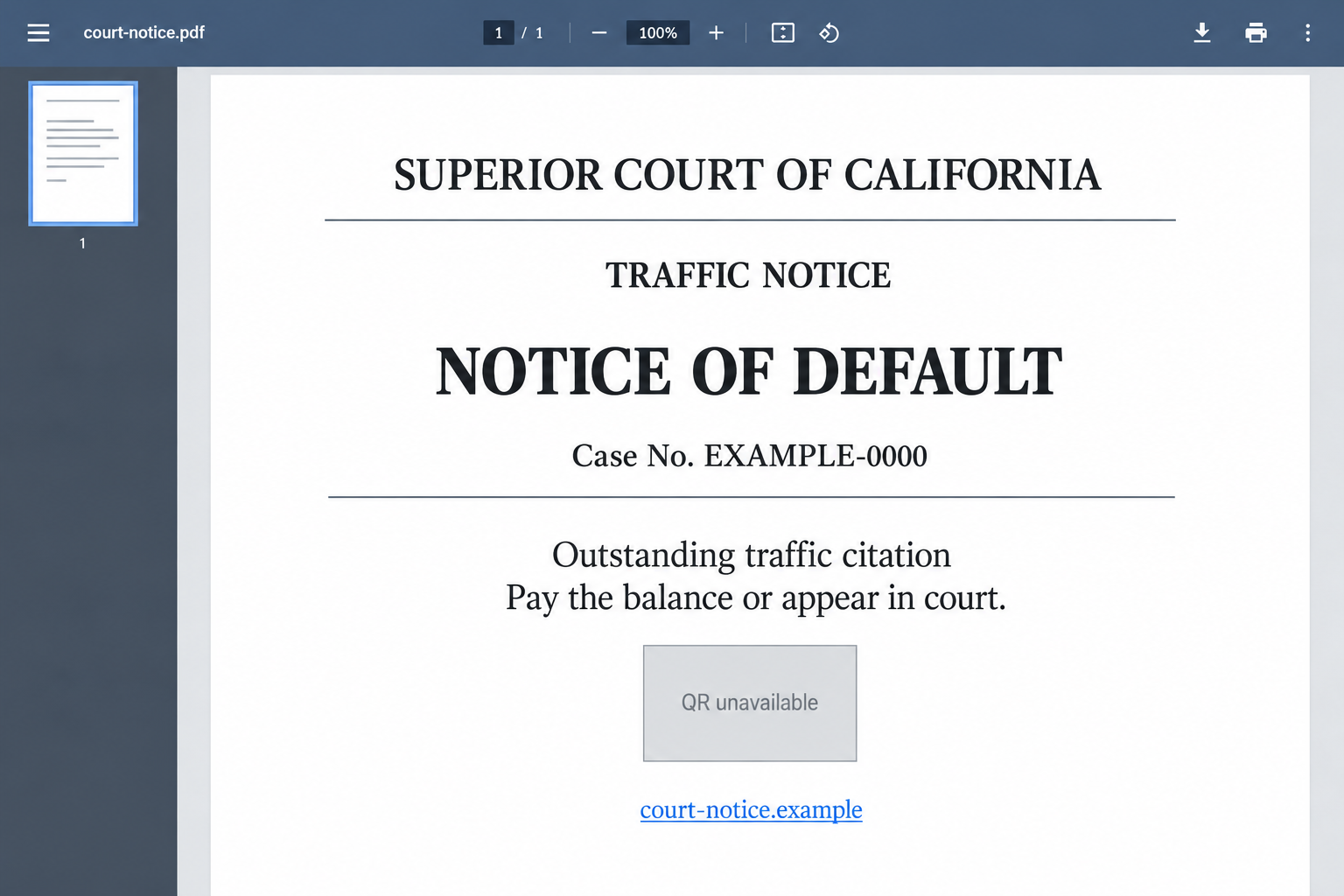
The image above is an illustration of false court-style paperwork. Its case reference and link are fictional; it does not represent an authentic San Diego notice.
You can check the concern without following the demand
A real case deserves attention, but the stranger’s instructions do not become legitimate merely because they mention a possible case.
- Find San Diego court information independently, outside the message.
- Ask the appropriate court office about the alleged record.
- Do not meet a supposed clerk or officer to hand over money.
- Contact your financial institution if a payment or card exposure already occurred.
Separate traffic cases, jury service, and an alleged warrant. The same caller should not be allowed to combine them into one urgent, unverified bill.
A Courthouse Address Is Not a Payment Guarantee
Being told to go near a courthouse may feel safer than being told to visit an unfamiliar website. That impression can be exploited.
A public building is easy to name. It does not verify a person waiting outside, a private meeting, or a demand to bring a particular payment instrument.
The same distinction applies to a caller ID showing a court number. Spoofing can make an incoming call appear to originate somewhere it did not.
Do not check an incoming caller by asking them to recite information available publicly. A convincing answer can still come from someone who copied the details.
End the conversation and initiate your own contact through the real court website. That changes who controls the connection and gives you room to ask clear questions.
If someone claims you must remain on the line while traveling or paying, do not let that instruction prevent you from seeking independent help.
How the San Diego Superior Court Scam Works
Step 1: A message or call introduces a court problem
A fraudulent text may claim an unresolved traffic citation needs payment or an appearance. A caller may instead raise criminal charges, missed jury service, or a warrant.
These are different storylines, not proof that one operator controls every approach. Their shared leverage is fear of getting a court obligation wrong.
A person who has never dealt with the court may be unsure what a normal contact looks like. The sender tries to fill that gap with instructions.
Keep the first question simple: which real court record is being discussed, and how can that court confirm it without this caller?
Step 2: Formal details make the claim feel established
A notice can display a case number, a judge’s name, and a clerk’s name. Those details create the appearance of a file already moving through the system.
A case reference is useful only when it can be connected to an actual record. Printed numbers on an image cannot authenticate their own source.
The San Diego warning describes notices with incomplete appearance information. A demand to attend court without a clear location is not something to resolve through an unknown link.
Nor is a familiar official’s name enough. Someone named in a forged document may have no involvement in the message.
Step 3: The sender narrows your choices to payment or trouble
The text may present payment as an alternative to appearing. A caller may insist that a fine must be settled immediately to avoid further consequences.
You want the worry to end, and the caller offers a way out. An unusual payment instruction can start to sound reasonable in that moment.
If you are genuinely worried, ask a trusted person to help locate official contact information. You do not have to solve an unexpected threat alone.
Do not let the sender’s claimed deadline stop you from verifying. A stranger’s urgency cannot establish what a real court has ordered.
Step 4: A fraudulent link or private handoff collects value
In the online version, the sender’s link may lead to a payment form asking for financial details. The court-style setting makes disclosure seem like compliance.
In a handoff version, the person may direct you toward a supposed officer or clerk. Being near an official building does not turn that person into authorized staff.
Do not buy a money order, withdraw cash, or transfer funds because an unsolicited caller specifies that method. First establish the case and approved payment options independently.
San Diego’s court warning says it does not request or accept payments through services such as Venmo, PayPal, or Zelle.
That is different from using a card through a genuine court-approved service. The instruction’s origin matters, not whether a particular financial product has legitimate uses elsewhere.
Step 5: A supposed resolution can leave you exposed
A receipt, reference number, or verbal promise from the collector does not show that the court received anything. Keep the evidence without treating it as resolution.
If you disclosed a card, protect it even if the site reported failure. If you handed over money, tell your provider or police exactly how it happened.
A follow-up request to correct the transaction is not independent confirmation. Stop giving the sender new opportunities to collect funds or information.
Any real case remains a separate matter to check. Paying an impersonator is not a reliable way to satisfy an actual legal obligation.
What Genuine San Diego Court Services Look Like
Correspondence and electronic service are not the same as a collection text
The court describes official correspondence through mail and, in some circumstances, electronic service for parties who opted in. That nuance matters.
Do not tell yourself that every court-related email must be fake. Instead, check the particular case, your existing arrangement, and the court’s own instructions.
A surprise demand to remedy an issue by telephone or text is not authenticated by the existence of legitimate electronic services.
Use the appropriate case and contact route
Start at the official San Diego Superior Court website. It provides court-record access, division information, and contact details.
Identify whether your question concerns traffic, jury service, or another division. Explain that an unexpected contact is making a demand in that division’s name.
Ask how to verify the alleged case or obligation. Use identifying information only after you have independently reached the appropriate official service.
If an online search does not locate a record, do not assume the matter is settled in every circumstance. Ask the relevant office about remaining uncertainty.
Check approved payment options before authorizing anything
The court offers several legitimate payment methods. Follow its current instructions for the particular matter, not a stranger’s insistence that only cash can prevent trouble.
Ask what a payment would do. Resolving a genuine traffic case may involve choices and consequences that a fraudulent “clear your record” button never explains.
If you need advice about an actual case, seek appropriate legal assistance. A scam guide cannot decide whether you should contest a citation or make a plea.
What to Do if You Have Fallen Victim to This Scam
-
Stop the collection process, especially a planned meeting. Do not travel to deliver money to a supposed clerk, officer, or person described by the caller.
If you feel threatened or believe someone is waiting for you, contact local law enforcement through a verified route. Seek emergency help if danger is immediate.
Preserve instructions, call logs, texts, receipts, and the proposed meeting details. Do not confront or attempt to investigate a collector yourself.
-
Tell the payment provider what actually occurred. For card exposure, contact the issuer and ask about blocking or replacing the card.
For a bank transfer, money order, or another payment method, contact the relevant provider promptly about possible action. Keep transaction numbers and beneficiary details available.
A payment made under deception is not necessarily handled like an unrecognized card charge. Explain the facts accurately and do not assume reimbursement is automatic.
-
Confirm any real court issue independently. Use the court’s own website to reach the right division and ask about the record described in the demand.
If you were told to appear, obtain the verified date, location, and instructions from court staff. Do not rely on the threatening message’s directions.
Keep an actual deadline separate from the scam report. The existence of fraud does not excuse ignoring a genuine order you have independently confirmed.
-
Protect credentials and identity information. Replace a password entered on the false page through the legitimate service, then address any other account using it.
Review account recovery details and unfamiliar access. Tell your bank if a caller persuaded you to share a code or approve a transaction.
For identity misuse, IdentityTheft.gov can guide a recovery plan. Retain your incident records without posting complete financial details online.
-
Review online exposure if a link led to downloads. Close the page and remove unfamiliar permissions, extensions, or remote-access tools you added.
A trusted scanner such as Malwarebytes may help after a suspicious installation. Reading a threatening text alone does not establish device compromise.
AdGuard may add filtering against some deceptive web content. It cannot undo a cash handoff or confirm a court’s payment record.
Do not give a supposed recovery technician remote access simply because they refer to the court scam. Verify any support service separately.
-
Report persistent impersonation and watch for a second approach. Provide the court and appropriate law enforcement with relevant messages through their genuine contact channels.
Report the fraud to the FTC and use your carrier’s spam-reporting function for unwanted texts. Keep the original evidence until it is no longer needed.
Someone promising to remove a warrant or recover your payment for another fee should not receive more money. Return to the institutions you independently contacted.
When the Message Names Someone You Know
A parent, partner, or employee may ask you to help because they are frightened by the demand. Start by helping them pause, not criticizing their reaction.
Find the real court page together and identify the relevant division. A practical verification plan is more useful than arguing about whether the document looks convincing.
If a payment is already underway, help gather transaction details and contact the provider quickly. Avoid continuing the caller’s conversation on the person’s behalf.
For workplace accounts, notify the appropriate finance or security contact about any company information disclosed. Do not hide the incident out of embarrassment.
If the person already has an attorney for a real case, use their established contact details to share the message. Do not accept a replacement lawyer introduced by the caller.
When preserving a purported court document, keep all pages together. A cropped warning may omit the payment instructions that help explain what the impersonator was asking.
Tell others if a meeting was arranged, so nobody delivers money on your behalf while you are contacting the real office.
Frequently Asked Questions
Is a San Diego Superior Court payment text legitimate?
The court warns about fraudulent citation texts and does not use demand calls or texts to remedy an issue or fine. Verify a real matter independently.
What if caller ID shows a court telephone number?
The number can be spoofed. End the call, find the court’s published contact information yourself, and initiate a separate inquiry.
Can San Diego court notices arrive electronically?
The court describes some opt-in electronic service. That does not authenticate an unsolicited collection text or replace checking the case and your actual service arrangement.
Should I meet an officer outside the courthouse to pay?
No. Do not deliver money under a stranger’s instructions. Confirm the obligation and approved payment process with real court staff before taking any action.
Does a case number prove the notice is real?
No. A printed reference needs independent confirmation through the appropriate court records or office. The sender cannot validate itself by repeating the same number.
Can I pay the claimed court fine with Zelle or Venmo?
San Diego’s warning says the court does not request or accept those payment services. Do not transfer money because an unsolicited caller claims an exception.
The Bottom Line
Do not pay the San Diego Superior Court impersonator or attend a private cash handoff. Verify an alleged court issue with the real court independently.
If you already transferred money or exposed a card, contact the relevant provider now. Keep the evidence and separately confirm any genuine appearance or deadline.

Join the discussion
0 commentsShare your experience or ask a question about this article.
Discussion
Start the conversation
Have a question or something useful to share? Add the first comment.