

A spoonful of baking soda and a doctor you recognize can make a strange online video feel worth a few minutes of your time.
The Dr. Peter Attia horse soda trick story is built to hold that attention. Look closely at where the promised explanation takes you.
Overview
The Familiar Doctor Is the Selling Point
The horse soda trick campaign presents apparent footage of Dr. Peter Attia discussing a baking soda method associated with male sexual performance.
The recorded advertising also stages supposed celebrity experiences and personal conversations. These are not reliable representations of the real people’s participation or medical advice.
Attia’s identity lends the story authority before the viewer knows which product, seller or evidence will eventually appear. That is the central deception.
The report concerns this specific recipe-and-performance narrative, not Attia’s genuine medical work, his audience or every legitimate discussion about men’s health.
A Household Ingredient Leads to a Commercial Supplement
The presentation begins with an inexpensive baking soda promise, then reveals a gummy product. Stallion Power is one documented bottle at the end of this route.
The product is an example, not the entire story. Changing the supplement label would not authenticate the same apparent doctor interview or validate the promised recipe.
Readers should recognize the recurring structure rather than memorize one bottle name. That makes it easier to spot a later advertisement using different packaging.
- The doctor appears to provide personal medical reassurance.
- A cheap kitchen ingredient makes the supposed discovery feel accessible.
- Emotional testimonials keep the explanation moving toward a product reveal.
- The buying decision arrives before independent evidence has been supplied.
Keep the Advertising Fraud Separate From Billing Allegations
The deceptive celebrity narrative is a reason to reject the pitch. It does not prove that every destination secretly enrolls buyers in monthly refills.
The recorded checkout raises consent questions, while one currently inspected referring page expressly claims one-time ordering. Those facts must not be flattened into a universal subscription allegation.
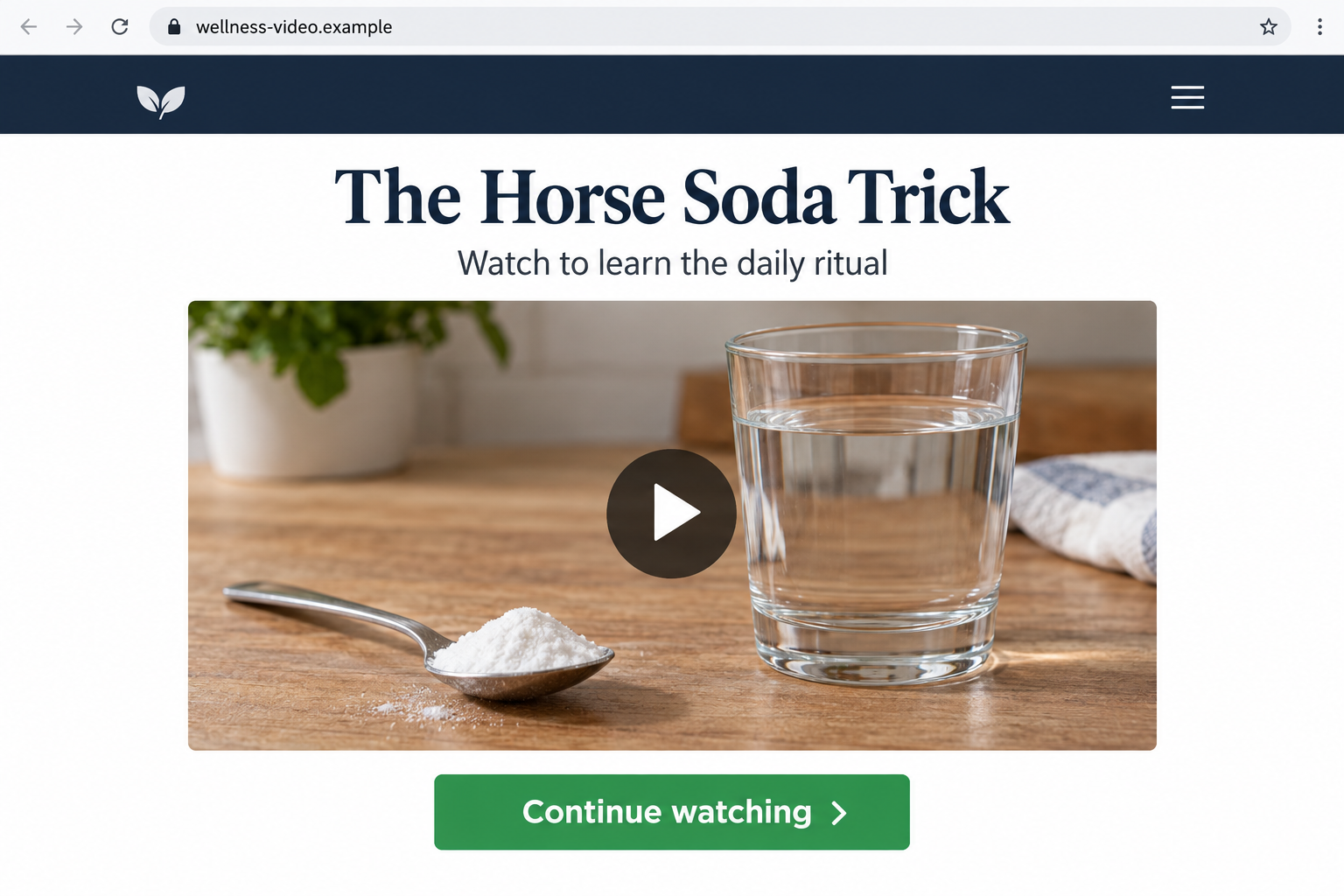
No product was consumed, no order was placed and no manufacturing origin was established. The image above illustrates the hook without depicting a real celebrity.
How the Dr. Peter Attia Horse Soda Trick Scam Works
Step 1: A Doctor’s Familiarity Lowers the Barrier to Watching
The opening does not ask viewers to evaluate an unknown gummy manufacturer. It presents a recognizable physician and a subject that may already worry them.
That is an important shift. Trust accumulated through genuine medical discussion is being borrowed for a commercial story the viewer has not independently authenticated.
The face can look familiar enough that the audience focuses on the explanation rather than asking whether the person really recorded it.
Do not assume that an apparent kitchen conversation or interview is genuine because the speaker resembles a real expert. The surrounding context matters as much as appearance.
A legitimate physician’s existence does not make every online video using their name an authorized recommendation.
Step 2: The Horse Soda Name Turns a Health Concern Into Curiosity
The unusual phrase invites a question: what could a cheap powder have to do with a difficult personal problem? Curiosity becomes the reason to keep watching.
The baking soda reference also makes the idea seem inexpensive and familiar. The viewer may expect a simple explanation they can evaluate without buying anything.
That expectation is useful to the advertiser. A person who would ignore a direct supplement promotion may continue watching a supposedly educational recipe.
The name itself is not a recognized treatment standard. A memorable label does not establish a safe dose, medical mechanism or clinically useful outcome.
Notice whether the presentation actually supplies evidence, or merely keeps promising that the important detail is coming next.
Step 3: Personal Drama Replaces the Evidence the Viewer Expected
The recorded campaign introduces emotionally loaded stories about confidence, relationships and aging. Apparent celebrity confessions make the problem feel urgent and socially important.
This is not the same as demonstrating an intervention. A persuasive account of distress says nothing reliable about whether a specific formulation addresses its cause.
The tactic can be especially effective for a sensitive subject. Someone who feels embarrassed may prefer a reassuring video to discussing symptoms with a clinician.
That discomfort should not be used against the viewer. Men’s sexual health deserves the same ordinary standards of evidence, consent and privacy as any other concern.
There is no need to finish an explicit or uncomfortable presentation to discover whether it contains useful medical guidance.
Step 4: Fabricated Celebrity Conversations Make the Story Feel Corroborated
The campaign record includes apparent appearances attributed to Kevin Costner, Sylvester Stallone, Harrison Ford and other public figures alongside the Attia narrative.
The staged interactions create the impression that several independent people can confirm the same result. In reality, a single advertisement can control every supposed witness.
A familiar actor’s face therefore does not provide an additional medical data point. Nor does an apparent discussion between famous people establish a genuine private conversation.
AI-manipulated imagery and audio can support this kind of impersonation. However, a reader should not rely on finding one odd mouth movement as the only authenticity test.
The stronger question is whether the claimed recommendation is independently supported through the real person’s own communications, rather than only inside a sales funnel.
Step 5: The Promised Recipe Becomes a Bottle Reveal
After the prolonged explanation, the presentation moves toward Stallion Power gummies. The viewer who arrived for a household trick now faces a commercial purchase decision.
That change deserves a pause. A homemade recipe and a manufactured supplement are different interventions, even when an advertisement treats them as parts of one discovery.
The video has not solved the buyer’s basic questions about the actual formula, doses, seller or quality controls by telling a dramatic story.
A scientific-sounding explanation must connect to the finished product at the dose sold. General discussion of circulation or vitality cannot make that connection automatically.
If a future version replaces Stallion Power with another brand, apply the same test. New packaging does not repair a false authority claim.
Step 6: Bundle Selection Makes the Purchase Larger Than the Original Hook
The inspected Stallion Power destination offers packages of two, three or six bottles. The six-bottle example totals $294, despite emphasizing a $49 unit price.
That is a substantial change from a cheap ingredient story. The reader is being asked to commit money before obtaining credible evidence for the promised transformation.
A low per-bottle figure does not establish value. It can simply mean buying more of an unverified product at once.
Do not assume a preselected package matches your intention. Read the final quantity, shipping and total after any additional offer pages.
Buying a six-bottle bundle is not automatically evidence that six bottles were sent without consent. Keep the actual selection and receipt to distinguish those situations.
Step 7: Checkout Consent and Later Contact Create Separate Risks
The advertising record shows a checkout with preselected legal-consent language. Such a checkbox deserves scrutiny, but does not by itself establish the terms of a recurring plan.
Read what any authorization actually says. A purchase agreement, optional service, marketing permission and automatic refill are different commitments.
If a later caller offers an upgrade, the apparent association with your original order is not medical verification. Do not provide fresh card details under pressure.
No such follow-up call was tested here. The important point is to evaluate each new charge or authorization, rather than assume the initial video explains it.
Why the Doctor Story Is Not Medical Evidence
A Real Expert Can Be Impersonated
Dr. Peter Attia is a real public-facing physician. This warning does not depend on pretending the person himself is fictional.
The issue is the use of his apparent identity within an untrustworthy promotional narrative. Authentic credentials do not automatically transfer to a clip using his likeness.
Start with the person’s independently located official channels when checking a specific claim. Do not use a verification page supplied by the same advertiser.
Equally, failure to find a quick search result is not sufficient proof by itself. Evaluate the recorded campaign, its context and the source of the claimed recommendation.
Testimonials Cannot Replace a Study of the Actual Product
A testimonial describes an alleged experience. A clinical investigation defines the product, dose, participants, comparison and outcomes so readers can assess what was actually measured.
The horse soda presentation relies on the emotional force of supposed experiences. That is not a substitute for evidence about a gummy’s benefits or risks.
Research on one ingredient should not be presented as proof for every combination containing it. The amounts, preparation and relevant patient group may differ substantially.
The FDA’s consumer explanation of supplements is useful context: supplements are not approved before sale in the same way as drugs.
A Sensitive Symptom Deserves an Ordinary Healthcare Conversation
Persistent sexual-health symptoms can have different causes. An advertisement cannot determine which explanation applies to the person watching it.
Do not improvise a baking soda regimen because a video promises restored performance. This article does not provide a recipe, dose or endorsement of that approach.
A qualified clinician can discuss symptoms, existing medication and appropriate options privately. That is more useful than an hour of sales narration framed as a breakthrough.
Seeing the advertisement alone is not evidence of an infected device. This case primarily concerns deceptive persuasion, health decisions and purchasing risk.
What to Do If You Watched or Bought Through the Advertisement
- Stop using the video as your source of medical advice.
You do not need to keep watching to discover a hidden recipe. Leave the presentation and look for independently supported information about the actual concern.
Do not change medication or start consuming baking soda on the basis of the story. Discuss treatment questions with your own healthcare professional.
- Preserve the advertisement without spreading it as genuine.
Save the page address and relevant screenshots privately. Record the supposed personality, product name and claims that influenced your decision.
If warning friends, explain that the apparent endorsement is not trustworthy. Avoid sharing edited clips without context, which can give the impersonation another audience.
- Identify the product and merchant from the receipt.
The bottle at the end may differ across advertisements. Find the name, quantity, total and payment business attached to your own purchase.
Do not pursue a refund through an unrelated website merely because it uses similar packaging. Start with the support information connected to the actual transaction.
- Check all authorizations rather than assuming the billing model.
Look for separate purchases, optional plans and later charges. If recurring billing exists, request its terms and cancellation confirmation in writing.
If your order promised a single payment, retain that promise. Unwanted refills require a specific billing complaint, not merely closing the promotional video.
- Use the applicable return process promptly.
Keep the bottles and package, request authorization and note the deadline. Ask about postage, opened products and any sale-item exclusion before sending goods back.
Retain tracking if you return anything. A headline guarantee is easier to challenge when you can show the actual advertisement and your documented compliance.
- Contact the payment provider about unresolved charges.
Explain precisely what occurred, including misleading advertising, unauthorized extras, nondelivery or refusal of a stated guarantee. Ask which dispute route fits the evidence.
Use your issuer’s official contact details. Do not pay a recovery agent who promises to retrieve the money through another urgent transaction.
- Get appropriate help if you consumed the supplement.
Keep the ingredient panel and lot number. Discuss the product with a clinician or pharmacist, particularly if medication interactions or unexpected symptoms are a concern.
Do not continue taking it merely to finish a package or reach a promised deadline. Seek timely medical attention for worrying symptoms.
Frequently Asked Questions
Did Dr. Peter Attia Promote the Horse Soda Trick?
The apparent endorsement in this campaign is not trustworthy evidence of his participation. Do not treat the staged footage as his verified recommendation.
This concerns the promotional impersonation, not an allegation that the real physician operates the sales funnel or takes its payments.
Is There a Genuine Baking Soda Recipe at the End?
The recorded presentation uses the household-ingredient promise to lead viewers toward a commercial gummy. It does not establish a safe, effective home treatment.
Do not search for a dose to reproduce the advertising claim. A medical concern is better addressed through appropriate clinical advice.
Is This Only About Stallion Power?
No. Stallion Power is a product shown in this recorded campaign, while the evergreen warning concerns the doctor-and-recipe story used to sell it.
A different bottle name would need its own investigation. It would not make the same unauthenticated celebrity narrative reliable.
Does AI Detection Settle Whether a Video Is Real?
No single visual quirk or detector score settles every case. Modern editing can make fabricated speech convincing and genuine footage imperfect.
Check the claimed recommendation’s origin and context. Do not let a realistic face replace verification of the person, product and actual evidence.
Will Everyone Who Orders Receive Monthly Refills?
That is not established. The advertising record and current storefront statements do not justify one billing allegation across every possible destination.
Inspect your authorization and statements. If a recurring charge was not agreed, challenge it specifically and request cancellation rather than assuming a refund stops it.
What Should I Do if I Only Watched the Video?
Leave it, avoid purchasing through it and report the misleading advertisement through the hosting platform’s reporting tools.
Watching alone does not prove device compromise. Take additional security action only if you submitted sensitive information, installed software or granted access.
The Bottom Line
Do not buy a supplement because the Dr. Peter Attia horse soda trick video appears convincing. Borrowed medical authority and celebrity drama are not treatment evidence.
If you paid, work from the actual receipt and terms to resolve the purchase. For the underlying health concern, choose a genuine clinical conversation over another recipe advertisement.

Join the discussion
0 commentsShare your experience or ask a question about this article.
Discussion
Start the conversation
Have a question or something useful to share? Add the first comment.