

The Dr. Stacy Sims Sticky Mounjaro video presents an intriguing weight-loss idea. A recipe with a familiar-sounding name seems to be the discovery viewers have missed.
The clip borrows the warmth of a wellness conversation. Before treating it as advice, follow the connection between the apparent interview and the offer.
Overview
The Sticky Mounjaro pitch is an impersonation story
The Dr. Stacy Sims Sticky Mounjaro scam uses an apparent expert recommendation to promote a supposed weight-loss shortcut. The commercial connection is not authentic.
A recorded version imitates the setting of a Mel Robbins conversation and presents a kitchen-style preparation as an alternative to ordinary weight-management efforts.
The story eventually introduces Mounja Patches. That product has separate MalwareTips coverage; this article follows the attributed Sims recipe and why it should not be trusted.
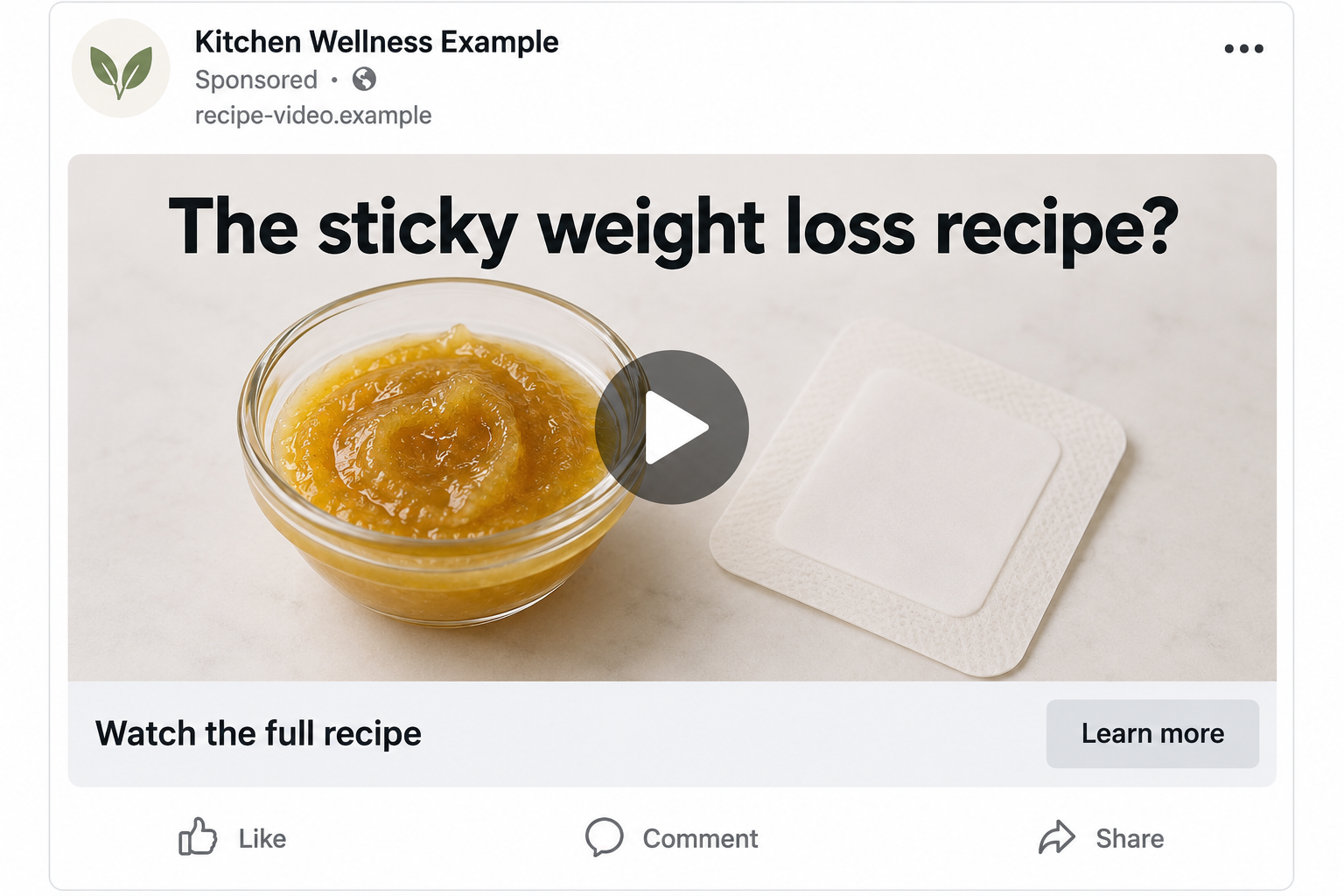
The lead image is a fictional illustration of the recipe-to-patch transition. It does not reproduce a real Sims video or prove the contents of any product.
A genuine podcast appearance makes the imitation more persuasive
Sims really did appear on the Mel Robbins podcast. Her own website discusses that episode, which gives the false sales narrative a recognizable foundation.
The same official article warns that AI-generated videos misuse her work to promote products with which she has no connection.
That warning is general, not a statement naming every Sticky Mounjaro advertiser. It nevertheless directly contradicts treating a commercial-looking clip as automatic proof of authorization.
A real interview can exist while a supposed product recommendation attached to it is false. The original appearance and the advertisement are different things.
The drug-like name does not make the recipe a medicine
Sticky Mounjaro borrows recognition from Mounjaro, a prescription medicine containing tirzepatide. A similar-sounding recipe or patch does not inherit that medicine’s evidence.
- The documented ad claims unusually rapid loss without normal effort.
- It compares the supposed trick with recognized prescription medicines.
- The offered product is not established as prescription tirzepatide.
- The expert’s own site warns about unauthorized AI product promotions.
- The sales story is not a reason to change your treatment.
Do not buy through this attributed recipe pitch. The familiar person, podcast format, and borrowed drug name do not validate the offer.
What Is Real, and What the Advertisement Adds
The genuine connection is a discussion between Sims and Robbins. It does not create permission for unrelated advertisers to manufacture a recommendation.
A viewer may recognize the microphones, tone, or general subject matter and feel the clip must belong to that conversation. That is exactly the inference to check.
Finding the real episode is useful only if you compare the relevant claim. A shared setting does not establish that the advertised recipe appears in the original.
On her official podcast article, Sims includes a warning about AI misuse of her work in product promotions. She provides a reporting contact through her own site.
The documented Sticky Mounjaro promotion instead puts her name beside a rapid-loss narrative and a purchasable patch. That is a new commercial message.
It also brings in other familiar personalities to create the impression of widespread success. Their apparent presence should not be converted into verified endorsements.
A montage can imply a shared recommendation without showing anyone actually recommending the exact item. Ask what each person is represented as doing.
This matters for reporting, too. Describe the unauthorized sales claim instead of accusing the real researcher of operating the store or collecting the payment.
How the Dr. Stacy Sims Sticky Mounjaro Scam Works
Step 1: A familiar wellness conversation attracts attention
The advertisement borrows the appearance of an expert interview. It feels like a useful excerpt someone selected from a longer, trusted discussion.
That format makes the sales intent less obvious. Viewers may listen for advice before wondering who placed the ad and what they intend to sell.
The genuine podcast background helps the imitation. Recognizing a real relationship between the speakers can make a fabricated statement feel consistent with something authentic.
The right question is narrower: did Sims authorize this particular recipe and commercial recommendation? Recognition alone cannot answer it.
Step 2: Rapid results make the ordinary route feel unnecessary
The recorded pitch claims loss as extreme as 3 pounds a day without dieting or exercise. That is a promotional claim, not an established result.
For someone tired of difficult routines, the promise can feel less like greed and more like relief. The advertiser is offering escape from frustration.
That emotional appeal deserves empathy, not surrender. Extraordinary speed and minimal effort increase the need for credible evidence about the exact intervention.
A video testimonial cannot establish how much someone lost, why their weight changed, what else they did, or whether the product shown was involved.
Step 3: The recipe borrows the reputation of a prescription drug
The Sticky Mounjaro name creates an association before the seller has explained ingredients or delivery. The viewer already knows Mounjaro is discussed in medical settings.
The advertisement then suggests that a kitchen method or adhesive product can offer an even easier version of that result.
That comparison needs evidence, not a similar name. A paste applied to skin is not established as equivalent to a prescribed injectable medicine.
The implication of an almost consequence-free shortcut is also misleading. Familiar ingredients and external application do not prove effectiveness or suitability for everyone.
Step 4: The promised household trick becomes a patch purchase
The recorded campaign eventually leads to Mounja Patches. Someone who began by expecting a recipe is now being asked to buy a manufactured product.
This is the critical switch. The original curiosity helped sustain attention long enough for the seller to introduce the item it actually wants to move.
At that point, the buyer needs an exact product identity, ingredients, quantity, full price, merchant, and return terms. An earlier video does not supply those facts.
A changing bottle or patch name would require a separate product investigation. It would not make the same unsupported Sims recommendation genuine.
Step 5: The checkout reduces a broad promise to a binding order
The reviewed campaign record showed a payment flow with terms linked around the buying button. The attractive story and the transaction details are not interchangeable.
Inspect whether the selected package matches your intention. A per-unit amount can look modest while a multi-unit order creates a much larger first charge.
Future-payment terms also need checking on the actual checkout. The evidence does not establish that every buyer of this campaign receives an undisclosed refill subscription.
A misleading endorsement is already a serious reason to reject the purchase. There is no need to add a billing allegation that has not been demonstrated.
Step 6: The customer is left dealing with the seller, not the apparent expert
Once money changes hands, the familiar podcast setting cannot issue a refund. The transaction belongs to the merchant and payment route identified on the order.
That practical separation is easy to overlook when the advertisement has spent so long making the offer feel personal.
Keep the represented expert claim as evidence of what influenced you, but direct the refund request to the party with your order record.
If the seller tries to redirect the conversation toward whether you followed the recipe faithfully, return to the actual product representation and requested remedy.
Mounjaro Is Not a Homemade Recipe or an Unverified Patch
The FDA prescribing information for Mounjaro identifies tirzepatide supplied for subcutaneous injection. It does not describe the advertised sticky preparation.
The label includes warnings and adverse effects. That alone contradicts treating a borrowed drug name as evidence of a universally safe, consequence-free shortcut.
These facts do not establish what any particular patch contains. They establish that the advertisement has not demonstrated equivalence to the medicine whose recognition it borrows.
Even if a patch listed an ingredient familiar from another supplement, that would not show that an effective amount reaches the body through the skin.
Product formulation and delivery matter. Advertising that skips those questions while emphasizing a celebrity’s confidence is asking the reader to trust the wrong evidence.
Do not try to recreate the promoted preparation as a substitute for prescribed care. This report is a warning about the sales story, not a recipe guide.
If you already use a prescribed weight-management or diabetes medicine, discuss changes with your clinician. A social advertisement is not a reason to stop it.
A Better Way to Check the Next Version
Start with the expert’s own publication, not the ad’s link
Locate Sims through her established website independently. Compare the claim with the actual article or original conversation rather than another page repeating the promotion.
A fake article can place a legitimate-looking name above its headline. The visible publication design is not proof that you are reading the publisher’s website.
If a promotion claims an expert is being censored, do not let that story explain away the absence of authorization. The advertiser still needs to establish the connection.
Separate the free-sounding information from the paid item
Write down what initially attracted you and what the seller finally requests payment for. The difference often makes the manipulation much easier to see.
A kitchen tip does not automatically justify a proprietary patch. A clip about metabolism does not automatically justify a recurring product shipment.
This simple comparison also helps if you need to explain the purchase later. It keeps the complaint focused on the actual transition that influenced you.
Use the order record to answer the billing question
Check the selected units, total, payment frequency, and cancellation route before entering card details. Save the order summary and any optional extras you declined.
A page claiming no ongoing charges should be preserved just as carefully as one disclosing a subscription. Both can matter if the later billing differs.
Do not purchase simply to discover which version of the offer you received. Missing or contradictory terms are a reason to leave, not conduct a paid experiment.
The Report Should Identify the Impersonation Clearly
When reporting the video, distinguish the account that placed it from the person shown inside it. The recognizable expert may be the person being impersonated.
Include the advertisement’s destination and the product it introduced. A platform reviewing only a still image may otherwise miss the commercial connection built into the clip.
You do not need to prove which software generated the voice. Explain that the advertisement represents an expert recommendation unsupported by an authentic commercial relationship.
Do not repost the complete sales pitch as a recommendation while asking others to investigate. Share only the context needed to document the misleading claim.
What to Do If You Responded to the Sticky Mounjaro Promotion
-
Stop using the advertisement as health advice. Keep your existing care plan and consult an appropriate professional about any product you have already used.
Save its packaging and full ingredient information. If a patch causes irritation or other concerning symptoms, seek suitable medical guidance rather than continuing to chase promised results.
-
Collect the complete sales journey. Keep the clip, apparent publisher page, recipe wording, final product name, and payment confirmation.
Note the expert endorsement you understood was being made. A later page may change the product name, so record what you actually saw.
-
Contact the merchant shown on your receipt. State the order reference and whether you want cancellation, a return, or a refund.
Explain the represented recommendation and any mismatch in quantity or description. Sims and Robbins are not the customer-service department for an advertiser misusing their identities.
-
Check for any continuing arrangement. Look for renewal and automatic-delivery language in the confirmation rather than assuming the initial refund request handles everything.
If ongoing billing exists, cancel it explicitly and request written confirmation. Retain evidence of the date and method used.
-
Speak with your issuer about unresolved charges. Distinguish an unauthorized transaction from an authorized purchase made under a misleading representation.
Provide the saved terms and correspondence. Ask about time limits while you are still trying to resolve the matter with the seller.
-
Report the impersonation without paying a recovery helper. Use the platform’s own misleading-ad reporting option and identify the false expert connection.
Sims’ official site also provides a route for reporting misuse. Keep private order and payment information out of public posts or messages to unfamiliar accounts.
Frequently Asked Questions
Did Dr. Stacy Sims endorse Sticky Mounjaro?
The documented commercial recommendation is not authentic. Her own site warns that AI videos misuse her work to promote unrelated products.
Was the Mel Robbins podcast appearance itself fake?
No. Sims discusses a genuine appearance on her official website. That real conversation does not validate a new recipe or patch advertisement built around its familiarity.
Is Sticky Mounjaro the same as prescription Mounjaro?
No. The medicine’s prescribing information describes injectable tirzepatide. The advertisement does not establish that its household preparation or patch is an equivalent treatment.
What product appeared at the end of the recorded pitch?
The examined campaign introduced Mounja Patches. Another version could use a different name, which is why the attributed expert story needs its own warning.
Does ordering automatically start a refill subscription?
That was not established for every transaction. Read the actual checkout and confirmation, and challenge any later charge that differs from what you authorized.
What is the most useful first step after paying?
Find the receipt and preserve the advertisement before either disappears. Then request a remedy through the actual merchant while monitoring relevant payment deadlines.
The Bottom Line
Do not buy through the Dr. Stacy Sims Sticky Mounjaro scam. A familiar podcast, a borrowed drug name, and a supposed recipe do not authenticate a recommendation.
If you ordered, keep the evidence, deal with the merchant named on the transaction, and separate cancellation or refund work from decisions about your health.

Join the discussion
0 commentsShare your experience or ask a question about this article.
Discussion
Start the conversation
Have a question or something useful to share? Add the first comment.