

A short video seems to offer a surprisingly simple answer for aging eyes. Dr. Ming Wang appears to explain why an ordinary berry deserves another look.
The Dr. Ming Wang blueberry recipe story feels both medical and familiar. Before following it, check where the promise takes you next.
Overview
The doctor’s identity is being used to sell a different message
The Dr. Ming Wang blueberry recipe scam uses an eye surgeon’s identity to make a nutritional shortcut appear professionally endorsed.
A recorded campaign discusses wild blueberries and everyday foods before leading toward OptiVision. Other pages attach Wang’s name to different vision-supplement offers.
The durable warning concerns the supposed recommendation and recipe, not one bottle name. A changed label does not authenticate the same sales story.
Wang’s own public warning is much clearer than the advertisements. He says AI-generated promotions misuse his likeness and background to advertise eyesight-restoring supplements.
A live page shows how the claim can outlast the product name
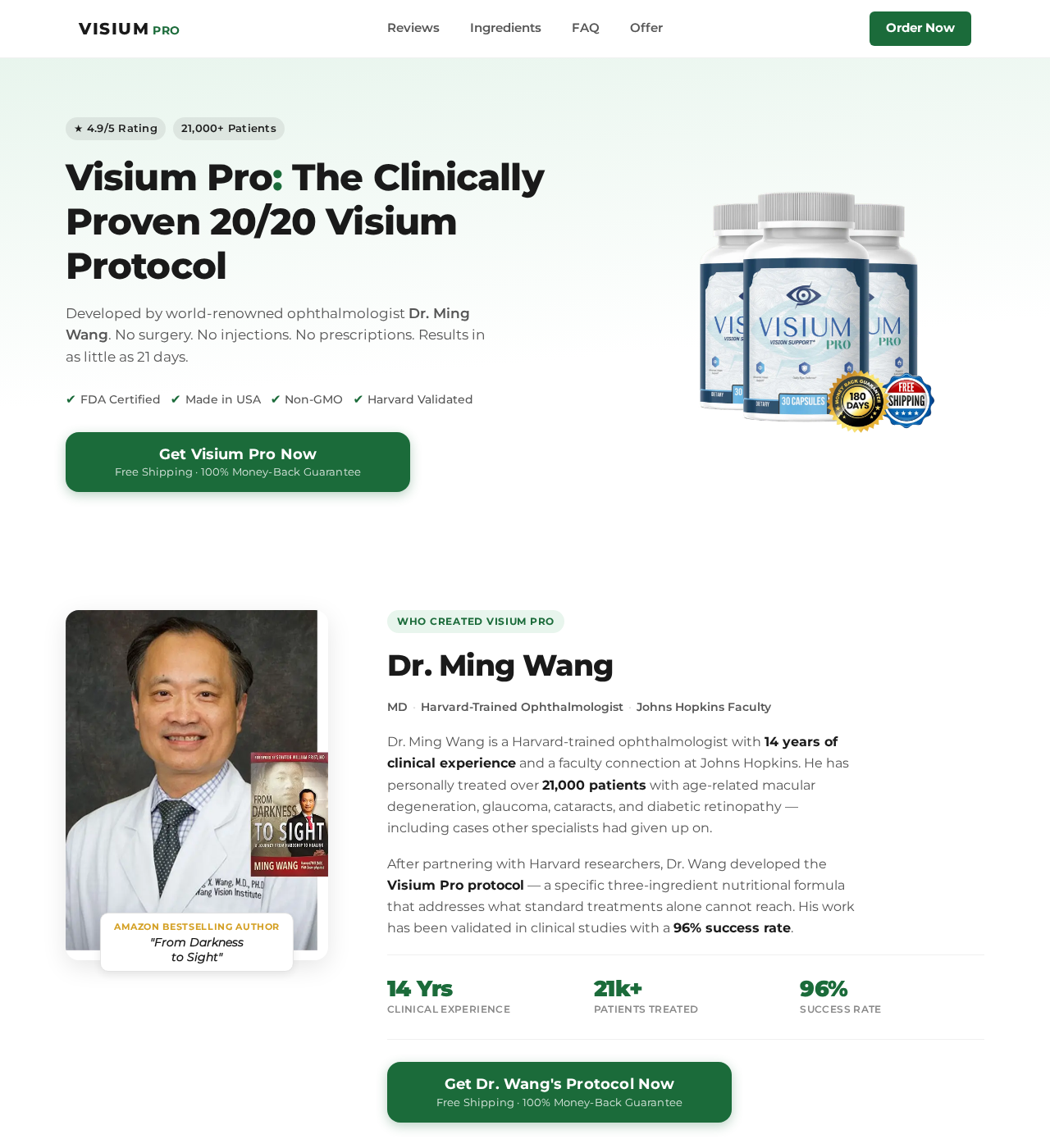
A current healthcenterassociation.com page promotes Visium Pro as a clinically proven 20/20 protocol supposedly developed by Wang. It displays his image and book.
The page claims rapid results and adds FDA-certification and Harvard-validation language. Those are promotional assertions, not independent verification of the product.
It even advertises a private Zoom consultation with Wang as a limited bonus. That should be read against his public rejection of supplement-development relationships.
- Wang’s public statement denies developing an eye supplement with any company.
- The live promotional page nevertheless attributes its formula to him.
- The berry narrative does not establish treatment for multiple eye diseases.
- The ordering page uses different guarantee and package details from the promotional page.
- An apparent official-looking offer still needs an accountable, consistent transaction.
The problem is not whether blueberries are a normal food
Enjoying berries is different from accepting a commercial claim that a recipe or capsule can restore eyesight. The advertisement tries to collapse that distinction.
The evidence supports rejecting the represented endorsement. It does not prove that Wang operates the pages, that all similarly named products share owners, or that every order renews.
Do not buy a supplement or delay eye care because this video appears to reveal his private method. The apparent recommendation is not trustworthy.
What Dr. Ming Wang Actually Said
In a public warning posted under his name, Wang explains that the supplement advertisements were not created by his team and are not endorsed.
The statement goes beyond denying one particular bottle. It says he has not worked with a company to develop any eye supplement.
It also asks people encountering the videos to report them on the platform showing them. That is the opposite of a recommendation to follow their shopping links.
A commercial page cannot override that denial by displaying his photograph, medical background, or book cover. Those recognizable materials are precisely what make impersonation persuasive.
The public warning addresses AI-generated eyesight-supplement ads generally. It is not evidence that Wang personally examined every later Visium Pro or OptiVision page.
That distinction does not rescue the attributed endorsement. A seller claiming his involvement still needs authentic authorization, not simply a newer advertisement.
How the Dr. Ming Wang Blueberry Recipe Scam Works
Step 1: A medical face turns a food tip into expert advice
The recorded promotion presents a recognizable eye specialist as the source of a discovery. Viewers are encouraged to hear medical guidance rather than an unfamiliar seller’s claim.
Blueberries make a useful opening ingredient because they sound ordinary. The hook feels less risky than a direct promise involving an unknown capsule.
That initial familiarity can obscure the essential question: did the doctor actually authorize these words and this product recommendation?
A realistic video is not enough. Wang’s warning provides an independent reason to reject the supposed connection instead of debating facial movements frame by frame.
Step 2: Everyday foods become reasons to distrust ordinary routines
The documented advertisement moves into claims about foods and household choices, including oatmeal, margarine, and bottled water. These are parts of the sales script.
The effect is to make familiar habits seem like hidden threats to eyesight. A viewer may feel they have finally learned what routine advice missed.
Do not treat an alarming montage as a nutritional diagnosis. A dramatic account of supposed retinal harm needs evidence relevant to the actual food, exposure, and condition.
The seller benefits when anxiety about ordinary meals makes its proprietary answer feel urgent. The emotional sequence is doing more work than the explanation demonstrates.
Step 3: The free-sounding recipe turns into a supplement
After the berry story has established curiosity, the offer introduces a product. In the recorded example, that product was OptiVision.
The transition changes the transaction. The reader is no longer simply learning about a breakfast ingredient; they are considering a manufactured formula with its own seller and terms.
Ingredient familiarity cannot bridge that change automatically. Lutein, zeaxanthin, or a berry extract must not be treated as proof of the finished product’s advertised outcome.
MalwareTips covers individual supplements separately. Here, the doctor’s attributed recipe remains the focus because the same hook can be attached to a different bottle.
Step 4: A medical-looking page makes the attribution appear established
The live Visium Pro example places Wang’s name beside a claimed research history, patient figures, study references, and a book image.
It claims a 96% success rate and improvements within 21 days. These precise figures make the offer look measured without supplying adequate traceable substantiation.
The page also spreads its promise across distinct eye conditions. Cataracts, glaucoma, diabetic eye disease, and retinal problems are not interchangeable purchasing categories.
Adding a purported consultation bonus deepens the false impression of participation. A bonus involving a real person needs that person’s authorization just as much as the main endorsement.
Step 5: Bundle totals and guarantees finish the sale
The promotional page emphasizes larger packages, limited availability, and a lengthy guarantee. Its purchase link leads to a Visium Pro order-selection page.
The destination lists package totals of $294 for six bottles, $207 for three, and $158 for two. Those amounts are not single-bottle charges.
The promotional page displayed a 180-day guarantee badge, while the linked order page advertised 60 days. That difference should not be waved away as decoration.
A reader who buys must preserve the actual terms accepted at payment. The doctor’s supposed involvement cannot settle a later dispute over quantity or refund timing.
The Actual Eye-Nutrition Research Is Much Narrower
Some eye supplements have a genuine, specific research context. The misleading move is turning that fact into a promise that a celebrity recipe repairs almost any eyesight problem.
The National Eye Institute’s AREDS and AREDS2 guidance concerns particular stages of age-related macular degeneration, not a universal vision-restoration method.
The studied formulas can reduce progression risk for certain patients. They do not establish that this advertised product restores 20/20 vision or reverses every condition listed.
Having a familiar antioxidant on a label is not equivalent to matching a studied formulation. The condition, ingredients, amounts, and measured outcome all matter.
The Visium Pro page’s broad FDA-certification language also deserves skepticism. Dietary supplements are not preapproved as effective treatments simply because a page displays an FDA-related badge.
If you have an eye condition, ask your own eye-care professional whether a studied supplement is appropriate. That conversation should begin with your diagnosis, not an advertisement.
Where the Promotional Story and Checkout Diverge
The linked order page identifies BuyGoods as retailer and explicitly says its role is not an endorsement of the product or advertising claims.
That disclaimer matters. It prevents a recognizable payment intermediary from being used as an extra layer of supposed medical approval.
The page also includes the standard statement that the product is not intended to diagnose, treat, cure, or prevent disease.
Read that beside the much broader upstream restoration claims. A restrained checkout disclaimer does not make an exaggerated promotional promise reliable.
Package information differs as well. The promotional page’s three-bottle figure and the linked order page’s three-bottle total were not identical when checked.
The destination also labels two bottles as a 30-day supply while using different supply arithmetic for larger packages. Ask which serving directions actually govern the item.
Do not guess that the most reassuring number is the correct one. Inconsistent price, supply, and guarantee information makes a careful purchase harder, not safer.
The promotional page expressly says one-time purchase and no automatic shipment. The recorded OptiVision example likewise displayed no-autoship language.
Those observations do not prove every future transaction will be handled correctly. They do mean a universal refill accusation is not supported by these examined pages.
Why the Name on the Bottle Is Not the Whole Warning
A person searching only OptiVision may miss a new advertisement using Visium Pro. Someone searching only Visium Pro may never learn about the earlier berry story.
The stable identifier is the unauthorized recommendation: a supposed Dr. Ming Wang shortcut that uses food imagery to introduce a product he has not authenticated.
Other named people, logos, and news-style layouts can strengthen the impression. Evaluate each represented connection rather than assuming one recognizable element verifies the rest.
This is also why a product can physically exist while its promotion remains deceptive. Shipment and advertising honesty are separate questions.
Rejecting the pitch does not require proving that every capsule is contaminated or that every customer receives nothing. The false medical endorsement is sufficient reason to walk away.
Keep the Advertiser’s Role Separate From the Retailer’s
The healthcenterassociation.com promotion and the Visium Pro order-selection page are different pages. Their connection is established by the purchase link, not an assumed common legal owner.
That distinction helps a customer explain a complaint. The upstream page records the medical promise; the receipt identifies the party handling the transaction.
Keep both records rather than sending support only the doctor’s name. A retailer may need the order number, while a misleading-ad report needs the promotional address.
A changed or removed promotional page does not erase a saved representation. Conversely, an accessible checkout does not prove every claim made by an affiliate was authorized.
Reporting the exact link and claim is more useful than accusing every company appearing along the route of running the same operation.
What to Do If You Followed the Blueberry Recipe Advertisement
-
Return to your real eye-care provider for health decisions. Do not postpone an appointment or alter treatment because the video promises a simpler route.
If your eyesight changes or symptoms concern you, obtain appropriate professional advice. A supplement seller’s reassurance is not an eye examination.
-
Keep the original advertisement and its destination. Save the attributed recommendation, recipe claim, bottle name, and any promised consultation.
Record the page address and the product on your receipt. Different names can appear along the same journey, so a single screenshot may not explain the purchase.
-
Check the charged total and quantity. Compare the number of bottles ordered with the amount authorized and the package that arrives.
If the order differs, contact the actual merchant promptly. Keep the outer packaging and avoid opening additional bottles while seeking return instructions.
-
Request a refund using the transaction’s own terms. Explain that the purchase relied on a represented doctor endorsement and identify any guarantee discrepancy.
Approach the seller or retailer shown on the receipt, not Wang’s medical practice. The impersonated person does not control the advertiser’s order system.
-
Review any future-payment terms separately. The examined pages do not establish universal autoship, but your own order still deserves checking.
If an unauthorized renewal appears, preserve the confirmation and speak with your payment provider. Describe the evidence rather than assuming all charges share one cause.
-
Escalate unresolved payment problems and report the ad. Ask your issuer about available dispute procedures and deadlines.
Use the platform’s impersonation or misleading-ad reporting tools. Remove private receipt details before posting publicly, and avoid recovery services demanding money upfront.
Frequently Asked Questions
Did Dr. Ming Wang recommend the blueberry recipe supplement?
His public warning says the eyesight-supplement advertisements are unauthorized and denies developing an eye supplement with a company. The attributed commercial recommendation should not be trusted.
Does a genuine photograph or book cover prove the page is official?
No. Those materials identify a real person but do not establish permission to use his identity for a product. An advertisement can borrow both without authorization.
Can blueberries restore 20/20 vision?
The advertising does not establish that a blueberry recipe restores eyesight. Normal food choices should not be confused with evidence for treating an eye condition.
Are AREDS2 supplements the same as the advertised vision protocol?
No. AREDS2 research concerns a specific formulation and particular AMD patients. Ingredient overlap does not make every promoted eye supplement equivalent.
Is the campaign definitely a subscription trap?
Not on the examined evidence. The promotional and recorded examples include no-autoship language. Check the actual order instead of assuming undisclosed recurring charges.
What if the next ad uses another supplement name?
Apply the same endorsement check. A new bottle does not override Wang’s warning or validate the promised recipe. Investigate its seller separately if necessary.
The Bottom Line
Do not buy through the Dr. Ming Wang blueberry recipe scam. His identity is being used to support a recommendation his own public statement rejects.
If you paid, keep the advertisement and receipt, pursue the correct merchant’s refund process, and protect your eye-care decisions from the sales story.

Join the discussion
0 commentsShare your experience or ask a question about this article.
Discussion
Start the conversation
Have a question or something useful to share? Add the first comment.