


The profile has a familiar face, and the reply sounds personal. Someone you follow appears to be offering a private conversation just for you.
Then the chat moves to another app, and a payment comes first. Before you send it, check how you reached that account.
Overview
The person in the pictures may not be writing the messages
The OnlyFans impersonation scam uses a real creator’s identity to sell a private session or content that the impostor has no authority to provide.
A familiar photo gets the conversation started. A convincing voice or video can make the account feel authentic before a payment request arrives.
The victim thinks they’re dealing with the creator. The real creator may know nothing about the exchange until an angry fan contacts them later.
The reported route leads from social profiles to advance payments
Security researchers described creator-impersonation cases involving stolen identity material, synthetic media, and conversations moving through TikTok and Snapchat toward Cash App payments.
People paid in advance for promised private access, then found themselves blocked. The deception was the false identity and undelivered promise, not simply the app used.
Creator Elaina St James also warns about impostors on her own social-links page, explaining that she doesn’t initiate contact with fans.
That is her stated practice, not a rule establishing how every creator communicates. Use the actual creator’s independently confirmed information for the case in front of you.
What to establish before discussing money
A profile can look right while its payment request is wrong. Check the relationship between the public identity, the private account, and the proposed purchase.
- Did you reach the account from the creator’s genuine established links?
- Does the actual creator advertise this type of private session through that route?
- Is the payment recipient consistent with the verified offer?
- Are you being pushed to pay before you can check those details?
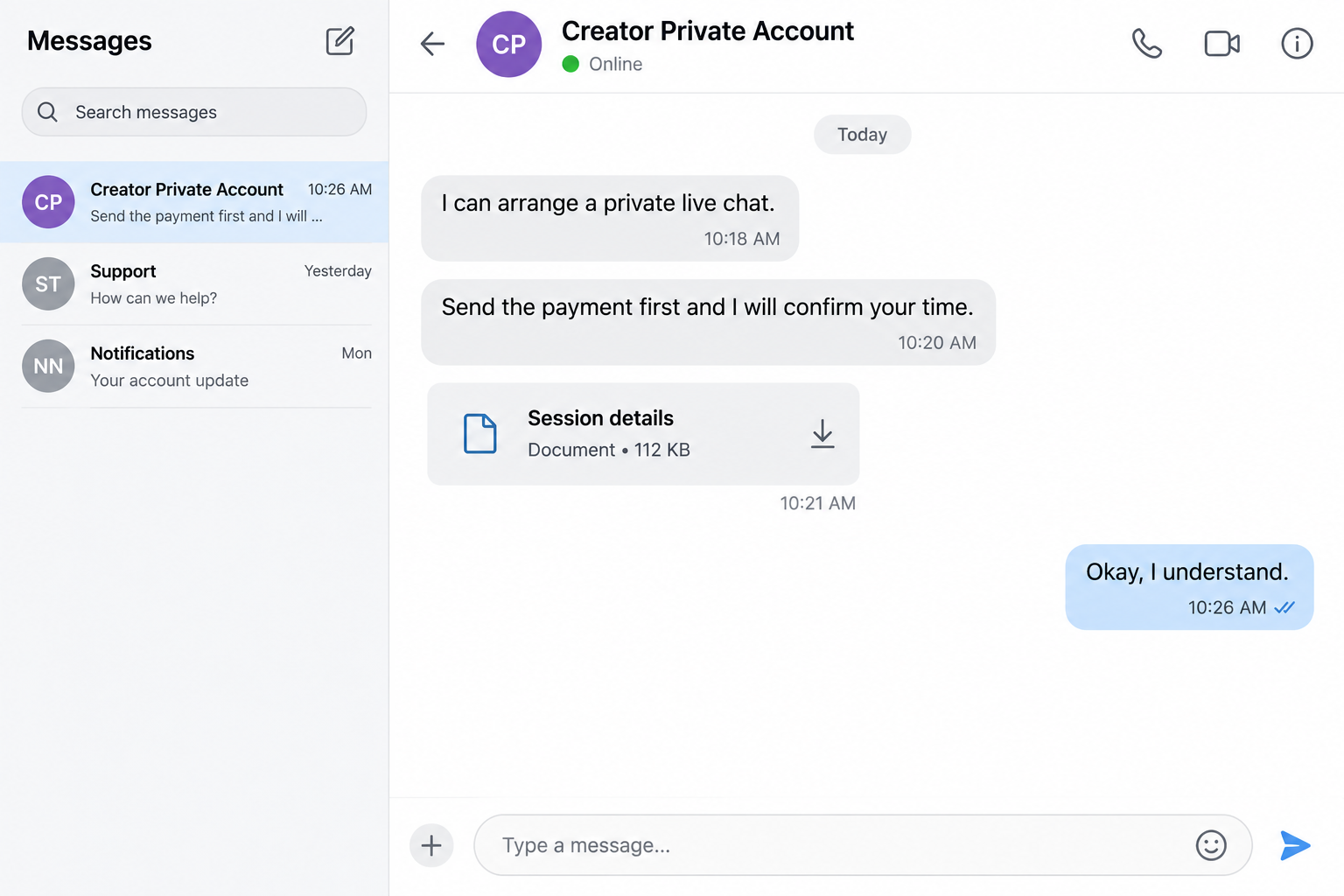
The chat shown above is a fictional illustration. It doesn’t reproduce a real creator’s messages, identity, price, or payment instructions.
The Familiar Face Does Most of the Work
Following someone for months creates familiarity. You recognize their style, voice, expressions, and the rooms appearing behind them in videos.
That familiarity can make an unexpected reply feel less like contact from a stranger. But recognizing the material is different from authenticating the account using it.
A copied picture may be completely genuine. The deception lies in using it to make you believe its owner is speaking to you.
Similarly, a stolen clip doesn’t need to be newly generated to mislead. A real recording can be placed in a false conversation.
A convincing voice can make you stop asking questions. It still doesn’t connect that private account to the creator’s established public channels.
You shouldn’t have to become a deepfake analyst before making a sensible decision. Check the account’s origin and the offered transaction instead.
Those checks still work when the picture is sharp, the voice sounds normal, and you can’t identify an obvious visual mistake.
The amount is irrelevant to that identity question. A cheap private session can be just as fabricated as an expensive one.
How the OnlyFans Impersonation Scam Works
Step 1: An account borrows a creator’s recognizable identity
The impostor presents photos, a familiar name, or other material associated with someone who already has an audience.
Fans arrive with a reason to believe they’re seeing the same person elsewhere. The account benefits from recognition it did not earn.
A search result or recommendation can put the lookalike profile in front of you without passing through the creator’s genuine links.
Don’t confuse discovery with verification. A platform showing you an account doesn’t establish that the account belongs to the person in its pictures.
Step 2: A personal reply makes the contact feel special
The exchange becomes more persuasive when it appears directed at you. A quick answer or friendly message can make ordinary verification feel awkward.
You may worry that asking questions will offend the creator or cause you to miss the opportunity. That pressure can exist without an explicit threat.
Give yourself permission to pause anyway. A purchase shouldn’t depend on accepting a stranger’s identity because the conversation feels flattering.
Step 3: The conversation shifts to a separate private channel
In the reported cases, accounts moved interactions across social platforms. That can make the chain of identity harder to follow.
You may have recognized the first profile but never checked whether the second username belongs to the same person.
A message saying an account is private or exclusive doesn’t create that connection. Verify the new destination from an independently established creator page.
If you can’t trace it back, stop before discussing payment. Another app doesn’t inherit authenticity simply because the first account recommended it.
Step 4: A promised session becomes an upfront transfer
The impostor offers something personal enough to justify advance payment: private content, a conversation, or a live session.
At that point, ask what you are buying and who is responsible for delivering it. Vague reassurance is not a substitute for an identifiable offer.
An ordinary payment interface can make the exchange feel settled and legitimate. It doesn’t verify the creator identity behind the request.
Cash App is a real service. Its presence in the chain doesn’t make Cash App or the impersonated creator the operator of the deception.
Step 5: The promised access never arrives
After payment, the account may block the fan or fail to provide the agreed session. The real creator cannot deliver a promise made by an impostor.
Keep the original offer and receipt together. They show why you paid and which account actually requested the money.
Don’t send another amount to reschedule or unlock a refund through the same unverified account. Move the issue to your provider’s legitimate support channel.
You Can’t Verify an Account With Material It Supplies
Requesting another photo can feel like a practical test. But it keeps the suspect account in charge of the evidence.
The same weakness applies to a voice note, prerecorded clip, or document bearing a name. Convincing material still needs an independent connection to its owner.
Instead, start with the creator’s established official presence. Follow the links published there and compare the exact account identifiers.
Read any warning about impersonators or contact practices. A creator saying they never initiate private messages gives you a concrete way to assess an unsolicited approach.
Don’t rely on a screenshot of that warning sent by the account itself. Open the genuine page independently.
Also distinguish a creator’s disclosed AI service from an impostor using synthetic media secretly. The technology alone doesn’t establish that the transaction is fraudulent.
The key question remains whether the person represented actually authorizes the account and offer. A fabricated relationship is the problem.
If you cannot establish that relationship, there is no need to buy anything to investigate further.
Check the Offer as Carefully as the Face
Even after identifying a genuine account, read what you’re purchasing. A subscription, custom recording, live appointment, and personal conversation are different things.
A public video doesn’t prove a private offer exists. Look for the offer through the actual creator’s established sales route.
If the private message introduces a service absent from those channels, ask for clarification through the genuine route before paying.
Consider what happens if the session doesn’t occur. You should understand whom to contact and which transaction record describes the purchase.
Avoid sending more private material simply to prove you’re a serious buyer. A stranger doesn’t need your identity documents or account codes to discuss availability.
You also don’t need to share personal images to authenticate someone else’s account. That reverses the responsibility and creates another exposure.
Keep boundaries even when the exchange feels consensual and friendly. The subject of the conversation doesn’t remove your right to verify a purchase.
If a recipient name surprises you, pause. An explanation may exist, but it should be confirmed through the genuine offer rather than accepted under pressure.
What to Do if You Have Fallen Victim to This Scam
- Preserve the conversation before ending contact. Save the account handle, profile address, promised session, payment request, and any messages showing the false creator identity.
Capture the full context privately. A receipt alone doesn’t explain the impersonation, and a profile picture alone doesn’t identify the payment recipient.
- Open the payment service yourself. Locate the actual transaction and contact support through the genuine app or official website, not a link sent by the account.
Cash App’s scam-response guidance recommends acting quickly, checking whether a pending payment can be canceled, and reporting to the provider.
A completed person-to-person payment can be difficult to recover. Don’t treat a review request or report as a promise of reimbursement.
- Explain the transaction accurately. State that someone impersonated a creator and obtained an advance payment for a service that wasn’t delivered.
Tell the provider whether you approved the transfer yourself. A transfer induced by deception isn’t the same factual situation as an account payment you never authorized.
- Report the account where the impersonation occurred. Use the platform’s built-in reporting route and include the profile identifier, not merely the creator’s displayed name.
If several accounts were involved, record each one and its role. That helps distinguish the first profile, private chat, and payment destination.
- Notify the genuine creator through an established channel if appropriate. Keep it brief and explain that an account is using their identity.
Don’t demand repayment from a person who didn’t receive the money. Their confirmation may clarify the impersonation, while financial recovery belongs with the payment provider.
- Secure any credentials you disclosed. Replace an exposed password through the genuine service, check active sessions, and protect other accounts using the same password.
Sending money doesn’t automatically reveal your password. Base these steps on what you actually entered or shared, rather than assuming every account has been accessed.
- Keep sensitive material out of public reports. Give necessary transaction details to the provider or authority privately, and redact financial identifiers in public warnings.
If the account threatens to expose personal material, preserve the threat and seek appropriate police or platform help. Don’t pay for a promise of silence.
- Reject unsolicited recovery offers. An account claiming it can retrieve the transfer for another upfront payment is creating a new risk.
Keep using your existing support case and report references. Anyone contacting you with guaranteed recovery should be independently verified before you share information.
A Useful Report Doesn’t Require Embarrassing Details
You can describe the fraud without reproducing intimate conversations. Explain the identity claimed, the service promised, the payment route, and the missing delivery.
The evidence that matters may be quite ordinary: a profile address, a message requesting advance payment, and the transaction identifier.
If more sensitive information is needed, ask the legitimate support team how to provide it securely. Don’t send everything to a public account asking for complaints.
Write down the order of events while it’s fresh. Which account contacted you first, when did the conversation move, and when was payment requested?
Keep original files or message exports if available. Avoid editing the only copy when making a redacted version to show someone else.
If you need help, choose a trusted person who can focus on the practical steps. Judgment about the purchase doesn’t help trace the payment.
Don’t Turn a Bad Transaction Into a Public Accusation Against the Creator
It is understandable to feel angry when the person in the pictures appears to have taken your money. First establish who actually controlled the account.
An impersonated creator can suffer the reputational damage while the recipient disappears. Naming the wrong person can also distract from the useful evidence.
When warning others, identify the suspicious handle and describe the false claim. Make clear whether the genuine creator denied any connection.
Likewise, avoid calling every fan account fraudulent. A clearly labeled fan page is different from an account pretending to sell private access as the creator.
The account’s conduct and claimed identity matter more than its follower count. A large audience can be copied, confused, or directed to the wrong destination.
You don’t need a public argument to stop paying. Ending the transaction and making a precise report are worthwhile even before the account is removed.
Frequently Asked Questions
Is the real creator responsible for an impostor’s payment request?
An impersonated creator may have no connection to the request or receiving account. Establish the actual recipient before assigning responsibility.
Can a video call prove the account is genuine?
Don’t rely on appearance alone. Synthetic or reused media can complicate identification. Trace the account and offer through the creator’s independently confirmed links.
Does moving to Snapchat automatically mean fraud?
No. The channel alone isn’t the verdict. The problem is an unverified identity obtaining payment for access it cannot genuinely provide.
Are all Cash App payments to creators scams?
No. This warning concerns impostors and false offers. A real payment service doesn’t authenticate a stranger’s claimed identity.
Should I send another payment to get the first one refunded?
No. Don’t fund the same unverified account again. Ask the legitimate payment provider about the original transaction and available recovery options.
Can I report without sharing private content publicly?
Yes. Use private provider, platform, or authority channels and supply only what they need. Keep unredacted evidence securely rather than posting it for strangers.
The Bottom Line
Do not send advance payments to an unverified private account using a creator’s identity. Confirm the actual account and offer through that creator’s established channels first.
If you already paid an impostor, preserve the messages and report the transaction now. Stop further transfers and keep the real creator separate from the account that deceived you.

Join the discussion
0 commentsShare your experience or ask a question about this article.
Discussion
Start the conversation
Have a question or something useful to share? Add the first comment.