

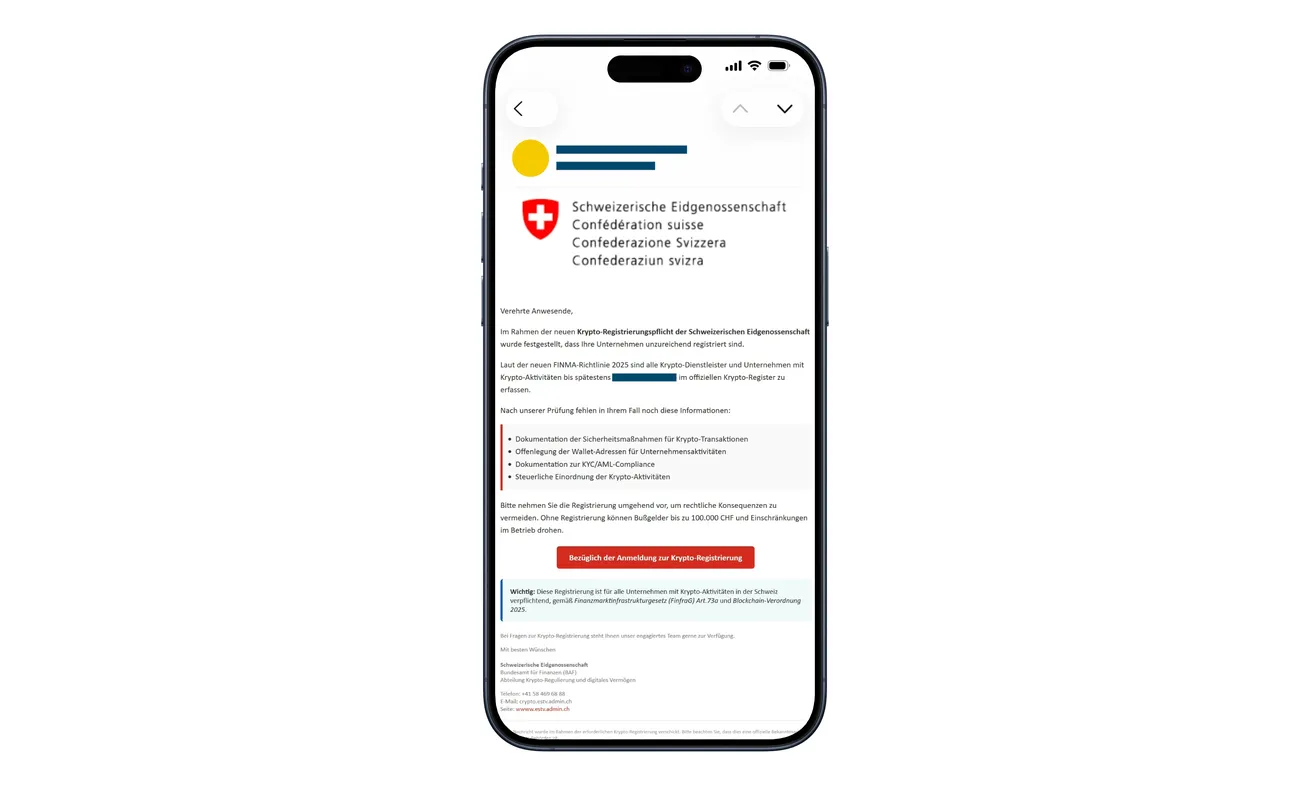
An official-looking email says cryptocurrency owners must complete a Swiss registration process. It refers to new rules and makes ignoring the notice sound expensive.
Even a cautious investor might wonder whether a requirement slipped past them. Before opening the registration form, separate the message’s authority from its appearance.
Overview
A made-up compliance notice targets cryptocurrency holders
The Swiss crypto registration email scam presents a false administrative requirement as something investors need to complete. Government-style branding gives the demand an official setting.
The pictured email invokes rules supposedly taking effect in 2025 and threatens consequences. Those are claims made by the impersonator, not legal guidance for cryptocurrency owners.
Don’t use this notice to decide what you owe, where to register or which regulator oversees your circumstances. The sender hasn’t earned that authority.
The form builds a personal and financial profile
Swiss police identify the false registration campaign and requests for names, birth dates, phone numbers, IBANs, and exchange or wallet information.
That combination can help tailor later fraud. The documented concern isn’t limited to an immediate request for money.
The warning doesn’t establish that this particular form drains wallets, collects recovery phrases or charges a withdrawal fee. Don’t confuse different crypto scams.
Refusing the form doesn’t mean ignoring genuine obligations
Real tax and regulatory questions belong with verified authorities or your qualified adviser. This email isn’t a shortcut to resolving them.
- Don’t submit financial or identity details through the registration button.
- Don’t treat the stated deadline or penalty as established law.
- Tell your bank if you exposed account information.
- Review exchange security if relevant login details were also shared.
- Expect follow-ups to sound more personal if you completed the questionnaire.
Why This Scam Can Work Without Asking for a Payment
People often judge a suspicious message by whether it wants money immediately. A form asking for information can seem less dangerous than an investment pitch.
Here, that instinct misses the point. The useful asset may be a profile connecting a real person, a bank account and cryptocurrency activity.
Each answer can make the next approach more convincing. A stranger can name your exchange instead of asking whether you use cryptocurrency at all.
Your phone number gives that stranger a route into a conversation. A birth date or bank identifier can make the conversation sound informed.
Knowing your exchange isn’t proof that a caller works there. It may mean they’re repeating an answer you gave the false registration form.
This matters after a delay, too. An approach arriving later can feel unrelated to a questionnaire you completed and forgot.
Keep a private note of what you disclosed. If an unexpected caller later knows those details, you’ll have a reason to pause instead of accepting their identity.
At the same time, don’t assume a financial loss has already occurred. The right response depends on the information shared and any later actions you authorized.
How the Swiss Crypto Registration Email Scam Works
Step 1: A supposed rule change creates an obligation
The email tells recipients that cryptocurrency holdings now require registration. It frames compliance as mandatory rather than asking whether the recipient wants a service.
References to a regulator or federal institution make the instruction sound grounded in law. The message itself doesn’t establish that the claimed rule exists.
A penalty threat adds pressure to act before checking. Someone unfamiliar with the subject may feel that asking questions is already a risky delay.
Don’t try to resolve that anxiety by supplying a small amount of information first. The entire registration route needs independent verification before any disclosure.
Step 2: The registration button supplies an official-looking destination
The recipient follows the email to a page designed to continue the administrative story. The change from reading a notice to completing a task can happen quickly.
A formal heading, Swiss symbols and reassuring language don’t show who controls the form. Those features can be copied without access to government systems.
Even a security-themed screen doesn’t authenticate the next step. A page claiming to verify visitors is still part of the unverified journey.
Don’t interpret a browser padlock as proof that a regulator owns the site. Encryption and institutional authorization are different things.
Step 3: The questionnaire connects identity, banking and crypto information
The documented fields reach beyond a name or email address. They connect the person to bank details and information about cryptocurrency services or wallets.
Consider what that means for a later conversation. Instead of a vague fraud warning, a caller could mention a service you actually use.
That accuracy can be unsettling. It can also persuade someone that the caller must have legitimate internal access, when an earlier disclosure offers another explanation.
Don’t help the form become more accurate by volunteering account statements or identity documents it didn’t initially request. A plausible compliance story isn’t permission to overshare.
If you stopped halfway, record the fields you filled. Don’t rely on a missing completion page to prove nothing reached the site.
The warning establishes data collection, not the same subsequent loss in every case. Protect what you actually exposed rather than guessing that every wallet is already empty.
Step 4: The collected profile can support a second approach
Police warn about misuse of the gathered information. A later financial approach can draw credibility from details the recipient remembers providing in an official-looking form.
A separate federal warning about crypto-tax data phishing describes related collection and a possible follow-up bank-call tactic.
That is a related warning, not proof of identical operators or an inevitable telephone stage in this registration campaign.
The practical lesson is to authenticate new contact independently, even when the person knows the subject of the earlier form.
If someone asks you to move money, reveal a recovery phrase or install remote access, stop. Those are additional demands, not obligations created by the questionnaire.
A claimed connection to fraud prevention doesn’t change that. Contact the genuine bank or exchange through a route you already used before the incident.
What an IBAN Does and Doesn’t Mean Here
An IBAN identifies a bank account. It isn’t the same thing as your banking password, a card security code or authorization for every type of transaction.
Disclosing it therefore doesn’t justify the claim that someone can automatically empty your account. But combining it with identity details can strengthen later deception.
Tell your bank what was shared and ask what monitoring or protection fits the exposure. Don’t present an IBAN disclosure as a transfer you never made.
Likewise, sharing an exchange name isn’t equivalent to handing over its password. It helps someone identify a convincing pretext, not necessarily sign in.
If you also supplied credentials, authentication codes or identity documents, say so separately. Those additions materially change what the provider needs to investigate.
A wallet address and a wallet recovery phrase are different kinds of information. Don’t substitute one for the other when describing the incident.
A clear record prevents both panic and underreaction. Providers can respond more usefully to specific fields than to a general statement that “my crypto was hacked.”
How to Check a Real Requirement Without Using the Email
Find the authority before asking about the claim
Use your established tax records, an independently located official website or a qualified adviser who already handles your circumstances.
Ask whether the claimed requirement applies and where its genuine instructions are published. Don’t begin with a form supplied by an unknown sender.
The Swiss Federal Tax Administration’s digital-threat warnings provide an independent example of government identities being abused online.
That page doesn’t turn the registration email into official tax correspondence. Keep genuine authorities and the identities borrowed by scammers distinct.
If an adviser needs your financial information, agree on an established secure channel. Don’t upload the same records to the suspicious site to compare the experience.
Separate a real deadline from the sender’s threat
An email can print a date and cite a large penalty without proving either applies to you. Treat those statements as claims to verify.
Don’t dismiss unrelated genuine correspondence because you’ve received phishing. Resolve actual obligations through the authority responsible, outside this message.
If you’re unsure who that is, seek qualified help rather than accepting the email’s self-appointed registration desk. Uncertainty doesn’t oblige you to disclose immediately.
Don’t use an apparently successful ending as reassurance
A confirmation screen can be manufactured. Even a final redirect to a genuine website wouldn’t prove that the preceding form was operated by that institution.
The related federal crypto-tax warning describes such a redirect. Its significance is straightforward: evaluate the page receiving your answers, not just where the browser finishes.
You don’t need to repeat the process to check the ending. Preserve existing records and stop giving the site new information.
Preparing for a Caller Who Knows Too Much
Write a brief account of the disclosure while you remember it. Include the service names, identifiers and contact details entered.
That note gives you a reference when someone calls claiming there’s suspicious activity at exactly the bank or exchange you named.
Don’t challenge them to prove themselves by repeating more personal information. They may possess enough to pass a test based on those same details.
Instead, end the contact and reach the institution yourself. Use an existing app, saved support route or information from your own records.
Don’t keep the caller connected while another person “checks” the account. A continuing conversation can make it harder to assess a fresh request calmly.
If a genuine institution confirms a problem, follow its authenticated process. You don’t need to continue through the person who initiated the unexpected approach.
Warn anyone who shares responsibility for the exposed finances. Explain which information was collected so they can recognize personalized approaches too.
If an accountant or adviser is already helping, tell them about the false notice. They can keep the invented registration requirement separate from your actual paperwork.
Don’t ask a public forum to verify you by sharing statements, balances or identity documents. A warning about data collection shouldn’t become another disclosure.
Likewise, avoid posting a complete financial profile when seeking help. A general description can explain the problem without advertising which accounts you hold.
What to Do if You Have Fallen Victim to This Scam
-
Stop submitting the registration. Close the site and decline requests for corrections, missing fields or another identity check.
If you only received the message, mark it as phishing. Receipt alone doesn’t establish access to your bank or cryptocurrency account.
-
List the information you actually provided. Distinguish identity details, IBAN, exchange names, wallet information, passwords and any uploaded documents.
Don’t store passwords or recovery phrases in that incident note. Describe the category without creating a second insecure copy of the secret.
-
Contact your bank about exposed banking information. Explain the false government registration and ask which precautions fit the fields disclosed.
Check for unfamiliar activity through your real account. Report an unauthorized transaction promptly rather than waiting for a supposed registration certificate.
-
Secure an exchange login if it was shared. Change the password through the genuine service and review its available session and authentication controls.
If the password was reused, address other affected accounts as well. Knowing only an exchange name doesn’t call for the same response as stolen credentials.
For any separately exposed wallet secret, obtain help from the wallet’s verified documentation. Don’t take asset-transfer instructions from a stranger responding to your report.
-
Keep evidence private and intact. Save the message, sender, destination, claimed requirement and approximate completion time without reopening the form.
If identity documents were uploaded, tell the relevant institution and ask about appropriate identity-protection steps. Avoid posting those documents in a public warning.
-
Report the impersonation and any misuse. Follow the genuine authority’s phishing-reporting guidance and contact police when financial loss or identity misuse occurs.
A reporting reference can help keep later bank or platform correspondence organized. It doesn’t guarantee recovery or require paying a private tracing service.
-
Verify follow-up contact from scratch. A familiar bank name, wallet detail or birth date is no longer persuasive proof of the caller’s role.
Refuse urgent transfers, remote-control sessions and requests for authentication secrets. Contact the institution independently before taking any account-protection action.
Frequently Asked Questions
Is this Swiss crypto registration requirement genuine?
The documented email campaign is fraudulent. Don’t treat its rule, deadline or penalty claims as authoritative instructions for your own financial circumstances.
Why collect an IBAN without immediately requesting money?
A connected identity and financial profile can support later personalized fraud. The lack of an immediate fee doesn’t make the questionnaire harmless.
Does sharing my IBAN mean my account was emptied?
No. An IBAN isn’t your login or a universal payment authorization. Tell the bank what was exposed and investigate actual account activity.
Did this particular campaign steal wallet recovery phrases?
The police warning establishes personal, banking, exchange and wallet-information collection, not a recovery-phrase theft stage. Describe any additional request in your case separately.
Can a later caller know my exchange without being legitimate?
Yes. Information from the form could make later approaches sound convincing. End unexpected contact and use the exchange’s or bank’s established support route.
Should I ignore real crypto tax questions now?
No. Ask the appropriate authority or qualified adviser independently. Refusing a phishing questionnaire is different from resolving genuine obligations.
The Bottom Line
Don’t complete the Swiss crypto registration email’s form. Its false compliance demand collects a financial profile that can make later fraud more convincing.
If you’ve submitted it, document the exposure and contact the relevant providers. Verify real obligations separately, and don’t trust follow-up callers because they know your details.

Join the discussion
0 commentsShare your experience or ask a question about this article.
Discussion
Start the conversation
Have a question or something useful to share? Add the first comment.