

A traffic notice names Judge Carolyn Hayes and warns that your vehicle registration could be suspended. You cannot remember a citation, but the consequences sound serious.
Before you have found the missing ticket, the message offers a court portal and a deadline. It seems to leave little room for questions.
Overview
The message uses two names to make a payment demand feel personal
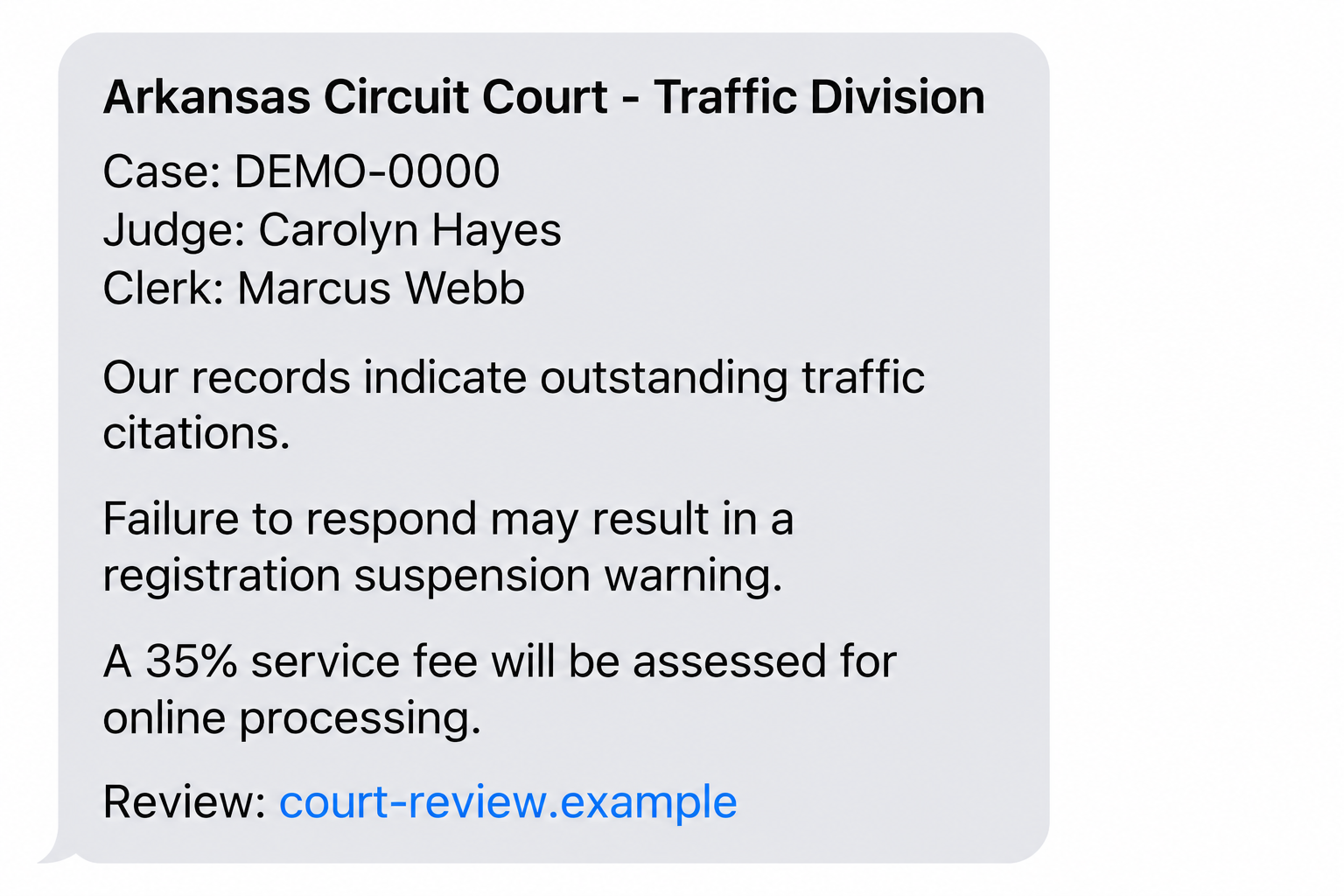
The Judge Carolyn Hayes scam text impersonates an Arkansas court notice. A reported example also names Marcus Webb as clerk and claims outstanding traffic citations.
It threatens registration suspension, a possible driving restriction, and a 35% service fee. These statements are the sender’s pressure tactics, not verified penalties against the recipient.
The attached court-style names and reference make an unexplained debt appear to have progressed through an official process. The recipient is encouraged to resolve it immediately.
Our lead illustration shows this message format using fictional interface details. It is not an original court notice or evidence of a newly received text.
The supposed portal does not belong to Arkansas government
The reported destination uses dfa-arkansas-govzs[.]life, with a payment path. Familiar words in that address do not make it an Arkansas government site.
Arkansas DFA’s official traffic-text warning confirms that scammers copy its website and send false ticket or toll demands.
The department says it does not send texts about traffic tickets or tolls. Its warning supports the impersonation mechanism, without authenticating every detail of this particular sample.
- A court title and named staff create apparent authority.
- An unexplained citation makes the reader search for a forgotten mistake.
- Threatened penalties make delay feel expensive.
- A misleading destination funnels that worry toward the sender’s process.
The right response is verification, not payment through the text
Do not reply, use the supplied portal, or enter financial information to check whether the notice is genuine. Contact the relevant institution independently.
This warning concerns the impersonating message. The appearance of a name does not identify a real person as the sender or prove misconduct by anyone sharing it.
If you have an actual traffic case, continue dealing with it through its genuine court or issuing authority. A scam text does not erase real obligations.
What the Threats Are Trying to Make You Believe
The message presents several consequences together: a court database entry, registration trouble, driving restrictions, additional fees, and possible further legal action.
That collection can feel more convincing than one demand. If even one consequence worries you, the text has a reason for you to click.
Yet listing government functions does not establish that the sender controls any of them. A person writing a text can describe powers they do not possess.
The 35% claim is particularly useful as a pressure device. It suggests that waiting will make an already unclear problem more expensive.
Do not calculate the fee as though the underlying debt were established. First determine whether there is a real citation and which authority issued it.
The same applies to a date. A printed deadline is not a verified deadline until it is tied to a genuine record through a trusted channel.
If the sample’s deadline has already passed, that does not make compliance with its link necessary. It makes checking the actual record more important than trusting the text.
How the Judge Carolyn Hayes Scam Works
Step 1: A court-style label introduces an unexpected debt
The text begins with an institution-like heading and an assertion that citations remain unresolved. It does not begin with a discussion you initiated.
A reader may assume the sender has located a genuine violation. That assumption can happen before the notice supplies a vehicle, location, or other checkable context.
Start by asking what you independently recognize. Do you have paperwork from an issuing authority, a known case, or a previous verified communication?
You do not need to prove your innocence to the sender. The institution claiming a debt must be reached through a route that the message does not control.
Step 2: Judge and clerk names imply an established proceeding
Carolyn Hayes and Marcus Webb give the document a human administrative structure. It appears that someone has reviewed the matter and is waiting for compliance.
The names are not credentials you can validate by their appearance. A copied or invented name is as easy to insert as a heading.
Do not search for an unrelated person and assume a name match authenticates the message. Identity, jurisdiction, and the actual proceeding are separate questions.
Ask the genuine court about the purported matter instead. Staff can explain how to verify records without requiring you to follow an unsolicited payment route.
Step 3: A case reference makes the claim look searchable
The reported notice includes a structured case-like identifier. Letters, a year, and grouped numbers can look like the output of an official database.
Formatting alone cannot establish that the database exists. A sender can create a plausible reference without registering a case anywhere.
Keep a copy if you need to report it, but do not treat it as a password to a site supplied by the same message.
If you cannot locate the alleged case, contact the appropriate court before assuming either that you owe money or that a real matter can be ignored.
Step 4: Threatened restrictions compress the decision
The notice connects inaction to losing access to a vehicle or driving privileges. For someone who needs a car for work, that possibility feels immediate.
It may seem safer to pay a small amount now than risk disruption later. That comparison skips the central issue: whether any debt is real.
Take the decision out of the sender’s deadline. Open a fresh browser session or use an independently obtained number to establish the real situation.
A legitimate record can be addressed through legitimate channels. You are not required to use a stranger’s link merely because they describe the matter as urgent.
Step 5: Government-sounding words disguise a separate website
The reported link combines DFA, Arkansas, and government-like wording before a .life ending. Read that as one external hostname, not a government credential.
Text placed before or after a familiar name can change who controls the address. A page title repeating the state does not repair that problem.
The payment path suggests that clicking is the normal next stage of resolving the citation. It is only the next stage of the sender’s instructions.
No authenticated checkout is needed to see the basic mismatch. Do not supply a card or identity details merely to find out what the page asks next.
Step 6: A false administrative task can become real financial exposure
If the destination requests information or payment, the recipient may comply believing it will prevent a restriction. That belief does not authenticate the recipient account.
Information entered into an impersonating page can expose accounts or identity details. A payment made there may need a separate dispute or recovery attempt.
What you actually did matters. Reading a text, visiting a page, entering a password, and approving a transaction are different levels of involvement.
Stop before further disclosures and use the relevant provider’s official assistance. You can respond proportionately without assuming that every account has already been taken over.
How to Check a Citation Without Following the Sender
Use the authority responsible for the actual matter
A real ticket should lead back to an identifiable issuer and process. Use paperwork you already know is genuine or find the institution independently.
Explain that an unexpected text alleges a citation. Ask what record can be checked and which office is responsible, rather than asking whether the link looks convincing.
Do not give the caller a bank password or security code while verifying a court matter. Those details cannot establish the existence of a traffic citation.
Keep the specific sample separate from all court communications
The reported Arkansas text is deceptive. That is different from claiming that courts everywhere use identical notification procedures or never send any reminder.
When you have a genuine case, verify the local court’s communication policy and continue checking the official notices associated with that case.
This avoids two mistakes at once: paying a fraudster and dismissing an unrelated real deadline because you have heard about text scams.
Do not substitute a web search result for an official contact
Searching the notice can provide useful context, but the first advertised number is not necessarily the right office. Check the site’s identity before using it.
A review page can describe a scam without becoming the authority that determines your case status. Only the responsible institution can resolve that question.
If you ask a relative to help, show them a saved image rather than inviting them to open the suspicious destination themselves.
If the office is closed, record the question for its next opening. A closed counter does not make the text’s contact a trustworthy alternative.
For an existing case with an approaching deadline, use the court’s published assistance options. Do not rely on a stranger to explain your procedural choices.
What to Do if You Have Fallen Victim to This Scam
-
Stop communicating through the notice. Do not reply with the requested letter, call its contact, or submit another form to cancel the first.
Save the conversation, visible destination, and any receipt. Record the dates of your actions while the sequence is still clear.
Keep sensitive identifiers private when warning others. A public screenshot should not expose your account information, address, or documents.
-
Confirm any real legal issue through the institution. Find the court or agency through an independently verified website.
Ask about the alleged citation and describe the suspicious text. If you already have authentic paperwork, use its details to locate the correct process.
Do not assume that sending money to the scammer settled anything. A genuine citation, if one exists, must be handled separately.
-
Tell your bank or card issuer if payment details were entered. Use the official app or the number printed on the card.
Explain whether you merely disclosed card information, approved a charge, or discovered a transaction you never authorized. Ask about replacement and dispute options.
Recovery depends on the payment and circumstances. Keep the provider’s reference number and respond promptly to requests for supporting records.
-
Change credentials that were exposed. Visit the real service independently and replace any password submitted to the impersonating page.
Update other accounts using the same password. Review available security controls and ask the provider about any unfamiliar activity or approvals.
There is no reason to reset unrelated accounts just because you received the message. Focus on the information you actually shared.
-
Address sensitive identity disclosures. If you supplied identity documents or other identifying information, use IdentityTheft.gov for a recovery plan.
Keep copies of reports and correspondence. Consider the protective steps recommended for your particular exposure, including relevant account or credit monitoring.
A fraudster may request more identification while pretending to fix the first problem. Do not send it through the original conversation.
-
Report the false traffic demand. Submit a report at ReportFraud.ftc.gov and use independently located local reporting channels when appropriate.
Include the original text and what happened after it, without guessing which organization or person operated the scheme.
After preserving evidence, block the sender and remove the conversation. Blocking one number may not prevent messages from other senders.
-
Check with anyone who helped you respond. A family member may have made the payment or supplied information on your behalf.
Work through their exposure too. Explain the scam without blaming them; fear about legal consequences can make an otherwise cautious person rush.
Decline paid promises to erase the supposed case or guarantee recovery. Seek help from the genuine institutions involved, not another unsolicited contact.
Frequently Asked Questions
Is the Judge Carolyn Hayes traffic text an authentic notice?
The reported Arkansas notice uses a misleading external payment address and fits the traffic-demand impersonation warned about by DFA. Do not resolve it through that link.
Does the name identify the person who sent it?
No. A displayed judge or clerk name does not identify the operator. Do not accuse a real person simply because their name matches.
Is the claimed 35% fee proof that my balance will increase?
No. That threat comes from the suspicious message. Verify an actual citation and its applicable process before treating any amount as owed.
Can the .life address become official because it contains Arkansas?
No. Government-related words within a hostname do not establish government control. Use the real institution’s independently located website instead.
Do I need to pay to find out whether a citation exists?
Do not pay the unsolicited sender for verification. Ask the responsible authority how to check the alleged matter through its genuine channels.
What if I only opened the text?
Receiving or reading it does not itself establish a payment or account compromise. Preserve, report, and delete it; take further action for actual disclosures.
The Bottom Line
Do not use the Judge Carolyn Hayes scam text’s portal or pay to stop its threatened restrictions. Named staff and a deadline cannot authenticate the demand.
Check any genuine citation independently. If you supplied financial details or sent money, contact the relevant bank or payment provider without waiting for the sender.

Join the discussion
0 commentsShare your experience or ask a question about this article.
Discussion
Start the conversation
Have a question or something useful to share? Add the first comment.