

A message cites California Vehicle Code 22500 and says a parking violation needs your attention. The legal reference looks precise enough to make you pause.
Perhaps you parked somewhere awkward recently. Before you have worked out where, a payment link is already offering to make the problem disappear.
Overview
A real parking rule gives a false notice borrowed credibility
The California Vehicle Code 22500 scam uses a genuine legal reference inside a deceptive parking or traffic-payment demand. The statute is real; the unsolicited claim remains unverified.
Section 22500 addresses prohibited stopping or parking in specified places. For example, South San Francisco’s sidewalk-parking explanation identifies it as a rule protecting pedestrian access.
That background makes the reference sound plausible. It does not prove that your vehicle was cited, that the sender issued a ticket, or that payment is due.
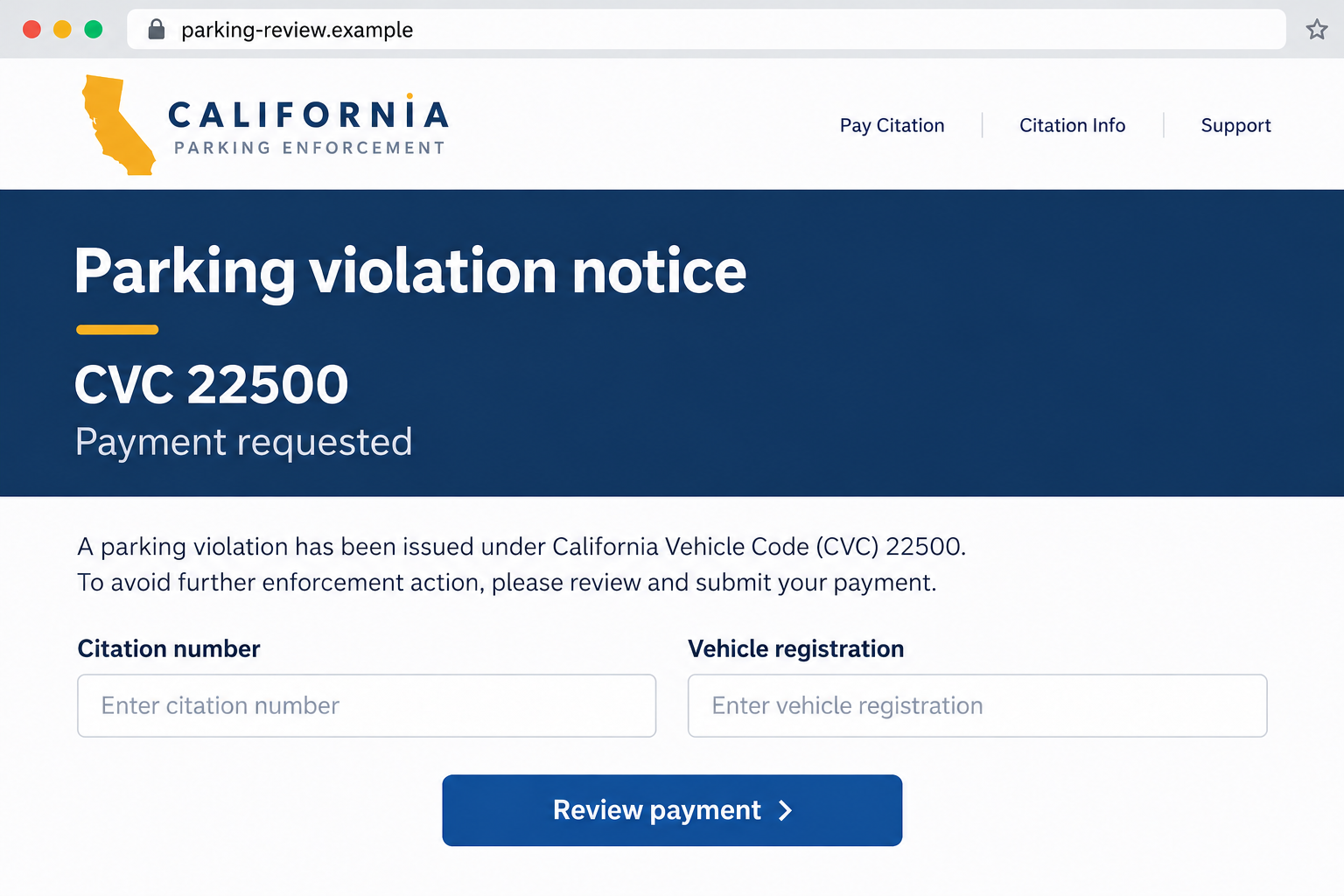
The image is an illustrative payment interface, not an original California citation or captured checkout. Its example address and fields do not identify an actual case.
The suspicious instruction matters more than the familiar number
The reported scam combines CVC 22500 with urgent enforcement language and a link or QR-based route toward payment. Its appearance encourages compliance before verification.
California Courts’ fake court-message warning describes false ticket demands and directs people to verify matters through genuine court channels.
A parking citation may instead involve a municipal issuing agency and its own process. Do not assume every parking matter belongs in Superior Court.
- A statute number explains a rule, not who sent a message.
- A supposed case reference does not establish a recorded citation.
- A payment form cannot prove that the underlying debt exists.
- A small requested sum can still expose valuable payment information.
Check the issuer before considering the payment route
Find the responsible agency independently and ask how to verify the citation. If the message claims to be from a court, use that court’s genuine contacts.
Do not treat every QR code or online parking payment as fraudulent. The problem is an unverified demand steering you into a destination chosen by its sender.
You should neither pay the suspicious notice nor dismiss a genuine ticket without checking. Verification separates those decisions instead of forcing you to guess.
What CVC 22500 Does and Does Not Tell You
A legal citation is often the most persuasive line in a fake notice. It suggests the sender has matched an actual event to a specific rule.
But copying a statute number does not require observing a car, recording a violation, or obtaining authority to collect a fine.
Think of the difference between a rulebook and a receipt. One describes what may be prohibited; the other records a particular transaction or event.
For a claimed citation, you need a checkable record from the responsible issuer. The text’s reference to a genuine statute supplies only background.
Even a notice containing your vehicle information should be checked through the agency. Accurate details can make a message persuasive without authenticating its payment instructions.
A missing vehicle identifier can raise questions, but its presence cannot settle them. Avoid turning any single visual detail into a universal test.
This article does not determine whether a particular parking maneuver violated the law. If you have a real ticket, follow the issuer’s official review or payment procedures.
How the CVC 22500 Scam Works
Step 1: A legal reference connects the demand to everyday driving
The sender cites a real California parking provision. That makes the message easier to connect with ordinary memories of parking near a curb, driveway, or sidewalk.
You do not have to remember a specific incident for the suggestion to work. Uncertainty can be enough to make the demand feel worth investigating.
The safe part is wanting to investigate. The unsafe shortcut is accepting the sender’s website as the place where that investigation must happen.
Pause before clicking and identify the alleged issuer. A statute number cannot substitute for a municipality, agency, or court with a record you can independently check.
Step 2: A notice-like presentation makes the allegation appear settled
Headings, enforcement language, and a reference number can make a claim look like the final stage of an administrative process you missed.
That appearance discourages the basic question: has anyone actually established that this citation belongs to me? The message wants the debt treated as a starting fact.
A reference can be recorded for your report without being accepted as genuine. Save the message, then use the responsible institution’s separate verification route.
Do not upload registration documents to the linked page to help it locate your case. First establish who operates the service requesting those documents.
Step 3: Penalty language makes a quick payment seem economical
The reported notices can threaten registration problems, legal consequences, or increased costs. These claims try to make delay feel more dangerous than paying.
You may be tempted to settle an unfamiliar small amount to avoid a larger imagined problem. That reaction is exactly what the notice’s urgency encourages.
Before comparing prices or consequences, confirm whether there is a real balance. An invented debt does not become legitimate because its proposed settlement looks affordable.
Actual deadlines deserve attention, but they should come from a verified record. Ask the issuer about them rather than relying on a stranger’s countdown.
Step 4: A link or QR code moves you into the payment funnel
A written destination or scannable code can open a page styled as a government payment service. The transition may feel like routine administration.
Once there, an official-looking heading can repeat the same statutory reference. Repetition makes the two screens consistent, but does not make either one authentic.
No exact live checkout or universal fee is established for every CVC 22500 message. Do not assume that another person’s amount or page matches yours.
Instead of opening the route to compare it, navigate independently to the alleged issuer. Use the official site’s own instructions for locating a citation.
Step 5: A modest payment request can expose more than the stated amount
If the impersonating form asks for card or personal details, the risk extends beyond a supposed fine. Those details may be valuable even when no payment completes.
A failed transaction message therefore does not prove that nothing was disclosed. Record what fields you filled and whether you submitted them.
Conversely, seeing the text alone does not establish that anyone obtained your card. Keep these situations separate so your response matches the actual exposure.
Never enter genuine information as a test. The person testing the page may otherwise become the person providing the data it was designed to collect.
Step 6: Independent verification determines the next real action
The issuing authority can tell you how to locate its records and whether a payment or review is required. The unknown sender cannot independently verify itself.
If a genuine citation exists, use the verified issuer’s process. If the demand is false, report it without sending money through the message.
If you already paid the wrong party, keep that recovery issue separate from any real parking matter. One does not automatically resolve the other.
You regain control by separating three questions: whether a violation exists, which institution handles it, and which payment route that institution actually authorizes.
Verifying a Parking Notice Without Overlooking a Real Ticket
Start with the named issuer, not a familiar logo
A municipality’s name and crest can be reproduced. Find its official website yourself and look for parking-citation information or a published contact.
Some legitimate agencies use external payment contractors. If so, follow the route linked by the independently verified agency rather than one supplied by an unsolicited text.
This is why judging only a domain ending can be misleading. Verify the relationship between the agency and its payment service, not just the page’s appearance.
Match the record before discussing the balance
Use the identifiers the genuine issuer requests through its verified system. Check whether the vehicle, date, location, and violation actually correspond to the alleged event.
If something does not match, ask about the appropriate review procedure. Do not send an explanation or payment to the suspicious sender to make the discrepancy disappear.
A real citation may have its own challenge deadline. Get that information from the issuer instead of assuming the scam’s deadline describes your rights.
Separate parking administration from court impersonation
Parking and traffic matters do not all follow one process. A threatening court heading can be used to exaggerate the authority behind a parking demand.
If the text alleges a court proceeding, contact the actual court using a trusted address. Ask how to establish whether the proceeding exists.
If it is an agency-issued parking ticket, work through that agency’s published process. Avoid letting the sender choose a different institution merely to increase pressure.
Keep genuine citation paperwork and any relevant photographs separate from the suspicious text. That preserves useful material if the real issuer offers a review process.
Ask that issuer about its requirements and deadlines. A scammer’s suggested explanation or promised cancellation is not a substitute for following the actual procedure.
What to Do if You Have Fallen Victim to This Scam
-
Preserve the demand before removing it. Capture the text, sender, visible link, and payment confirmation if one exists.
Note whether you scanned a code, opened a page, filled a form, or approved a payment. These details help the next organization assess the problem.
Do not keep revisiting the destination to gather more evidence. The saved material is a starting point for a report, not an invitation to continue.
-
Verify any real citation through its responsible issuer. Locate the agency or court independently, rather than using the text’s contact details.
Ask about the alleged reference and the appropriate process. Explain if a suspicious notice prompted the call, especially when its details are inconsistent.
Do not assume your payment to an impersonator satisfied a real ticket. Confirm any genuine obligation separately.
-
Contact the card issuer if you submitted payment information. Its genuine app or the number printed on the card is a safer route.
Describe the fields you provided and any charge you approved. Ask whether blocking or replacing the card is appropriate and what dispute options apply.
Keep receipts and the provider’s case reference. Reimbursement is not automatic, so respond promptly to its requests and follow the applicable process.
-
Secure any account whose credentials you entered. Replace the password on the actual service and check available login or security records.
If another account shares that password, give it a unique replacement too. Tell the provider about security codes or approvals you supplied.
A card-payment form does not necessarily mean an email account was accessed. Avoid guessing; work from the information you actually disclosed.
-
Take identity-recovery steps for sensitive disclosures. Use IdentityTheft.gov if you shared information that could be used to impersonate you.
Follow a plan tailored to the data involved. Keep records of reports, unfamiliar activity, and correspondence with the affected organizations.
Do not provide further documents to someone claiming they need them to erase the fine. Verify any new request through the genuine institution.
-
Report the impersonating message. California Courts directs recipients of fake messages to the Federal Trade Commission.
File at ReportFraud.ftc.gov. You can also notify the named agency using its independently published reporting or contact options.
Describe the conduct rather than accusing an unrelated business whose name appeared on the page. Let the evidence establish who handled the transaction.
-
Review the situation with anyone who assisted you. A friend may have scanned the code or used their own card to help.
Make sure that person’s information is protected too. Share redacted images when discussing the warning instead of forwarding a live payment link.
Be wary of unsolicited recovery services promising an immediate refund for a fee. Handle disputes through the provider that actually processed your payment.
Frequently Asked Questions
Is California Vehicle Code 22500 a real law?
Yes. It covers specified prohibited stopping or parking. Its existence does not authenticate a message claiming that you violated it.
Does a CVC 22500 reference prove I received a ticket?
No. The issuing agency must have a checkable record. Copying a statute number into a text does not create one.
Should every parking citation be checked with Superior Court?
No. Identify the actual issuer and its process. Some parking matters involve municipal agencies; an alleged court proceeding should be checked with the relevant court.
Are all parking payment websites or QR codes fraudulent?
No. Follow payment instructions obtained from the genuine issuing agency. An unsolicited message’s code is not enough to establish an authorized route.
What if the linked page says the payment failed?
Information may still have been submitted. Contact the relevant provider about the details you entered and check for actual charges.
Can I ignore a genuine citation after receiving a scam text?
No. Verify the real record and follow its official process. A fraudulent demand and an authentic ticket can be separate issues.
The Bottom Line
Do not pay an unverified CVC 22500 scam demand through its text link or code. A genuine parking statute cannot authenticate an unknown sender.
Confirm the record with the actual issuer. If you entered card information or paid, contact your financial provider and keep the evidence for a report.

Join the discussion
0 commentsShare your experience or ask a question about this article.
Discussion
Start the conversation
Have a question or something useful to share? Add the first comment.