

Someone named Carmen Russo appears to have sent you $0.02 through PayPal. You were not expecting money, and the notification leaves an obvious question: why?
A note beside the payment seems to offer help. For a moment, calling its support number may feel more sensible than leaving the mystery unresolved.
Overview
The two-cent payment is an opening for a conversation
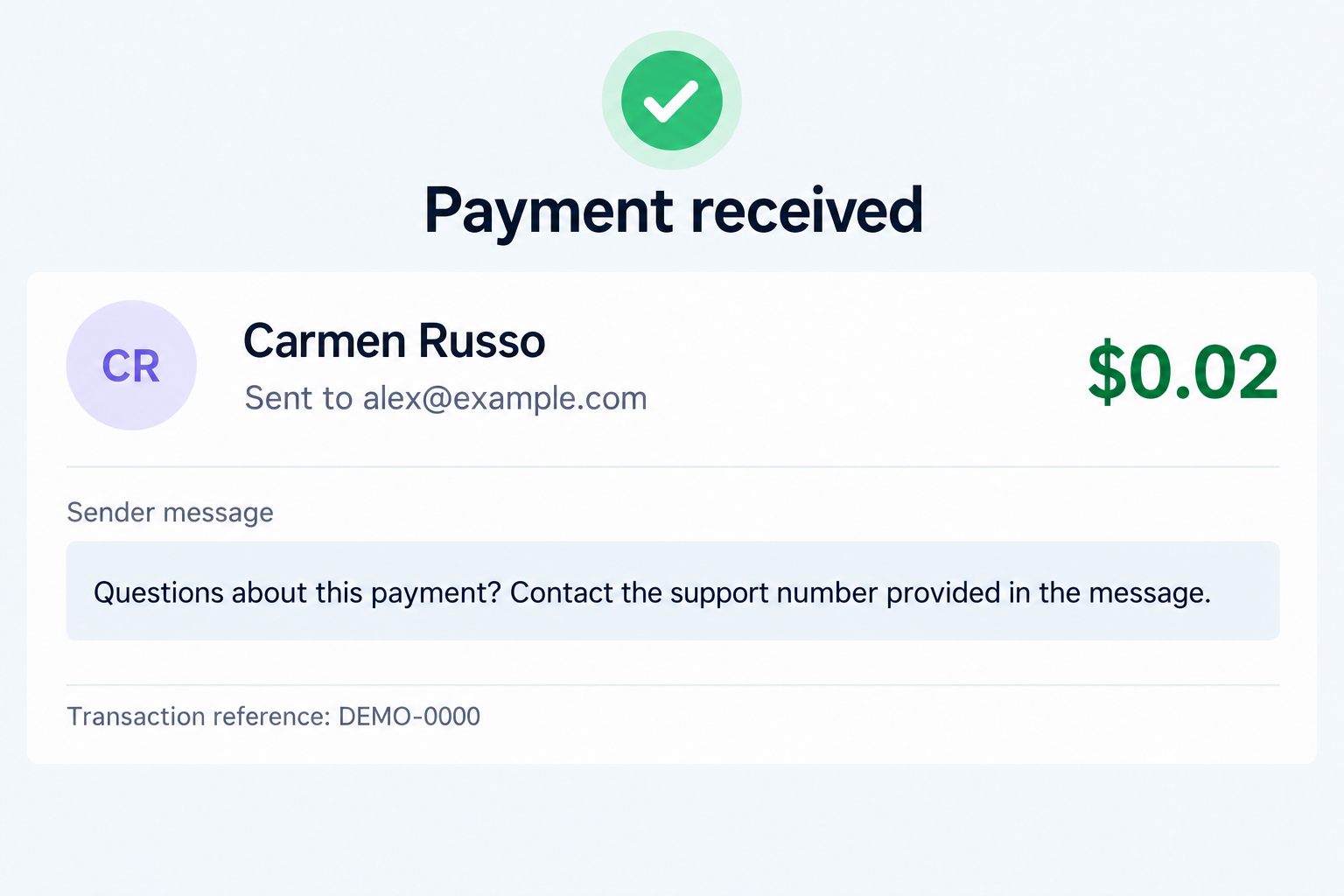
The Carmen Russo PayPal scam uses a reported $0.02 incoming payment and an accompanying support instruction. The money attracts attention; the callback is where trust is redirected.
A recipient can reasonably want to understand an unfamiliar transaction. The trap is treating the sender’s preferred contact as the authority that can explain it.
The reported example does not establish who controlled the sender account. It also does not justify an accusation against a real person who happens to share the name.
The image illustrates the incoming-payment format. It is generated, uses fictional interface details, and is not an authenticated copy of a received notification.
Payment delivery and trustworthy assistance are separate questions
An entry appearing in PayPal can confirm that an account event exists. It cannot establish that a support instruction supplied alongside it came from PayPal.
PayPal’s warning about alarmist payment notes describes fake support numbers used to obtain personal or financial information.
That warning concerns invoice and request abuse. It corroborates the callback tactic without authenticating this specific historical two-cent payment or identifying its operator.
- An unfamiliar payment deserves a record check, not an automatic callback.
- A sender’s explanation is separate from the account’s transaction data.
- Receiving money does not mean a larger withdrawal was approved.
- Official-looking delivery does not make an embedded contact trustworthy.
The safe answer comes from the original transaction record
Open your account independently and locate the entry, if one exists. Use PayPal’s genuine support options for questions about its status or appropriate handling.
Do not move the conversation to a number supplied by the stranger. You can investigate the payment without letting that person choose your adviser.
If someone requests the money back, ask the service how to handle the original transaction. Do not create a separate payment to a destination supplied in a note.
Why an Incoming Penny-Size Payment Can Feel Less Suspicious
Many people recognize the danger in an unexpected bill. Money arriving in the opposite direction can seem like an error rather than an attempt to manipulate them.
Two cents is too little to resemble a substantial reward. That can make the event appear administrative, perhaps a verification, correction, or test.
The sender benefits if you supply that explanation yourself. An unfamiliar account entry then feels like something a knowledgeable support representative should clear up.
But a technical-sounding explanation still needs verification. The size or direction of the payment does not establish why it was sent.
The useful question is not whether $0.02 is worth worrying about. It is whether the notification is being used to obtain your attention for a different request.
Look at the note as a separate piece of content. Who wrote it, what does it ask you to do, and how would you verify that instruction?
This approach avoids both panic and complacency. You do not need to assume a hack, but you should not trust a caller simply because money arrived first.
How the Carmen Russo PayPal Scam Works
Step 1: A small incoming amount creates a question
The reported message names Carmen Russo and describes a $0.02 payment. Those concrete details make it feel like a transaction to investigate rather than generic spam.
You might recognize neither the sender nor a reason for the payment. That uncertainty makes the explanation attached to it unusually noticeable.
Check whether the event exists in the genuine account before accepting the notification. A fabricated email can imitate the same format without any corresponding transaction.
If the entry is real, continue reading its status independently. A real amount does not establish the authenticity of the message’s proposed next step.
Step 2: A note offers an apparently convenient explanation
The sender-controlled text directs attention toward assistance. Its position beside payment information can make it look like part of the service’s own instructions.
That visual association matters. You may read the payment record and the note together, even though they answer different questions and may come from different sources.
Do not treat a warning, payout description, or account explanation in the note as a verified security finding. Compare it with actual account information.
Where the explanation remains unclear, reach genuine support independently. The uncertainty does not give the unknown sender authority to interpret your account.
Step 3: The support label transfers trust to a phone contact
The reported example steers the recipient toward a number presented as customer support. Calling is the key change from observing an entry to following someone else’s process.
A caller can use the service’s name, familiar terminology, and a professional greeting. None of those features independently verifies their employment or role.
Do not ask the number from the note to certify itself. Instead, use PayPal’s official contact page or assistance inside the genuine app.
Specific numbers can change or be reassigned. The enduring warning is an unsolicited sender directing you toward their own supposed support contact.
Step 4: Questions can become requests for sensitive information
Once the fake support role is accepted, the caller may ask for details under the pretext of investigating or fixing the unexplained payment.
A name or email address can make the conversation feel personalized. It does not justify disclosing a password, financial details, or a security code.
If a genuine service sends an approval prompt, read what it authorizes. Do not accept the caller’s claim that every prompt is simply a cancellation check.
The available report does not include a complete authenticated call recording. These are risks of the callback mechanism, not a fixed script claimed for every recipient.
Step 5: A supposed refund or correction may ask you to do something new
A stranger may frame a transfer or further disclosure as necessary to restore the account. That proposed correction should be treated as a fresh request.
Do not assume the original two-cent entry proves that request is appropriate. A legitimate-looking starting event cannot authorize an unrelated action on your behalf.
In particular, avoid sending a separate return payment to another account provided by the caller. Ask genuine support how the original item should be handled.
Keep any recovery process attached to verifiable records. You should be able to explain the action to the real provider without relying on the caller’s private instructions.
Step 6: A separate account review establishes what actually happened
End the unverified conversation and inspect your activity independently. Look beyond the two-cent entry for unfamiliar transfers or changes to your account details.
Do not confuse an alarming note with an actual debit. Likewise, do not overlook an unfamiliar completed transaction simply because the original payment was tiny.
Give genuine support the facts: what you received, what you disclosed, and what actions you approved. Accurate details make the next steps clearer.
If you only received the message, reporting may be enough. If you shared credentials or sent money, address that additional exposure promptly.
What a Two-Cent Transaction Cannot Prove
It cannot identify the operator behind the message
The display name is useful for recognizing a reported example. It is not a reliable basis for accusing an individual found through an internet search.
Account control and real-world identity require evidence beyond a matching name. Keep the original transaction reference for the payment service investigating it.
Do not contact unrelated people demanding reimbursement or an explanation. That can harm someone who has no connection to the notification.
It cannot establish a larger outgoing authorization
A small received amount says nothing by itself about whether you approved a future transfer. Check actual activity and authorized arrangements through the service.
If a note describes a bigger pending event, treat that as an assertion to verify. Do not rush to cancel it through the sender’s number.
A request or invoice should also be distinguished from a completed debit. The relevant status comes from the account, not a threatening sentence.
It cannot make a private support contact official
A user can supply text that appears in a notification. That does not give the user authority to speak for the company delivering it.
Even a message genuinely transmitted through a payment platform can therefore carry an unsafe instruction. Authentic delivery and trustworthy content must be assessed separately.
Starting assistance from the genuine account avoids this confusion. You are asking the service about its record instead of asking the sender to validate its own note.
Preserve the original email when possible, not only a cropped image. Its delivery details can help the provider distinguish a platform notification from a fabricated imitation.
Share that material privately through the provider’s published reporting route. Publishing full headers or account details in a discussion can expose information unnecessarily.
What to Do if You Have Fallen Victim to This Scam
-
Break contact and save the relevant evidence. Keep the notification, payment reference, sender note, and the number you called.
Write down any information shared and actions taken. It helps to distinguish what the caller claimed from what your account actually recorded.
Do not publish unredacted account details while warning others. Share a safe description rather than inviting someone else to contact the same number.
-
Examine the original entry inside PayPal. Access the service through its app or a trusted address entered independently.
Confirm whether a $0.02 payment exists and whether there are other unfamiliar items. Ask official support how to deal with the unexpected entry.
Do not create a new transfer simply to return the money. Follow the service’s appropriate process for the transaction that actually appears.
-
Replace any password you disclosed. Use the genuine service and choose a unique replacement that is not shared with another account.
If your email login was exposed, secure that mailbox too. Review available account security settings and tell support about unfamiliar access or changes.
Also disclose whether you supplied a one-time code or approved a prompt. Changing a password does not necessarily reverse a transaction already authorized.
-
Report outgoing activity according to the facts. PayPal’s unauthorized transaction guidance provides a genuine reporting route.
Explain if the caller persuaded you to approve a transfer yourself. Ask which support, dispute, or recovery process applies to the situation.
Contact any linked financial provider involved. Keep its reference numbers, and do not assume that a particular transaction is guaranteed to be reimbursed.
-
Discuss exposed card or bank information with its provider. Use a verified contact rather than one supplied by the supposed agent.
Explain exactly which details you entered or read aloud. The provider can assess replacement, blocking, monitoring, and any already visible transactions.
Review statements and alerts afterward. An absence of immediate charges does not make an earlier disclosure disappear, but it also does not prove every account was accessed.
-
Report the suspicious email and account item. Follow the reporting options inside the genuine account for the transaction concerned.
PayPal’s invoice-scam page lists phishing@paypal.com for suspicious emails and websites. Preserve your copy when needed for a financial dispute.
For a US fraud report, visit ReportFraud.ftc.gov. Include actual events and losses, not assumptions drawn solely from the sender’s name.
-
Keep subsequent help independently verifiable. A new caller may claim to be handling your report or arranging a refund.
Verify that role through the real service before answering questions. Refuse requests for advance recovery fees or security codes from an unsolicited contact.
If a relative helped you respond, review their exposure as well. Make the discussion practical and calm rather than turning it into blame over two cents.
Frequently Asked Questions
Why does the Carmen Russo message involve only $0.02?
The reported tiny payment supplies a reason to read the accompanying support instruction. The callback, rather than the value received, is the concern.
Does an actual incoming payment mean my account was hacked?
Not by itself. Review the account and any disclosures or approvals you made. An unexplained received amount cannot establish unauthorized access.
Can I trust the support number because it appears beside a PayPal transaction?
No. A sender-written note does not become official assistance merely because a payment service displays or delivers it.
Should I return the money to an account provided by the caller?
Do not send a separate transfer on those instructions. Ask genuine PayPal support how to handle the original recorded entry.
Is a real person named Carmen Russo necessarily responsible?
No. A displayed name does not identify an operator. Avoid accusations against individuals who may have no connection with the message.
What if I called but did not share anything or pay?
End the interaction, preserve the message, and report it. Further protective actions should reflect any actual information, approvals, or account activity involved.
The Bottom Line
Do not follow the Carmen Russo PayPal scam message’s support instruction. A $0.02 incoming payment cannot authenticate a stranger’s explanation or contact.
Ask PayPal about the original entry through a genuine route. If you disclosed credentials or authorized money, contact the affected providers and report what happened.

Join the discussion
0 commentsShare your experience or ask a question about this article.
Discussion
Start the conversation
Have a question or something useful to share? Add the first comment.