


The balance keeps climbing, and the person who introduced the investment seems pleased for you. Everything on the screen suggests your patience is paying off.
Behind one such operation, prosecutors traced a very different story. Following the money reveals something a convincing trading dashboard can easily hide.
Overview
A $36.9 million case behind the investment screen
A cryptocurrency investment network described by US prosecutors used personal contact and imitation trading websites to persuade Americans to send money.
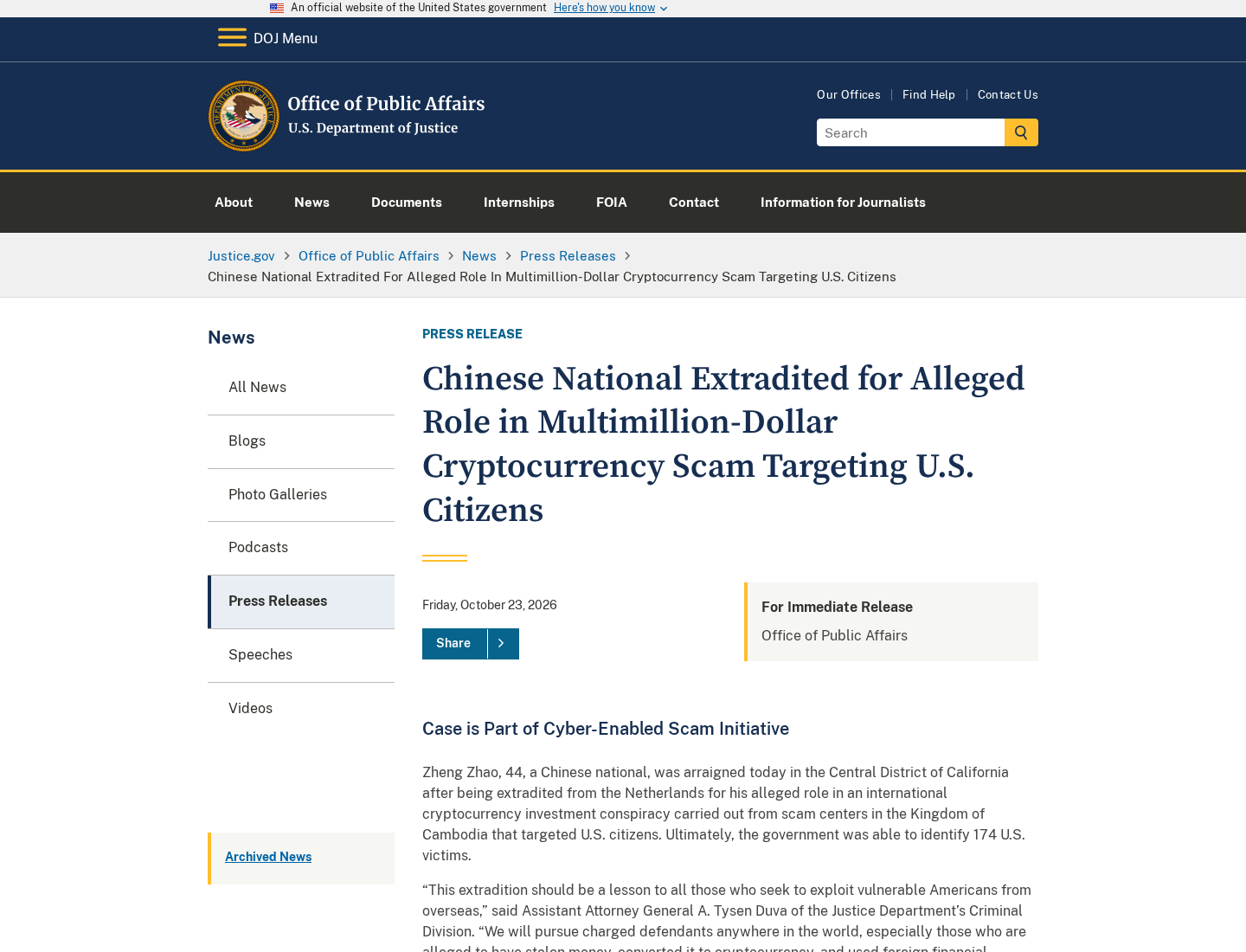
The Justice Department’s October 23 announcement concerns Zheng Zhao’s extradition from the Netherlands and arraignment in California over an alleged money-laundering role.
It identifies 174 US victims and describes more than $36.9 million moving from conspirator-controlled US accounts to an account in the Bahamas.
The supposed investment and the actual money trail
According to prosecutors, contacts promoted fraudulent digital-asset investments while websites made the arrangements resemble real cryptocurrency trading.
People were told their investments were appreciating. Prosecutors describe the funds instead passing through shell companies, bank accounts, and digital-asset wallets.
The announcement says funds were converted into USDT and transferred to a wallet controlled in Cambodia before further distribution.
What the case proves, and what it doesn’t
Zhao’s alleged role remains an accusation, not a conviction. The government says eight co-conspirators have pleaded guilty, but those outcomes cannot replace his individual trial.
The case illustrates several important distinctions:
- A realistic website is not proof that trades occurred.
- A bank transfer can fund a crypto-related fraud without the victim buying cryptocurrency directly.
- A familiar financial institution’s involvement doesn’t authenticate the person requesting payment.
- A screen showing gains is different from money under your control.
- An enforcement announcement doesn’t create an automatic refund for everyone with a similar experience.
Don’t send money to an investment introduced through an unverified personal contact. If you’ve already paid, stop further transfers and report the transaction trail.
The Important Detail: A Fake Platform Can Use Real Financial Rails
People often picture a crypto scam as a request to send coins to an unfamiliar wallet. This case describes a broader route.
Prosecutors say victims transferred funds to accounts controlled by co-conspirators. Those funds then moved through other institutions and were converted into digital assets.
For a reader, the practical lesson is that the first payment’s appearance doesn’t establish what happens afterward. A recognizable bank name isn’t an investment guarantee.
A transfer confirmation proves that your payment was processed. It doesn’t establish that the beneficiary bought assets for you or placed them in your account.
Likewise, an account titled in a company’s name tells you which beneficiary was supplied. It doesn’t independently establish that company’s role in the promised service.
Keep these documents because they matter to investigators. Just don’t mistake a document showing where you paid for evidence of a genuine investment.
How This Cryptocurrency Investment Scam Works
Step 1: An unsolicited contact starts a personal conversation
The Justice Department describes initial approaches through social media, telephone calls, texts, and online dating services. The aim was to gain the recipient’s trust.
That starting point matters because the investment arrives inside a relationship. The person may feel more familiar than a business advertising to strangers.
Knowing someone’s daily routine or hearing an encouraging story still doesn’t verify their professional role. Personal warmth and financial authority are separate questions.
If the conversation changes from getting acquainted to moving your savings, stop and assess that new request independently of the relationship.
Step 2: The contact introduces a digital-asset opportunity
The supposed opportunity gives the relationship a financial purpose. In the charged scheme, co-conspirators promoted fraudulent investments involving digital assets.
The attraction isn’t necessarily a mysterious coin. It can be the impression that someone you trust knows how to use a platform successfully.
Ask who actually operates the service, what assets would be held, and whose account receives payment. Don’t let a chat contact answer for every separate organization.
A person who supplies the opportunity, website, payment instructions, and reassurance controls your entire view of it. Look for confirmation outside that conversation.
Step 3: A website supplies the appearance of trading
Prosecutors describe fake sites resembling genuine cryptocurrency platforms. This provides a place for the victim to see an account and believe the arrangement is operating.
Buttons, charts, account numbers, and a help window can imitate a real service. Their presence doesn’t demonstrate custody, execution, or an independently held balance.
Before paying, find the operator through sources unrelated to the contact. Compare its genuine domain and contact details rather than trusting a link inside a message.
If a regulated firm is named, check the relevant official register and contact the firm independently. A matching name alone doesn’t authenticate the website using it.
Step 4: Money moves to accounts controlled by the network
According to the government’s account, victims transferred money into accounts controlled by co-conspirators, rather than receiving the investments they believed they were purchasing.
This is where the supposed trading relationship becomes a real loss. Your payment can clear even though the dashboard’s account is only an appearance.
Record the beneficiary name and account details exactly as supplied. If instructions change, retain both versions rather than replacing the earlier document.
Don’t send another transfer simply because someone says the first used the wrong reference. Contact your own bank about the original payment first.
Step 5: Claimed gains keep the story believable
Victims were told their investments were increasing in value, according to prosecutors. That claim encouraged confidence while the money was being taken.
The crucial question is not whether a displayed number looks plausible. It’s whether independently verifiable assets and access stand behind that number.
Don’t count an on-screen balance as available savings when deciding whether to borrow, liquidate other assets, or commit more money.
A separate FBI guide to cryptocurrency investment fraud explains how manipulated profits and later fee demands can sustain similar schemes.
Step 6: The proceeds are moved beyond the victim’s account
The charged network allegedly moved funds through shell companies, international accounts, and wallets. The announcement describes a Bahamas account and a Cambodia-controlled wallet.
These details explain the alleged money trail. They don’t mean that every transfer involving those countries, institutions, or USDT is fraudulent.
For someone who paid, the useful response is to preserve the exact transaction path they know. Don’t guess at later wallets or intermediaries.
Investigators can assess how your records fit the broader case. A stranger offering a guaranteed private recovery cannot replace that process.
Why the Criminal Case Must Be Described Carefully
An extradition is not a guilty verdict
Zhao was charged with conspiracy to commit money laundering in August 2025, according to the announcement. His October 2026 arraignment follows extradition, not a reported conviction.
The maximum potential sentence is not an imposed sentence. Describing it as punishment already ordered would give readers a false account of the proceedings.
Other defendants have separate outcomes
The government names ShengSheng He and Jingliang Su among people who pleaded guilty. Those are individual outcomes within the broader investigation.
They don’t establish that every alleged participant performed the same tasks. The contact recruiting a victim and someone moving proceeds can occupy different roles.
A named bank or token isn’t automatically an accused scammer
The announcement describes how money moved. Readers shouldn’t turn that description into an accusation that every financial service along the route knowingly operated the scheme.
Keep the warning attached to the deceptive solicitation, imitation platform, and alleged laundering conduct. That is clearer and more useful than blaming a payment technology.
Withdrawal Fees: A Related Warning, Not an Extra Fact About Every Victim
The FBI warns that crypto investment scams can demand taxes or fees before releasing a balance. Paying those demands doesn’t make the supposed account genuine.
The Zhao announcement doesn’t detail every victim’s withdrawal conversation. Don’t assume everyone in this case received the same tax demand or fee schedule.
If you encounter such a demand, treat it as a separate warning sign. Don’t send additional money to unlock funds displayed by an unverified platform.
Ask your bank or the genuine exchange you used about the payments already made. Use their established support channels, not a support link from the questionable site.
Nor should you accept a screenshot of someone else’s withdrawal as a substitute for verification. A picture doesn’t show who controls your funds.
What to Do if You Have Fallen Victim to This Scam
-
Stop every additional payment. Don’t increase the deposit, cover a withdrawal charge, or borrow money because the platform shows a profit.
You don’t need the contact’s agreement to pause. End the financial conversation and ask someone you trust to help you organize the next steps.
-
Contact the institution that processed your payment. For a bank transfer, report the beneficiary, amount, date, and reason you now suspect investment fraud.
Ask whether a pending transfer can be stopped or a completed payment recalled. Recovery isn’t guaranteed, but a prompt report gives the institution clearer information.
-
Preserve the route into the scheme. Save the original approach, profile address, username, telephone number, and investment instructions before blocking the contact.
Keep the platform’s full domain, account identifier, and payment confirmations. Note any app you were instructed to install without opening it again just for evidence.
-
Collect transaction identifiers, not just balance screenshots. For cryptocurrency payments, record the network, asset, amount, receiving address, transaction hash, and date.
Include the time zone shown on each record so transfers can be placed in the right order.
For bank payments, keep the bank’s receipt and beneficiary details. A displayed investment balance isn’t the same as a record of what actually left your account.
-
File a report at IC3.gov. Describe what happened in chronological order and supply the transaction information you have.
The FBI asks people to report even when records are incomplete. Explain any possible connection to this case without claiming investigators have already confirmed it.
-
Secure access that was actually exposed. If you shared a password, reused it elsewhere, or approved an unexpected login, protect the affected accounts through genuine recovery routes.
If someone obtained a wallet recovery phrase, seek help from the wallet provider’s authentic guidance. Never give that phrase to someone offering investigative assistance.
-
Verify anyone who contacts you about the case. An announcement naming victims can give an impostor a convincing reason to approach people with similar experiences.
Find the agency’s genuine contact route independently. Don’t pay an alleged investigator or move your money because a new caller claims that recovery requires it.
-
Keep updates with the original report. Add new account details or messages through the reporting agency’s instructions instead of starting an argument with the suspected network.
Don’t warn the contact about investigative steps. Let investigators decide what can be disclosed, and keep copies of every reference number you receive.
If a Friend Is Still Convinced the Balance Is Real
Begin with the transaction they are about to make. Ask them to wait while you examine the operator and payment instructions together.
Calling them gullible can make the relationship with the supposed mentor feel safer than the conversation at home. Focus on documents and practical questions instead.
Ask who legally holds the assets and where that fact can be checked outside the site. Don’t treat another screenshot as an answer.
Offer concrete help: find the bank’s actual number, arrange the payment receipts, or sit beside them while they submit a report.
If money has already gone, avoid presenting another payment as their chance to make the loss disappear. Stopping further transfers is a meaningful first success.
Frequently Asked Questions
What is the $36.9 million cryptocurrency investment case?
It concerns a network described by US prosecutors as using imitation trading sites and trust-building contacts to obtain funds from 174 identified US victims.
Has Zheng Zhao been convicted?
The October 23 announcement reports extradition and arraignment over an alleged laundering role. It says he remains presumed innocent unless proven guilty.
Did victims have to buy cryptocurrency themselves?
Not necessarily. Prosecutors describe payments into conspirator-controlled bank accounts and subsequent conversion of proceeds. A bank transfer can be part of a crypto-related fraud.
Does the case mean USDT or every named bank is a scam?
No. A description of the payment route doesn’t make every asset or institution on that route responsible for the deceptive investment pitch.
Can I pay a fee to release my investment balance?
Don’t pay an unverified platform to unlock supposed profits. The FBI warns that tax and fee demands can be another stage of cryptocurrency investment fraud.
Does the extradition mean my money will be refunded?
No automatic repayment follows from the announcement. Report your circumstances and transaction details through official channels, and reject anyone selling a guaranteed connection to the case.
The Bottom Line
Don’t fund an investment because an online contact recommends it or a dashboard shows gains. Verify the operator independently before giving it control of your money.
If you’ve already transferred funds, stop paying, notify your bank or genuine exchange, and report the transaction trail to IC3. Don’t buy a supposed recovery.
The case’s lesson is concrete: a convincing screen can tell one story while your money follows another. Payment records matter more than promised profits.

Join the discussion
0 commentsShare your experience or ask a question about this article.
Discussion
Start the conversation
Have a question or something useful to share? Add the first comment.