

Your trip is approaching, your passport needs attention, and a search result seems to offer exactly the help you need. You click before checking who runs it.
That small decision can change what you’re buying. The GovAssist and Entry case shows why a passport-looking website deserves more than a quick glance.
Overview
The FTC case concerns government impersonation allegations
The Federal Trade Commission has sued GovAssist LLC, Entry LLC, and Scott Zuckerman over passport-service advertising and related practices.
The agency alleges that paid search ads and landing pages made travelers believe they were dealing with the federal government or an affiliated passport provider.
Its complaint also challenges prices, delivery promises, and reviews. These are allegations for a court to decide, not a final judgment against the defendants.
A service charge is not the government passport fee
According to the FTC, advertised starting prices of $89 concealed a minimum service costing $119 plus $29 shipping, with government charges still separate.
In some cases, the agency says, customers received a completed application form rather than the passport they expected. Free government forms and paid assistance aren’t interchangeable.
Those figures describe the challenged offers. They shouldn’t be mistaken for a verified quote covering every option sold on the current websites.
The current Entry website makes important disclosures
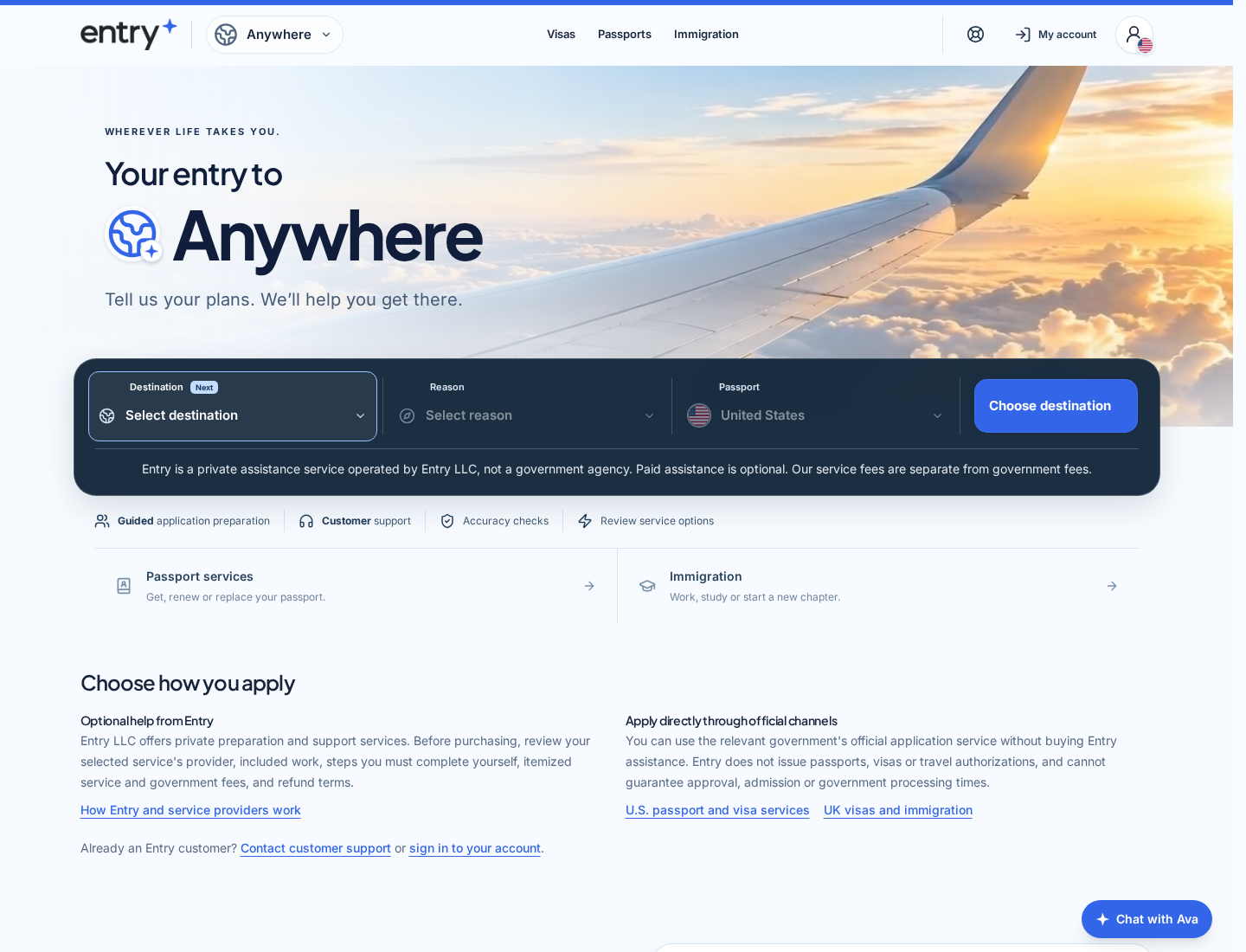
Entry’s current homepage explicitly calls its assistance private and optional. It says its service fees are separate from government fees.
It also says Entry doesn’t issue passports or guarantee government processing times. Readers should know that, rather than being shown an outdated description of today’s page.
- The FTC case addresses alleged advertising and business practices.
- Only the government can issue a US passport.
- A private preparation fee may leave official fees unpaid.
- Completing a form is not the same as submitting an accepted application.
- Today’s disclosures don’t resolve what earlier customers were told.
What Travelers Need to Understand Before Paying
When people search for passport renewal, they usually want a result: an application accepted and a usable passport delivered before travel.
A private company may sell something narrower, such as help preparing documents. If that distinction isn’t clear before payment, the customer can misunderstand the entire transaction.
Consider the word “application.” It can mean a blank form, a completed draft, a package awaiting signature, or a submission the government has actually received.
Those stages require different actions from you. Paying a preparation service doesn’t necessarily move your application from the first stage to the last.
The same applies to “expedited.” Ask whether it describes the company’s work, courier delivery, or the government’s processing. Faster postage doesn’t determine when a passport is approved.
If a departure is close, that distinction is especially important. An attractive delivery estimate can distract from the steps you still have to complete yourself.
How the Passport-Service Sales Funnel Works
Step 1: A sponsored result meets an urgent search
The FTC says the defendants bought Google ads for searches concerning new passports and renewals. Sponsored placement put those services where travelers might expect official results.
Paying for an ad is not itself evidence of wrongdoing. The issue is whether its presentation causes people to misunderstand who is offering the service.
Before opening an application, examine the actual destination. A paid result can appear above the government page without having any authority to issue documents.
If you’re already rushed, start a fresh visit to the State Department’s passport website. That removes the search advertiser from the decision.
Step 2: The page defines what the customer thinks they are buying
A person expecting a government application may interpret official-looking language differently from someone knowingly shopping for private administrative help.
The FTC’s allegation is that the challenged operation encouraged the first impression. Entry’s current homepage, however, expressly identifies a private service.
Read that distinction before entering your personal details. Ask what the company will deliver, what it cannot do, and which steps remain your responsibility.
Don’t assume a passport image, polished form, or familiar travel terminology answers those questions. Look for the actual description of the service being purchased.
Step 3: A private fee is collected separately from official charges
The agency’s stated minimum of $148 combines a $119 service and $29 shipping charge. It alleges that additional government fees weren’t explained clearly enough.
That creates a practical problem beyond the initial cost. A customer may believe the passport is paid for when the official application still requires payment.
Keep an itemized record separating preparation, shipping, government fees, and any optional extras. Don’t rely on a single total described simply as a passport charge.
If the seller cannot explain where each payment goes, don’t continue. A government fee and a company’s fee should be distinguishable before you authorize either.
Step 4: Delivery promises shape the customer’s travel decisions
The complaint challenges promises of passports in as little as three to four or six to ten business days. Those are the FTC’s allegations about the offers.
A traveler hearing such a promise may buy a flight or postpone contacting an official passport agency. That can make unclear wording costly even before departure.
Check your actual route through government guidance. Urgent appointments, ordinary processing, online renewal eligibility, and document requirements are separate matters.
Don’t treat a private company’s preparation deadline as confirmation of a government appointment or issuance date. Ask for the precise event the deadline describes.
Step 5: The customer must establish what actually happened
After payment, the useful question is concrete: do you have a prepared form, a submitted application, or a government acknowledgment?
Compare the company’s order confirmation with any official application record. An internal order number isn’t automatically a State Department application locator.
If further signatures, photographs, documents, or official fees remain necessary, don’t assume the company has completed them. Clarify responsibilities promptly.
At the same time, save the original promises. If you seek a refund or dispute a charge, the offer you accepted matters more than later explanations.
GovAssist, Entry, and the Limits of a Private Passport Service
The named businesses are not federal offices
The FTC announcement names GovAssist LLC, Entry LLC, and owner Scott Zuckerman. It identifies GovAssist.com, Entry.com, and IVS.us among the websites involved.
Those names describe the entities and sites in the agency’s case. They don’t make the companies part of the State Department.
Entry’s current page makes that separation explicit. A reader who still believes they are applying directly to the government should stop and use the official route.
Current disclosures must be separated from earlier advertising
The homepage now says paid help is optional and that travelers may apply directly through government channels. That is a material disclosure, not something to omit.
It doesn’t tell us what every earlier advertisement said or when each disclosure appeared. The court case and the present website answer different questions.
If you already paid, preserve the ad and order page you actually saw. Don’t assume a current homepage screenshot reproduces the terms of your transaction.
Paperwork assistance is not passport-issuing authority
The State Department’s courier guidance explains that private companies charge extra and are not part of the department.
Some couriers are registered to submit and collect documents. That limited role doesn’t give a company authority to approve an application or issue a passport.
Don’t confuse a real business, a courier arrangement, and government affiliation. Each describes something different, and none should be silently substituted for another.
Support must explain the order, not just repeat a promise
Contact the provider identified on your receipt about the service you bought. Ask which work is complete, what remains outstanding, and how cancellation applies.
Keep the answer in writing. If you sent original documents, ask where they are and how they will be returned before sending anything else.
A company’s reply can clarify its own work. It still cannot replace confirmation from the government about an application the government is processing.
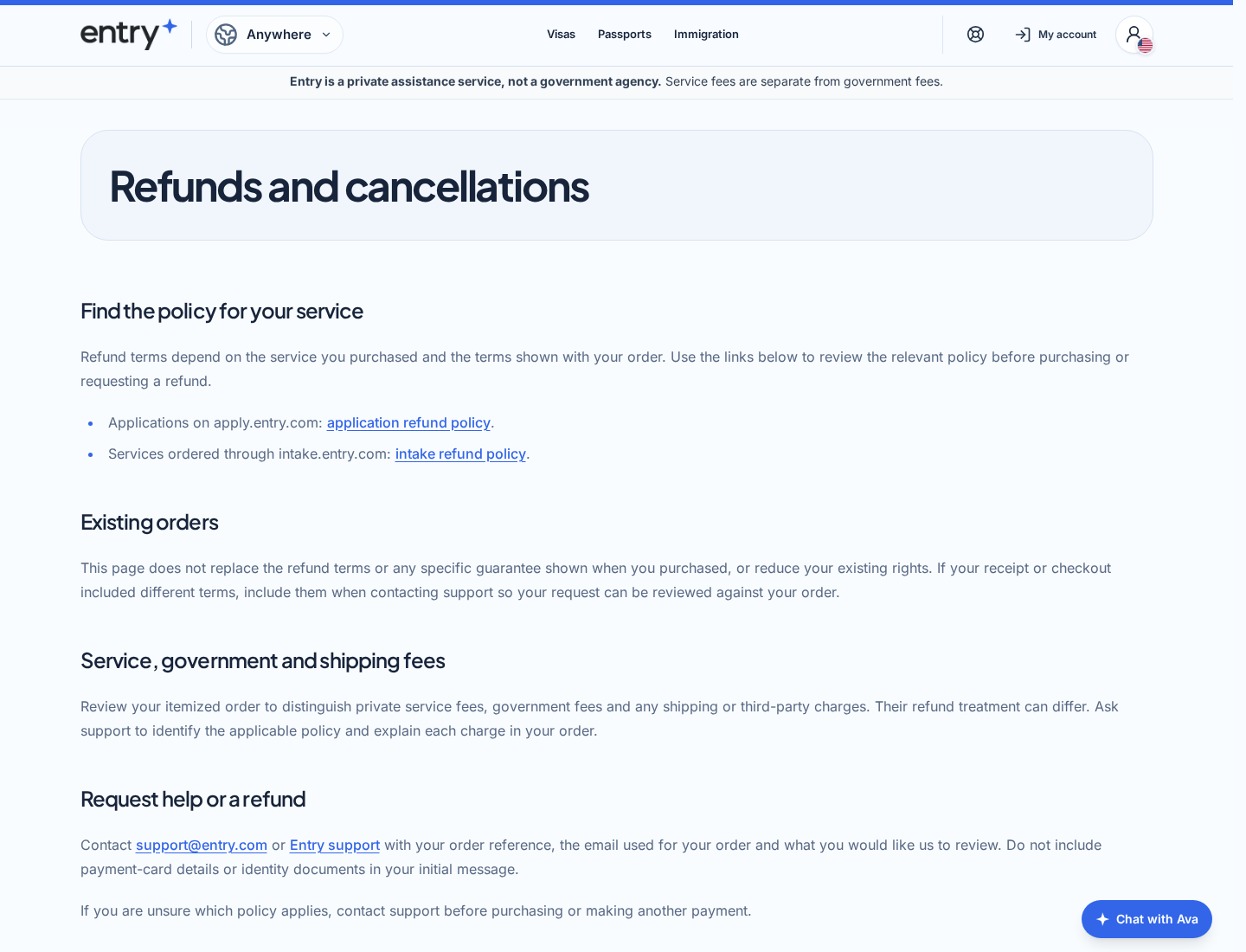
Entry’s current refund page separates applications handled through different order routes. It says the applicable policy depends on the service and terms shown with the purchase.
That makes your receipt important. Ask support to identify the relevant policy instead of assuming one refund window covers every Entry order.
The page also distinguishes private fees, government fees, and shipping. Keep those amounts separate when describing what you want refunded.
Reviews and Search Rankings Cannot Verify Government Affiliation
The FTC also alleges that fake positive reviews made the services appear trustworthy. A rating claim can influence a rushed decision without explaining the underlying purchase.
Even authentic praise wouldn’t establish authority to issue passports. Someone can be satisfied with form assistance while another customer mistakenly expects a government service.
Ask whether a review describes the outcome you need. Receiving a completed form, helpful support, and a passport are not the same experience.
Likewise, a high search position says where a page appeared, not who approved it. Don’t use placement as a shortcut for checking the provider.
You don’t need to investigate every reviewer to make a safe choice. Start with the official application route and decide whether you need optional private help afterward.
What to Do If You Paid for Passport Assistance
-
Identify the purchase before making another payment. Read the receipt for the merchant, exact service, charges, and any outstanding government fees.
Write down what you expected and what arrived. A prepared document may be a real deliverable without being the passport service you believed you purchased.
-
Check application progress through official channels. Use the State Department’s own passport information, not a link supplied by an unexpected follow-up caller.
Don’t submit a second application automatically. Establish what, if anything, was already submitted and follow official instructions for your situation.
-
Request cancellation or a refund in writing. Give the order number and explain the difference between the advertised service and what you received.
Ask the provider to identify any work it says prevents a refund. Save its reply alongside the refund terms that accompanied your purchase.
-
Contact your card issuer if the dispute remains unresolved. Supply the receipt, advertisement, promised timeline, actual deliverable, and your efforts to resolve the issue.
Describe the transaction accurately, including whether you authorized the payment. Ask about applicable dispute deadlines rather than assuming the FTC case guarantees reimbursement.
-
Assess which personal information you disclosed. Distinguish a name and email from passport details, identity documents, or financial information.
If information was misused or you suspect identity theft, use IdentityTheft.gov for a recovery plan. Don’t assume every private application automatically caused identity theft.
-
Resolve an approaching departure separately. Check official urgent-service instructions and appointment availability rather than paying another advertiser for an unsupported guarantee.
Don’t purchase a supposed government appointment from an unsolicited contact. Keep travel decisions separate from promises the provider hasn’t fulfilled.
-
Report the specific advertisement or conduct. ReportFraud.ftc.gov accepts reports about misleading business practices. Include dates, domains, amounts, and the claims that influenced your purchase.
A report helps describe the conduct. It is not the same as submitting a refund request, joining a court case, or receiving a compensation award.
What to Check on Your Next Passport Search
Before filling anything out, decide whether you want the government’s application or optional help from a private company. Choose the route deliberately.
Start at the genuine State Department passport website. Read the requirements for your age, passport condition, travel timing, and renewal eligibility.
If you still consider private assistance, require a written account of its role. The description should make sense without relying on official-looking graphics.
Check the full price, government charges, deliverables, refund rules, document custody, and tasks you must complete. Don’t give up those answers because departure feels urgent.
Most importantly, preserve your ability to verify progress independently. A paid intermediary shouldn’t be your only source of information about your own passport application.
Frequently Asked Questions
Are GovAssist and Entry government passport offices?
No. The FTC names private businesses, and Entry’s current homepage expressly says its assistance is private and optional, with government fees separate.
Has the FTC case already established liability?
The announcement describes a filed complaint and allegations. Those allegations are for the court to decide; they should not be presented as a final judgment.
Does the reported $148 include the government passport fee?
The FTC describes $119 plus $29 shipping for the challenged private service, with official charges separate. Check your own receipt rather than assuming identical pricing.
Is every private passport courier a scam?
No. Some couriers have legitimate document-handling roles. They remain private businesses, charge extra, and do not become government passport issuers.
Can I still need to submit documents after paying?
Yes. Your purchase may cover preparation rather than a completed government application. Establish which signatures, documents, photographs, and payments remain necessary.
Will the FTC automatically refund my order?
Don’t assume so. Request a remedy from the provider and discuss an unresolved charge with your payment issuer. A complaint announcement isn’t an individual refund confirmation.
The Bottom Line
Don’t pay a private site because you think it is the government or can issue your passport. Start with the official State Department route instead.
If you already paid, establish what was actually delivered and what remains outstanding. Pursue a refund or payment dispute with the advertisement and receipt in hand.
The FTC’s allegations are serious, and current disclosures deserve fair reporting. Neither changes the essential decision: know whose service you’re buying before supplying money or documents.

Join the discussion
0 commentsShare your experience or ask a question about this article.
Discussion
Start the conversation
Have a question or something useful to share? Add the first comment.