


Money arrives from someone you do not recognize. A message follows almost immediately: they made a mistake, and they need you to put it right.
Returning it sounds like the decent thing to do. Before you tap Send, though, there is an important difference between returning a payment and making another one.
Overview
The incoming money and your outgoing transfer are separate events
The Cash App accidental payment scam turns a request for help into a new transfer. A stranger says money reached you by mistake and wants it back.
In the fraudulent version, the original funds may come from a compromised account. A later reversal can remove that credit after you have already paid the stranger.
Your outgoing transfer does not necessarily reverse the incoming one. It can become a separate loss, particularly when the requested destination is another account.
Cash App describes this pattern in its official scam guidance. The platform is being used for the transfers, not identified as the criminal behind them.
A real mistake is possible, which is why the process matters
Someone can genuinely choose the wrong recipient. An unfamiliar name or unexpected payment is a reason to investigate, not proof that every sender is dishonest.
You don’t have to judge a stranger’s intentions in chat. Ask official support to check the payment instead of accepting the requester’s repayment instructions.
Do not spend the unexpected balance or move it elsewhere while its status is being checked. Treat it as unresolved money, not a surprise gift.
The safest response avoids a fresh person-to-person payment
- Confirm whether an incoming payment exists in your own account.
- Leave the disputed amount alone while contacting official support.
- Never follow a stranger’s request to repay a different account.
- Distinguish a refund attached to the original transaction from a new transfer.
- Keep messages and payment identifiers if pressure or threats begin.
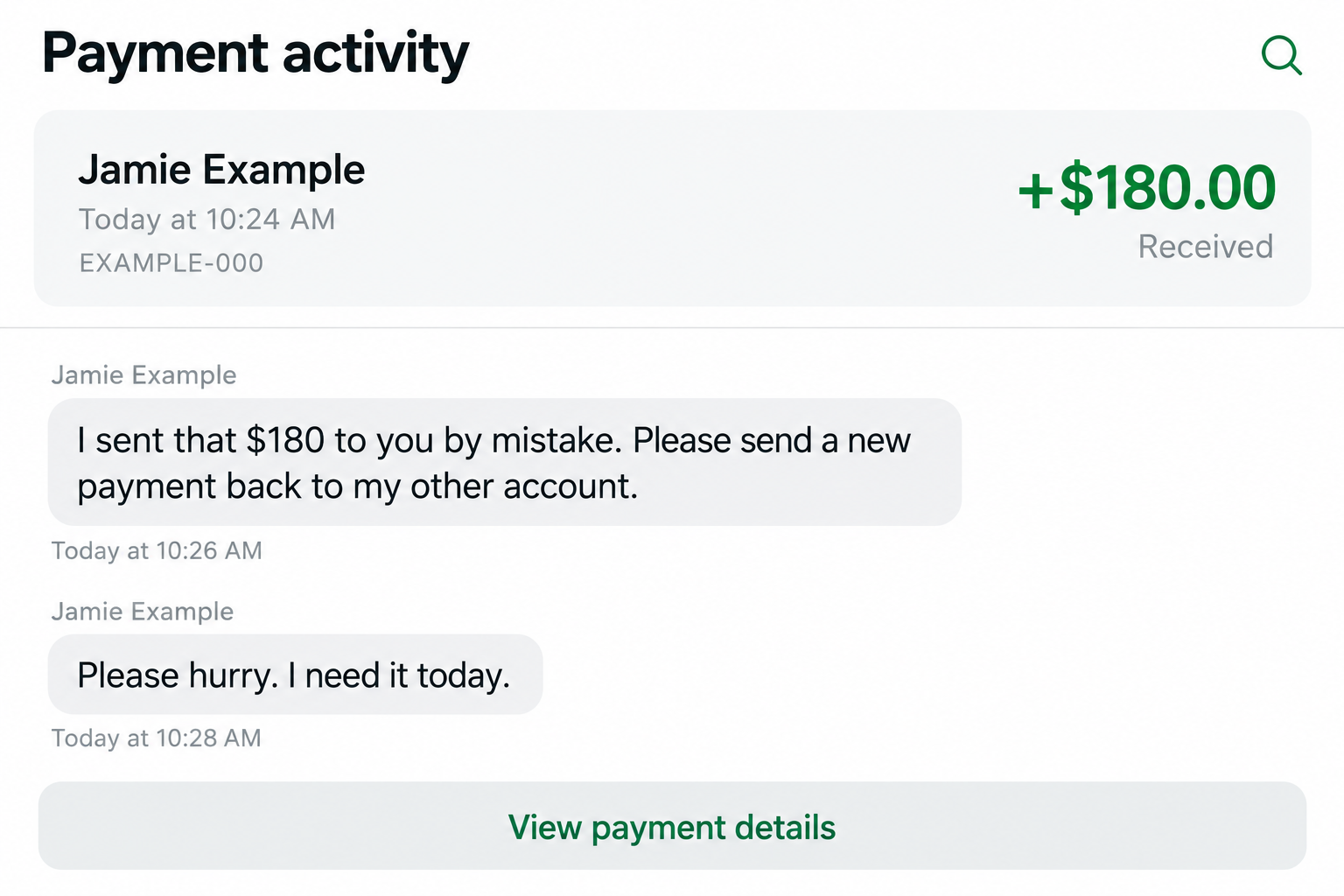
The screen above is a fictional interface example. Its name, amount, and messages illustrate the decision point; they are not a captured conversation or authenticated transaction.
Why an Unexpected Deposit Can Feel More Trustworthy Than a Request
Most people recognize a stranger asking for free money as suspicious. Someone who appears to have sent money first creates a very different impression.
You may feel that you are holding something that belongs to them. A quick return seems considerate, and hesitation can feel unfair.
The scam relies on confusing a moral intention with a payment instruction. Wanting to correct a mistake does not make every suggested way of correcting it safe.
The sender may sound embarrassed, apologetic, or desperate. They might say the money was meant for rent, groceries, or a relative waiting for help.
Those details can explain why you feel rushed. They cannot establish who funded the payment or whether another person’s account has been misused.
A legitimate error deserves proper handling. Waiting for the platform to check it is not the same as refusing to return someone else’s money.
How the Cash App Accidental Payment Scam Works
Step 1: An unfamiliar payment gets your attention
You see an incoming amount associated with someone you do not know. The surprise itself encourages you to inspect the account and respond.
Start by separating a real account entry from an email or text claiming money arrived. A notification outside the app may be entirely fabricated.
If no incoming transaction exists in the independently opened account, there is no verified deposit for you to return. Do not use a message link to investigate.
If the transaction is real, that confirms an entry, not the sender’s explanation. The funding source and final handling may still need review.
Step 2: The sender supplies a believable explanation
A message says a name, number, or recipient was entered incorrectly. The person asks you to help because they supposedly cannot fix it themselves.
A simple typo is plausible. Payment apps are familiar, quick to use, and easy to associate with casual exchanges between friends.
The story may contain enough detail to sound personal without giving you anything independently verifiable. A display name is not proof of the account holder’s identity.
You can acknowledge that support should resolve the issue without confirming your address, balance, linked bank, or other private details to the sender.
Step 3: You are asked to create a new payment
This is the critical change. Rather than letting the platform handle the original transaction, the person wants you to select a recipient and press Pay.
They may request the same amount, part of it, or repayment through another service. A different recipient can be explained as their preferred or working account.
That explanation should not become your instruction. You cannot verify an account connection merely because one stranger says two profiles belong to them.
A transfer you initiate has its own recipient, authorization, and payment record. Calling it a return in the chat does not necessarily connect it to the original credit.
Step 4: Urgency makes the ordinary support route seem unreasonable
The sender may insist that waiting will cause a missed bill or another immediate problem. Your hesitation becomes the focus instead of the payment’s status.
Pressure sometimes turns into accusations. A person may claim you are stealing, threaten to expose you, or demand personal information to supposedly open a case.
Do not let a threat drive a second financial decision. Keep the messages and move the matter to official support or appropriate authorities if necessary.
You do not need to negotiate a deadline with the sender. Explain once that you are asking the platform to handle the disputed transaction.
Step 5: The original funds can be challenged or reversed
The account that funded the incoming payment may not belong to the person messaging you. Its owner or financial provider can identify unauthorized activity later.
If the incoming credit is removed, the new payment you sent does not automatically disappear with it. That mismatch creates the financial exposure.
There is no universal countdown after which unfamiliar funds become safe. A displayed balance and a quiet few days are not a substitute for resolving the issue.
The National Cybersecurity Alliance explains why returning money through a new transaction can separate your funds from the original compromised payment.
Step 6: A helpful gesture becomes a dispute about two transfers
By the time you notice the loss, the sender may stop answering. You are left explaining both the unexpected receipt and the payment you approved afterward.
Keep those records together, but describe them separately. Support needs to know which transaction you received and which one the stranger persuaded you to send.
If another person offers to recover the money for a fee, do not repeat the pattern. A further payment can create another loss rather than resolve either transaction.
A Simple Example of the Risk
Imagine an unfamiliar $180 credit appears. The sender then asks for a new $180 payment to another profile, saying their first account has a problem.
After you send it, you may feel that the two amounts cancel each other out. You received $180 and returned $180, so everything seems balanced.
But the payment records do not necessarily describe a single reversed transaction. One is an incoming credit; the other is your separately authorized outgoing transfer.
If the initial $180 is subsequently removed, the second payment may still stand. Depending on the account’s handling, you can lose money or face an unresolved balance.
This is an illustrative calculation, not a prediction about every transaction. It explains why matching amounts do not guarantee matching protections.
Sending a smaller amount is not a safe compromise. It still puts your money into a new transfer while leaving the original payment unresolved.
Refund, New Payment, and Payment Request: Do Not Mix Them Up
A refund belongs to the payment being corrected
Cash App’s published guidance points users toward refunding the original transaction when a return is needed, rather than sending an unrelated payment.
For suspicious funds, contact support first and ask which action is appropriate. A refund option is not a guarantee against every dispute or reversal.
If a review or reversal has already started, tell support before doing anything else. You want one correctly handled correction, not multiple overlapping attempts.
A payment request is not money received
An incoming request can display a name and amount prominently. Accepting it may mean you pay the requester, not that you receive or acknowledge a deposit.
Read the direction of the action before approving it. If the interface is unclear, stop rather than treating an unfamiliar button as a harmless confirmation.
A new transfer follows the recipient you select
Changing the destination changes the financial event. A request to send the amount to another app, person, or account deserves particular caution.
Do not accept a small reward for forwarding the funds. A promise that you can keep a portion does not establish ownership of the original money.
What to Do if You Have Fallen Victim to This Scam
-
Pause all movement of the disputed money.
Do not withdraw it, spend it, forward it, or send another amount to satisfy the requester. Leave any remaining funds available for the provider’s instructions.
If you already paid the stranger, a second transfer will not undo that decision. Stop while you establish which transactions need review.
-
Collect the two sides of the exchange.
Save the original receipt, your outgoing payment details, the sender’s profile, and messages requesting repayment. Record any different account or payment service they supplied.
Include the order of events. A timeline showing the deposit, request, and new transfer can be more useful than disconnected screenshots of balances.
-
Ask Cash App to investigate the incoming transaction.
Reach support from the app you normally use. Explain that an unknown sender claimed a mistake and asked you to make a separate return payment.
Ask how to handle the original credit without duplicating a refund or interfering with an existing investigation. Keep the case reference and written guidance.
-
Report the money you actually sent.
If you approved a transfer, identify that transaction separately. Explain the deception that led to it and ask whether cancellation or recovery remains possible.
Do not describe an authorized payment as something you never made. Accurate details help the provider choose the appropriate investigation.
-
Notify the bank or card issuer connected to the loss.
Use its independently obtained fraud contact. Tell the representative whether money came from your app balance, a linked account, or a card.
The FTC’s recovery advice is to ask the relevant provider about reversing scam payments. Available remedies vary, and reimbursement is not assured.
-
Address any information you disclosed.
Receiving money alone does not prove someone accessed your account. If you also supplied a sign-in code, PIN, or linked-email access, tell support immediately.
Secure the affected accounts through their real recovery channels. Do not respond to a new caller who claims another security code will cancel the incident.
-
Report pressure, threats, and the suspected fraud.
Preserve threatening messages before blocking the account. If you feel physically unsafe or a threat is immediate, contact the appropriate emergency or local police service.
For the financial deception, submit the account and transaction information to the relevant national reporting service. Keep private account details out of public complaint posts.
-
Use only independently reached help going forward.
The FTC lists Cash App’s support routes. Open those yourself instead of calling a number supplied by the requester.
Be wary of anyone promising to trace or release the funds after a deposit. Your support case should not require paying an unsolicited recovery agent.
Frequently Asked Questions
Is every unexpected Cash App payment a scam?
No. Genuine mistakes happen. The safe approach is to verify the payment and let official support guide its return, rather than deciding through a stranger’s messages.
Can the deposit be real and the repayment request still be fraudulent?
Yes. An actual credit can originate from a compromised funding source. Its presence does not prove that the person requesting a new payment owns the money.
Why is sending it to the same person still risky?
A new transfer can remain separate from the original transaction even when the names match. Ask support about the correct refund process instead of assuming the payments cancel.
Should I keep or spend money a stranger sent?
No. Leave it untouched while the platform investigates. Uncertainty about the sender does not turn disputed funds into money you should treat as yours.
Does a refund button guarantee there can be no further loss?
No. A transaction-linked refund differs from a new payment, but suspicious or disputed funds still need support guidance. Avoid making duplicate corrections.
Do I need a malware scan just because money arrived?
Not on that fact alone. Focus on the payment and any information you shared. Device cleanup becomes a separate concern if you also installed untrusted software.
The Bottom Line
Do not make a new Cash App payment to fix an unfamiliar deposit. Keep the money untouched and ask official support to resolve the original transaction.
If you already sent funds back, document both transfers and report the outgoing payment promptly. A stranger’s urgency should not control the next step.

Join the discussion
0 commentsShare your experience or ask a question about this article.
Discussion
Start the conversation
Have a question or something useful to share? Add the first comment.