


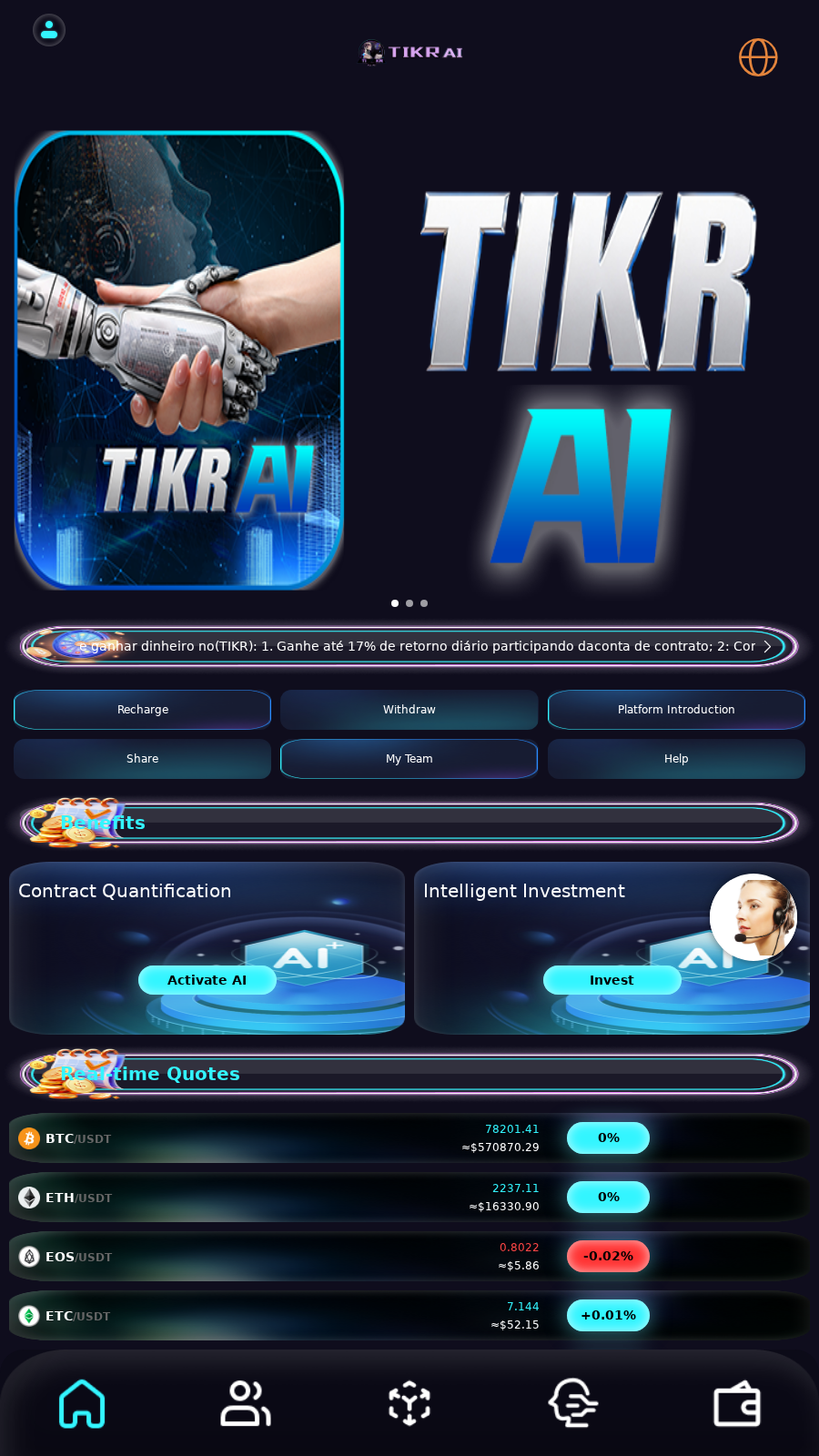
The page looks ready for business: crypto prices, a withdrawal button, an AI feature, and a counter describing years of safe operation.
Then a message explains the ways you can earn. If you’ve been sent a TIKR AI link, that message deserves your attention before you deposit anything.
Overview
The public pitch promises extraordinary daily returns
The TIKR pages at tikrx.shop and tikrgo.shop advertise a crypto earning opportunity using AI and contract terminology. They include recharge, withdrawal, investment, and team features.
A Portuguese promotional message describes returns of up to 17% daily for a contract account. It also advertises 46% daily for certain cycle products.
Those figures are promises made by the page, not payments independently confirmed here. They are far beyond a reasonable assumption of dependable investment income.
Recruiting and deposits are part of the same invitation
The same message encourages participants to share referral links and have friends recharge their accounts. It advertises a 10% commission connected to those recharges.
It also mentions creating chat groups to promote the project and earn bonuses. The opportunity is therefore not presented as private investing alone.
Someone sending you the link may have a direct incentive to bring you in. That matters even when the recommendation comes from a familiar person.
The practical reasons to keep your money out
- A percentage displayed by an app does not identify the revenue available to pay it.
- Recruitment commissions can reward bringing in deposits before an investment strategy has been explained.
- A withdrawal button is a control on a page, not a completed withdrawal into your own wallet.
- Platform counters and trading-style graphics do not establish custody, reserves, or an accountable counterparty.
Do not deposit into this TIKR AI offer. Its extreme daily-return pitch and recruitment incentives are not a sound basis for entrusting cryptocurrency.
What the Daily Figures Would Mean in Ordinary Money
It helps to stop looking at the percentage and imagine the obligation behind it. A simple 17% daily payment on 1,000 units would be 170 units.
At 46%, the daily amount would be 460 units. These examples explain the advertised arithmetic; they are not a forecast that a participant will receive anything.
Even the smaller figure would require an exceptional stream of money to keep arriving. A label such as intelligent investment does not explain that stream.
Ask what produces the return, who bears losses, and how the operator could meet withdrawals during difficult markets. The answer needs more than an animation.
Do not assume that a claim involving USDT is risk-free because the payment asset is a stablecoin. The service receiving it is a separate source of risk.
Nor should you assume the advertised rate compounds automatically. A simple daily percentage, reinvestment schedule, product term, and repayment of principal are different contract questions.
The public message does not settle all those questions. That is not an invitation to send a test deposit to discover the answers.
How the TIKR AI Investment Funnel Works
Step 1: A trading-style homepage makes the opportunity feel familiar
The page shows cryptocurrency pairs and market-style figures alongside controls for investing and withdrawing. It resembles the tools a person expects around a financial account.
That appearance can make the offer feel less experimental. But market information can be displayed separately from whatever happens to customer deposits.
Seeing a Bitcoin price does not tell you where your USDT would be held, who can move it, or what legal claim you would have.
Start with those questions rather than treating a professional-looking dashboard as the answer.
Step 2: Contract and AI labels turn a deposit into an earning story
The homepage includes contract quantification, an AI activation feature, and an investment area. The promotional message supplies the exceptional daily percentages.
These labels give the process a technical vocabulary without showing the reader an independently audited explanation of the promised income.
An AI system can analyze information and still lose money. Calling an activity intelligent does not remove market, custody, operational, or counterparty risk.
Before considering any investment, you would need its actual agreement and loss conditions. Here, the published headline promises already justify stepping away.
Step 3: Recharge language makes adding money feel routine
The word recharge is common in games, telephone plans, and prepaid services. It can make an irreversible transfer feel like topping up an ordinary balance.
But adding cryptocurrency to an investment platform is not the same as buying a small prepaid service. You may surrender control of the transferred asset.
Keep the transfer separate from any balance later displayed in the app. A number assigned to your account is not necessarily money you can retrieve.
Check the network as well as the asset when documenting a transfer. Different networks can use similar-looking token names, while a transaction reference identifies a particular movement.
Save that reference from your sending wallet or exchange, not only from the receiving platform’s history. An independent record remains useful if access to the site changes.
No account was opened or funded for this article. The warning concerns the public offer, not a claim that a particular withdrawal test failed.
Step 4: A referral reward draws other people into the decision
The advertised 10% referral commission connects a recommendation to another person’s recharge. Group-promotion bonuses add a further reason to circulate the invitation.
That can change a financial question into a social one. A participant may feel that doubting the offer means doubting a friend.
Separate the relationship from the transaction. Someone can sincerely believe the opportunity works while lacking the information needed to assess its obligations.
Do not recruit others to recover your own outlay. Passing on the exposure is not a solution to an unclear withdrawal or a disappointing balance.
Step 5: A growing balance can encourage another commitment
If a platform credits daily earnings, the visible increase can make a larger deposit seem less risky. That feeling can arrive before any meaningful repayment.
The useful comparison is what left a wallet you control and what returned to one. Internal credits should be recorded separately.
If anyone later asks for a new activation, tax, or account-release payment, stop and obtain independent help. That would be another proposed transaction.
Such demands are a common danger in online investment fraud, not a fee this article independently observed on a funded TIKR account.
TIKR Operator, Custody, Promotion, and Withdrawal Checks
Identify the party receiving the transfer
The public pages examined do not provide a sufficiently clear contracting identity alongside the earning pitch. A project name alone does not identify who owes you performance.
Before money moves, the legal entity, jurisdiction, agreement, and permitted financial activity should fit together. A referral contact cannot substitute for that information.
Do not assign responsibility to another business merely because it uses TIKR in its name. This warning concerns the two domains identified above.
Separate platform access from control of the funds
A login lets you interact with a service. It does not necessarily give you the private keys or signing authority over the receiving cryptocurrency address.
Likewise, a password reset can restore account access without restoring the ability to withdraw. Those are different dependencies.
A custody explanation should identify who controls transfers, what safeguards apply, and how assets are treated if the service stops operating.
Ask who benefits from the invitation
The promotional text expressly connects referrals with recharges. Someone explaining the offer should disclose whether they stand to receive that advertised reward.
A group administrator’s confidence, audience size, or frequent updates do not establish an independently profitable strategy. They show that someone is promoting the opportunity.
A disclosed incentive makes a recommendation easier to evaluate. It still leaves the operator responsible for explaining the investment, rather than delegating that explanation to enthusiastic participants.
Treat activity counters as claims, not protection
The pages display a safe-operation day count and a large total-income figure. Neither supplies the records needed to validate the platform’s history or financial position.
A meaningful track record would involve identifiable operations and independently checkable performance, with losses and limitations included rather than only a reassuring total.
Do not convert the presence of a counter into a guarantee that your own funds will remain available.
Why an Early Payment Would Not Settle the Question
A small withdrawal can be persuasive because it is more concrete than a dashboard. It still cannot explain how the whole offer is funded.
The amount, source, and conditions of a payment matter. A service could return a small amount while a participant commits substantially more later.
That is why testing with money you can afford to lose is not the right recommendation for this pitch. It risks becoming the opening step toward a larger exposure.
Nor does someone else’s receipt guarantee your outcome. It may concern a different date, amount, product, destination, or account condition.
The question is not whether any transfer could occur. It is whether the advertised obligations have a credible, sustainable, and accountable basis.
For the offer presented on these pages, we would not take that risk or recommend that you do so.
What to Do If You Used TIKR AI
-
Stop adding cryptocurrency. Pause fresh deposits, reinvestments, product upgrades, and invitations to friends while you assess your position.
Money already committed should not decide the next payment. A larger deposit does not make an earlier balance safer.
-
Write down the actual cash flow. Record each asset sent, the amount, date, network, transaction hash, receiving address, and any amount returned.
Keep internal earnings separate. This gives you and a reporting agency a clearer picture than a screenshot of a single combined balance.
-
Save the offer that brought you in. Retain the domain, referral link, messages, rate claims, group invitations, and terms supplied to you.
Include the exact person or account requesting a transfer. Do not post private conversations, identification documents, or financial details publicly when asking for help.
-
Contact the sending exchange or payment service. Explain the investment pitch and provide transaction references to its fraud or compliance team.
Ask whether it can flag a receiving address or guide a report. A completed blockchain transfer cannot normally be canceled like an unprocessed payment instruction.
-
Request clear withdrawal information in writing. Identify the balance, asset, destination, and condition you want explained.
Do not send extra money to satisfy a supposed release requirement. Preserve any such demand and discuss it with the sending provider or appropriate authorities.
-
Secure reused account credentials. Replace any password also used on email, an exchange, or another financial service. Review unfamiliar sessions where available.
If you separately exposed a wallet recovery phrase, treat that wallet as compromised. Seek help through the genuine wallet provider, not a stranger offering recovery.
-
Report the exact solicitation. Include the domains, payment addresses, promotional statements, and a chronological explanation of your interaction.
US readers can use IC3. Elsewhere, contact the relevant police or financial regulator through an independently found official channel.
-
Refuse guaranteed recovery offers. Someone who recognizes the platform or knows your loss may still be attempting a second scam.
Never pay a recovery stranger, disclose a private key, or install remote-access software to unlock a promised reimbursement.
What to Tell Someone Who Sent You the Link
You do not need to win an argument about whether the platform will last. Explain that the public return promises are not an acceptable basis for your deposit.
Ask the person not to present referral earnings as independent proof of investment quality. Those earnings are connected to the recruitment process itself.
If you previously shared the offer, correct the recommendation clearly. Tell people you cannot substantiate its promises and that you no longer recommend funding it.
Avoid promises that everyone can recover their money by following your next step. Each person’s payment history and options may differ.
Frequently Asked Questions
What does TIKR AI promise?
The public promotional message advertises up to 17% daily for a contract account and 46% daily for certain cycle products. Those are unverified earning claims.
Is USDT itself the reason for the warning?
No. The concern is the receiving platform’s return pitch, accountability, and withdrawal dependencies. Using a stablecoin does not make that arrangement safe.
Does a withdrawal button prove that funds are available?
No. It shows a website feature. Availability requires an actual transferable balance and cooperation from whoever controls the funds.
Should I send a small deposit to test it?
No. An early credit or payment would not validate the extreme promises or protect a larger later transfer. Do not fund this offer.
Are referral commissions the same as trading profits?
No. The advertised referral reward is linked to invited users recharging. It does not demonstrate profits from an independently verified investment strategy.
Does this warning cover every company called TIKR?
No. It concerns the offer on tikrx.shop and tikrgo.shop. Similar names alone do not establish common ownership or responsibility.
The Bottom Line
Do not deposit into this TIKR AI offer. Extraordinary daily returns and recharge-based referral rewards are reasons to walk away, not to increase your stake.
If you already sent funds, stop new payments, preserve the transaction trail, and contact your sending service. Decline anyone charging to guarantee recovery.

Join the discussion
0 commentsShare your experience or ask a question about this article.
Discussion
Start the conversation
Have a question or something useful to share? Add the first comment.