

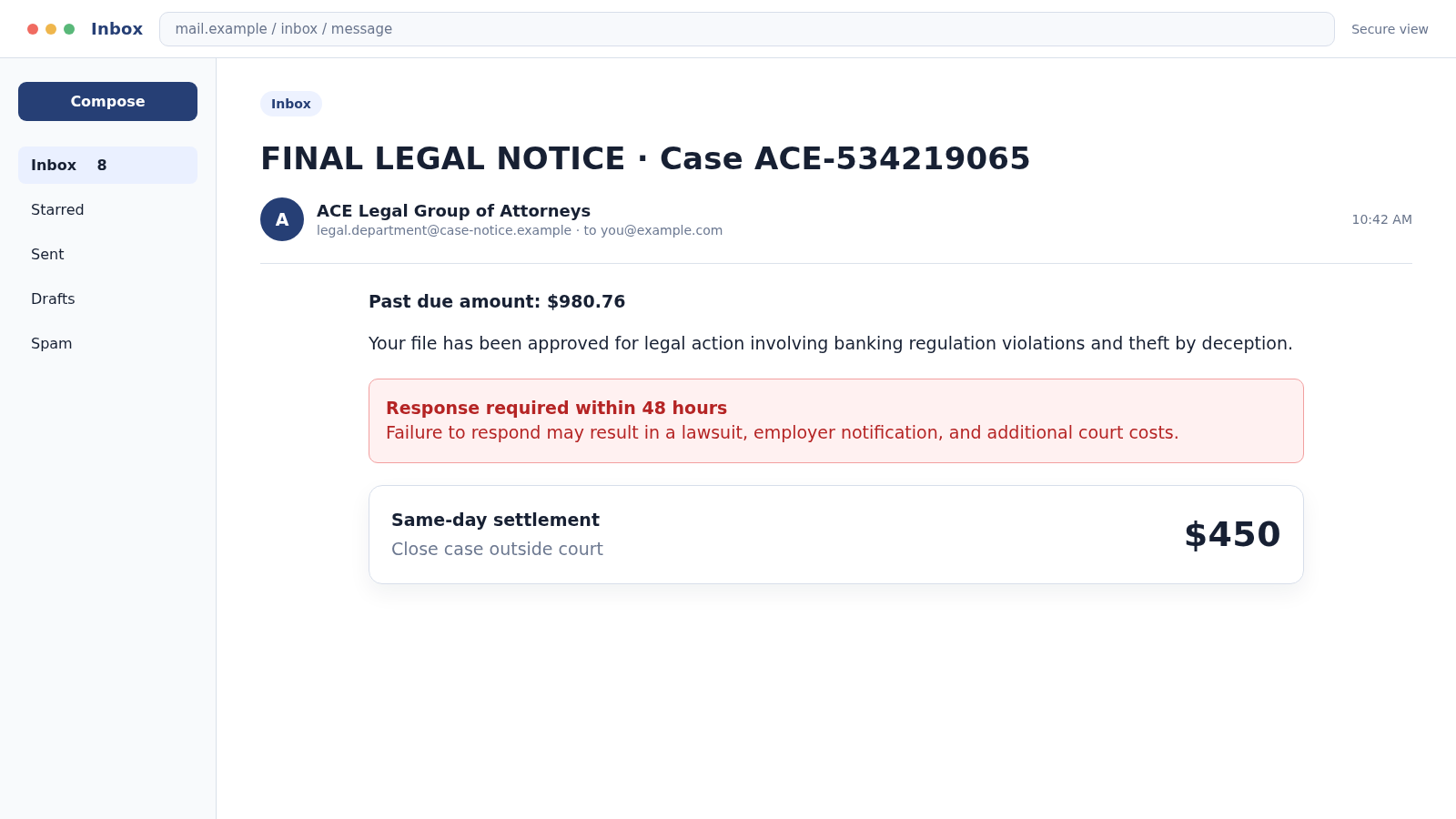
The email does not sound like an ordinary bill. It says a payday loan case is under investigation, lists criminal-sounding accusations, and gives you only hours to prevent a lawsuit or arrest.
Then comes the offer: pay a smaller “settlement” today and the case will disappear. The ACE Legal Group scam sounds intimidating, but its supposed legal process falls apart when examined carefully.
Overview
The message turns an unknown debt into a criminal emergency
The ACE Legal Group scam is a fake debt-collection and lawsuit scheme. Messages claim that a payday lender, often described with a variation of ACE, Cash America, Advance Cash Services, or Speedy Cash, has authorized legal action.
The recipient is accused of check fraud, theft by deception, violating banking regulations, or refusing to repay an online loan. Those labels are used to make an ordinary civil debt claim sound like an active criminal prosecution.
The settlement offer is the real purpose of the email
After describing a much larger lawsuit cost, the sender offers a reduced payment if the victim responds immediately. Some versions present several plans, such as a one-time payment or biweekly installments.
The amounts and case numbers create the appearance of precision, but the sender often provides no verifiable original account, signed agreement, payment history, or legally required validation information.
The name has appeared in changing versions for years
Fake legal notices using ACE-related names have circulated under different email addresses, payment instructions, case formats, and supposed attorneys. A new sender address does not make the underlying script new or legitimate.
Common warning signs include:
- A lawsuit threat delivered through an unsolicited email from a free or unrelated address.
- Criminal accusations attached to a consumer payday loan.
- A deadline of a few hours or days to avoid arrest, court, or employer contact.
- No original creditor account number or meaningful debt history.
- Refusal to send a proper debt validation notice.
- Payment through gift cards, cryptocurrency, transfers, or emailed card details.
Why the Legal Language Feels So Convincing
Most people do not receive court papers often enough to recognize the normal process. A scammer fills that knowledge gap with capital letters, statute-like numbers, courthouse names, confidentiality statements, and references to federal agencies.
Some emails include real addresses for courts, regulators, or lenders. Copying a public address does not show that the named organization opened a case or authorized the sender.
The message may also contain part of a Social Security number, an old address, employer name, or relative. Personal data can come from breaches and lead lists. Its presence proves only that someone obtained data about you, not that a debt exists.
Under federal debt-collection rules, a legitimate collector must provide identifying and validation information about the debt. Threatening arrest for an unpaid consumer bill is not a substitute for that process.
How the ACE Legal Group Scam Works
Step 1: A mass email is personalized with fragments of data
The campaign begins with a legal notice addressed to “debtor,” an email address, or a real name obtained from a marketing list or breach. The sender may include a random case number and a standard balance such as $980.76.
Because many consumers have applied for short-term credit or received loan advertisements, a vague reference to an online payday loan can feel possible even when the person does not recognize the creditor.
Step 2: The sender claims to represent a lender and legal department
The email combines several official-sounding names so the recipient cannot easily identify one entity to verify. “ACE Legal Group,” “Advance Cash Services,” “Legal Investigation Bureau,” and a payday lender may all appear in the same message.
This confusion is deliberate. When challenged, the sender can claim that one name is the parent company, another is the collector, and another is the law office handling the case.
Step 3: Civil debt is reframed as a criminal offense
The notice may accuse the recipient of check fraud, theft, wire fraud, or violation of federal banking rules. It threatens arrest, prosecution, employer notification, or a sheriff delivering a summons.
Unpaid consumer debt is generally a civil issue. A real collector cannot turn a disputed payday loan into an arrest simply because someone refuses an emailed demand.
Step 4: A large penalty makes the settlement look attractive
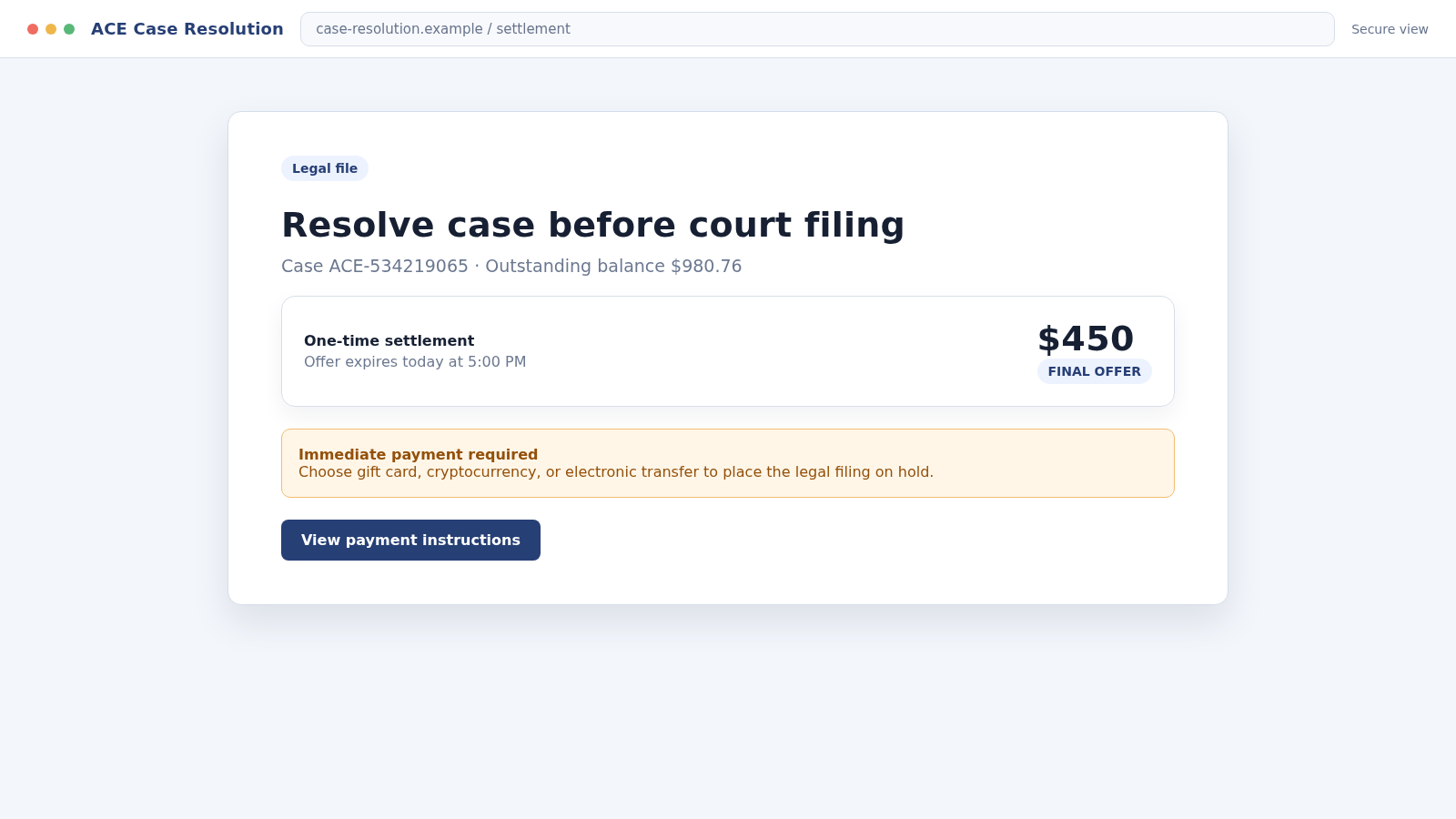
The scammer contrasts a frightening lawsuit figure with a smaller same-day payment. A supposed $3,200 or $8,679 case may be “closed” for $350, $450, or another amount the recipient can send quickly.
The discount is psychological. It encourages the victim to pay before asking whether the debt, collector, attorney, and court file can be independently verified.
Step 5: The victim is moved into a private conversation
The email asks for a reply stating the victim’s “intention” or preferred payment plan. Once the recipient responds, an operator can apply pressure, collect personal details, and adapt the deadline.
The scammer may insist that discussing the case with anyone else violates confidentiality. Real legal advice and independent verification do not invalidate a legitimate debt.
Step 6: Payment is directed outside normal collection channels
Some versions request gift card numbers, money transfers, cryptocurrency, payment-app transfers, or card details by email. Others send a link to a generic payment form that has no verifiable connection to a licensed collector.
These methods reduce the victim’s ability to reverse the payment. They also avoid the clear billing identity and dispute options that a legitimate collector should provide.
Step 7: Paying produces another balance or allegation
The first payment rarely closes anything. The sender may discover a court fee, document charge, credit-reporting cost, tax, or second loan. A new department then demands more money.
Because there was no genuine case to settle, the scammer can invent unlimited obstacles. A receipt from the same sender does not prove that a real debt was resolved.
Step 8: Stolen information fuels new collection attempts
If the victim shares identity documents, banking details, or an employer name, the information can support account fraud and more personalized threats. The same person may later receive a notice under another law-firm name.
Scammers also pose as recovery agents who promise to refund the settlement for another fee. That follow-up is a continuation of the fraud, not assistance.
Why Making One Payment Does Not Validate the Debt
A scammer can send a receipt, balance update, and case-closure letter because they control the documents. None of those files shows that money reached a real creditor or satisfied a genuine account.
After payment, the sender may claim the transfer was coded incorrectly, arrived late, or covered only an administrative part of the case. The supposed remaining balance is simply changed on the next email.
Victims sometimes continue because they want the first payment to have accomplished something. This sunk-cost pressure is powerful: admitting the first transfer was lost feels harder than sending a smaller final amount.
A valid settlement should identify the creditor, account, authorized collector, agreed amount, and effect of payment. Verify those facts through the original creditor before relying on a letter produced by the demanding party.
If a real collector accepts a settlement, keep the written agreement and payment confirmation permanently. A credit-report dispute may require those records long after the conversation ends.
Company, Address, and Fulfillment Checks
The display name is not proof of a law firm
A sender can type “ACE Legal Group of Attorneys” into an email profile without creating a licensed firm. Ask for the attorney’s full name, bar number, jurisdiction, physical office, and written authority to represent the creditor.
Verify those details through the state bar and regulator, not through a link or phone number supplied by the sender. A real lawyer should appear in an official licensing record.
The address may be copied or impossible
Fake notices often borrow a courthouse or government address. Others use an incomplete location, a mismatched ZIP code, or no mailing address at all.
Search the exact suite and call the office through an independently found number. An address printed beneath a legal disclaimer is not evidence that the sender occupies it.
The support channel avoids accountable contact
Free email accounts, reply-only communication, changing numbers, and refusal to accept certified mail are major warning signs. A legitimate collector should identify its company and provide a mailing address for disputes.
Do not send identity documents merely because the sender says they are needed to locate a file. First establish that the collector and debt are real.
The debt must be traceable to an original account
Ask for the original creditor, account number, date and amount of the loan, itemized balance, and documentation showing the collector has authority. Compare that information with your own records and credit reports.
If you receive genuine court papers, contact the court using its official public number and respond within the stated legal deadline. A scam email should be rejected, but an independently verified lawsuit should never be ignored.
How a Real Debt Collection Process Differs
A real collector identifies the company, provides a mailing address, explains the amount, names the original creditor, and tells you how to dispute the debt. The Consumer Financial Protection Bureau calls this validation information.
Collectors cannot falsely claim to be attorneys or government officials. They cannot threaten arrest for an ordinary unpaid bill, and they cannot pretend a document is a court filing when it is not.
A legitimate lawsuit creates a case that can be confirmed with the named court. It is served according to legal rules, not resolved through a gift card number emailed to an anonymous address.
If you recognize the loan but question the amount or collector, dispute it in writing. Do not let the scam’s obvious defects cause you to overlook a separate genuine obligation in your records.
What to Do if You Have Fallen Victim to This Scam
- Stop communicating and paying. Do not send a final settlement or document fee. Preserve the messages, then block the sender and related numbers.
- Contact the payment provider quickly. Tell the bank, card issuer, transfer service, gift card company, or payment app that the transaction resulted from a fake debt-collection threat. Ask about reversal, recall, or account protection.
- Verify whether any real debt exists. Review your records and credit reports. Contact the original lender using independently verified details, not information in the threatening email.
- Check any claimed court case. Find the court’s official website and phone number yourself. Ask the clerk whether the case number and parties exist. Do not ignore papers confirmed by the actual court.
- Secure exposed identity information. If you shared a Social Security number, license, bank statement, or date of birth, place a fraud alert or credit freeze and monitor for new accounts.
- Change compromised passwords. Start with email and financial accounts, use unique passwords, and enable multifactor authentication. Remove unknown recovery methods and active sessions.
- Check the device. If you opened an attachment, downloaded a “case file,” or visited a payment portal, run a full scan with Malwarebytes. It can detect many malicious files, credential stealers, and remote-access tools.
- Reduce repeat exposure. AdGuard can block many malicious ads, tracking domains, and known scam pages that funnel victims into fake legal forms. It cannot verify a collector, so continue using official records.
- Report the fake collector. File reports with ReportFraud.ftc.gov, the Consumer Financial Protection Bureau, your state attorney general, and local police if money or identity documents were taken.
- Expect a second approach. Ignore anyone promising guaranteed recovery for an upfront fee. The original scammers may reuse your case details to sound like investigators or refund specialists.
Frequently Asked Questions
Is ACE Legal Group a real law firm?
The name in an email does not prove a licensed firm exists or contacted you. Verify the named attorney and office through the relevant state bar and independently found contact details.
Can I be arrested for not paying a payday loan?
A collector cannot have you arrested for an ordinary unpaid consumer debt. Real lawsuits follow a civil court process, and false arrest threats are a strong sign of a scam or abusive collection.
What if the email contains my Social Security number?
Personal information can come from breaches or purchased records. It does not validate the debt. Freeze your credit if sensitive data is exposed and demand proper debt documentation.
Should I reply and ask for proof?
You can preserve the message without engaging. If you believe a real debt may exist, contact the original creditor independently and send any formal dispute to a verified collector’s mailing address.
Are emailed court summonses always fake?
Rules vary, so do not decide from appearance alone. Verify the case through the court’s official website or clerk. A demand for gift cards or an instant settlement is not normal service.
Can paying the requested settlement make the threats stop?
It often produces more demands because the sender has no real case to close. Stop paying, contact the payment provider, and report the operation.
The Bottom Line
The ACE Legal Group scam uses legal vocabulary, payday-loan anxiety, and impossible deadlines to replace verification with fear. Its goal is not to prove a debt. Its goal is to collect a fast payment.
Do not ignore a real court case, but never treat an email as proof of one. Confirm the collector, creditor, attorney, and court independently before sharing information or paying anything.

Join the discussion
0 commentsShare your experience or ask a question about this article.
Discussion
Start the conversation
Have a question or something useful to share? Add the first comment.