

If you’ve stumbled across a website called Aice-Cream.com, you’re probably already intrigued by its bold claims. Promising to churn out $1,000 to $2,000 daily using nothing but AI and a smartphone, it seems too good to pass up—especially if you’re in search of financial freedom. With glossy videos, happy testimonials, and phrases like “no experience required,” Aice-Cream positions itself as the future of easy, automated income.
But behind this polished front lies something much darker. Aice-Cream is being increasingly exposed as a well-packaged scam that manipulates emotion, exploits trust in artificial intelligence, and preys on economic insecurity. This expanded guide reveals everything you need to know about how it works, why it’s dangerous, and how to protect yourself if you’ve already been caught in the trap.
Scam Overview: How Aice-Cream Lures You In
Aice-Cream.com advertises itself as an “AI-powered income generator” requiring zero skill and zero experience. The pitch is simple: you sign up, push a few buttons, and watch the money roll in. They suggest that hundreds are already profiting—some allegedly earning $45,000 in just one month.
Let’s break down exactly how they construct this illusion of success.
Overhyped Claims
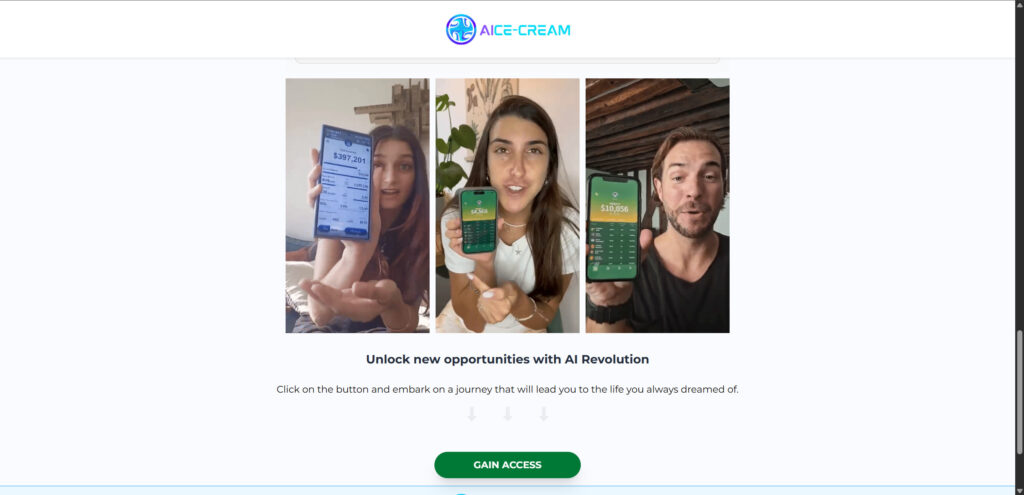
- Screenshots of massive balances: $10,000, $45,000, even $397,000.
- Claims of passive income from “AI automation.”
- Promises that anyone—regardless of age or tech skills—can start today and earn by tomorrow.
This formula is familiar and intentionally designed to appeal to people who are financially vulnerable or unfamiliar with how real online business works.
Major Red Flags
- No Transparency: There are no team members listed, no business registration, and no information on how the AI actually works.
- Fake Testimonials: The people in the videos are actors or paid promoters. Many of the reviews use identical scripts seen in other scams.
- Ambiguous Product: They never tell you what the system does. There’s no mention of a business model like e-commerce, dropshipping, or freelancing.
- Urgency and Scarcity Tactics: You’ll see messages like “Only 3 spots left!” or “230 people watching now.” These are pre-programmed scripts meant to apply psychological pressure.
- Pay Before You Learn: You’re required to give up your information—and usually money—before you learn anything concrete.
The design, language, and flow of the site follow a proven scam template repackaged under a new brand.
This scam has been also investigated by Jordan Liles on his YouTube channel, where he offers a detailed video on the subject. We recommend watching his content for a comprehensive understanding of the scam.
Next, let’s break down exactly how scammers carry out this scam from start to finish.
How the Aice-Cream Scam Works
Step 1: Targeted Ads with Fake Stories
It all starts with paid ads, often on YouTube, Facebook, or Instagram. These videos feature cheerful testimonials from people claiming they were broke until Aice-Cream transformed their lives. Someone might say they were $20K in debt, but now they’re making $1,200 a day. The goal? Hook you emotionally.
Step 2: Video Demo Without Substance
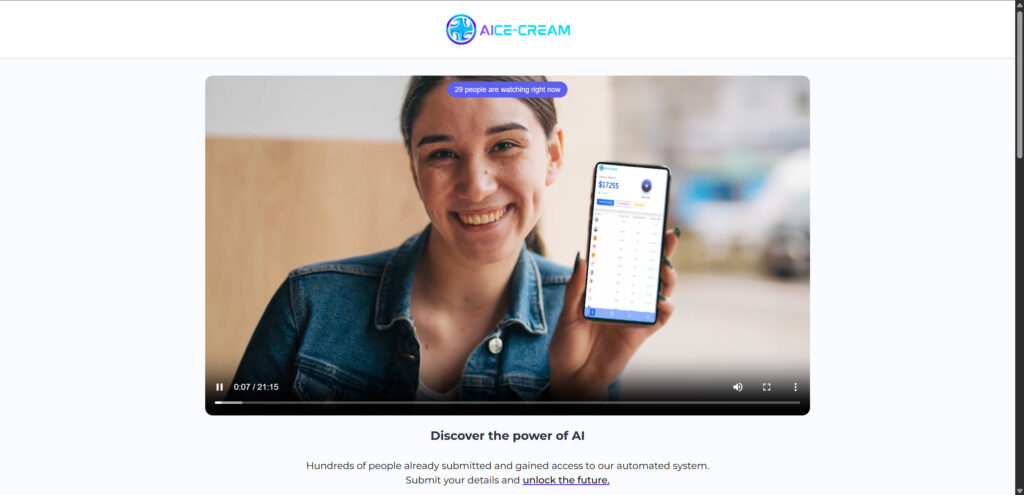
Click the link and you’re taken to a long, polished video. It’s professionally produced with upbeat music and happy people. Terms like “unlock the future,” “automated income,” and “AI revolution” are sprinkled throughout—but there’s no technical explanation of what you’re buying.
Step 3: Fake Social Proof & FOMO
You’ll see widgets and counters saying things like:
- “29 people are watching now.”
- “Only 3 free spots left.”
- “Hundreds already unlocked this system.”
These tactics are not real—they’re built into the code to simulate popularity and urgency.
Step 4: The Sign-Up Trap
You’re asked to submit your name, email, and phone number to “gain access.” Once you do, your data may be sold to other scam operations. You’ll also start receiving aggressive upsell pitches via text, email, or calls.
Step 5: Initial Payment Wall
After sign-up, you’ll be prompted to pay a fee—usually between $47 and $97. They claim this gives you lifetime access to their secret AI system. But what you’re buying isn’t software or access to AI. You’re buying into the next stage of the scam.
Step 6: Upsells Disguised as ‘Opportunities’
Once inside, you’ll be offered even more costly packages:
- $197 for an “AI Turbo Booster”
- $297 for “Elite Coaching”
- Monthly fees for data access or analytics
Each new level promises more money, faster. But each one delivers generic materials and no functional product.
Step 7: Delivery of Worthless Material
After payment, you’ll gain access to a “dashboard.” This often includes:
- Poorly made training videos
- Outdated PDFs or generic YouTube links
- Vague instructions with no real value
There’s no AI, no earnings system, and no support if you ask for help.
What to Do If You Fell for the Aice-Cream Scam
1. Cancel Any Payments or Subscriptions
Log in to your bank or PayPal account and cancel any future payments. Scammers often bill again after a few days or weeks.
2. File a Chargeback
Call your credit card company and request a chargeback, citing fraud or deceptive practices. Be specific about what was promised versus what was delivered.
3. Report the Scam to Authorities
- FTC (U.S.): reportfraud.ftc.gov
- Internet Crime Complaint Center (IC3): ic3.gov
- Better Business Bureau: bbb.org
Include screenshots, receipts, and communications to strengthen your case.
4. Protect Your Identity
Change your passwords and enable two-factor authentication. Be alert for phishing emails or spam calls.
5. Raise Awareness
Post reviews, share your story on Reddit or TikTok, and comment on scam warning sites. The more people who know, the fewer fall into the trap.
Frequently Asked Questions (FAQ) About the Aice-Cream
Is Aice-Cream.com a legitimate website?
No. Aice-Cream.com is not a legitimate business opportunity. It presents itself as an AI-powered income system but fails to explain what the system actually does. There is no product, service, or verified proof of earnings behind its claims.
What does Aice-Cream actually sell?
Aice-Cream does not sell a real product or service. Users are prompted to pay for vague “AI access” or “automated income systems,” but what they receive is usually generic training material, outdated PDFs, or recycled YouTube links.
Is there real AI involved?
No. Despite marketing claims, there is no working AI tool offered through Aice-Cream.com. The mention of AI is a buzzword used to make the site sound modern and credible without backing it up with a functional product.
Why are there so many positive testimonials?
The testimonials on the site and in the videos are often staged using paid actors or stock footage. Many of these individuals appear in other scam promotions as well. The results they describe are not verified and are meant to deceive.
Why does the site say “Only 3 spots left” or “200 people watching now”?
These counters are fake and coded into the page to create artificial urgency. This psychological trick is designed to pressure users into acting quickly without researching further.
Can I get my money back?
If you paid with a credit card or PayPal, you should immediately request a chargeback and report the site as fraudulent. Many victims are able to recover funds by citing deceptive business practices.
Is Aice-Cream part of a larger scam network?
Yes. The structure, language, and design of Aice-Cream match dozens of other scam websites operating under different names. These are often recycled schemes launched by the same scammers under new branding.
How do I report Aice-Cream?
You can report the scam to:
- FTC – reportfraud.ftc.gov
- IC3 (FBI Internet Crime Center) – ic3.gov
- Better Business Bureau – bbb.org
Attach all relevant documentation, such as receipts and screenshots.
What should I do if I gave them my personal information?
If you shared your name, phone number, or email:
- Be alert for phishing attempts.
- Block unknown contacts and avoid clicking suspicious links.
- Consider using an identity protection service if you shared financial data.
Are there real ways to make money online?
Yes, but they require time, learning, and legitimate effort. Proven paths include freelance work, remote employment, affiliate marketing (done ethically), selling digital products, and offering services on platforms like Upwork or Fiverr. None of these promise overnight riches.
The Bottom Line
Aice-Cream.com is not a legitimate business opportunity—it’s a carefully crafted manipulation scheme. It uses emotion, urgency, and tech buzzwords to lure people into spending money on something that doesn’t exist. The flashy dashboard, testimonials, and live counters are just smoke and mirrors.
Real income is possible online, but there’s no shortcut. Whether it’s freelancing, launching an online store, or learning digital skills, building income takes time and effort. If someone refuses to tell you how a system works unless you pay, it’s almost always a scam.
Stay sharp, stay skeptical, and always research before you spend a dime. Your caution could save your money—and help protect others too.








