

Have you seen an ad or website claiming you can earn $750 Amazon gift cards just by reviewing products from home? If so, you’re not alone. A site called ApplyAmz.com has been circulating widely with promises of high payouts for minimal effort. Unfortunately, this is not a legitimate opportunity—it’s a sophisticated scam designed to trick users into giving away personal information and money.
This article dives deep into how the scam works, what risks it poses, and what you should do if you’ve already interacted with it.
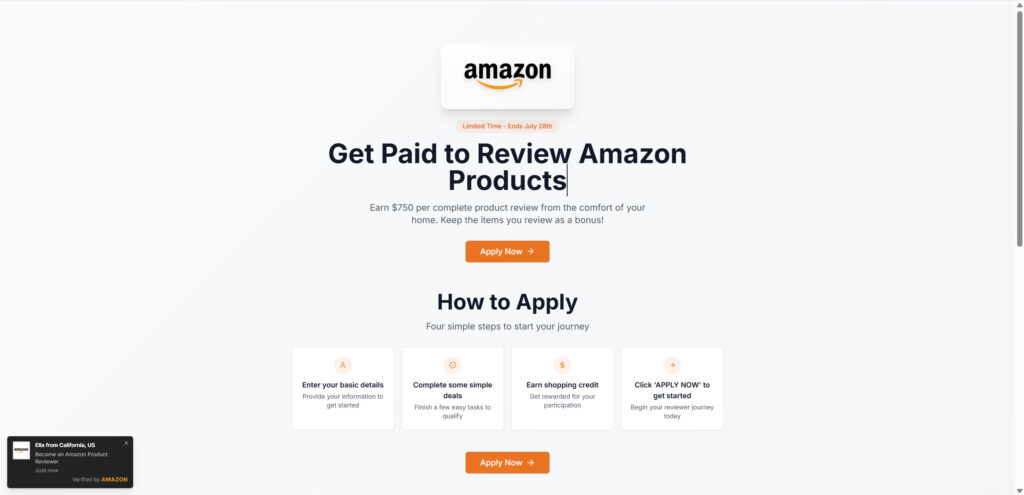
Scam Overview: The Illusion of $750 Amazon Rewards
At first glance, ApplyAmz.com looks like an official Amazon program. It uses Amazon branding, a professional layout, and enticing headlines such as:
“Get Paid to Review Amazon Products – Earn $750!”
The homepage suggests that all you need to do is:
- Enter your basic details
- Complete a few simple deals
- Earn $750 Amazon gift cards
The promise of easy money and free products makes this scam extremely appealing, especially to those looking for side hustles. But the reality is much darker.
Why This Scam Feels Convincing
ApplyAmz.com uses:
- Amazon’s logo and colors for authenticity
- Countdown timers to create urgency
- Fake testimonials to show “real users” earning big money
- Step-by-step visuals to make the process look simple
On the surface, it seems like a real Amazon affiliate or product review program. But there’s one major problem: Amazon does not run any program like this through third-party sites.
The Real Goal of the Scam
The site’s actual objective is not to pay you—it’s to:
- Harvest your personal data (name, email, phone number)
- Push you through affiliate deals that generate revenue for scammers
- Get you to sign up for paid trials, often leading to recurring charges
- Install malicious apps or software on your device
You’ll never see that $750 gift card.
How the ApplyAmz.com Scam Works
The scam relies on psychological triggers and deceptive tactics. Here’s the detailed flow:
Step 1: The Hook
You might see:
- Sponsored ads on Facebook, Instagram, TikTok
- Links shared in YouTube comments
- Pop-ups on questionable websites
These ads promise $750 Amazon rewards for product reviews. Clicking the ad leads you to ApplyAmz.com, a landing page featuring Amazon’s branding.
Step 2: Data Collection
The first requirement is to enter:
- Name
- Email address
- Phone number
This data is later used for:
- Spam emails and robocalls
- Selling your info to data brokers
- Future scam campaigns targeting you
Step 3: The “Simple Deals” Trap
Once you provide basic info, you’re asked to complete “a few simple tasks” or sponsored deals. These often include:
- Signing up for free trials that require a credit card
- Downloading apps that track your behavior
- Filling out endless surveys with personal details
- Subscribing to services with hidden recurring charges
Each completed “deal” generates affiliate commission for scammers. The more you complete, the more they earn—while you get nothing.
Step 4: The Endless Loop
After completing several deals, you’ll see messages like:
- “Almost there! One more deal to unlock your gift card.”
- “Congratulations! You’re 90% done—just complete two more steps.”
The cycle repeats until you either give up or end up losing money on subscriptions.
Step 5: No Reward—Only Risk
Even if you complete every single offer, you will never receive the $750 Amazon gift card. The site has no mechanism to track completion because the real purpose is monetizing your activity and data.
What to Do If You Fell for the ApplyAmz.com Scam
If you interacted with this site, take these steps immediately:
1. Stop Engaging
Close the page. Do not click additional links or provide further details.
2. Change Passwords
If you used the same email/password combo anywhere else, update those credentials immediately.
3. Check Your Bank Statements
If you signed up for any “trial offers”:
- Cancel the subscription
- Dispute unauthorized charges with your bank
- Consider replacing your card
4. Run a Malware Scan
Download trusted tools like:
- Malwarebytes
- Bitdefender
- Norton Security
Remove any malicious software installed during the process.
5. Block Spam
- Use email spam filters
- Install call-blocking apps like Hiya or RoboKiller
6. Report the Scam
- Federal Trade Commission (FTC): reportfraud.ftc.gov
- Internet Crime Complaint Center (IC3): ic3.gov
- Amazon Customer Support: Inform them of brand misuse
7. Educate Others
Post warnings on:
- Social media
- Reddit’s r/scams forum
- Consumer protection groups
Is Your Device Infected? Run a Free Malware Scan
Slow performance, constant pop-ups, or strange behavior? These are classic signs of a malware infection. The fastest way to find out is to scan your device with Malwarebytes Free — one of the most trusted malware removal tools available.
The free version detects and removes the most common threats, including:
- Adware — the cause of those annoying pop-ups
- Browser hijackers — unwanted redirects and changed homepages
- Trojans and spyware — hidden programs stealing your data
- Potentially unwanted programs (PUPs) — software you never asked for
👉 Select your device below — Windows, Mac, or Android — then follow the simple steps to download Malwarebytes, scan your system, and remove any threats it finds. The scan usually takes 5 to 20 minutes.
Run a Malware Scan with Malwarebytes for Windows
Malwarebytes is one of the most popular and trusted anti-malware tools for Windows — and it’s completely free for removing infections. It catches threats that many antivirus programs miss, including adware, browser hijackers, and trojans. Follow the steps below to scan and clean your PC in just a few minutes.
Download Malwarebytes
Click the button below to download the latest version of Malwarebytes for Windows from the official source. The free version is all you need — it will scan your computer and remove adware, browser hijackers, and other malicious software at no cost.
Download MalwarebytesOfficial installer for Windows 11 and 10. Your download starts right away.Want real-time protection? See Malwarebytes Premium Malwarebytes Free for WindowsScans and removes malware at no cost
-
Install Malwarebytes
When the download finishes, open your Downloads folder and double-click the MBSetup file. If Windows shows a User Account Control pop-up, click “Yes” to allow the installation.

Follow the On-Screen Prompts to Install Malwarebytes
The setup wizard will walk you through a few quick screens:
-
Choose where you’re installing the program — “Personal Computer” or “Work Computer” — then click Next.

-
Malwarebytes will now install on your device. This usually takes under a minute.

-
When installation is complete, the “Welcome to Malwarebytes” screen will open automatically.

-
On the final screen, click Open Malwarebytes to launch the program.

-
Enable “Scan for Rootkits”
Before scanning, turn on rootkit detection so Malwarebytes can find even the most hidden threats. Click the Settings gear icon on the left side of the screen.

In the settings menu, find “Scan for rootkits” and click the toggle so it turns blue.

Done? Click “Dashboard” in the left pane to return to the main screen.
Start the Scan
Click the blue Scan button. Malwarebytes will automatically update its virus database and start checking your computer for malware.

-
Wait for the Scan to Finish
The scan checks your entire system for browser hijackers and other malicious programs, so it can take 5 to 20 minutes depending on your computer. Feel free to do something else — just check back occasionally to see the progress.

-
Quarantine the Detected Threats
When the scan is done, you’ll see a list of everything Malwarebytes found — malware, adware, and potentially unwanted programs. Click the “Quarantine” button to remove all of them at once.

Malwarebytes will now remove the malicious files and registry entries and move them safely into quarantine.

-
Restart Your Computer
Some threats can only be fully removed after a reboot. If Malwarebytes asks you to restart, click Yes. Once you’re logged back in, Malwarebytes has finished removing the threats it found.

That’s it — your Windows PC is now clean of trojans, adware, and other malware, and should be back to running smoothly.
If you are still having problems with your computer after completing these instructions, then please follow one of the steps:
- Run a computer scan with ESET Online Scanner
- Ask for help in our Windows Malware Removal Help & Support forum.
Run a Malware Scan with Malwarebytes for Mac
Malwarebytes for Mac is a free on-demand scanner that removes the malware other security software tends to miss — adware, browser hijackers, and unwanted programs included. Cleaning an infected Mac with Malwarebytes has always been completely free, and it’s our go-to recommendation. Follow the steps below to scan and clean your Mac in just a few minutes.
-
Download Malwarebytes for Mac
Click the button below to download the latest version of Malwarebytes for Mac.
Download MalwarebytesOfficial installer for macOS. Your download starts right away.Want real-time protection? See Malwarebytes PremiumMalwarebytes Free for MacScans and removes malware at no cost -
Open the Malwarebytes setup file
When the download finishes, open your Downloads folder and double-click the setup file to begin the installation.

-
Follow the On-Screen Prompts to Install Malwarebytes
The Malwarebytes for Mac Installer will guide you through a few quick screens. Click “Continue” and keep following the prompts until the installation completes.



When the installation is complete, Malwarebytes opens to the Welcome to Malwarebytes screen. Click “Get started“.
-
Select “Personal Computer” or “Work Computer”
Malwarebytes will ask what type of computer you’re installing it on. Click either Personal Computer or Work Computer, whichever applies.

-
Start the Scan
Click the “Scan” button. Malwarebytes will automatically update its detection database and begin checking your Mac for malware.

-
Wait for the Scan to Finish
Malwarebytes will scan your Mac for adware, browser hijackers, and other malicious programs. This can take a few minutes, so feel free to do something else — just check back occasionally to see the progress.

-
Quarantine the Detected Threats
When the scan is done, you’ll see a list of everything Malwarebytes found. Click the “Quarantine” button to remove all the threats at once.

-
Restart Your Mac
Malwarebytes will now remove all the malicious files it found. Some threats can only be fully removed after a reboot — if Malwarebytes asks you to restart, allow it. Once you’re logged back in, your Mac is clean.

That’s it — your Mac is now free of adware, rogue browser extensions, and other potentially harmful software.
If you are still experiencing problems while trying to remove a malicious program from your computer, please ask for help in our Mac Malware Removal Help & Support forum.
Run a Malware Scan with Malwarebytes for Android
Malwarebytes for Android automatically detects and removes dangerous threats like malware and ransomware so you don’t have to worry about your most-used device being compromised. Aggressive detection of adware and potentially unwanted programs keeps your Android phone or tablet running smooth.
-
Download Malwarebytes for Android.
You can download Malwarebytes for Android by clicking the link below.
Get Malwarebytes for AndroidOpens Google Play in a new tab.Want real-time protection? See Malwarebytes Premium for AndroidMalwarebytes for AndroidScans your phone and removes malware at no cost -
Install Malwarebytes for Android on your phone.
In the Google Play Store, tap “Install” to install Malwarebytes for Android on your device.

When the installation process has finished, tap “Open” to begin using Malwarebytes for Android. You can also open Malwarebytes by tapping on its icon in your phone menu or home screen.

-
Follow the on-screen prompts to complete the setup process
When Malwarebytes will open, you will see the Malwarebytes Setup Wizard which will guide you through a series of permissions and other setup options.
This is the first of two screens that explain the difference between the Premium and Free versions. Swipe this screen to continue.
Tap on “Got it” to proceed to the next step.
Malwarebytes for Android will now ask for a set of permissions that are required to scan your device and protect it from malware. Tap on “Give permission” to continue.
Tap on “Allow” to permit Malwarebytes to access the files on your phone.
-
Update database and run a scan with Malwarebytes for Android
You will now be prompted to update the Malwarebytes database and run a full system scan.

Click on “Update database” to update the Malwarebytes for Android definitions to the latest version, then click on “Run full scan” to perform a system scan.

-
Wait for the Malwarebytes scan to complete.
Malwarebytes will now start scanning your phone for adware and other malicious apps. This process can take a few minutes, so we suggest you do something else and periodically check on the status of the scan to see when it is finished.

-
Click on “Remove Selected”.
When the scan has been completed, you will be presented with a screen showing the malware infections that Malwarebytes for Android has detected. To remove the malicious apps that Malwarebytes has found, tap on the “Remove Selected” button.

-
Restart your phone.
Malwarebytes for Android will now remove all the malicious apps that it has found. To complete the malware removal process, Malwarebytes may ask you to restart your device.
That’s it — your Android phone is now clean — no more malicious apps, adware, or browser redirects.
If you are still having problems with your phone after completing these instructions, then please follow one of the steps:
- Restore your phone to factory settings by going to Settings > General management > Reset > Factory data reset.
- Ask for help in our Mobile Malware Removal Help & Support forum.
Stay Protected: Block Ads and Malicious Sites
Now that your device is clean, keep it that way. Most infections start with a malicious ad or a fake download button — so blocking them at the source is your best defense.
We recommend AdGuard, which blocks malicious ads, phishing pages, and dangerous redirects before they can reach you.
👉 Download AdGuard and browse safely
The Bottom Line
ApplyAmz.com is a fraudulent website exploiting Amazon’s name to scam users. It promises $750 gift cards for simple tasks but delivers nothing. Instead, it:
- Collects your personal data
- Signs you up for recurring charges
- Risks infecting your device with malware
If it sounds too good to be true, it probably is. Amazon never asks customers to complete unrelated offers for rewards. Always verify promotions on the official Amazon website.
Frequently Asked Questions About the ApplyAmz.com $750 Amazon Gift Card Scam
Is ApplyAmz.com a legitimate Amazon program?
No, ApplyAmz.com is not affiliated with Amazon in any way. Amazon does not operate any program that offers $750 gift cards in exchange for completing deals or reviewing products through third-party sites. This website is a scam that uses Amazon’s name and logo to appear credible.
Will I actually receive a $750 Amazon gift card from ApplyAmz.com?
No. Despite the promise, users who sign up and complete all the steps never receive the $750 Amazon gift card. The site’s real purpose is to collect your personal information, push you through sponsored offers, and generate revenue for scammers—not reward you.
Why does ApplyAmz.com look so professional?
Scammers design these websites to look legitimate by:
- Using Amazon’s logo and branding elements
- Adding countdown timers to create urgency
- Featuring fake testimonials and user activity notifications
- Displaying simple step-by-step instructions to make the process seem easy and real
Why do they ask for personal information like email and phone number?
The primary goal of ApplyAmz.com is to collect user data. When you enter your email, phone number, or name:
- You will likely receive a surge of spam emails and scam calls
- Your data may be sold to third-party marketers or fraud networks
- It can be used in future phishing attacks or identity theft attempts
What are the “simple deals” or “sponsored offers” on this site?
These deals are usually:
- Free trial subscriptions that require your credit card details
- App downloads that may contain tracking or malware
- Surveys asking for sensitive personal information
- Paid services that include hidden recurring charges
These deals are not connected to Amazon and only serve to generate affiliate commissions for scammers.
Is it safe to provide my credit card for these offers?
No. Providing your credit card information is extremely risky because:
- You may be charged for unwanted subscriptions
- Some services add recurring billing without clear consent
- Scammers can sell your financial data to other fraudsters
If you’ve entered your payment details, contact your bank immediately to block or dispute any unauthorized transactions.
Can ApplyAmz.com infect my device with malware?
Yes, it’s possible. Some offers prompt you to download apps or browser extensions, which can:
- Install spyware or adware
- Steal your personal and financial information
- Monitor your online activity
Always run a full antivirus and anti-malware scan after visiting such websites.
How can I tell if this is a scam?
Key red flags include:
- Promises of large rewards for minimal effort
- A requirement to complete multiple unrelated tasks or offers
- Requests for credit card details for “free trials”
- No official Amazon domain (Amazon promotions are only on Amazon.com)
What should I do if I already interacted with the site?
If you’ve signed up or provided details:
- Stop engaging with the site immediately
- Change your email and account passwords
- Cancel any unwanted subscriptions
- Contact your bank to dispute unauthorized charges
- Run a malware scan on your device
- Report the scam to the FTC and Amazon
How do I report this scam to authorities?
You can report ApplyAmz.com to:
- Federal Trade Commission (FTC): reportfraud.ftc.gov
- Internet Crime Complaint Center (IC3): ic3.gov
- Amazon Support: Report misuse of their brand through their official customer service page
How do I avoid scams like this in the future?
- Verify promotions on the official Amazon website or app
- Never provide personal or payment information to unverified sites
- Be skeptical of offers that sound too good to be true
- Install security software and enable fraud alerts on your accounts
- Stay informed through trusted consumer protection resources








