

An invitation arrives from a book festival you recognize. Someone has noticed your novel, mentioned its themes, and asked whether you would like to take part.
After the work of writing and finding readers, that feels good. Before saying yes, give the invitation the same careful attention you gave the book.
Overview
The real festival is not the person sending the invitation
Author invitation scams impersonate literary festivals, publishers, radio programs, or other organizations. They borrow real names to make an unsolicited approach feel like professional recognition.
The Edinburgh International Book Festival’s warning confirms fraudulent invitations using staff names and ongoing email conversations that can end in a payment demand.
The festival says its author invitations come from @edbookfest.co.uk and that authors are not charged to appear. It also says its data was not breached.
This is impersonation of a genuine organization, not evidence that the festival itself scams authors. Verify the sender before treating its reputation as reassurance.
Personal praise can come from public information
A message can mention your characters, setting, or latest publication without its writer having read the book. Reviews and sales descriptions contain useful material for an impersonator.
The Society of Authors’ joint guidance with the Writers’ Guild describes scraped praise, convincing identities, delayed fees, and upselling.
AI can help produce that material, but polished prose is not an AI detector. The practical test remains whether the genuine organization recognizes the offer.
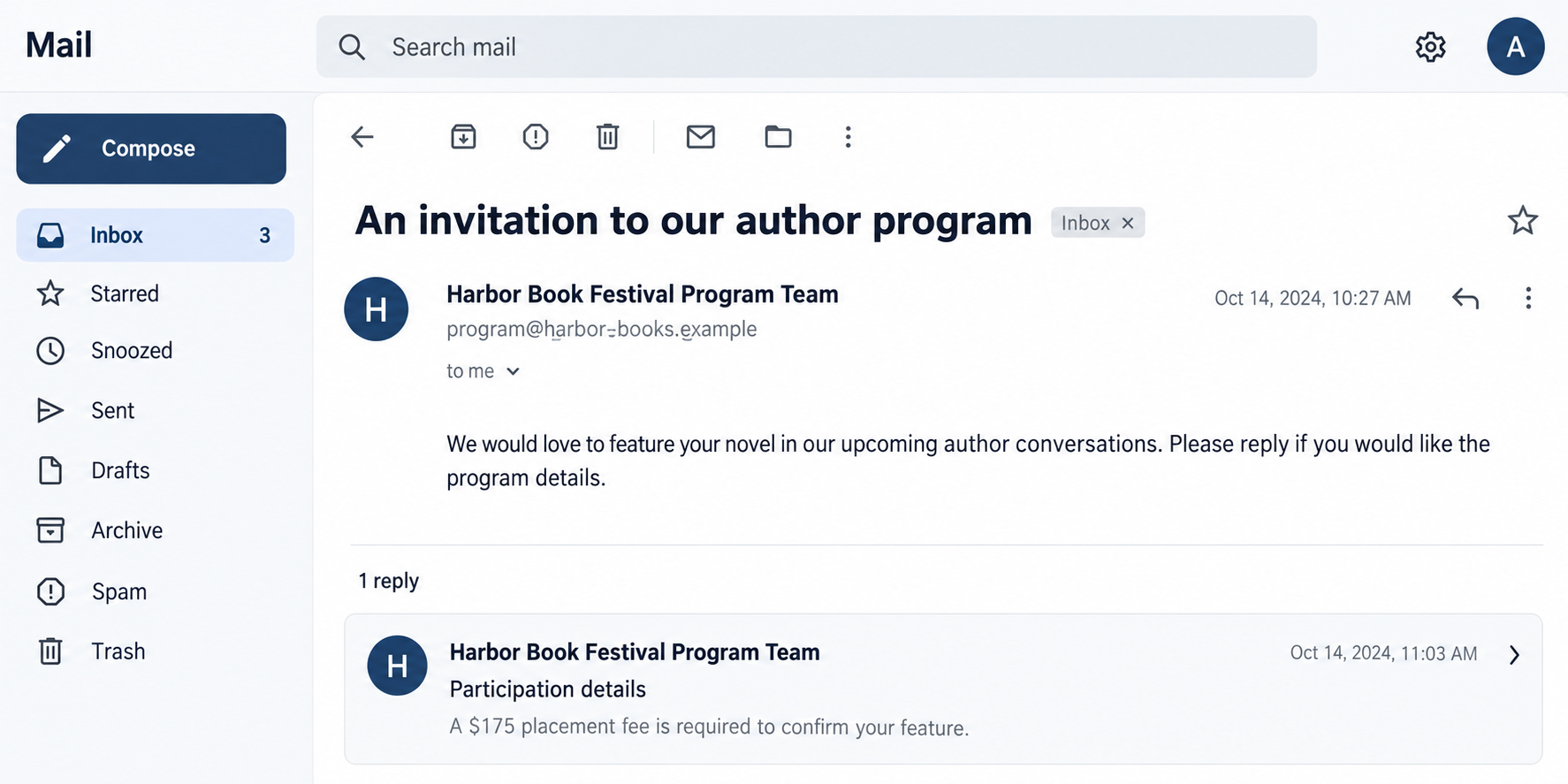
The lead image is a fictional email thread illustrating a fee appearing after an invitation. It is not correspondence from a real festival.
A surprise fee changes what you are being offered
The approach may sound like an invitation to speak until the next email introduces a placement, coordination, production, or promotion charge.
Before responding further, establish:
- Whether the named organization issued the invitation.
- Whether the representative is authorized to discuss it.
- Whether the role is a program appearance, exhibition table, or paid advertising service.
- Who receives the money and what the written agreement promises.
- Which materials are needed, and why unpublished work would be necessary.
Not every literary-event fee is fraudulent. A legitimate exhibitor booking is different from paying an impostor for an invented place in an official program.
Why an Author Can Be Drawn into the Conversation
Writing often means doing difficult work privately and waiting a long time for an outside response. A thoughtful invitation seems to answer that wait.
Scammers can exploit that feeling without sounding pushy. They begin by asking whether you would like more information, an easy question to answer.
After several friendly replies, you may already be planning the appearance. That makes a surprise charge harder to question, even though nothing has been verified.
A real employee’s name adds confidence. Finding that person online proves the person exists, not that they wrote to you.
The same applies to a venue, program date, or festival photograph. Public information can make an invented invitation look specific without making it authorized.
Imagine being offered a remote appearance when travel would be difficult. That accommodation may feel considerate, but it still needs confirmation from the organizer.
A scammer can also say your book will be represented without you. Now the promised outcome is harder to observe and may depend entirely on their reports.
The useful question is not whether the message made you feel recognized. It is whether the people responsible for the event stand behind what it promises.
How the Author Invitation Scam Works
Step 1: Public book information becomes personalized praise
The sender collects enough information to mention your title and a few distinctive details. The email can feel individually written rather than mass-produced.
A book description, review, author biography, or earlier interview can supply those details. Correct facts do not establish a legitimate professional relationship.
Do not try to authenticate the sender by asking more questions about your novel. Someone using public summaries may answer convincingly.
Move the verification outside the literary conversation. The genuine organizer’s administrative team is better placed to confirm whether the invitation belongs to its program.
Step 2: A recognizable organization supplies borrowed credibility
The message claims a connection with a known festival, publisher, or broadcaster. Its signature may include the actual website and office address.
Those details can be copied. A genuine website linked in a signature does not authenticate the sender’s mailbox, payment request, or attachment.
Compare the complete sender address with contact information on the organization’s established site. A familiar display name can hide a separate domain.
Some small events use ordinary email providers legitimately. That is a reason to verify the organizer, not declare every personal mailbox criminal.
Step 3: The invitation becomes an ongoing exchange
The sender answers questions about timing, audience, participation, and promotion. A responsive conversation can look more credible than a single unsolicited email.
Responsiveness only tells you somebody is maintaining the approach. It does not show that the genuine organization approved an appearance.
Keep the thread intact, but pause before supplying materials. You are entitled to check an opportunity before making financial or contractual commitments.
A legitimate organizer should not need you to keep the invitation secret from your agent, publisher, or the event office.
Step 4: Recognition is reframed as a paid package
A later message introduces a participation charge, promotional contribution, or special placement. The name softens the request without explaining whether the placement exists.
Writer Beware documented festival and interview impersonations where invitations turned into fees and reduced-price offers when an author objected.
The amount changing is not proof on its own. The decisive issue is an unauthorized person selling something under a real organization’s identity.
Ask the actual event whether the package is part of its program. Do not let the seller’s assurance substitute for that answer.
Step 5: Extra services make the payment harder to evaluate
The sender may request a trailer, book mockup, or promotional material, then offer to supply what you lack for an additional charge.
Now several purchases can depend on one unverified promise. Paying for the first package does not validate the next provider or service.
Separate each deliverable: an appearance, advertisement, display, trailer, or rights agreement. Ask who supplies it, where it appears, and how completion is established.
Do not assume that professional-looking materials prove an event connection. A person can deliver a digital graphic while still lying about festival placement.
Step 6: Payment or sensitive files move to the impersonator
A transfer may be directed to an unrelated person or business. An agreement or invoice can repeat the festival name without proving authorization.
Other approaches seek unpublished manuscripts, identity information, or account credentials. These are different exposures, and each needs an appropriate response.
Penguin Random House warns of editor impersonation and says it does not request upfront payments while considering acquisition of a new title.
Do not assume a proposed publishing conversation is genuine because it sounds exploratory. Verify the editor before sharing work you have not made public.
Organizer, Representative, Agreement, and Payment Checks
Reach the organization without the invitation’s help
Locate the festival or publisher through its established public website. Use its published contact route rather than replying to the person whose identity is in question.
Ask whether the invitation, program slot, and requested charge are genuine. Supply the original email so the organization can compare the actual sender details.
Finding an event’s name in search results is not enough. You need confirmation connecting the particular offer to the people running it.
Verify the person’s role and authority
A staff profile can confirm employment but not ownership of the mailbox that contacted you. Ask the office whether that person sent this message.
Be particularly careful when the sender explains a different email address as a temporary technical workaround. Verify the workaround independently before accepting it.
For a broadcaster, confirm the program and booking contact. A presenter having interviewed authors before does not authenticate a new approach using their name.
Read the actual deliverable before agreeing
Invited appearances, paid exhibitions, publicity packages, and publishing contracts are not interchangeable. The agreement should make clear which one is being offered.
Consider a promise to display your book “to industry professionals.” Where, for how long, and with what evidence of delivery? Vague access can be difficult to assess.
If rights are involved, seek qualified advice before signing. Do not treat a flattering invitation as a reason to bypass an agent or author organization.
Connect the payee to the verified service
Check the legal recipient and payment instructions against what the genuine organization confirms. An individual’s account requires an explanation that can be independently verified.
A legitimate business registration does not prove the business represents a festival. Likewise, a familiar bank name does not authenticate the person receiving the funds.
Do not use gift cards, cryptocurrency, or another difficult-to-recover route merely to hold an unverified slot. A deadline does not create missing authorization.
A Paid Literary Service Is Not Automatically a Scam
Authors can legitimately pay for editing, design, exhibitions, or self-publishing services. The arrangement should be transparent about its commercial nature and actual provider.
A clearly priced table at a verified fair is not the same as a surprise fee from somebody impersonating the program director.
Nor is a paid advertisement the same as editorial selection. You should know whether the promised attention is an advertisement, an invitation, or neither.
Judge the offer on its identity, deliverables, terms, and evidence. Do not label a disappointing but honestly described service fraud simply because it did not produce sales.
For an unsolicited pitch, the burden is on the seller to establish the connection and service. You do not owe payment because they praised your work.
What to Do If You Fell Victim to an Author Invitation Scam
Being pleased by recognition is not a mistake. Stop the unverified arrangement, preserve what happened, and handle the payment, files, or credentials according to their exposure.
- Pause the entire package.
Do not pay for another placement, trailer, travel arrangement, or refund fee. Tell collaborators not to send materials or money on your behalf.
Keep the email thread and invoice before blocking the sender. Do not negotiate a smaller fee as a way to test whether the invitation is genuine.
- Notify the real organization.
Forward the approach through the organization’s independently located contact route. Ask it to confirm the sender, invitation, and requested payment.
A clear denial helps explain the incident to your payment provider. It also lets the organization warn other authors without blaming its genuine employees.
- Ask the payment provider for assistance.
Explain the false affiliation and what was promised. Supply receipts, transaction references, and the genuine organizer’s response.
Request the applicable dispute, reversal, or fraud-report process promptly. Recovery depends on the method and circumstances, not the sender’s promise to refund you later.
- Inventory the materials you shared.
List manuscripts, contracts, identification, publicity files, passwords, and financial information separately. Note whether any work was unpublished.
Tell your agent, publisher, or a qualified author-advice organization about sensitive work or agreements. Do not assume sharing a file automatically transferred your rights.
- Secure exposed account access.
If a supposed scheduling or manuscript portal received an existing password, change it through the real service and review unfamiliar sessions.
Revoke suspicious connected access where available. An email-only invitation does not by itself establish that your accounts or device were compromised.
- Check devices if you installed anything.
If the sender required software, a browser extension, or remote access, seek trusted cleanup help and remove the unverified access.
Use MalwareTips’ Malwarebytes scanning guide for relevant device checks. A scan cannot authenticate an invitation, recover a transfer, or decide contractual rights.
- Report the impersonation accurately.
Report the mailbox, fake profile, or website through the relevant provider. Give the sender’s exact address rather than only the borrowed employee name.
For a financial loss, report to your local fraud authority. Avoid publicly posting personal payment records, private manuscripts, or identification while warning other writers.
- Use a second opinion for future offers.
Ask your agent or author organization to review unfamiliar agreements before payment. Keep verified organizer contacts separate from incoming pitches.
Ignore unsolicited promises to recover money or obtain a replacement festival slot for another fee. A new person knowing about the loss is not automatically trustworthy.
Frequently Asked Questions
Can a genuine festival contact an author unexpectedly?
Yes. An unsolicited invitation is not automatically fake. Verify the representative and offer through the organization’s established contact route before committing.
Does detailed praise prove somebody read my book?
No. Public reviews, summaries, and interviews can supply convincing details. Accurate praise is not proof of the sender’s identity or professional authority.
Are all book-fair fees fraudulent?
No. Legitimate exhibitor and service fees exist. Confirm the actual role, provider, terms, and payee instead of equating a paid table with an invited appearance.
Why would a scammer lower the price?
A reduced charge can keep the conversation going after you object. It does not resolve an unverified affiliation or make an invented placement real.
Should I send a manuscript before confirming the editor?
No. Verify the editor through the genuine publisher first. Unpublished work deserves more protection than a public book description or promotional biography.
What should I do if the genuine organizer denies the invitation?
Stop engaging with the impostor, preserve the denial and correspondence, and contact the payment provider if you paid. Report the identity being misused.
The Bottom Line
Do not pay for an unverified author invitation or send unpublished materials to its sender. Borrowed prestige and personal praise cannot establish an authorized opportunity.
Confirm the offer with the real festival, broadcaster, or publisher. If it denies the connection, reject the request and report the impersonation.








