

An unexpected message from a celebrated novelist can make an ordinary writing day feel extraordinary. Suddenly, someone whose books you admire wants to hear about yours.
If you are checking a Thomas Pynchon email scam warning, take a breath before replying. The name in your inbox deserves a closer look.
Overview
The famous author is being impersonated
The Thomas Pynchon email scam involves someone pretending to be the novelist while approaching writers. The deceptive identity is the problem, not Pynchon or his books.
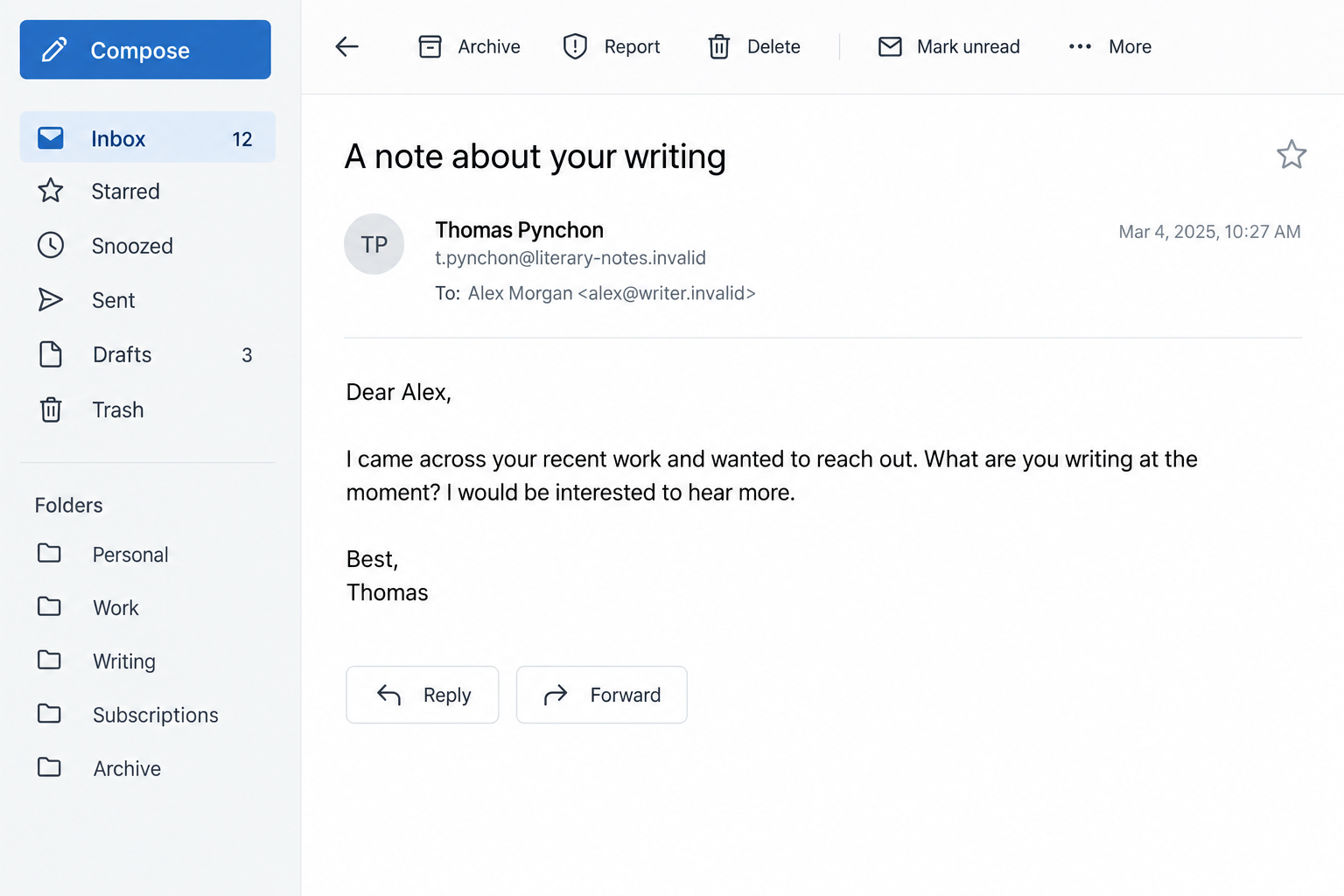
An initial message can sound friendly rather than threatening. It may ask about your current manuscript, mention your published work, or suggest an informal conversation.
That opening can be enough to encourage a reply. For a writer hoping to reach readers, recognition from an established author feels unusually meaningful.
Do not mistake a recognizable display name for a verified sender. An email account can carry a famous person’s name without belonging to that person.
What has actually been reported
In a February 2026 first-person account, author Evelyn Skye described receiving bogus outreach supposedly from Pynchon. The sender wanted to know what she was writing.
She also discussed author impersonation more broadly, including possible paid manuscript readings, editing offers, or endorsements. Those possible endings should not be confused with one documented transaction.
There is no basis here to claim that every message demands the same fee, installs malware, or comes from one identified criminal group.
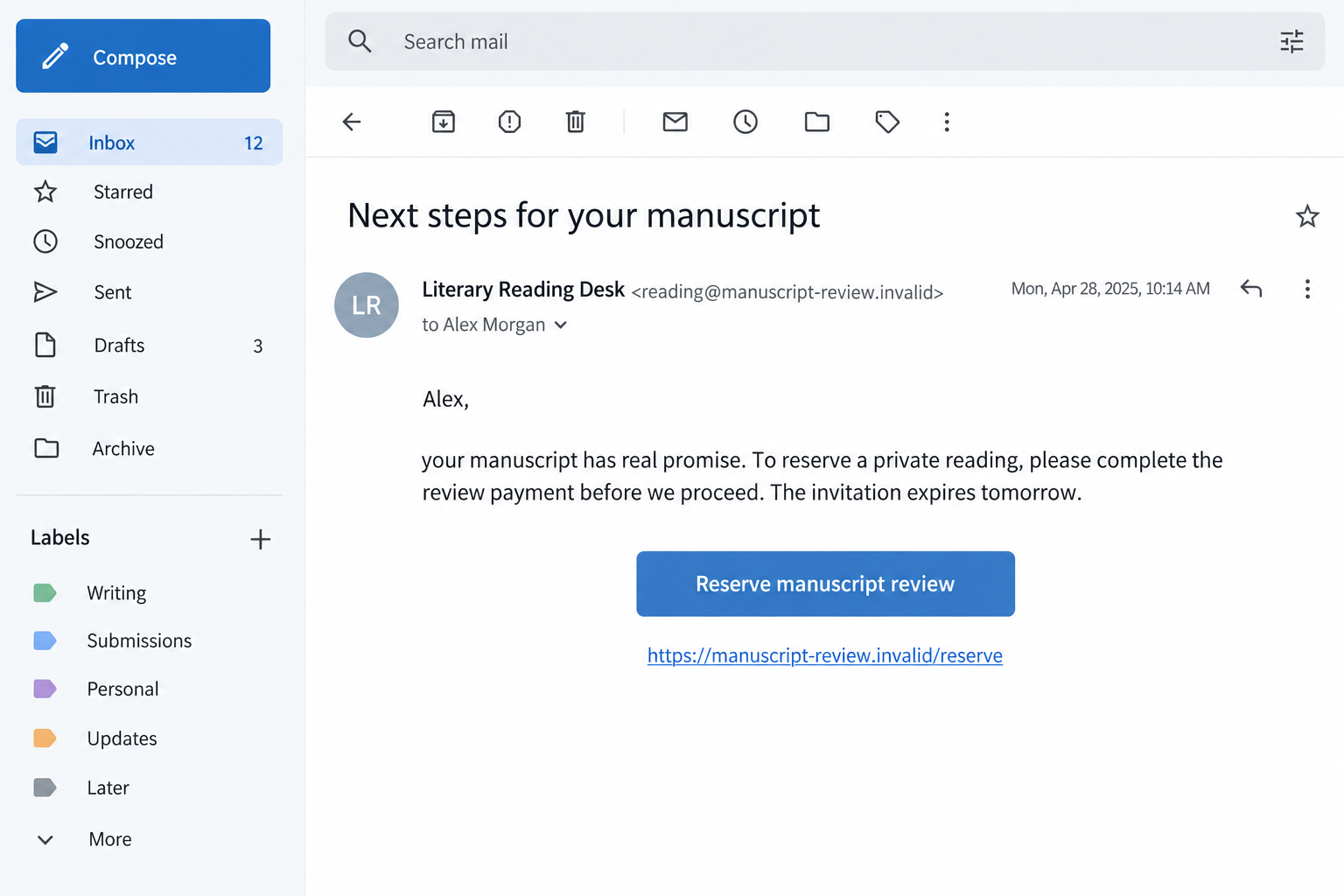
The illustrations show fictional examples of the opening and a possible paid-review follow-up. They are not intercepted correspondence or evidence that Pynchon offered those services.
What a writer should watch for
The clearest concern is a gap between the claimed identity and independently verifiable contact information. Later demands can help reveal what the impersonator wants.
- Unexpected praise from a famous author who has no established relationship with you.
- A sender address or reply destination that cannot be connected to an official contact channel.
- A request to pay for private access, a reading, an endorsement, or a supposed publishing opportunity.
- Instructions to keep the offer secret or avoid asking a publisher, agent, or trusted colleague.
- A link requesting a password, financial details, or a document download unrelated to the conversation.
These signs deserve investigation, not a rushed payment. A legitimate professional should not need you to abandon basic identity checks to keep an opportunity alive.
Why This Message Can Feel So Personal
Public writing details are easy to borrow
A writer’s biography, book description, newsletter, and social posts offer plenty of material for a personalized email. None of that information proves a private connection.
The sender might mention your genre or a recent release. That can feel like evidence they read your work, although the same detail may appear publicly.
Even a thoughtful reference to your writing is not identity verification. Judge the claimed relationship separately from the accuracy of the compliment.
The invitation arrives before the sales pitch
A direct demand for money would be easier to reject. A friendly exchange gives the impersonator time to create familiarity before introducing a paid opportunity.
You may start imagining what this connection could mean for your career. That anticipation can make an unusual follow-up seem like a reasonable next step.
Wanting encouragement does not make you gullible. The approach works by placing an invented identity inside a conversation that writers would normally welcome.
A real service is different from a borrowed identity
Freelance editing, manuscript assessments, and publishing consultations can be legitimate paid services. Charging for professional work does not automatically establish fraud.
The crucial distinction is whether the provider honestly identifies themselves, describes the service, and supplies verifiable terms. A fabricated celebrity connection changes that assessment entirely.
Nor does a genuine author name guarantee a good commercial arrangement. Identity, service quality, rights, price, and promised outcomes all need separate checks.
How the Thomas Pynchon Email Scam Works
Step 1: A familiar literary name appears in your inbox
The message introduces its sender as Pynchon or another established author. Your attention goes to the name before the underlying address gets much scrutiny.
The opening may be brief, polite, and plausible. There does not need to be a threatening subject line or an obvious claim about money.
A personal greeting can reinforce the impression that you were selected deliberately. In reality, a name and email address can come from an ordinary public author profile.
At this stage, the safest response is no response until you verify the sender. There is no benefit in confirming your availability to an unverified identity.
Step 2: The sender turns public information into apparent familiarity
The conversation may reference a book, article, or creative project. Those details make the contact seem informed and reduce the distance between stranger and mentor.
You might be invited to describe your manuscript, ambitions, or publishing plans. That information can help the sender tailor a later offer to your circumstances.
A writer seeking an agent could receive a supposed introduction. Someone struggling with revisions might instead hear about a private reading or editorial package.
These are possible developments, not a fixed script documented in every Pynchon impersonation message. What remains constant is the need to verify the claimed person.
Step 3: An opportunity is attached to the borrowed reputation
The sender may propose feedback, a promotional endorsement, or contact with a publishing professional. The celebrated name supplies credibility that the offer itself has not earned.
Sometimes another supposed coordinator or assistant enters the conversation. A second name can make the arrangement feel organized without providing independent confirmation.
Be particularly cautious when all verification stays inside the same email chain. An introduction from the original impersonator does not validate the newly introduced contact.
A genuine professional arrangement should survive a check through a separately located official channel. Refusal to allow that check is more informative than polished presentation.
Step 4: Money or sensitive information becomes the next requirement
A possible escalation is an upfront reading, editing, or reservation payment. The sender may portray it as a necessary step before the promised attention can begin.
Another route could involve a payment page or a login link presented as a way to exchange material. Those requests introduce risks beyond the original conversation.
Do not upload your manuscript or enter an email password simply because the page uses literary language. Check who operates the service and why access is needed.
The illustration below depicts a hypothetical paid-review request. It explains the decision point without suggesting that every reported message contained that exact wording.
Step 5: A deadline discourages outside advice
A short reservation window can make careful checking feel like hesitation. The writer is encouraged to protect the opportunity rather than question the person offering it.
Secrecy serves a similar purpose. If you are told not to contact a publisher or discuss the invitation, the sender is restricting your verification options.
You do not owe an unverified correspondent discretion about a financial request. Asking a trusted writing colleague for a second opinion is entirely reasonable.
No amount of enthusiasm makes a false identity acceptable. When the opportunity depends on skipping checks, stop participating instead of negotiating a faster payment.
Step 6: The original promise may be replaced by more demands
If a payment is made, further requests are possible. An impersonator could invent additional review costs, delays, or introductions that supposedly require another transaction.
There is no verified universal fee schedule for this story. Avoid relying on a particular amount as the boundary between a safe offer and fraud.
A different ending may involve silence after the writer replies or pays. Lack of further contact does not prove that the original identity was genuine.
Keep the complete exchange, not just the final invoice. The early identity claim helps explain why you trusted the later request.
How to Check an Unexpected Author Email
Look beyond the name and signature
Expand the sender details in your email application. Compare the address with any different reply address, rather than relying on the visible name above the message.
A free email account is not proof of fraud by itself. Some real writers use ordinary providers, which makes independent confirmation more important, not less.
Likewise, a custom literary domain can be invented. Its professional appearance does not establish that an author, agent, or publisher controls it.
Do not publish an address as belonging to a criminal based only on a suspicious message. Sender details may be spoofed or involve compromised accounts.
Find a contact route independently
Start with the author’s official website or a publisher page you locate yourself. Do not use the message’s own links as the source of verification.
Ask whether the contact and any commercial offer are authentic. Share the suspicious email privately with the appropriate official contact, minimizing unnecessary personal information.
For messages claiming publisher affiliation, consult that publisher’s published guidance. Simon & Schuster’s fraud alert describes warning signs involving invented publishing connections.
That guidance does not mean every Pynchon impersonator invokes Simon & Schuster. It illustrates why publisher relationships must be confirmed outside the sales conversation.
Ask what you would actually receive
Before considering any genuine paid service, request a clear description of the work, delivery date, provider identity, cancellation terms, and total price.
A promise of guaranteed representation or publication needs particular scrutiny. A manuscript assessment is not the same thing as a publishing contract.
Review permissions carefully before sending unpublished work. A legitimate request to read a manuscript does not require your email password or unrestricted access to cloud storage.
If the sender claims only they can authorize contact with a publisher, verify that claim independently. Exclusive access is not a substitute for evidence.
What to Do if You Have Fallen Victim to This Scam
- Stop the exchange without paying to close it.
You can leave an unverified conversation even after several friendly replies. Do not send a cancellation fee or a final payment to preserve a supposed connection.
Once the record is saved, block the sender. You do not need to persuade an impersonator that you have identified the deception.
- Preserve the complete correspondence.
Save the original messages, full sender details, dates, links, invoices, and payment receipts. Include any introduced assistant or coordinator in the record.
Where your mail provider permits it, export the original email with headers. Keep private manuscript content out of public screenshots or warning posts.
- Contact the payment provider if money changed hands.
Explain that you paid someone using a false author identity. Supply the identity claim and payment request, then ask what dispute or transfer-recovery options apply.
Describe the transaction accurately. A payment you approved under deception is different from a card charge you never authorized, and the provider will need that distinction.
Act promptly, but do not assume a refund is guaranteed. Preserve the provider’s case number and any requested follow-up dates.
- Secure accounts you actually exposed.
If you entered a password through a message link, change it using the genuine service. Replace reused passwords and review active sessions, forwarding rules, and recovery settings.
Enable multifactor authentication where available. If the suspicious page requested access to a cloud account, review connected applications and revoke unrecognized permissions.
- Respond proportionately to files and downloads.
A plain email reply does not automatically infect a computer. However, an opened attachment, installed application, or unexpected browser extension warrants a closer security check.
Run Malwarebytes if you downloaded or executed something suspicious. Remove unfamiliar extensions and avoid reopening the questionable file to see what it does.
AdGuard can add filtering against some malicious destinations and advertising. It cannot identify the real author or recover money, and should not replace independent sender verification.
- Protect unpublished work and any identity documents.
If you sent a manuscript, preserve your dated original and the transmission record. Tell your agent or publisher if an existing professional relationship could be affected.
Sharing a manuscript does not automatically transfer copyright. If a dispute or misuse develops, obtain qualified advice rather than accepting legal threats from the same sender.
If identity documents were shared, follow official identity-theft guidance for your country. The appropriate response depends on the information disclosed, not simply the email subject.
- Report the impersonation and warn relevant contacts privately.
Use your mail provider’s phishing or abuse control. Send a factual report to the genuine author’s verified representative when an appropriate contact channel exists.
US readers can report online fraud through IC3. Include what you observed and any loss, without assuming an unverified sender’s real identity.
Ignore anyone offering guaranteed manuscript recovery or refunds for another upfront payment. A second persuasive stranger can exploit the same disappointment as the first.
Frequently Asked Questions
Is Thomas Pynchon responsible for these emails?
No evidence connects the real author to the impersonation described here. A message using his name does not establish that he sent or authorized it.
Does a Gmail address prove an author email is fake?
No. The provider alone cannot settle identity. Confirm the correspondent through an independently found official route before sharing material, information, or money.
Can a legitimate editor charge for manuscript feedback?
Yes. Honest paid editing differs from an offer built on a false celebrity identity. Verify the provider and evaluate the service terms separately.
What if I only replied with my writing plans?
Stop engaging and expect possible follow-ups tailored to those details. A reply alone does not establish malware infection, account takeover, or financial loss.
Should I send my manuscript to check whether the offer is genuine?
No. Verify the person first. Sending additional material to an unverified address gives the recipient more information without resolving the identity question.
Can security software tell me whether the writer is real?
Not reliably. Security tools may detect harmful files or destinations, but a friendly impersonation email can contain neither. Independent identity checks remain essential.
The Bottom Line
The Thomas Pynchon email scam borrows a respected author’s name to make unsolicited contact feel special. The real novelist is not the person making the deceptive approach.
Verify the correspondent before sending a manuscript or considering any payment. An opportunity worth pursuing can withstand a calm check outside the inbox where it began.








