

If you’ve seen social media ads for a free Le Creuset cookware giveaway endorsed by Ayesha Curry, don’t rush to enter. This widely-promoted “giveaway” is unfortunately just an elaborate ruse to scam consumers.
In this comprehensive guide, we will uncover everything about the Ayesha Curry Le Creuset Giveaway scam – how it ensnares victims, what to watch for, and most importantly, how to protect yourself.
Scam Overview
As a successful cookbook author, Food Network host and lifestyle influencer, Ayesha Curry has amassed millions of adoring fans. Her family-friendly, wholesome image makes her an ideal celebrity for scammers to impersonate in phony giveaway promotions.
That’s exactly what’s happening with the free Le Creuset cookware giveaways currently advertised across social platforms using Ayesha Curry’s name and image without her permission.
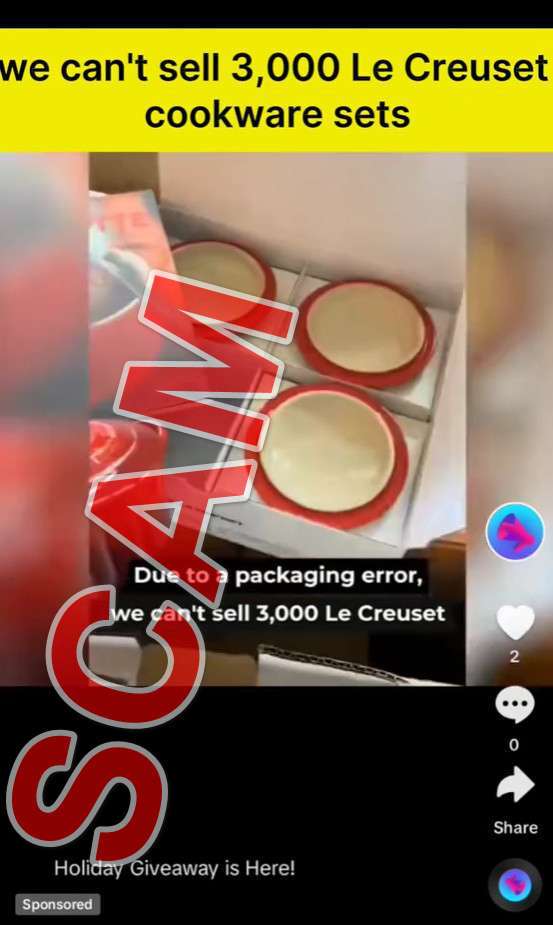
The giveaways are promoted using convincing fake videos that appear to show Curry announcing the promotion. But make no mistake – these giveaways are completely fake and used solely to scam consumers through deceptive subscription fees.
Quick Breakdown
The Ayesha Curry Le Creuset Giveaway scam starts when scammers run social media advertisements promoting a fraudulent free Le Creuset cookware giveaway featuring celebrity Ayesha Curry. The ads contain fake AI-generated videos showing Curry announcing the giveaway due to an excess inventory of Le Creuset products.
These convincing videos are fabricated to deceive viewers into believing the famous cookbook author and TV personality is personally endorsing the promotion. In reality, Ayesha Curry has no association with this scam giveaway.
The advertisements also aim to create urgency by claiming supplies are limited and the giveaway will end soon. This convinces targets to act fast without carefully evaluating the giveaway’s legitimacy. Time pressure is a common manipulation tactic used in many online scams.
When social media users click on these promoted ads, they are redirected away from mainstream platforms like Facebook or Instagram to external phishing websites. These fraudulent sites are carefully designed to mimic the appearance of legitimate news sources like Fox News, CNN, NBC, and others.
The phishing sites feature logos, branding, formatting, and web addresses extremely similar to real news organizations in order to appear credible. However, they are not actually affiliated with any of these trusted outlets.
These impersonator sites contain wholly fabricated claims that Ayesha Curry has partnered with Le Creuset for an exclusive free cookware giveaway. To bolster legitimacy, they reference fake press announcements and release dates regarding the launch of the imagined partnership.
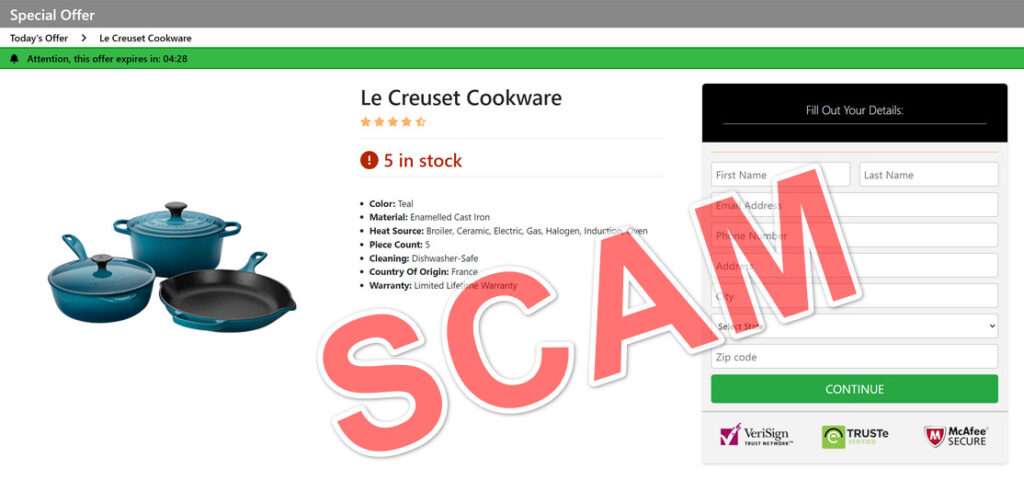
The phishing pages also display stock photos of Le Creuset products and details about the cookware sets users can supposedly claim. Incentivizing users with free, valuable merchandise helps convince targets to lower their guards.
To actually secure their free Le Creuset set, users are prompted to take action by clicking a prominent button or link to claim the offer. They are led to believe all they need to do is cover a small $9.95 shipping and handling fee, which seems reasonable for expensive cookware.
However, this payment processing page is where the scam truly begins. Users must input personal billing information like their name, address, phone number, email address, and credit card number.
Unbeknownst to victims, by submitting payment details they are actually being automatically enrolled in a recurring monthly subscription with exorbitant fees. The fine print disclosing the terms of this subscription scam is buried in obscure links far from the checkout button.
Within just a few days of making the shipping payment, victims find their cards charged up to $99.95 or more as the first month’s subscription fee. The fraudulent companies behind these scams will continue to charge monthly subscriptions ranging from $79.95 to $199.95 indefinitely.
Canceling or stopping these unauthorized repeat charges is made extremely difficult by the scammers. Contact information is unavailable, account management portals are non-functioning, and customer service requests are deliberately ignored.
This prevents victims from halting the charges and forces most to eventually cancel their credit card altogether just to stop the stealth monthly fees. Meanwhile, the free Le Creuset cookware sets are never shipped out.
By promoting the phony giveaway through social platforms utilizing a well-liked celebrity like Ayesha Curry, the scammers execute an effective bait-and-switch strategy. They bank on the credibility of Curry’s reputation to lure in targets, then pivot to fraudulently extracting as much money as possible through deceptive recurring fees.
This is why it is crucial to use heightened scrutiny when evaluating celebrity-endorsed giveaways requiring financial information. An offer may appear legitimate, but can actually serve as a gateway into predatory subscription scams.
In summary, this is an overview of how the Ayesha Curry Le Creuset Giveaway scam strategically deceives and exploits victims for financial gain through:
- Fabricated celebrity endorsement videos
- Phishing pages mimicking reputable news brands
- High-value free merchandise offers
- Low shipping fees hiding costly subscriptions
- Repeated unauthorized credit card charges
- Nonexistent customer support
How the Scam Works
The Ayesha Curry Le Creuset giveaway scam systematically targets and exploits victims in the following steps:
Step 1: Promotion Using Celebrity Impersonation
The scammers rely heavily on impersonating Ayesha Curry to add legitimacy to their fake giveaway.
AI-Generated Videos
Across Facebook, Instagram, YouTube and more, paid video ads appear showing Curry announcing the giveaway. But the videos are AI-generated – not actually her.
The fake Curry claims that due to excess inventory, Le Creuset urgently needs to give away free cookware sets. This tricks viewers into believing the giveaway is endorsed and recommended by Ayesha Curry.
Fake News Articles
In addition to video ads, the scammers also run phony Curry giveaway articles on fake news sites mimicking CNN, Fox News, NBC and more.
These look deceptively real with official branding and fonts, but contain totally fabricated claims of Curry’s partnership with Le Creuset.
False Urgency
Both the videos and articles emphasize acting fast with phrases like “limited time only!” to panic viewers into clicking without scrutiny.
Step 2: Drive Clicks to the Phishing Site
The prominent call-to-action buttons on the ads and articles direct victims to the phishing site.
The URL often imitates Le Creuset’s real website, with slight misspellings or repeats to seem plausible, like:
- leccreusetgiveaway.com
- le-creusetofficialgiveaway.com
The phishing site features Le Creuset branding and images of cookware sets. Details like contest rules and entry deadlines aim to legitimize the fake giveaway.
Step 3: Collect Shipping Payment
On the phishing site, victims are prompted to pay a reasonable $9.95 shipping fee to have their free cookware set shipped.
To complete “checkout,” users must enter sensitive personal and payment information, including full name, address, phone number, email and credit card details.
This gives scammers access to both your private data and payment method to start charging exorbitant subscription fees.
Step 4: Auto-Enroll in Monthly Subscription
Entering payment information unwittingly enrolls victims in an undisclosed monthly subscription.
Within days, victims see large charges from $99.95 up to $199.95 as the first subscription fee. The small print says these excessive charges will continue monthly.
Terms are buried intentionally to ensure users don’t realize paying shipping signs them up for recurring charges.
Step 5: Difficulty Canceling and Getting Refunds
Canceling the unwanted subscription is made purposefully difficult by scammers.
Contact information is unavailable, account management links are broken, emails are ignored. Victims most often have to cancel their credit card altogether just to stop the membership fees.
And the promised free Le Creuset cookware never arrives. Obtaining refunds is also rare, as scammers block refund requests however possible.
What To Do If You Are A Victim
If you got duped by the Ayesha Curry Le Creuset giveaway scam, take these steps immediately:
- Call your credit card company to report fraudulent charges and request a chargeback. Provide transaction dates/details.
- Cancel your credit card to stop upcoming bogus charges and get a new card number.
- Contact your bank if any fees hit your bank account and ask them to block payments.
- File reports with the FTC, FBI, BBB and other relevant agencies complaining about this scam.
- Review statements closely to watch for any other surprising charges from scammers. Dispute promptly.
- Avoid “refund” scams demanding an upfront fee – only work directly through your bank.
- Spread awareness about this scam to help prevent others from falling victim too.
- Monitor your credit and continue to check for any signs of identity theft stemming from this scam.
The more victims speak up, the better chances we have of getting the Ayesha Curry Le Creuset giveaway scam shut down. But staying vigilant about similar celebrity-fronted scams is crucial going forward too.
Frequently Asked Questions About the Ayesha Curry Le Creuset Giveaway Scam
Many consumers have questions about the supposed Ayesha Curry Le Creuset giveaway promoted on social media. Below we answer some of the most frequently asked questions to reveal the truth about this fraudulent scam.
Is the Ayesha Curry Le Creuset giveaway real?
No. The giveaway advertised across social platforms is completely fake. Ayesha Curry is not involved in or endorsing this scam promotion in any way.
How does the Ayesha Curry Le Creuset giveaway scam work?
Scammers use AI-generated videos of Curry to falsely claim she is giving away free cookware. Users pay a $9.95 “shipping fee” on phishing sites, unintentionally signing up for a costly monthly subscription.
What happens when you pay the $9.95 shipping fee?
The fee signs you up for recurring subscription charges around $99.95 per month or higher, continuing indefinitely. It is a pretext to get your payment info.
Do you actually receive free Le Creuset cookware?
No. No physical products are ever shipped out, despite users paying expensive repeating fees monthly.
What is the monthly subscription cost after paying shipping?
You will be charged as much as $99.95 or more every month after submitting your info and paying the deceptive $9.95 shipping fee.
How can you cancel the subscription and get a refund?
Canceling is purposely difficult. Contact info is unavailable, account links don’t work. Most victims have to cancel their credit card entirely to stop the fees.
Is Ayesha Curry affiliated with Le Creuset cookware?
No. The real Ayesha Curry has no partnership with Le Creuset. Scammers completely fabricated this celebrity association.
How can you report this scam and avoid it?
Report it to the FTC. Carefully read all terms before entering giveaways requiring your information. Avoid celebrity promotions pushing urgency.
Can you get your money back if you fell for the scam?
You can request a chargeback from your credit card company. But getting refunds is difficult by design. Immediately cancel affected payment accounts.
Hopefully this FAQ helps reveal the deceitful techniques used in the Ayesha Curry Le Creuset Giveaway scam, so consumers can detect and evade it. Let us know if you have any other questions!
The Bottom Line
While the fake promotion exploits Ayesha Curry’s positive image to seem credible, the reality is this giveaway is just a fraudulent ploy to scam consumers through misleading subscriptions.
Avoid any giveaways you encounter promoted using:
- Impersonation of Ayesha Curry via AI video generation
- Phony news articles and websites mimicking trusted brands
- Deceptive shipping fees hiding costly monthly billing
- Predatory autobilling practices nearly impossible to halt
With heightened scrutiny and awareness, hopefully consumers can evade celebrity-linked scams like the counterfeit Ayesha Curry Le Creuset giveaway. Please share this article to help protect others from being exploited by these deceptive schemes.

Join the discussion
0 commentsShare your experience or ask a question about this article.
Discussion
Start the conversation
Have a question or something useful to share? Add the first comment.