

You have probably seen the clip already. A bad afternoon. You are bloated again. You woke up at 2 or 3. A page says parasites did that, and two droppers a day will fix it.
That is why people land on Ellora’s site after midnight. The bottle is Ellora Parasite Cleanse, black walnut, wormwood, and clove. Keep reading and a second bottle shows up, a zeolite flush. If your stomach has been bad, a doctor still beats a sales page.
This is the same pattern as the other cleanse campaigns. A scare about something living in you. A kit that feels safer than one bottle. A 30-day badge. Then a refill sitting under a happy-customers label, and a refund that shrinks once you open the policy.
Overview
Ellora Parasite Cleanse is sold on myellora.com, on a product URL that still says binder cleanse. The page does not feel like a shop. It feels like someone already decided you have worms.
The story on the page
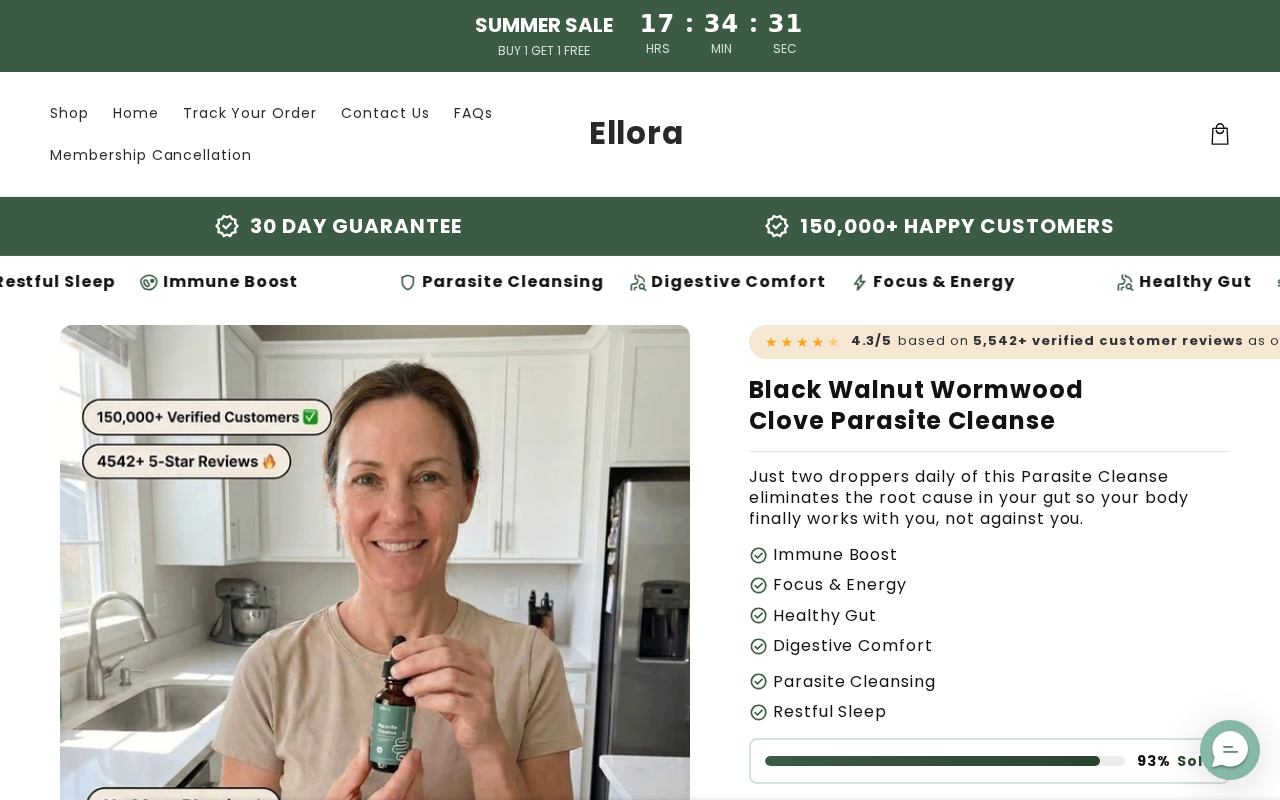
It is 2 in the morning and you click the ad. The page that loads is already in a hurry. A summer sale banner says buy one, get one free, and a clock is running in that banner so you do not wander off. The clock restarts at the end of each day, so the sale never quite dies. A bar says 93% sold.
The first promise is two droppers a day. “Just two droppers daily of this Parasite Cleanse eliminates the root cause in your gut so your body finally works with you, not against you.” It never names what is supposedly in you, and it never asks you to test. A bad week in your stomach is treated as enough.
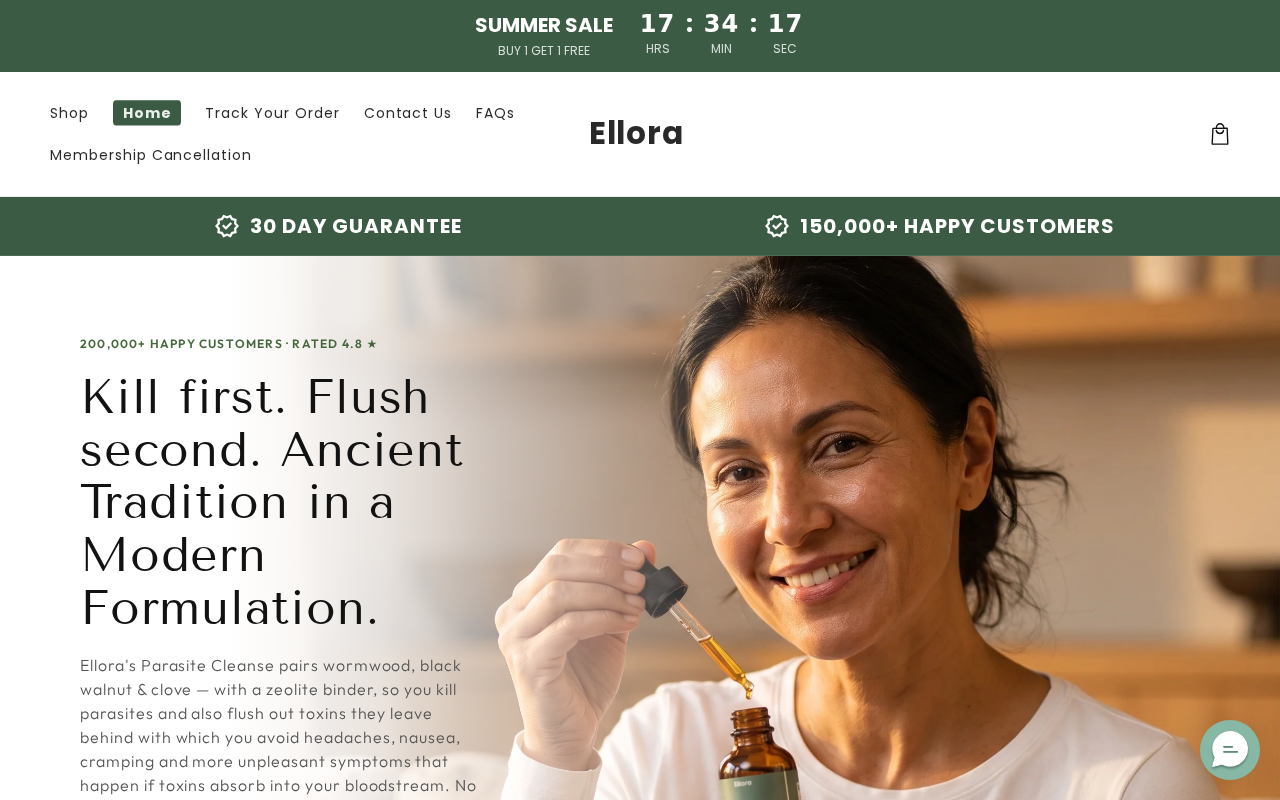
Then the page adds a second bottle. Kill first, it says. Flush second. Without zeolite, the dead parasites will poison you. That is how they sell two products instead of one. You came looking for one dropper. The kit is already lit up as the smart choice. The fear is not that the first bottle fails. The fear is that it works, and then the dead things poison you unless you pay again.
Open the homepage and the volume goes up. “Kill first. Flush second.” It puts a quote on the screen about poison in the blood and tags it as an old Ayurvedic rule from around 400 BCE. It wants a leaf-logo kit to feel ancient. The same homepage claims 67,000 customers “cleared herpes forever.” A parasite dropper is not a herpes treatment. That line is doing medical work on a sales page that also sells a liver bottle and a candida bottle from the same grid.
If you have a real prescription in the cabinet, that sentence still lands. It is sitting next to a gut cleanse as if both were the same kind of product.
The numbers and the price ladder
Under the stars it says “4.3/5 based on 5,542+ verified customer reviews as of Sep 10.” A badge on the same photo says 4542+ 5-Star Reviews. Sep 10 is a strange date to leave on a page in August. Click those stars and you stay on the same photo.
The header says 150,000+ happy customers. The homepage says 200,000+ and 4,784 five-star reviews at 4.8. Same shop, and the counts do not agree. None of those numbers open a page you can sort.
In August 2026 the buy box showed:
- 1 bottle: $29.99, with $39.99 crossed out
- 2 bottles: $54.99
- 3 bottles: $74.99
- Most popular: one cleanse plus one zeolite flush for $49.99
- Under the cart: “1 Bottle Every 30 Days – $29.99” and “Pause/Cancel Anytime”
That is how a $29.99 dropper becomes a $50 checkout. Below the homepage pitch sit more bottles: a candida cleanse for $24.99, a liver cleanse, zeolite on its own, and that same $49.99 kit. Same leaf. Same 30-day badge. Same inbox. Once the parasite story works, the shop has a next product ready.
Delivery, guarantee, and the smaller print
On the product page, a small line says delivery in 3 to 6 days. The shipping policy is slower: 1 to 2 business days to process, then 4 to 10 business days, and international can take longer because of customs. A person who bought after the 3 to 6 day promise can wait two weeks and still be inside the policy. The ad said the bottle was already on its way. The policy said the warehouse had not even packed it.
The homepage says Ships from USA. That chip sits with Third-Party Tested and a 30-day trial badge. The Made in USA line is not on that homepage. It lives on the product page, in a table that also says doctor formulated. The same page walks you through four weeks of relief, energy, a deep cleanse, then lasting balance. None of those weeks ask you to get a test first.
You can picture week four from the couch at 2am. You cannot picture a stool test from that same couch, because the page never sent you there.
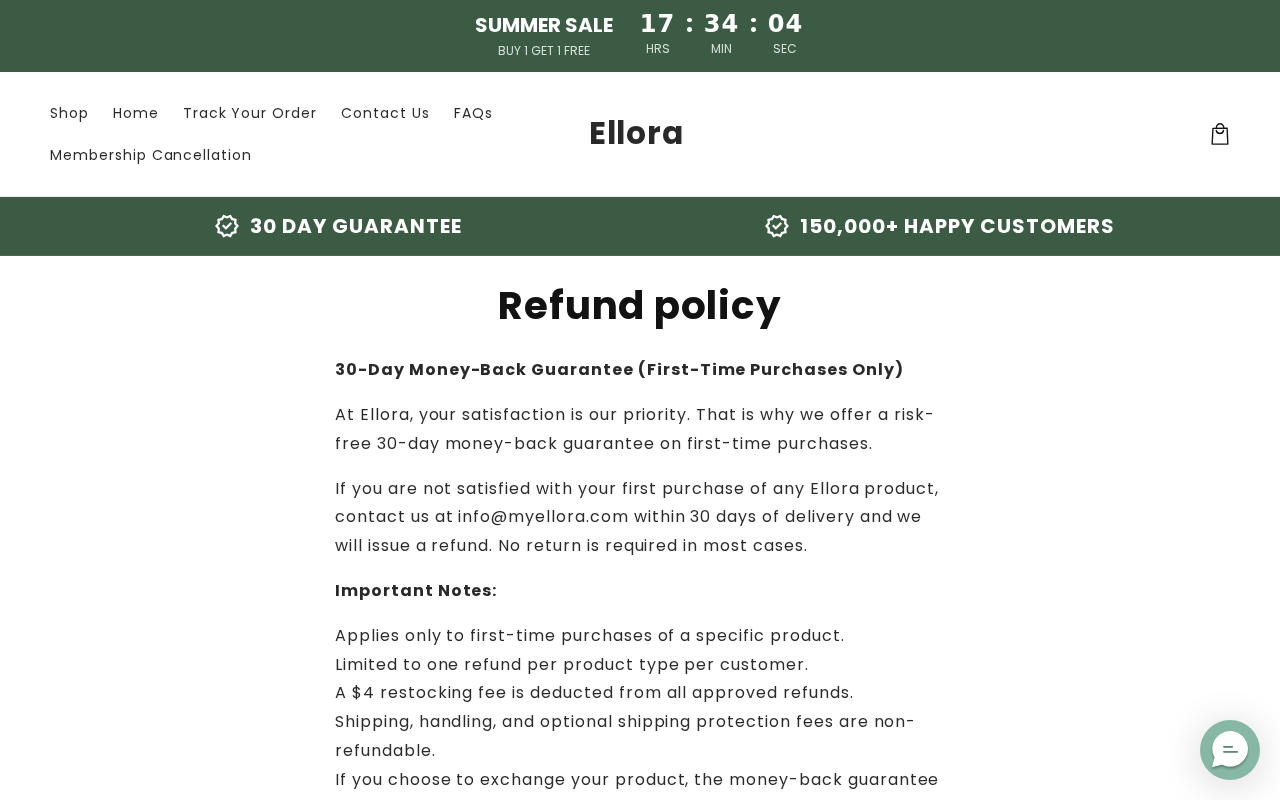
The shop lists a 30-day money-back guarantee in big type. On the product page it is “no questions asked.” On the homepage it is “no questions, no hassle.” Open the refund page and that promise gets smaller: first-time purchases only, one refund per product type, a $4 restocking fee, shipping kept, and no 30-day promise if it was a subscription. You have six hours to cancel an order. After that, they say it is already going out. Six hours is enough time to close the laptop and miss the window.
If you do send it back, the return is on you unless the item is damaged or wrong. The return warehouse in the terms is 2249 S Yale St, Santa Ana, CA 92704, not the Sheridan street on the refund page.
Who sells it
Refund and shipping still send you to info@myellora.com, plus a form that wants your phone number. The refund page names the business Ellora at 30 N Gould St, Sheridan, WY 82801. Privacy and Terms also print +1 607 670 0128. They do not put that number on the refund page, the shipping page, or the main contact block. The footer posts hours, Monday through Sunday, 9am to 5pm, then the same email. People who later look this shop up still sound like they never got a human on a line.
The company on those policy pages is Ellora Brand LLC. The Sheridan street and the Miami PMB at 66 W Flagler Street, Suite 900, PMB 12528, Miami, FL 33130 are mailboxes. The registered and opt-out line uses the same Sheridan building with STE N. Neither address is a lab you can visit.
This shop has been up since last spring. The page you see now was rebuilt in May 2026. The product itself was created on May 2, 2025 and published on May 8, 2026. The domain was registered on January 3, 2025, with the owner’s name hidden behind Domains By Proxy.
The header has a Membership Cancellation link. That page loads. It does not look like a simple cancel form. A separate membership-cancellation page on the site is still a dead end. Pause/Cancel Anytime is easy to read under the cart. Finding the actual stop button is not the same sentence.
The herbs are the old trio: black walnut hull, wormwood, clove. Bloating is common. Worms are not the default. Wormwood is not a casual tea. Ellora does not lead with that. It leads with flush, herpes, and a 30-day badge.
Trustpilot reviews of this shop describe the other version of that story: a monthly charge after a one-time buy, refunds that stall, and support that only answers email. The score sits around 1.4 from a few dozen reviews. Treat that as themes, not as named quotes you can paste.
How The Scam Works
The page is built to get a worried person into a kit, then keep them on a 30-day refill.
1. The ad already knows what is wrong with you
You do not start on a quiet shop. You start on bloating, bad sleep, or a search for parasites at 2am. The page is already sure. Hidden culprit. Two droppers. A kit if you want to do it right.
The homepage says standard stool tests miss 70% to 90% of infections. So a normal result is treated as a reason to buy, not a reason to stop. You already feel bad. A test would take a week. The dropper can be in the cart in twenty seconds. The page is counting on that gap.
2. The review counts are there so you do not leave
One line says 5,542 reviews. The photo says 4542+. The homepage says 200,000 customers. None of those numbers open a page you can sort. Next to that sit a running sale clock and a 93% sold bar. Initials sit next to herpes and skin stories, marked verified customer.
Real reviews argue with each other. This page is tidy, and the numbers do not match. They are there so you do not open a new tab and type the shop name into Trustpilot.
3. The second bottle is sold with fear
The cleanse is step one. The zeolite binder is step two. The copy says that if you only buy the drops, toxins will hit your blood and you will crash at week two. Then they price the kit as a saving against a homemade stack of bottles. You came for one dropper. You leave with a protocol.
Someone in the house may even ask why there are two bottles on the receipt. The page already has an answer: because one bottle is not safe enough.
4. A monthly refill is sitting under the cart
There is a real 30-day plan at $29.99 a bottle, with no discount. The option is not labeled subscribe. It is labeled “Over 100k+ Happy Customers.” That is a brag, sitting where a plan name should be.
A one-time buy still exists. The page still puts “1 Bottle Every 30 Days” next to the cart. Pause/Cancel Anytime is easy to read. The Membership Cancellation link in the header does open. The old membership-cancellation page is still a 404. The same complaint is already on Trustpilot: they thought they bought once, then the charge came back.
The terms give you 24 hours before the next bill to cancel a subscription. That is a different window from the six hours you get to stop a brand-new order. Easy to mix up. Easy to miss both.
5. The guarantee shrinks when you need it
The poster says 30 days, no questions. The contract says first time only, $4 off the top, shipping kept, and no 30-day refund if it was a subscription. Return shipping is on you unless the item is damaged. You have six hours to cancel after you pay.
That is why the badge feels easy and the email thread does not. You write from the kitchen table. You attach the order number. You wait. The clock on a chargeback does not wait with you.
6. The addresses are mailboxes
You already saw the Sheridan mailbox and the Miami PMB. Neither one is a factory behind the leaf. The homepage says Ships from USA. The shipping policy still talks about customs on international orders. The shop’s own pages do not agree.
If you call the number on Privacy or Terms, you are calling a line the refund page never showed you. If you email info@myellora.com, you are writing to the only door they actually advertise.
7. You have seen this bottle on another site
Open the Alora shop after this one and you hear the same lines. Two droppers. Ten herbs. Your body working with you, not against you. Eggs, larvae, and adults. The same typo, “proccess,” is still in the instructions.
The older Vello page is still up. The public copy is softer now: two droppers, eight herbs, and that same typo. Ellora and Alora are the twins today. That does not prove who wrote the letter first. It proves the pitch travels.
8. The medical story is the real risk
Bloating is common. Parasites in a person who has not traveled, and who has a negative stool test, are not the default. A page that sells a herpes cure next to a gut dropper is not being careful with you. If you feel worse on the drops, stop. Keep any medicine you were prescribed. Do not stop a prescribed antiviral because a sales page mentioned herpes.
The night after the first extra charge, you finally open Trustpilot. People say they bought once and got billed again. They say the refund stalled. They say they never got a phone that picked up.
What To Do If You Have Fallen Victim to This Scam
If the charge already landed, do this in order. Do not wait for a warm reply.
- Save the evidence. Screenshot the 5,542 reviews line, the 93% sold bar, the 30-day badge, the every-30-days cart line, the order email, and the refund page that carves out subscriptions and takes $4. Write down dates, amounts, and the merchant name as it actually printed.
- Read the statement today. Look for a second $29.99, a kit charge, or the words subscribe or monthly. The merchant name may not say Ellora. If it is recurring, call the bank. Ask them to block the merchant and dispute the charge.
- Email info@myellora.com once, from the address on the order. Subject: cancel and refund, plus the order number. Ask for the money back on the original card. Say every future billing should stop. Save the sent mail.
- If they point at the first-time-only rule, the restocking fee, or the subscription exception, forward that to the bank with your screenshots of the no-questions-asked badge.
- Stop the drops if you feel worse. Cramps and “die-off” are not proof you had parasites. If you are pregnant, nursing, or on other medicine, take the bottle to a clinician. Do not stop a prescribed antiviral because a sales page mentioned herpes.
- If you actually worry about parasites, get a stool test. A positive test gets a named drug. A negative test means you can stop buying these pages.
- File a report. In the US, use the FTC fraud report form. Watch the card for two or three months. Ignore anyone who messages you offering to recover the money.
- Cut the ads. Install Malwarebytes if the click tried to push a player. Use AdGuard so the next cleanse clip has a harder time finding you.
If a relative sent you the ad, send them this page instead of the checkout. These pitches move through worried texts. That is part of how they travel.
The Bottom Line
Ellora is a cleanse shop that sells a kit with fear, a 30-day badge that shrinks on the refund page, and a refill sitting under a happy-customers label. The review counts do not agree with each other. The herpes line is a hard stop.
If you are still holding the card, you do not need a sale clock and a second bottle to catch the poison. If you have paid, keep the emails, cancel in writing, and call the bank. info@myellora.com is slower than a chargeback deadline.
Save the 30-day badge and the refund page that takes $4. If the next charge lands anyway, those two screenshots are the whole argument.

Reviews & discussion
0 commentsShare a firsthand experience, or ask a question.
Community reviews
Ellora Parasite Cleanse
Moderated reader experiences, not an editorial verdict.
Start the conversation
Have a question or something useful to share? Add the first comment.