

Holior Wormwood ads tell a frightening story: hidden parasites may be behind ordinary problems such as bloating, fatigue, brain fog, poor sleep, and skin changes. The proposed answer is a daily softgel blend that supposedly attacks adults, larvae, and eggs.
That is a powerful sales pitch, but it is not the same thing as a medical diagnosis. We reviewed the Holior Wormwood offer, checkout, automatic-refill option, cancellation language, company transparency, and available medical evidence before reaching a verdict.
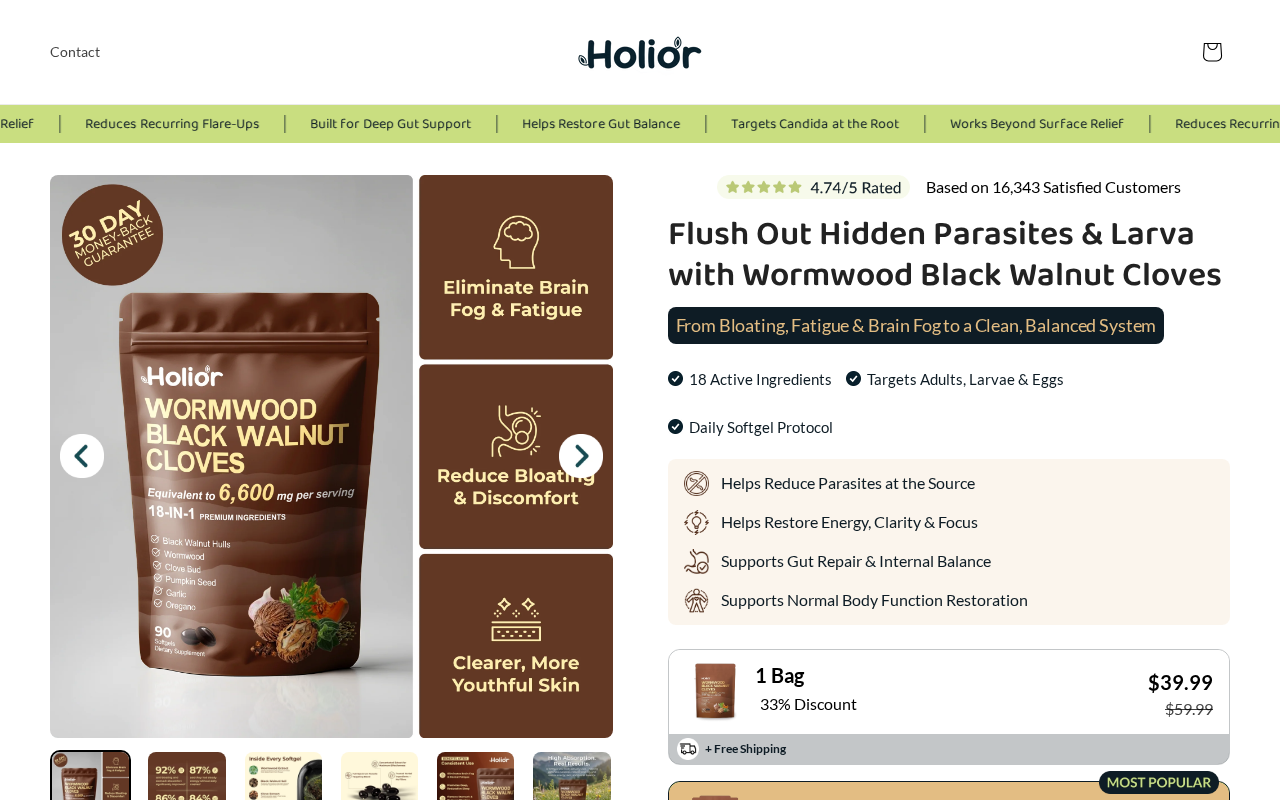
Holior Wormwood Overview
Holior Wormwood Black Walnut Pumpkin Seed & Clove Softgels is sold as a dietary supplement for “parasite cleansing.” The product page says its 18-ingredient formula delivers the equivalent of 6,600 mg per serving and instructs customers to take three softgels before breakfast.
The page makes unusually specific promises for a supplement. It says the formula targets adult parasites, larvae, and microscopic eggs, helps parasites detach from the intestinal wall, addresses Candida “at the root,” and supports recovery from problems supposedly created by parasites.
Our quick verdict
We did not find enough evidence to call Holior a confirmed non-delivery scam. The website has a functioning Shopify checkout, clearly shows a one-time purchase option, and does not select automatic refills by default during our test.
However, we consider the offer high risk. The medical claims go far beyond the evidence shown for the finished product, the domain was registered only in March 2026, the public contact page lists only an email address, and the subscription cancellation window contains unfinished template language.
- Product: Holior Wormwood Black Walnut Pumpkin Seed & Clove Softgels
- Advertised purpose: eliminating parasites and restoring gut balance
- Tested one-time prices: $39.99 for one bag, $79.98 for three bags, or $119.97 for five bags
- Automatic-refill discount: 25% off
- Renewal frequency advertised: every four weeks
- Guarantee: 30 days
- Contact shown: contact@holior.com
- Risk level: high-risk health offer; not proven to be an outright fake store
Is Holior Wormwood a Scam?
The most accurate answer is that Holior combines a real online supplement offer with several practices that deserve caution. A customer may receive a product, yet still be misled about what that product can reasonably do or about the quality of the evidence behind it.
Calling every questionable supplement a fake-store scam can hide the more important problem. Here, the central concern is health marketing that encourages shoppers to connect vague symptoms to parasites and then presents one proprietary blend as the solution.
The parasite claims are not a diagnosis
Bloating, low energy, poor concentration, sleep changes, and skin irritation can have many causes. They do not prove that a person has parasites, Candida overgrowth, or a hidden infestation.
The Centers for Disease Control and Prevention explains that parasite testing depends on symptoms, medical history, and travel history. Tests may include several stool samples, blood work for a specific parasite, imaging, or endoscopy. There is no single supplement-page checklist that can establish the diagnosis.
Holior’s page says its herbs work across the “full parasite lifecycle,” but we did not find a published, product-specific clinical trial showing that the finished Holior formula eliminates human parasite infections. Traditional use or research on individual ingredients does not prove that this particular mixture treats an infection.
A dietary supplement is not an approved antiparasitic treatment
The U.S. Food and Drug Administration does not approve dietary supplements for safety and effectiveness before they are sold. FDA guidance also says that a product marketed to diagnose, treat, cure, or prevent a disease is subject to drug requirements, even when the seller calls it a supplement.
This distinction matters because a confirmed parasitic infection may require a specific prescription chosen for the organism involved. Replacing diagnosis with a broad herbal cleanse can delay appropriate care while the underlying condition continues.
How the Holior Wormwood Offer Works
1. The page turns common symptoms into a hidden threat
The sales story begins with symptoms almost anyone may recognize. The page links bloating, afternoon fatigue, brain fog, skin changes, low vitality, and slower recovery to parasites that supposedly attach to the gut and consume nutrients.
This framing creates urgency before evidence is discussed. Instead of asking whether the shopper has a diagnosed infection, it encourages the reader to interpret a broad collection of everyday complaints as proof that something is “living inside” the body.
2. The supplement is presented as a complete lifecycle solution
Holior then contrasts its blend with weaker cleanses. Wormwood and black walnut are described as attacking active organisms, pumpkin seed as forcing detachment, clove as eliminating eggs, and L-glutamine as repairing the gut lining.
The language sounds clinical, but the page does not provide product-specific trial data showing those steps occur in people who take the advertised dose. A mechanism proposed for an ingredient is not proof of a real-world cure.
3. Large discounts steer buyers toward bundles
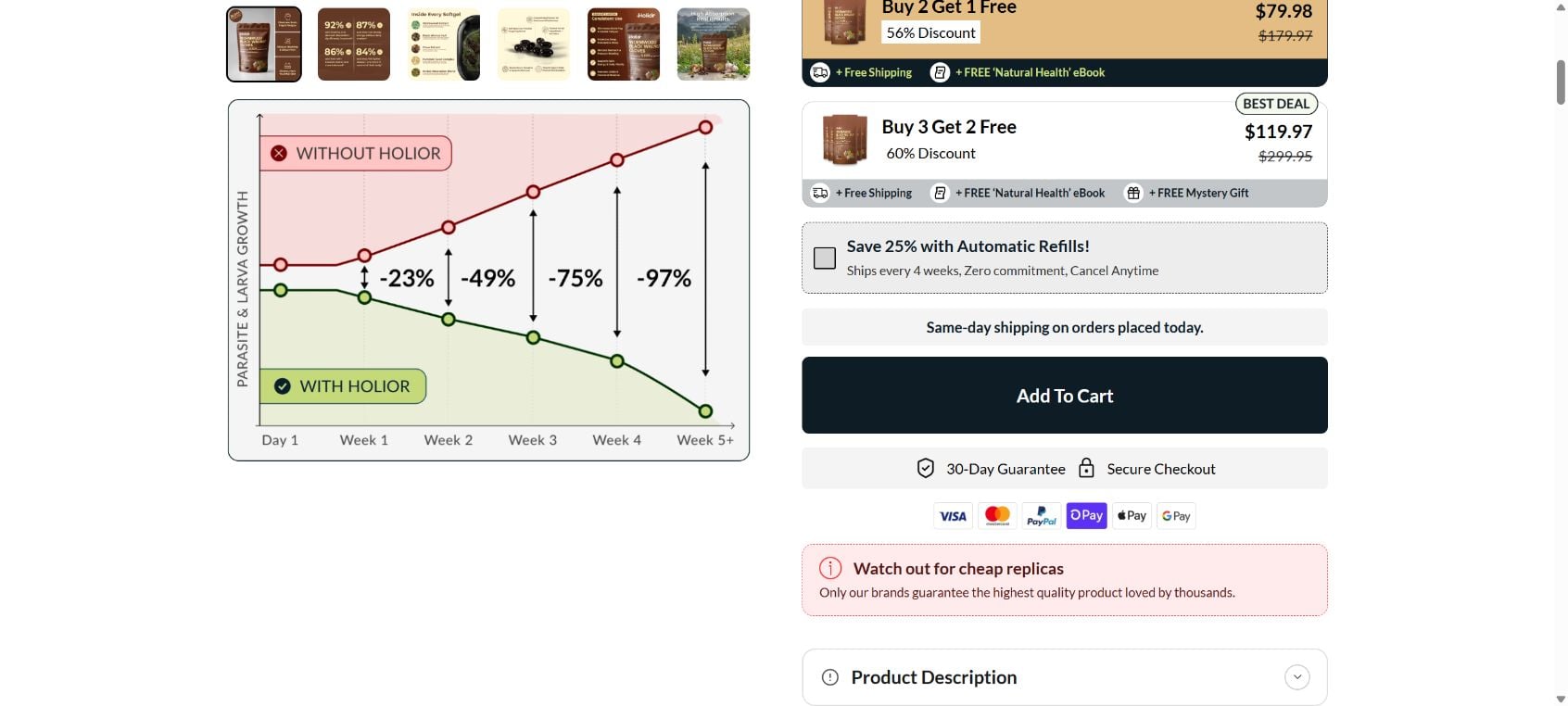
During our review, the standard offer displayed one bag for $39.99, a buy-two-get-one-free bundle for $79.98, and a buy-three-get-two-free bundle for $119.97. The larger bundles were labeled with discounts as high as 60% off.
Reference prices can make a bundle look more valuable, but they do not establish product quality or clinical value. Shoppers should focus on the amount charged today, the number of servings, the refund rules, and whether future charges are enabled.
4. Automatic refills reduce the price by 25%
Below the bundle selector is an automatic-refill option promising 25% off. The page says the order ships every four weeks, has “zero commitment,” and can be canceled at any time.
Importantly, this box was not selected when we loaded the product page. A shopper had to click it to switch from the one-time prices to the lower subscription prices. That is better than hiding a preselected subscription, but buyers still need to inspect the final order carefully.
5. The cart does not repeat the renewal details clearly
We selected automatic refills and added the three-bag bundle. The cart drawer showed the product, quantity, discount, and a $59.99 subtotal, but it did not visibly repeat “every four weeks” beside the item.
The Shopify checkout displayed a general notice saying that continuing with payment means agreeing to future charges and the cancellation policy. Yet the visible order summary still showed only the product and today’s $59.99 total, without an easy-to-scan recurring amount and schedule next to it.
6. The cancellation policy contains unfinished text
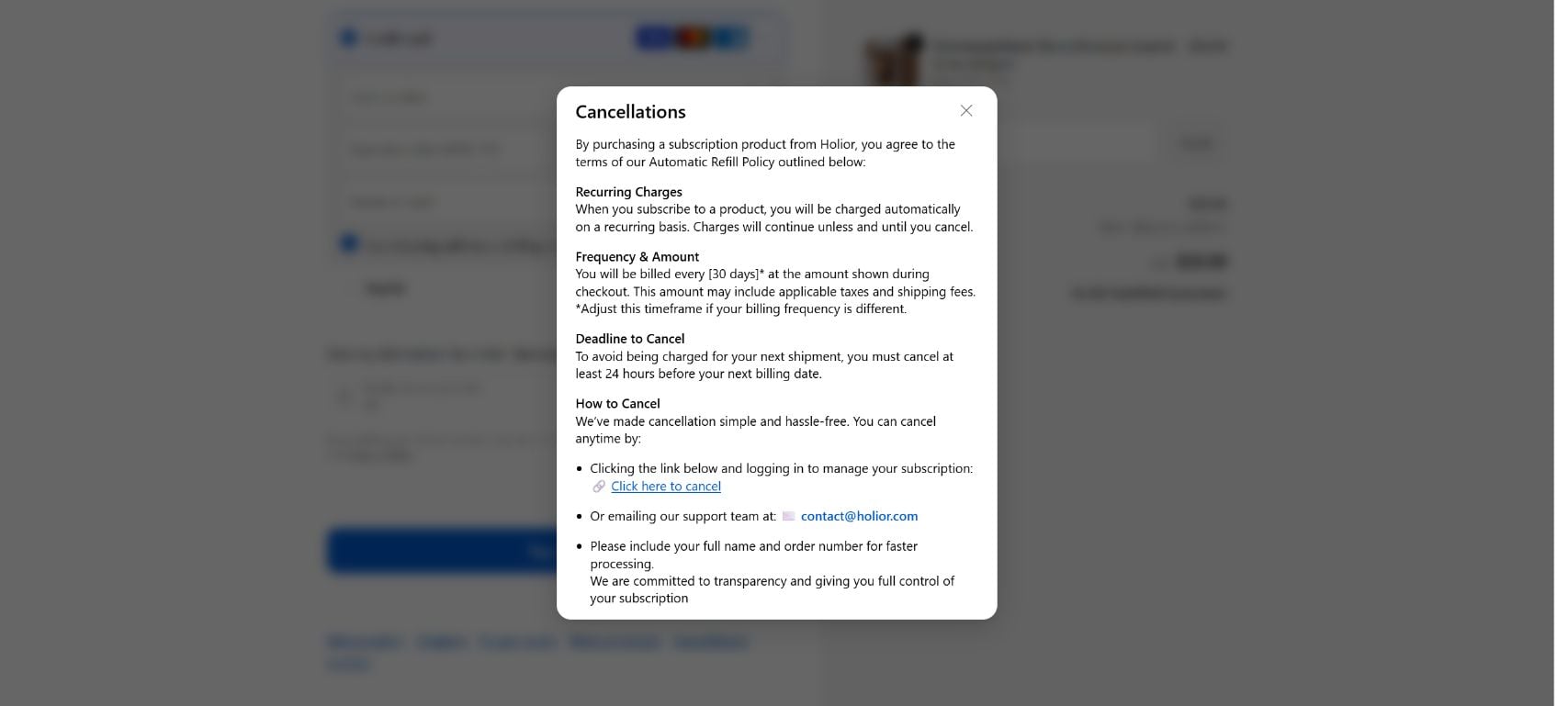
The checkout cancellation window says subscribers are charged on a recurring basis until they cancel. It lists billing every “[30 days]” and requires cancellation at least 24 hours before the next billing date.
More concerning, the customer-facing policy still includes the instruction: “Adjust this timeframe if your billing frequency is different.” That is clearly template text that should have been removed before customers were asked to accept it.
The product page says shipments occur every four weeks, while the cancellation window says every 30 days and then questions its own timeframe. Those periods are close, but they are not identical. A recurring-charge agreement should not leave customers guessing.
7. Testimonials and percentages create social proof
The site says it is “based on 16,343 satisfied customers” and displays outcome figures such as 95% for reduced bloating, 87% for steadier energy, 91% for clearer skin, and 84% for stronger vitality.
We did not find a methodology explaining who was surveyed, how participants were selected, whether outcomes were verified, or whether anyone had a confirmed parasite infection. On-site testimonials are marketing evidence controlled by the seller, not a substitute for an independent clinical study.
8. The 30-day guarantee lowers the buyer’s resistance
A money-back promise can make a purchase feel safe, but it is only as useful as the written policy and the seller’s response. Consumers should save the version of the policy shown when they order and request any refund in writing before the deadline.
For a product that recommends consistent daily use, 30 days is also a relatively short period in which to assess a vague wellness outcome, contact support, and complete any required return process.
Red Flags We Found in the Holior Wormwood Offer
- Disease-like claims without finished-product evidence. The page describes eliminating parasites, eggs, larvae, and Candida, but we found no published clinical trial of the Holior formula proving those results.
- Symptoms are treated as proof. Fatigue, bloating, and brain fog are nonspecific and should not be used to self-diagnose an infection.
- A very new website presents very large customer numbers. Public WHOIS data reported by domain-analysis services shows holior.com was registered on March 6, 2026, yet the page claims 16,343 satisfied customers. That mismatch deserves an explanation.
- Limited business identification. The public contact-information page lists an email address but no named legal operator, street address, or telephone number.
- Incomplete subscription language. The cancellation policy contains a bracketed interval and an instruction intended for the merchant, not the customer.
- Renewal details lose prominence in the cart. The cart and visible order summary did not clearly repeat the four-week schedule beside the product.
- Strong social-proof statistics lack methodology. Large percentages are shown without enough information to independently evaluate them.
- Safety and testing claims are general. “Third-party tested” and “manufactured in certified facilities” are not the same as publishing a batch-specific certificate of analysis for the item a customer receives.
What we could not independently verify
We could not independently verify that 16,343 people bought this product, that the percentages came from a representative survey, or that the stories involved medically confirmed infections.
We also did not find a public study protocol, participant count, control group, or raw results behind those figures.
The site says the supplement is third-party tested and made in certified U.S. facilities. We did not find a prominently linked batch certificate identifying the laboratory, test date, lot number, or measured ingredient amounts.
A shopper should ask for microbial and heavy-metal results before ordering. The lot on the certificate should match the delivered pouch.
We also could not verify the normal retail history behind every crossed-out price. A comparison price is most meaningful when the product was genuinely offered at that amount for a substantial period, not when it exists mainly to make today’s bundle look urgent.
Questions to ask before placing an order
- What legal company processes the payment and appears on the card statement?
- Where can customers find a physical business address and telephone support?
- Which independent laboratory tested the current batch, and can the certificate be downloaded?
- What exact recurring amount, shipping fee, tax, and billing date apply after the first discounted order?
- Does canceling stop only future shipments, or does it also affect an order already queued for fulfillment?
- Must unopened bags be returned to qualify for the 30-day guarantee, and who pays return shipping?
Are Wormwood, Black Walnut, and Clove Proven to Remove Parasites?
Some botanical compounds have shown biological activity in laboratory research, and some have a long history of traditional use. That does not establish that an over-the-counter blend will reliably cure a human parasitic infection at the dose and duration on this label.
Wormwood can contain thujone, a biologically active compound. The safety of an herbal product depends on the plant species, extraction method, dose, contaminants, other ingredients, medical conditions, pregnancy status, and interactions with medicines.
“Natural” does not mean risk-free. Combining many botanicals also makes it harder to know which ingredient caused an adverse effect. Anyone with suspected parasites, persistent digestive symptoms, liver or kidney disease, a seizure disorder, or regular medication use should speak with a licensed clinician before taking a cleanse.
What to Do If You Bought Holior Wormwood or Were Enrolled in Automatic Refills
- Check the confirmation email and card statement. Look for words such as subscription, automatic refill, recurring, every four weeks, or future charges. Note the merchant descriptor exactly as it appears.
- Save evidence immediately. Take screenshots of the product page, selected purchase option, checkout total, cancellation policy, guarantee, confirmation email, and every support message. Online terms can change.
- Cancel in writing before the next billing date. Use the account-management link if it works and email contact@holior.com. State that you revoke authorization for all future recurring charges and request written confirmation.
- Ask for a refund within the stated 30-day window. Include your order number, purchase date, amount, and the reason for the request. Keep the email and any ticket number.
- Monitor the payment method. A cancellation message does not remove the need to watch for another charge. Check the next two statement cycles.
- Dispute an unauthorized renewal. If another charge appears after cancellation or you did not knowingly authorize a subscription, contact the card issuer or PayPal promptly and provide your saved evidence.
- Report misleading recurring billing. U.S. consumers can submit a report at ReportFraud.ftc.gov and notify their state attorney general. Consumers elsewhere can contact their national consumer-protection authority.
- Seek medical advice for symptoms or reactions. Do not rely on a cleanse if you suspect an infection. Stop using the product and contact a clinician if you experience a serious or unexpected reaction.
The Bottom Line
Holior Wormwood appears to be a real supplement offer, not a proven fake storefront. Its automatic-refill box was not selected by default in our test.
Even so, the parasite claims are much stronger than the evidence presented, business transparency is limited, and the cancellation policy contains unresolved template text.
We would not use Holior to diagnose or treat a suspected parasite infection. If you still consider buying it, choose the one-time option, save every term, use a payment method with dispute protection, and speak with a qualified healthcare professional first.









I do not want to continue receiving this product . cancel this product for me
I just opened my package this afternoon, and already upon reading all these reviews have a very bad case of buyers remorse. I too take a blood thinner, but seeing that this product was made in China further exacerbates my doubt surrounding this product. I not trust China to do anything right. So with my paying only $39.00 for the 3 packs, I will not do a refund as the time and trouble involved isn’t worth it. I will however, be sending a do not renew letter. Being so mesmerized at first when I watched the presentation, has soon soon vanished, and will not have anything to do with this firm or the product for that matter.
Steve, thank you for sharing your experience. Before using the supplement, ask your pharmacist or prescribing clinician to review the actual ingredient label for possible interactions with your medication. Do not stop or change prescribed medication because of a supplement advertisement. A product’s country of manufacture alone does not establish whether it is safe or effective.
For cancellation, use the seller’s contact details from your original order, clearly request that any recurring orders and charges be canceled, and ask for written confirmation. Keep a copy of your request and monitor subsequent statements. If another charge appears after cancellation, contact your card issuer promptly with those records. We are an independent information site and cannot cancel the order on your behalf.
I received a recurrence order notice without checking recurrence when I made the primary order, I called the number 619-383-1678 that appeared on my billing from my Bank. The auto response is: pleas email our support team or use one of the contact website.
Joshua, save the original order confirmation and the recurring-order notice. Send a written cancellation request using the contact details on your original order, state that you did not authorize recurring orders, and keep a copy. Contact your bank through its official app or the number on your card to report any unauthorized charges and ask how to stop future recurring payments. The FTC also accepts reports at https://ReportFraud.ftc.gov/.
I Am On Blood Thinner And Tried to Return The Product They Are Claiming that it was not the first Shipment ( Which It Was) and then turned around and sent another Shipment
Brenda, please check with your prescribing clinician or pharmacist before using the supplement, since supplements can interact with medicines. For the additional shipment, keep the order and delivery records, request cancellation in writing, and ask your card issuer about any charges you did not authorize. Keep copies of the seller’s conflicting explanations as part of your records.
I also ordered TheWormwood Clove supplement 3 pkg. first sentence says do not take with Anticoagulants. Sure wish it was in advertising. I hope you can help me get a refund.
I received my order today and read that if taking anticoagulants, you should not use Holior. How can I return this product.
I am sorry you are dealing with this, Gail. MalwareTips is an independent review site and did not sell Holior, so we cannot process the return. Because the label warns against use with anticoagulants, do not take it unless your doctor or pharmacist confirms it is safe for you. Use the contact details in your order confirmation to request a written return authorization and address, keep all records, and contact your payment provider if the seller does not honor its refund terms.
Seems to me all ads on Facebook are scammers so why does Facebook not do anything about it? Are they benefiting from these dodgey sites also? I’ve been scammed by so many of these nasties I’m so grateful for these scam checking websites that I now compare their findings
Platforms earn advertising revenue, but that does not mean every advertiser has been thoroughly verified or that the platform endorses the product. Scam campaigns also rotate accounts, domains, and landing pages faster than many takedown systems can respond. Reporting the advertiser and landing page helps, but the most reliable protection remains the habit you have adopted: check independent evidence before paying.
cannot find contact info. for this product holior for refund purchased at amazon on 8/11/2026
any info. please help send to dansslots@aol.com
this must another scam
parasite detox
Because the purchase was made through Amazon, use the order page in your Amazon account and select the return or problem-with-order option rather than relying on contact details printed on the product. If the seller does not cooperate, escalate through Amazon’s customer service and keep screenshots of the listing and charge. For your privacy, avoid posting your email address publicly in future comments.
On July 28th i ordered this product and paid $69.94 again before 30 days (august 24th)my bank was charged again $69.94. I verified i have no subscription for this product. I am waiting for an answer to my email.
That second charge should be treated as a possible recurring payment even if the account page shows no subscription. Save the original offer and order confirmation, contact the payment provider now to challenge the new charge, and ask it to block further billing from that merchant. Do not rely solely on the seller’s email response while another billing date approaches.
there is a email with tracking info on it click and look for cancel subscription
Thanks for sharing that, Regina. Readers should first verify that the email belongs to their actual order before following any link. If a cancellation option is available, save the confirmation and check subsequent statements to make sure the charges stop. Avoid entering card details or passwords into an unfamiliar page reached from a tracking message.
How do I stop popup virius info and popup malware and spam
Start by removing notification permission for unfamiliar sites in your browser, then uninstall extensions you do not recognize and run a full scan with your installed security software. Do not click cleanup buttons inside the warnings, since those pop-ups are often the source of the problem rather than a real antivirus alert. If the pop-ups continue, follow the browser-specific removal steps in our guide and tell us which browser and device you use.
There is no email address on the package to cancel the continuious orders. Do you have a CS email address please. I cannot find anything. Many, many thanks,
John P. McGee
We have not found a verified customer-service address that we can safely recommend. Do not send account or card details to an address found in an advertisement or an unverified search result. Instead, cancel through the marketplace or payment provider used for the order and ask it to block further recurring charges from the merchant.
Our order was in a package that came from China. Is this purchase a scam or is that where the product comes from?
A package arriving from China does not by itself prove that the purchase is fraudulent; many legitimate and poor-quality products alike are manufactured or fulfilled there. The stronger questions are whether the product, seller, ingredients, billing terms, and claims match what was advertised. Check the label and statement carefully, and do not take it if the ingredients or manufacturer cannot be verified with a clinician or pharmacist.