

Email scams promising free money or lottery winnings are unfortunately all too common these days. One such scam that has been making the rounds involves a supposed donation from B. Raymond Buxton, winner of a $425 million Powerball jackpot in 2014. This convincing but fake email claims Buxton is donating over $600,000 to random individuals as part of a “charity project.” But before getting too excited about this sudden windfall, read on to learn all about how this donation scam really works.
Overview of the B. Raymond Buxton Donation Scam
In February 2014, B. Raymond Buxton made headlines when he claimed a $425 million Powerball prize, the largest ever won on a single ticket at the time. Buxton, a retiree from Northern California, chose to take the lump sum payment of $242.2 million before taxes. He maintained his anonymity for months by creating a trust to manage the winnings.
Buxton’s record-setting jackpot win seems to be what scammers are capitalizing on with this donation scam email. The email is made to look like it comes directly from Buxton through something called the “B. Raymond Buxton Foundation.” It states that as part of a charity project, he has decided to donate over $600,000 to 10 random individuals worldwide.
The scam email goes on to provide a link to a real 2014 news article announcing Buxton’s Powerball win, likely to make the email appear more legitimate. It then instructs the recipient to reply to the email address provided to “claim” the promised donation funds.
This may sound very exciting and convincing initially. But in reality, the entire thing is a scam designed to steal money and personal information from unsuspecting recipients. There is no evidence that a B. Raymond Buxton Foundation even exists. And Buxton himself almost certainly has nothing to do with these fake donation emails being sent out with his name attached.
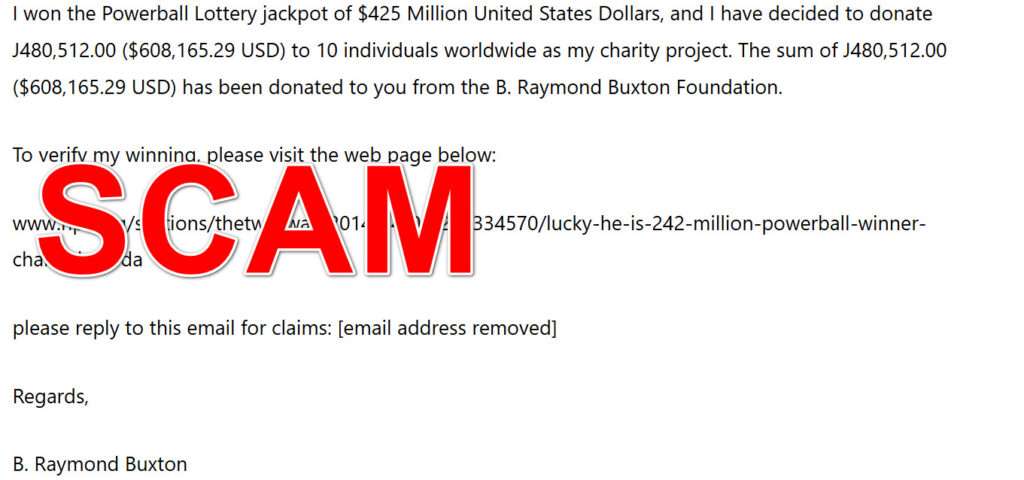
Here is how the scam email might look:
Subject: Donation.
I won the Powerball Lottery jackpot of $425 Million United States Dollars, and I have decided to donate Ј480,512.00 ($608,165.29 USD) to 10 individuals worldwide as my charity project. The sum of Ј480,512.00 ($608,165.29 USD) has been donated to you from the B. Raymond Buxton Foundation.
To verify my winning, please visit the web page below:
www.npr.org/sections/thetwo-way/2014/04/02/298334570/lucky-he-is-242-million-powerball-winner-channels-yoda
please reply to this email for claims: [email address removed]
Regards,
B. Raymond Buxton
How the B. Raymond Buxton Donation Scam Works
The scammers behind this donation scam are very strategic in how they operate:
1. Scammers obtain emails and send out messages en masse
The first step for the scammers is getting their hands on email lists to send out their scam donation messages to. They likely purchase lists of email addresses from the dark web or shady data brokers. Or they may use email scraping tools to harvest addresses from websites and online forums.
Once they compile a large list of emails, the scammers can use email blasting software to send out their B. Raymond Buxton donation scam email to thousands of inboxes at once. This allows them to reach huge numbers of people rapidly.
2. Email is made to look official and references real lottery win
The emails sent out are crafted to appear as official as possible. The subject line normally reads something like “Donation” or “Congratulations Beneficiary.” The body of the email is made to look like it comes directly from B. Raymond Buxton through an organization called the “B. Raymond Buxton Foundation.”
The email also references Buxton’s very real $425 million Powerball jackpot win in 2014. It includes a link to a legitimate news article announcing his win, likely to make the whole thing seem more credible.
3. Recipients are instructed to contact the scammer to “claim” funds
After establishing legitimacy and claiming Buxton is donating over $600,000 to random individuals, the email instructs recipients to contact the sender to “claim” their promised funds. This involves replying to the scam email address provided.
Once recipients respond, the scammers can engage in further phishing attempts and extraction of personal information. Or they may direct targets to fake websites dressed up to look like legitimate lottery, charity, or bank portals.
4. Scammers collect personal info and targets are eventually asked for money
Upon initial response, the scammers posing as Buxton or his foundation will likely ask for personal details like name, home address, phone number, age, occupation, etc. This starts the information harvesting process.
Eventually, after building trust through continued email exchanges, the scammers will start asking the targets for money to allegedly process the donation funds. They may claim they need to pay fees, taxes, or processing costs before the winnings can be released.
This is where the standard donation scam crosses over into an advance fee scam. Once money is sent, the scammers disappear with it, leaving the targets with nothing.
5. Scammers disappear once they get money from victims
After the targets send money as requested, the scammers take off with it and the whole ruse falls apart. They stop responding to emails and all the fake websites claiming to be the B. Raymond Buxton Foundation suddenly vanish into thin air.
At this point, the victims realize they have been scammed out of their own money under the guise of a fake donation. But sadly the scammers are long gone, having cashed out on their upfront fees already. They are likely on to their next scam targets.
What to Do if You Have Fallen Victim to the Scam
If you have already responded to one of these scam emails and gotten embroiled with the fraudsters, here are some important steps to take right away:
- Stop all contact immediately: Do not respond to any further emails or calls from the scammers. The more contact you have, the more opportunity they have to extract information and money from you. Cut off contact completely.
- Report the email: Forward the scam email to the Anti-Phishing Working Group at reportphishing@antiphishing.org and to the FTC at spam@uce.gov. This helps get the scam on their radar.
- Alert your bank: If you gave the scammers any financial account information or sent them money, call your bank immediately so they can take action to protect your accounts.
- Place fraud alerts: Contact the major credit bureaus to place fraud alerts on your credit reports to help prevent identity theft.
- Change all passwords: Change passwords on all of your online accounts if there is any chance the scammers obtained login credentials. Enable two-factor authentication wherever possible.
- Contact authorities: File reports with the FBI’s IC3 at www.ic3.gov and your local police to leave a paper trail of the scam.
- Consult with an attorney: If you already transferred money to the scammers, speak with a lawyer about legal options to potentially recover lost funds.
The most important thing is acting swiftly upon realizing you have been scammed. Quickly take steps to protect yourself from further harm. Unfortunately, any money already paid out to the scammers is unlikely to be recovered. But cutting off contact and reporting the scam can help prevent these fraudsters from deceiving other potential victims.
Frequently Asked Questions About the B. Raymond Buxton Donation Scam
1. What is the B. Raymond Buxton donation scam?
The B. Raymond Buxton donation scam is a fraudulent email scheme where scammers pretending to be 2014 Powerball winner B. Raymond Buxton offer a large cash donation, often claiming it is for charity. The emails look official and reference Buxton’s real $425 million jackpot win. Recipients are instructed to contact the sender to claim the promised funds, which allows the scammers to extract money and personal information from victims. There is no evidence that Buxton or any foundation in his name is truly giving away money.
2. How do the scammers carry out this donation scam?
The scammers send out mass emails to addresses harvested from the dark web or scraped from websites. The emails are made to look official, claiming the donation comes from the “B. Raymond Buxton Foundation.” A link to a real news story about Buxton’s lottery win is included to seem more legitimate. Recipients who respond are asked for personal information and eventually told to pay fees, taxes or processing costs to receive the “donation.” Once money is paid, the scammers disappear.
3. What techniques do the scammers use?
This scam utilizes email spoofing, fake websites, and phishing techniques. Spoofed emails mimic official correspondence from someone trustworthy. Fake sites mimic bank, lottery and charity sites to extract information and payments. Phishing tricks targets into providing personal and financial data the scammers exploit. Links in emails often install malware.
4. How much money do victims lose?
Reported losses from those scammed vary from several hundred to several thousand dollars paid out as alleged “fees.” The scammers often persuade victims to make multiple payments over time once the initial trust is gained. Total losses can grow through continued phishing and manipulation. Some have lost much more before realizing it is a scam.
5. How can I avoid becoming a victim?
The best way to avoid this scam is knowing that unsolicited jackpot or donation offers via email are nearly always fraudulent, no matter how official they look. Maintain skepticism, do not provide any personal information to the sender, and never pay any money upfront for promised winnings or donations. Reporting scam emails helps prevent perpetuation.
6. What if I already responded and gave information or money?
If you already responded and provided scammers with any information or payments, immediately cease contact and notify your bank, the authorities, credit bureaus and the FTC. Place fraud alerts, change account passwords and closely monitor statements for any signs of identity theft. Speak with an attorney about recovering lost money. The sooner action is taken, the better.
7. Can the scammers be traced and held accountable?
Scammers go to great lengths to conceal their identity and location, using technical tricks to mask their trail. Most operate from overseas in countries out of reach of U.S. authorities. IP addresses associated with scams are usually anonymized through VPNs. Bringing scammers to justice is very rare, unfortunately.
8. Why has this scam been so successful at duping people?
This scam succeeds by exploiting two things – the reputation of a well-known lottery winner and people’s belief they may have lucked into an unexpected windfall. The real Buxton gives it credibility. Recipients let excitement cloud their judgment when faced with the potential for a huge cash “donation.” But it pays to remember nothing good comes free or out of the blue.
The Bottom Line on the B. Raymond Buxton Donation Scam
This compelling scam uses the reputation of a real, high-profile lottery winner to try tricking people into paying phony “fees” to receive a big cash donation that will never actually materialize. Scammers impersonate Buxton to make their ploy seem legitimate on the surface.
But the entire thing is an elaborate ruse designed to steal identities and money. There is no evidence that Buxton or any related foundation is actually giving money away to random individuals. Any communication claiming otherwise should be considered fraudulent.
The best protection is being aware that these fake donation scams exist and maintaining skepticism about any sudden windfalls. If an unsolicited email promising you money seems too good to be true, it almost certainly is. Avoid taking the bait of responding, providing personal information, or paying any alleged fees.
With scamming techniques constantly evolving, we all must stay vigilant to protect ourselves. Being informed is the best defense against these predatory frauds seeking to take advantage of unassuming recipients and their bank accounts. Don’t become their next victim.

Join the discussion
0 commentsShare your experience or ask a question about this article.
Discussion
Start the conversation
Have a question or something useful to share? Add the first comment.