

The caller says someone at your bank is stealing, and you can help catch them. The bank examiner scam starts by making you feel useful.
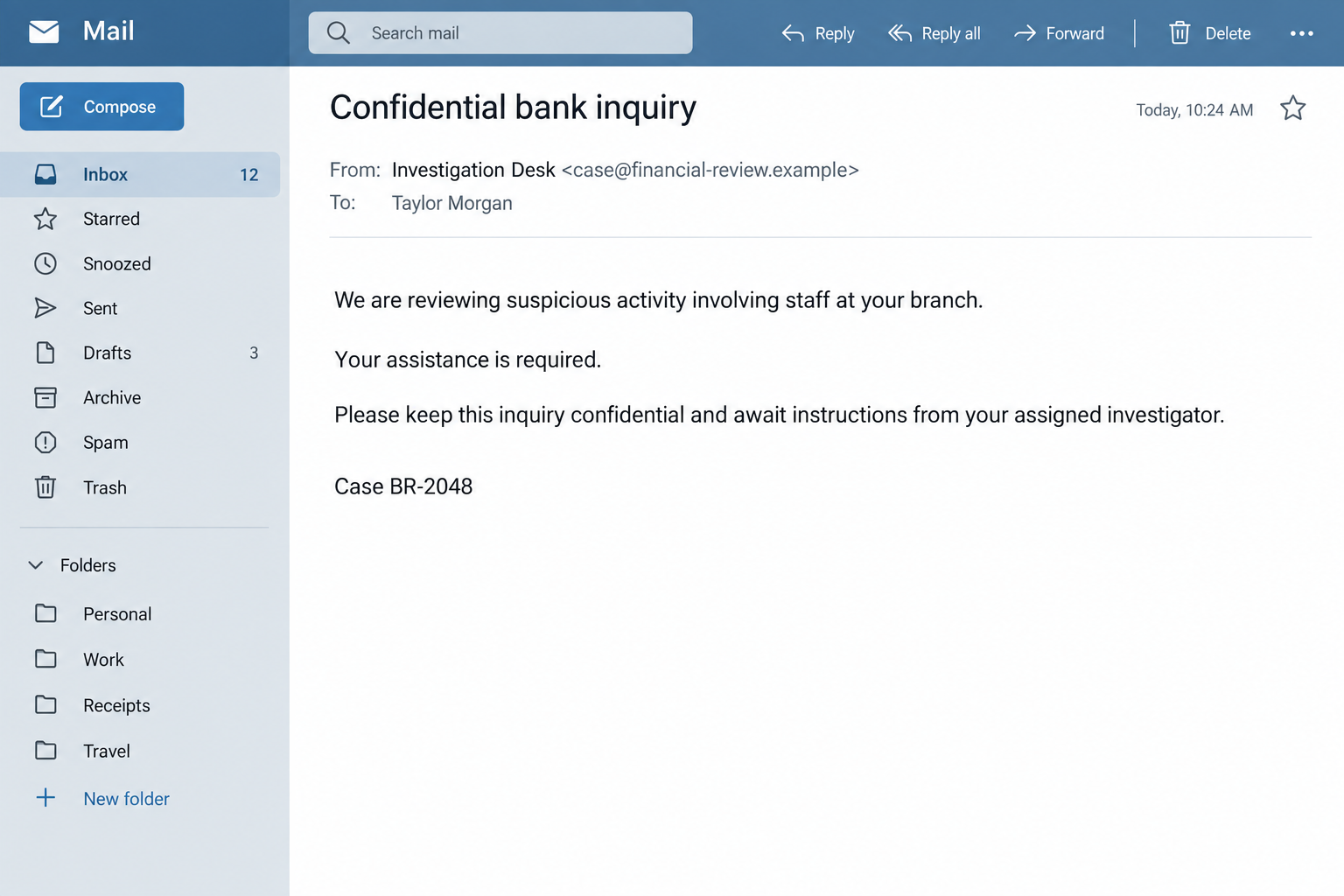
There is a case number, an investigator, and one unusual condition: the people who normally help with your money must not hear about this.
Overview
The caller recruits you into an invented investigation
In this scam, an impersonator claims bank employees are corrupt and asks a customer to assist an inquiry. Cooperation eventually means putting personal money at risk.
The supposed examiner may claim to represent a regulator, law enforcement agency, or bank security department. Those organizations are being impersonated, not conducting the scheme.
The distinctive hook is not simply that your account needs protection. It is that moving your money will supposedly expose somebody else’s wrongdoing.
The method has official documentation behind it
An FDIC consumer warning describes the phony-investigator scam, including requests to withdraw money to help investigate alleged bank misconduct.
This is historical documentation of the mechanism, not evidence of a newly announced FDIC case. The old script remains useful for recognizing new impersonation attempts.
The FDIC Office of Inspector General also warns that it does not ask for money or personal information by phone.
Secrecy turns ordinary safeguards into supposed threats
- The caller claims employees handling your account cannot be trusted.
- You are told your assistance is necessary for a confidential investigation.
- Questions from the bank are presented as interference rather than protection.
- A withdrawal, transfer, or handover becomes part of the alleged operation.
- Independent verification is discouraged at the moment it matters most.
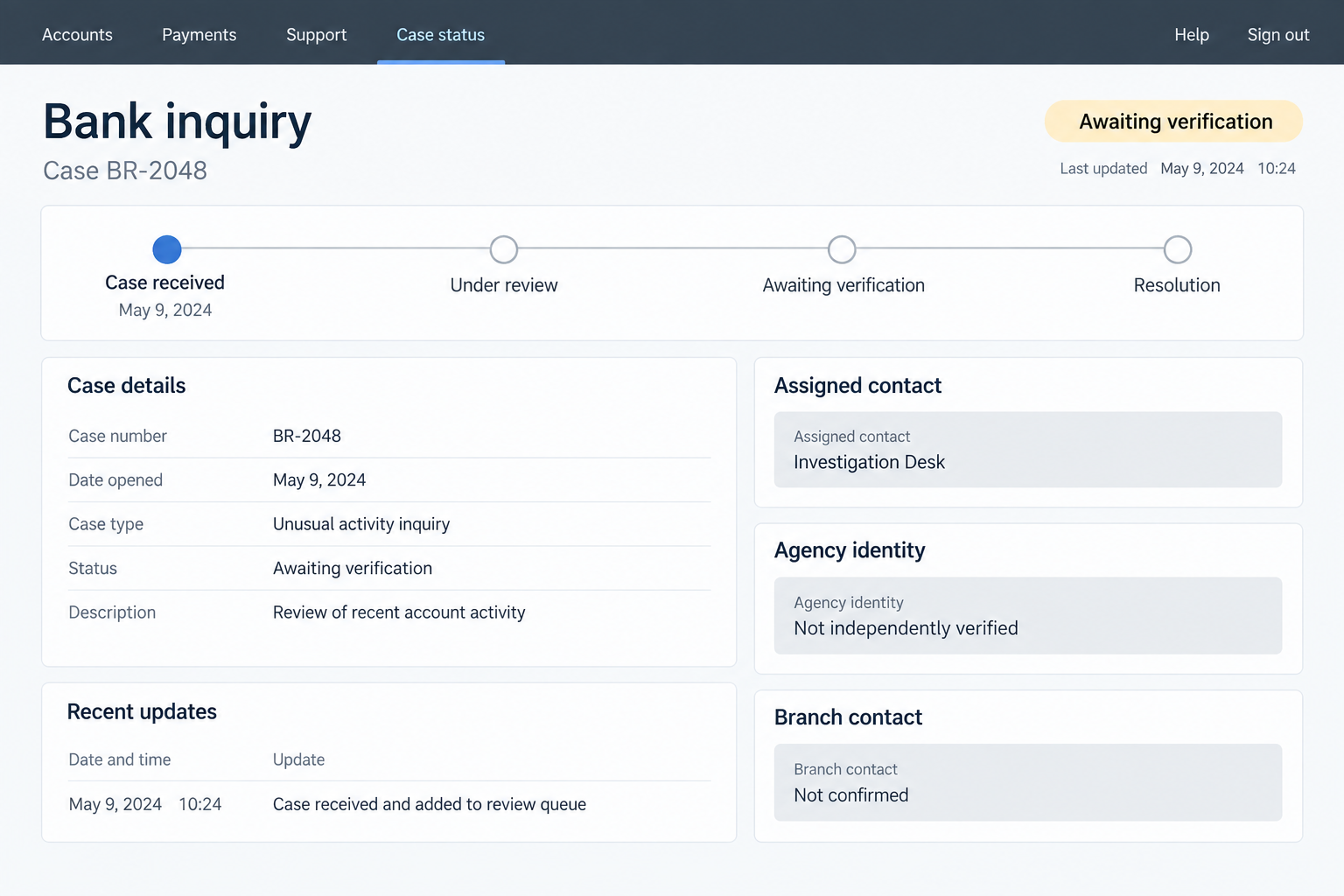
This article uses fictional interface reconstructions to illustrate the approach. They are not government correspondence, evidence of a particular victim’s loss, or authentic case records.
Why Helping an Investigator Can Feel Different From Paying a Stranger
Many people would refuse an unexplained demand for cash. Being asked to help stop a crime can feel like a completely different proposition.
The caller gives the customer a role: witness, trusted account holder, or confidential assistant. That role can make hesitation feel like letting someone down.
It also changes how a withdrawal is understood. The money is framed as evidence or a temporary operational necessity, rather than a payment to the caller.
But the label does not change who loses control of it. Cash handed over for an invented inquiry is still cash leaving your possession.
The allegation against bank employees supplies a second advantage. It anticipates the safest response, contacting the bank, and gives the victim a reason to avoid it.
This is not evidence that a named teller or branch committed wrongdoing. The accusation itself is part of what the caller needs you to believe.
A real concern about staff misconduct can be reported independently. You do not have to resolve it through the person who unexpectedly introduced the allegation.
That distinction lets you take the possibility of fraud seriously without surrendering control to an unverified investigator.
How the Bank Examiner Scam Works
Step 1: An official-sounding caller introduces a problem at your branch
The opening may mention suspicious transactions, dishonest staff, or a confidential audit. It is specific enough to sound urgent but difficult to verify during the call.
A caller may already know your name or some banking context. Familiar details can come from many sources and do not establish official authority.
Rather than answer security questions, ask for the claimed agency and end the conversation. Find that agency’s contact details yourself.
Do not use a transfer offered by the caller as the verification step. Another voice on the same connection can belong to the same operation.
Step 2: You become the person who can help catch the culprit
The impersonator explains why your account or cooperation is important. This makes the request personal and gives you a reason to remain involved.
There may be praise for your discretion or reassurance that authorities will protect you. Neither statement creates protection for a transaction you are being pressured into.
You are not obligated to become an undercover participant because somebody called. An unexpected invitation to investigate bank staff deserves independent checking, not immediate compliance.
If the caller threatens consequences for declining, that pressure is another reason to stop. A frightening claim is not a deadline you must obey.
Step 3: The caller cuts off the people who could interrupt
Family members may supposedly jeopardize the case. Bank staff may supposedly be suspects. Even routine fraud questions can be reinterpreted as proof of a cover-up.
This creates a trap where every warning reinforces the story. The victim is encouraged to trust the caller precisely because everyone else advises caution.
The practical answer is to break that isolation. Tell someone you trust what is happening before withdrawing money, visiting another branch, or following further instructions.
If you are worried about a particular employee, use the bank’s independently verified fraud department or another appropriate reporting channel. Secrecy is not your only option.
Step 4: Helping the inquiry requires access to your money
The documented phony-investigator approach includes getting the customer to withdraw funds. Other official-impersonation schemes seek transfers or conversion into assets the criminals can collect.
Do not assume every version uses the same payment method. The shared problem is an unverified stranger controlling a financial action under false authority.
A promise that funds will be returned after inspection does not secure them. Nor does a document calling the movement temporary or protected.
Pause before any transaction, even if the destination appears to be your own account. Ask your bank to explain the complete transaction and its risks.
Step 5: Continued contact keeps the story ahead of your doubts
Once you cooperate, the caller has an incentive to keep you engaged. Updates, new case stages, and reassurance can delay the moment you seek outside help.
If something fails, the explanation may change while the central demand remains: keep following instructions and do not speak to anyone else.
There is no need to win an argument with the caller. Ending contact removes their immediate opportunity to redirect your next decision.
If money already moved, switch from discussing the case with the impersonator to reporting the transaction through real institutional channels.
A Badge Number, a Video Call, and a Case File Still Need Verification
The FBI has warned about people impersonating federal agents, including staged appearances intended to make fraudulent demands credible.
An FBI discussion of agent-impersonation scams also describes role changes involving purported bank representatives and federal agents.
These warnings support skepticism about the impersonation methods. They do not authenticate a specific person merely because their call resembles a reported case.
Official details can be copied
A genuine agency name, public office address, or real employee’s name can be repeated by someone with no connection to that institution.
Ask yourself how the identity was established. If every supporting detail came from the caller, you have several claims from one source, not independent confirmation.
A document number becomes useful only when the real organization can verify it through contact details you obtained separately.
Caller ID is a display, not an identity document
The number shown on your screen does not prove who is speaking. Do not let a familiar name override an unusual request involving money or secrecy.
End the call and start a new one using a trusted contact. If you remain unsure about the connection, use another phone.
Explain the allegation from the beginning. You do not need to know the technical method used to impersonate the number before asking for help.
A convincing appearance does not authorize a withdrawal
A video, identification image, or professional email layout may feel stronger than a voice call. It still requires verification outside the conversation.
Do not spend time deciding whether an image was AI-generated. The more useful question is whether independently contacted authorities confirm the person and requested action.
Even polished materials do not turn a request to hide a financial transaction into a safe investigation.
When You Are Helping a Parent or Another Relative
Start by reducing the pressure, not by criticizing their judgment. Someone who believes they are helping investigators may interpret criticism as another obstacle.
Ask what the caller wants them to do next. A planned bank visit or handover can be interrupted before you resolve every part of the story.
Offer to contact the real bank together. Use the existing banking app, statement, or another contact source already trusted before the suspicious call.
Avoid debating whether a voice sounded foreign, educated, or official. Accent and confidence are not reliable tests of identity.
If the person has already withdrawn cash, focus on keeping it secure. Contact bank staff about safe handling rather than arranging any meeting with the caller.
If someone is due to collect money, do not confront them or set up your own sting. Contact local police and follow their safety advice.
Preserve the person’s dignity. They were approached with a story designed to reward trust and cooperation, and shame can make further contact harder to disclose.
After the immediate danger passes, agree on a simple household rule: no secret financial actions for unexpected callers, regardless of the title they claim.
A Real Complaint Does Not Require a Secret Withdrawal
You might have a genuine reason to question your bank. That does not make an unexpected investigator the right person to manage your response.
Keep any actual disputed transaction separate from the caller’s claims. Gather your own statements and contact the institution through a route you already know.
The FDIC’s consumer guidance on avoiding scams offers a useful starting point for recognizing impersonation and checking financial contacts.
If your concern involves a specific staff member, explain that to an independently reached fraud team. Do not let the caller present silence as the only alternative.
You can also ask a trusted person to sit with you while making the report. That support does not require sharing your banking passwords.
Separating the real concern from the invented operation protects both your money and the quality of any legitimate complaint you need to pursue.
What to Do if You Have Fallen Victim to This Scam
- Break contact with the supposed examiner.
Stop answering instructions, and do not announce plans to report them. Save messages before blocking where practical.
If the caller knows where you live and has arranged a collection, contact local law enforcement. Prioritize personal safety over gathering additional evidence.
- Reach your bank’s real fraud team immediately.
Describe the payment method, amount, time, and destination. Ask whether a pending transfer can be stopped or a completed transaction recalled.
Be candid if you authorized the transaction under deception. The bank needs the actual sequence, not a simplified version that leaves out important details.
Recovery depends on the circumstances and payment method. Reporting quickly is worthwhile, but nobody should promise that the funds will definitely return.
- Protect exposed banking access.
If you shared login details or security codes, tell the bank specifically. Ask about securing online access and reviewing recent activity.
If only your name was disclosed, do not assume complete identity theft. Make your response match the information and permissions actually exposed.
- Keep the investigation story as evidence.
Record the claimed agency, names, phone numbers, case references, messages, and transaction receipts. Separate what the caller said from what you independently confirmed.
Report the impersonation to the relevant agency through its genuine website. An FDIC-related allegation can be checked through the official channels linked above.
- Address device exposure only if it occurred.
If the caller persuaded you to install software, arrange a security assessment. Malwarebytes can help identify malicious software on a personal device.
If you encountered deceptive web pages or ads, AdGuard may reduce similar exposure. Neither tool can retrieve cash or authenticate a person on the phone.
- Bring a trusted person into the follow-up.
Review later messages together, especially offers from supposed recovery specialists. A demand for another payment to release recovered funds deserves immediate suspicion.
Set aside time to complete reports without staying available to the scammer. You do not owe the impersonator an explanation for ending contact.
Frequently Asked Questions
Would the FDIC ask me to help catch a dishonest teller?
The FDIC has warned about that exact phony-investigator pretext. Do not withdraw or surrender money for an unexpected caller claiming such authority.
What if the caller knows which branch I use?
Accurate personal context does not verify the caller. Confirm the claimed inquiry through independently obtained institutional contacts before discussing account details or taking financial action.
Does a confidentiality warning mean I cannot tell my family?
A stranger’s demand for secrecy is not a reason to give up trusted support. Seek independent verification instead of accepting their description of your obligations.
Is a transfer safe if they call it a test transaction?
The label does not protect the funds. Have your real bank review the destination and purpose before authorizing any transaction suggested by the unverified caller.
Should I keep talking to help police catch them?
Do not conduct your own operation. Preserve existing evidence, report the contact, and follow instructions from authorities you reached independently.
What if I withdrew money but still have it?
Do not hand it to anyone sent by the caller. Contact your bank about safely securing the funds and police if a collection was arranged.
The Bottom Line
The bank examiner scam makes financial risk sound like public service. Its strongest move is persuading you to distrust the people who could stop it.
You can take alleged misconduct seriously without participating in a secret operation. Keep control of your money and verify the story outside the caller’s reach.








