

Blaze AI Smart Home Workout is being promoted in social media ads as a smart home gym with AI-guided fitness, 300+ workouts, and “gym-level results at home” for only $99.99.
But the ad raises major red flags. The video itself appears to show an AEKE K1 Smart Home Gym, a premium AI fitness machine that normally costs thousands of dollars, not $99.99. This price gap, combined with repeated ads across different pages, suggests buyers may be dealing with a fake or misleading offer rather than a real clearance sale.
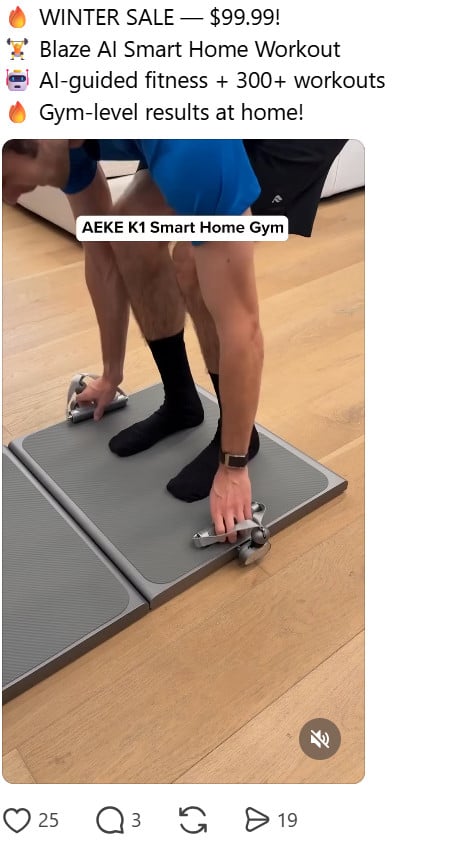
Blaze AI Smart Home Workout Overview
The ad claims:
- “WINTER SALE — $99.99”
- “Blaze AI Smart Home Workout”
- “AI-guided fitness + 300+ workouts”
- “Gym-level results at home”
The product shown in the video ads is labeled “AEKE K1 Smart Home Gym.” That is important because AEKE K1 is a real premium smart fitness system, not a cheap $99 gadget.
AEKE’s official page describes the K1 as an AI-powered smart strength gym with real-time form analysis, digital resistance, personalized training, and AI body assessment features.
Independent coverage from T3 describes the AEKE Smart Home Gym K1 as a large 77 kg fitness mirror with a 43-inch 4K display, twin cable attachments, digital resistance, and AI coaching. T3 also listed the product at around $3,498 on offer, with a recommended price of $4,598.
That makes the $99.99 “Blaze AI Smart Home Workout” offer extremely suspicious.
Search results also show the same or very similar ad copy appearing on multiple social media posts and pages, including “CLEARANCE SALE — $99.99,” “WINTER SALE — $99.99,” and “Blaze AI Smart Home Workout AI-guided fitness + 300+ workouts Gym-level results at home.”
This looks like a common fake-ad pattern: use footage or images of a real premium product, rename it under another brand, offer it at an unbelievable discount, and send buyers to questionable ecommerce pages.
Why the Blaze AI Smart Home Workout Ads Are Suspicious
1. The price is not realistic
A real AI-powered home gym with a screen, motorized resistance, cables, workout software, and form tracking cannot realistically sell for $99.99.
The AEKE K1 shown in the ad is a large premium machine. T3 reported that it weighs 77 kg, includes a 43-inch 4K touchscreen, and was priced in the thousands of dollars.
A $99.99 offer is not a normal discount. It is a red flag.
2. The ad appears to use another product’s footage
The screenshot clearly shows the label “AEKE K1 Smart Home Gym,” while the caption calls the product “Blaze AI Smart Home Workout.”
That mismatch matters. If the seller were legitimately selling an AEKE product, the ad would normally use the AEKE brand name, official store, official pricing, and verified product page.
Instead, the ad appears to rebrand the device as “Blaze AI,” which suggests the seller may be using footage of a real product to promote a different offer.
3. The same ad copy appears across multiple pages
Search results show the same “Blaze AI Smart Home Workout” wording appearing in multiple Facebook posts and Threads discussions. Some posts use “Winter Sale,” while others use “Clearance Sale,” but the core message stays the same: $99.99, AI-guided fitness, 300+ workouts, gym-level results at home.
That is a common sign of a rotating ad funnel. The same product pitch is pushed from different pages so that if one page gets reported, another can keep running.
4. The offer relies on urgency
The ad uses “WINTER SALE” and a very low price to create pressure. This is designed to make people click quickly before checking whether the product is real.
Fake product ads often use:
- clearance sale claims
- warehouse liquidation claims
- winter sale or holiday sale wording
- huge discounts
- limited stock messaging
- “only today” pricing
- stolen product footage
The goal is to stop buyers from comparing prices or checking the real brand.
5. Buyers may not receive the product shown
This is the biggest risk.
If a customer orders from a fake $99.99 smart home gym ad, several outcomes are possible:
- nothing arrives
- a cheap resistance band set arrives
- a low-quality fitness gadget arrives
- tracking shows delivery to the wrong location
- the seller refuses refunds
- customer support disappears
- the site shuts down and reopens under another name
Because the real product shown appears to be expensive, the chance of receiving the actual AEKE K1 for $99.99 is extremely low.
How the Scam Likely Works
Step 1: The scammer uses impressive product footage
The ad shows a high-end smart gym product in action. This makes the offer look premium and believable.
The viewer sees a real-looking workout machine, cable handles, AI fitness claims, and a polished home workout setup.
Step 2: The product is renamed
Instead of advertising it as AEKE K1, the ad calls it “Blaze AI Smart Home Workout.”
This may help the advertiser avoid direct comparison with the real AEKE price.
Step 3: The price is made unbelievable
The ad claims the machine is only $99.99.
That price is low enough to trigger impulse buying, but high enough that scammers can collect meaningful payments from many victims.
Step 4: The buyer is sent to a sales page
The page may look professional and may include fake reviews, countdown timers, fake stock warnings, and “secure checkout” badges.
It may also use bundle offers or post-purchase upsells.
Step 5: The buyer receives nothing or a cheap substitute
Instead of the smart gym shown in the ad, buyers may receive a cheap product that does not match the video. In many similar scams, sellers ship a small unrelated item so they can claim the order was delivered.
Step 6: Refunds become difficult
When buyers complain, the seller may:
- delay responses
- offer a tiny partial refund
- require return shipping to China
- claim the item was delivered
- say the buyer ordered the correct item
- disappear completely
This is why buyers should be cautious before entering payment details.
Main Red Flags
- The ad shows “AEKE K1 Smart Home Gym” but sells “Blaze AI Smart Home Workout.”
- The advertised price is only $99.99.
- The real AEKE K1 is a premium system priced in the thousands.
- The same ad copy appears across multiple social media posts and pages
- The offer uses urgency-based sale language.
- The claims include “AI-guided fitness” and “300+ workouts” without clear proof from the seller.
- Buyers may receive a cheap substitute instead of the product shown.
- The seller may not be connected to AEKE.
- The product may be promoted on multiple questionable sites.
Is Blaze AI Smart Home Workout a Scam?
The $99.99 Blaze AI Smart Home Workout offer should be treated as highly suspicious.
The product shown appears to be the AEKE K1 Smart Home Gym, a real high-end smart fitness machine. But the ad promotes it under a different name and at a price that does not match the real product category.
A fair conclusion is this: the Blaze AI Smart Home Workout ads appear to be a high-risk fake product offer using footage or branding from a real premium smart gym to promote an unrealistic $99.99 deal.
Buyers should not expect to receive a real AEKE K1 Smart Home Gym for that price.
What To Do If You Already Ordered
1. Save all evidence
Take screenshots of:
- the ad
- the product page
- checkout page
- order confirmation
- tracking page
- seller contact details
- payment receipt
This evidence is useful if you need to dispute the charge.
2. Check the merchant name
Look at your card or PayPal statement. The name on the charge may not say “Blaze AI.” Save the exact merchant name.
3. Contact the seller immediately
Ask for cancellation if the order has not shipped. Keep the request short and in writing.
Example:
“I am requesting immediate cancellation and full refund for this order. The product was advertised as an AI smart home gym for $99.99, but the ad appears to show a different premium product. Please confirm cancellation and refund in writing.”
4. Do not accept a tiny partial refund
Scam sellers often offer 10% or 20% back while asking you to keep the wrong item. If the product is not as advertised, you can dispute the transaction.
5. Open a payment dispute
Contact your bank, credit card company, or PayPal if:
- the item never arrives
- you receive a cheap substitute
- tracking is fake
- the seller refuses a refund
- the product does not match the ad
- the seller used misleading product footage
Use phrases like:
- “item not as described”
- “misleading advertising”
- “counterfeit or unauthorized product listing”
- “seller used product footage from another brand”
- “received wrong item”
6. Report the ad
Report the ad to the platform where you saw it. Include the fact that the video shows AEKE K1 but the caption sells “Blaze AI Smart Home Workout.”
FAQ
What is Blaze AI Smart Home Workout?
It is a product name being used in social media ads for a supposed AI-guided home fitness system. The ads claim it includes 300+ workouts and costs $99.99.
Is Blaze AI Smart Home Workout real?
The offer is highly suspicious. The ad appears to show an AEKE K1 Smart Home Gym, but sells it under the “Blaze AI” name.
Is AEKE K1 a real product?
Yes. AEKE K1 is a real smart home gym system with AI coaching, digital resistance, and real-time form analysis.
Does AEKE K1 cost $99.99?
No. Independent coverage from T3 listed the AEKE Smart Home Gym K1 at thousands of dollars, with an offer price around $3,498 and recommended price of $4,598. (T3)
Why do the ads say $99.99?
The low price is likely used to make people click and buy quickly. It does not match the real value of the product shown.
Is this sold on multiple sites?
The same or similar “Blaze AI Smart Home Workout” ad copy appears across multiple social media pages and posts.
What might buyers receive?
Buyers may receive nothing, a cheap substitute, or a basic fitness accessory that does not match the smart gym shown in the ad.
Should I buy it?
No. Avoid the $99.99 Blaze AI Smart Home Workout offer unless you can verify that the seller is officially authorized and the product is genuinely what is shown.
The Bottom Line
Blaze AI Smart Home Workout appears to be a risky social media offer built around an unrealistic $99.99 price for a product that looks like the AEKE K1 Smart Home Gym.
The real AEKE K1 is a premium AI fitness machine priced in the thousands, not a cheap clearance gadget. The mismatch between the ad name, the video label, and the price is a major warning sign.
If you see this ad, do not rush to buy. Check the real product, verify the seller, and avoid any site claiming to sell a high-end AI smart gym for $99.99.








