

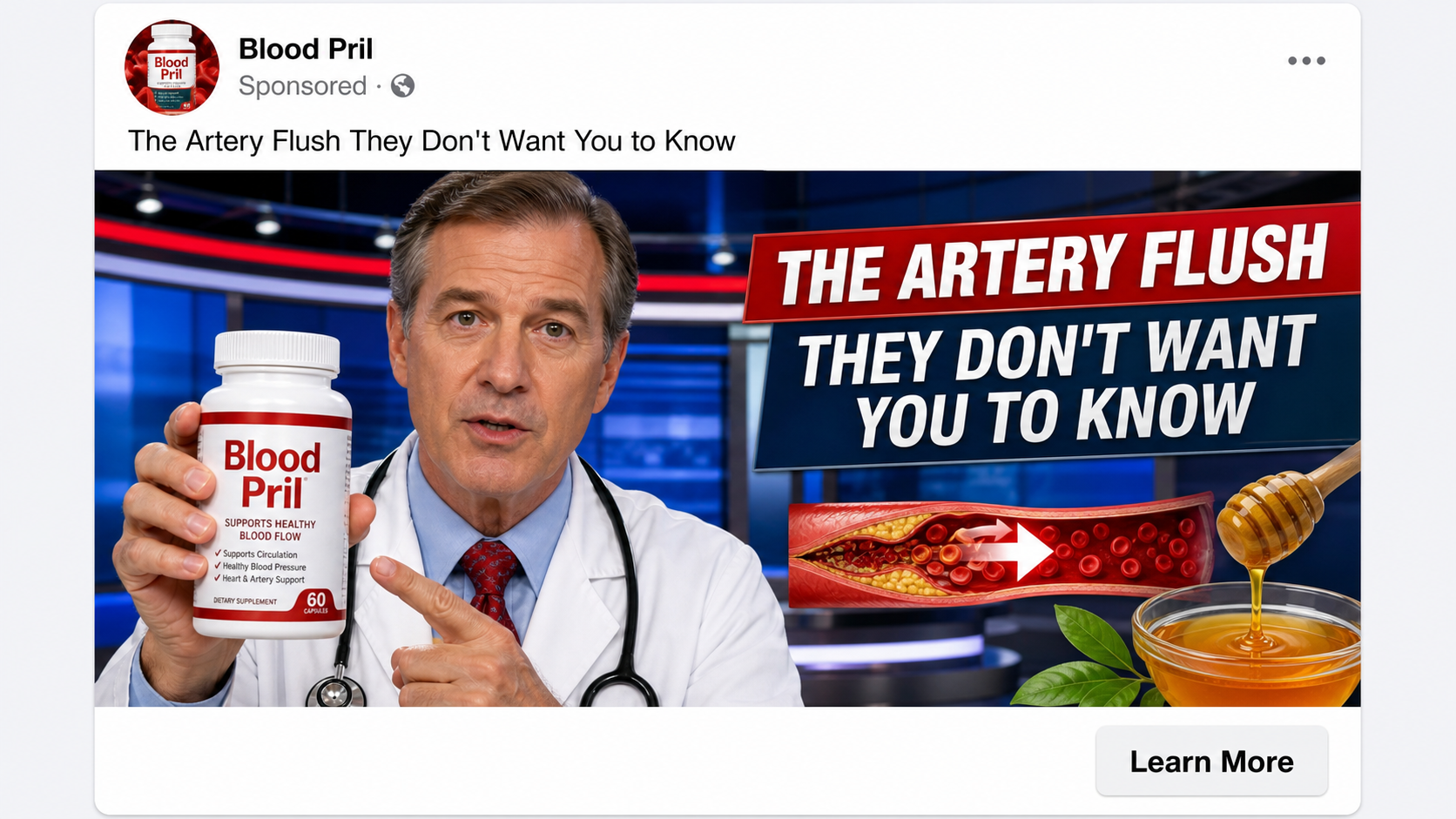
A dramatic interview claims that an “arterial flush ritual” can clear dangerous buildup from the body. The familiar doctors and celebrities make the discovery sound urgent, personal, and almost impossible to ignore.
The presentation keeps its promised honey recipe just out of reach. Each new claim makes the supposed discovery feel more important, while the real purpose of the video remains hidden.
We traced the fake broadcast, competing Blood Pril websites, contradictory formulas, checkout links, pricing, guarantees, missing company details, and the medical claims surrounding the offer.
Overview
What Blood Pril Is Supposed to Do
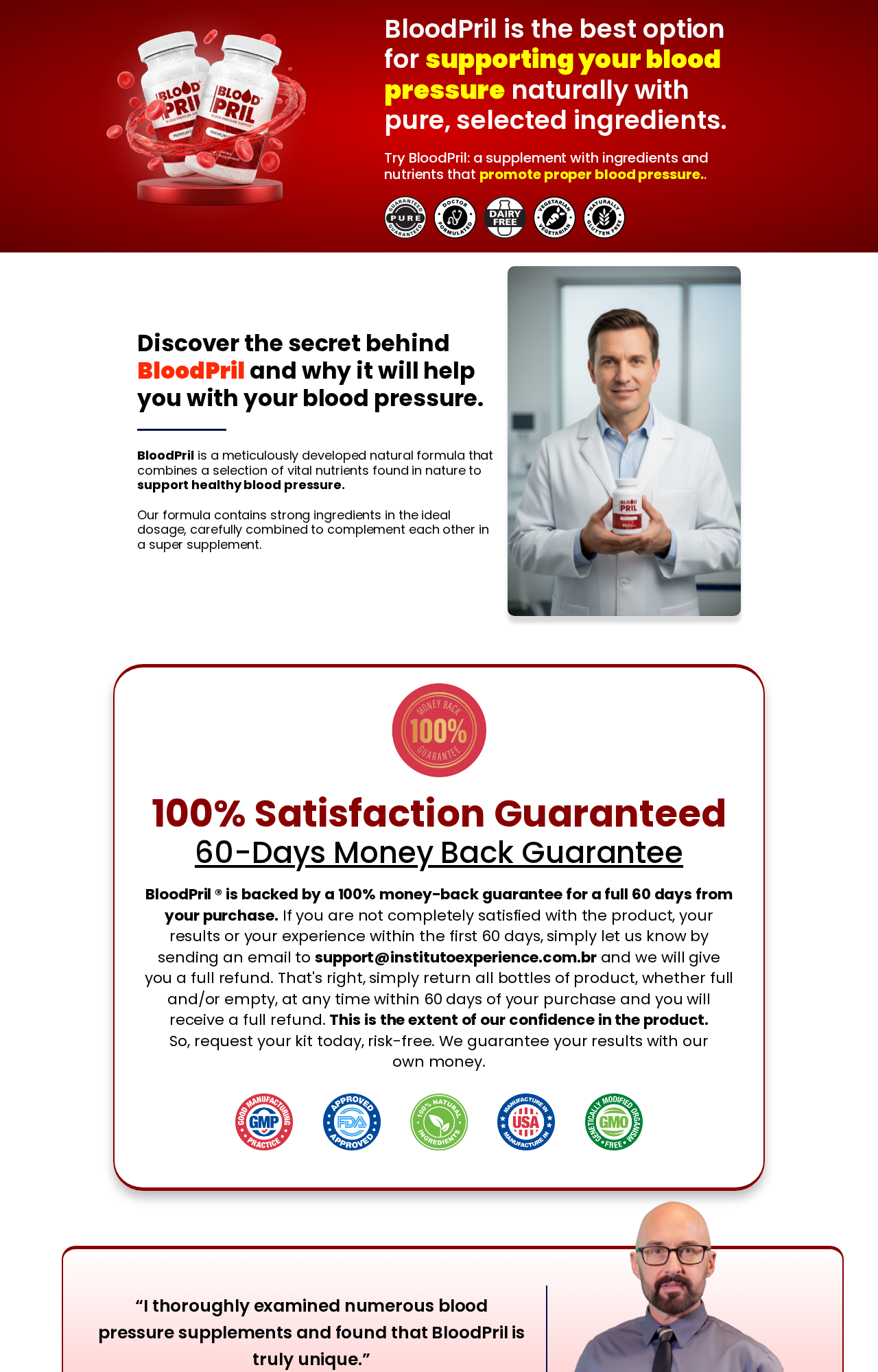
Blood Pril is marketed as a dietary supplement for blood pressure, circulation, nitric oxide, and arterial flexibility. One current page lists L-citrulline and two forms of L-arginine as a 500 mg proprietary blend.
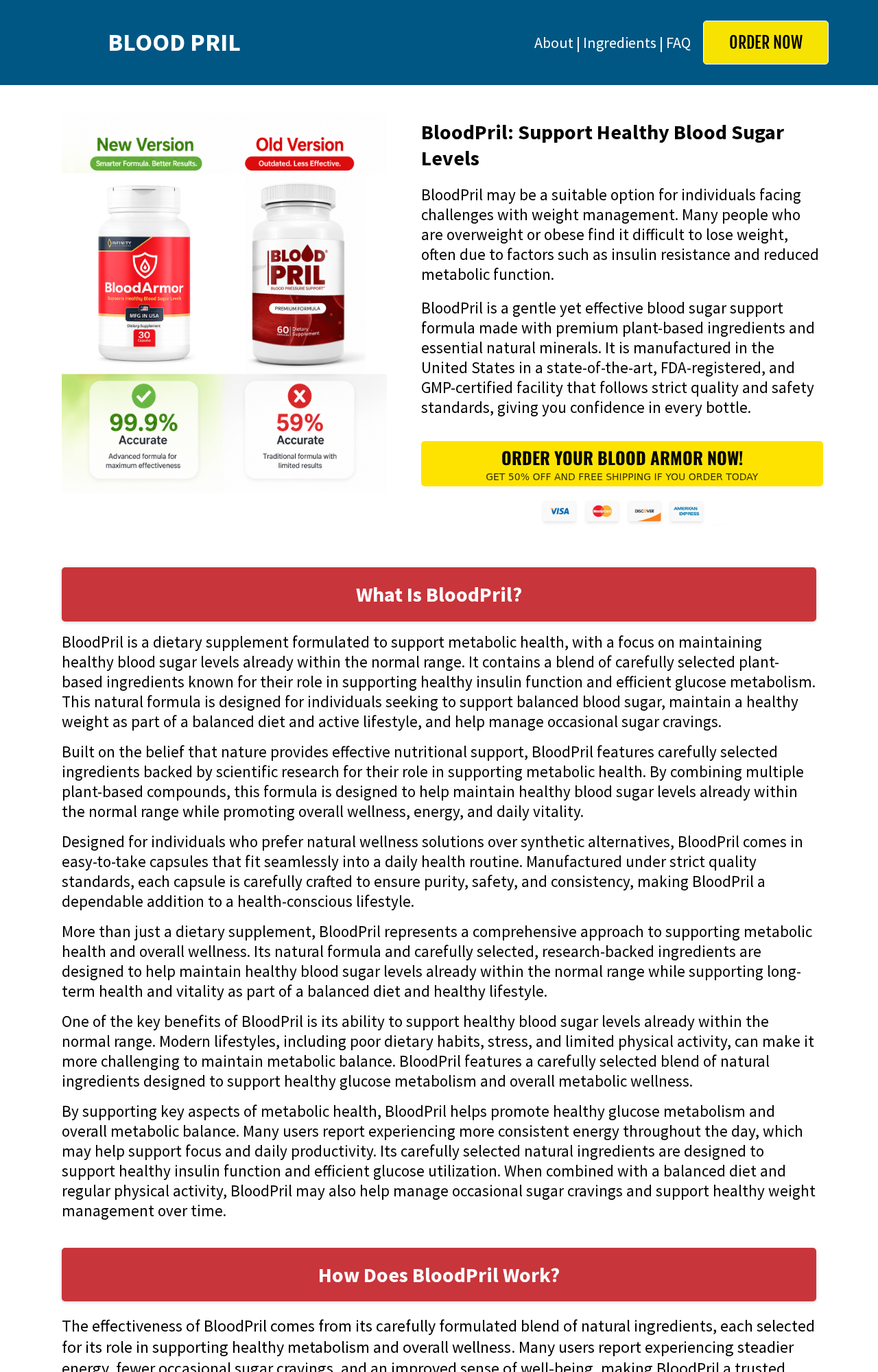
Another official-looking BloodPril page describes a completely different blood sugar formula containing ingredients such as mulberry leaf, berberine, bitter melon, juniper berry, and cinnamon.
These are not minor wording changes. The pages use the same product name while presenting different health targets and ingredient stories.
How the Fake “Arterial Flush” Story Sells the Capsules
The promotion begins with a fake news article about Dr. Sanjay Gupta’s wife and a preventable stroke. A long video then imitates a 60 Minutes report and uses unauthorized AI depictions of prominent doctors, celebrities, and broadcaster Lesley Stahl.
The video promises a honey-based arterial flush ritual that supposedly removes “arterial cement.” By the end, viewers are not given an independently verified home remedy. They are directed to buy Blood Pril.
We found no evidence that CBS News created the segment or that the public figures shown endorsed Blood Pril.
Our Blood Pril Verdict
We recommend avoiding Blood Pril when it is promoted through the fake 60 Minutes campaign. The advertising relies on fabricated authority and medical promises that the product pages do not substantiate.
The web trail is also unusually confused. Different domains describe different formulas, one sales page links its legal policies to another organization’s domain, and an affiliate page sends order buttons to a site that currently displays a default WordPress post.
The strongest warning signs are:
- A fake CBS-style report uses unauthorized AI celebrity depictions.
- The promised honey ritual becomes a supplement purchase.
- Blood pressure and blood sugar versions use different ingredient stories.
- Several domains call themselves official.
- One page links legal policies to an unrelated Brazilian domain.
- An affiliate order path leads through BloodArmor and BuyGoods.
- The pages do not consistently identify the legal seller and manufacturer.
- No finished-product trial supports an arterial-cleaning claim.
The Fake Arterial Flush Broadcast
A Stroke Story Creates Fear Before the Sale
The advertorial says a respected doctor’s wife nearly suffered devastating consequences from preventable high blood pressure. This personal story makes the viewer feel that waiting could be dangerous.
Fear is then paired with hope. The video suggests that mainstream medicine overlooked a simple answer available in an ordinary kitchen.
A health decision made under emotional pressure is rarely an informed one. The viewer should be able to verify the report before being asked for payment details.
AI Doctors and Celebrities Reinforce the Claim
The campaign has used apparent depictions of Sanjay Gupta, Caldwell Esselstyn, Peter Attia, Mick Jagger, Bryant Gumbel, Harrison Ford, Denzel Washington, Whoopi Goldberg, and David Letterman.
Showing many familiar people creates the illusion of broad agreement. The number of synthetic endorsements does not turn them into evidence.
No verified statements from those individuals were found connecting them with Blood Pril or the arterial flush ritual.
The Recipe Is a Delay Device
The promised honey recipe keeps viewers watching because it sounds free, safe, and easy. The presentation delays the details while repeating stories about hidden causes and suppressed discoveries.
Eventually, the free ritual becomes a proprietary bottle. The delay gives the campaign time to build urgency, isolate the viewer from normal medical advice, and present the supplement as the only logical conclusion.
If the central promise cannot be explained without sitting through a sales video, it is probably a marketing hook rather than a medical breakthrough.
Different Blood Pril Websites Tell Different Stories
One Formula Focuses on Blood Pressure
Bloodpril.com describes a nitric oxide supplement built around L-citrulline and L-arginine. It sells two bottles for $158, three for $177, and six for $294.
The page claims the formula relaxes arterial walls, restores elasticity, and produces smoother circulation. It also tells buyers that imported ingredients and small-batch production can make stock run out.
The same page says there is no hidden subscription. That statement applies to the page reviewed, not to every affiliate, cloned site, telephone upsell, or future checkout using the Blood Pril name.
Another Formula Focuses on Blood Sugar
Bloodspril.com calls BloodPril a blood sugar and metabolic support formula. Its ingredient list centers on mulberry, berberine, bitter melon, cinnamon, and other botanicals.
That page lists two bottles at $69 each, three at $59 each, and six at $49 each. Its order buttons point to bloodarmor.net and a ClickBank tracking link.
Two official-looking pages should not use the same supplement name for materially different formulas without explaining the relationship. A buyer cannot know which label, seller, or guarantee applies from the name alone.
The Destination Page Adds Another Brand
The Bloodspril order links use “ORDER YOUR BLOOD ARMOR NOW” even though the page headline says Blood Pril. Bloodarmor.net currently displays a generic WordPress “Hello world!” page rather than a normal product explanation.
Its footer mentions BuyGoods and BloodArmor products. A payment processor can handle the transaction, but it does not endorse the medical claims or prove that the funnel’s story is authentic.
This layered path makes it essential to identify the exact merchant before paying. The ad, affiliate page, brand name, retailer, and fulfillment operation may all be different entities.
How the Blood Pril Arterial Flush Scam Works
Step 1: A Native Ad Looks Like a Health Story
The campaign can begin in a recommendation widget or social feed. Its headline focuses on a stroke, a doctor’s family, or a discovery rather than a bottle of capsules.
The commercial purpose is hidden until the viewer has invested attention in the story.
Step 2: A Fake News Page Borrows Trust
The click opens an advertorial designed to resemble an independent health publication. It frames the subject as breaking news and introduces a supposedly suppressed treatment.
The page is part of the sales path, not neutral journalism.
Step 3: AI Footage Imitates 60 Minutes
A recognizable studio, broadcaster, doctors, and celebrities make the video feel like a nationally televised investigation.
The segment cannot be verified on CBS News, and the people shown are not evidence of a real endorsement.
Step 4: “Arterial Cement” Creates a Simple Enemy
The script turns hypertension and cardiovascular risk into a vivid blockage that one ritual can supposedly flush away.
Blood pressure is influenced by many factors. It cannot be diagnosed or safely managed through a metaphor in a sales presentation.
Step 5: The Honey Recipe Becomes Blood Pril
After a long wait, the promised pantry solution is replaced by a proprietary supplement. The viewer is told the formula captures the real discovery more effectively than an ordinary recipe.
This is the point where a story-driven funnel reveals its commercial destination.
Step 6: Multi-Bottle Pricing Raises the Commitment
The sales page pushes two, three, or six bottles and places the lowest per-bottle price on the largest package.
Read the full total. A prominent $49 figure can correspond to a $294 authorization.
Step 7: Affiliates and Retailers Split Responsibility
If the buyer later challenges a claim, the affiliate may point to the retailer, while the retailer’s disclaimer says it did not endorse the author’s medical statements.
This separation makes saved screenshots, receipts, and merchant descriptors crucial.
Company, Address, and Fulfillment Checks
The Brand Name Does Not Reveal the Legal Company
The pages reviewed prominently display Blood Pril, BloodPril, and BloodArmor. They do not consistently name the legal entity responsible for the formula, advertising, and customer service.
One page names an author, while another routes legal links to lp.institutoexperience.com.br. Buyers need the company shown on the receipt and card statement, not just the label brand.
The Legal Links Point Outside the Product Site
Bloodpril.com’s terms, privacy, returns, disclaimer, and contact links point to an Instituto Experience domain. The page also contains an image reference labeled “Gluco Control,” another product name.
These mismatches suggest a reused marketing template or affiliate setup. They do not provide a clear Blood Pril headquarters, return depot, or manufacturer.
Support Is Not Clearly Presented Across the Funnel
The guarantee says buyers can write for a refund, but the visible sales page does not provide a consistent phone, physical address, and legal entity near the offer.
Use the support information in the actual BuyGoods or ClickBank receipt. Test the contact route before the refund window expires and keep every response.
The Manufacturing Chain Remains Unclear
The pages say Blood Pril is made in the United States or in an FDA-registered facility, sometimes with imported ingredients. They do not clearly name the factory or publish a lot-specific laboratory report.
That does not prove Chinese manufacture, contamination, or danger. It means the origin and quality controls cannot be confirmed from promotional badges. Request the exact Supplement Facts panel, distributor, lot, manufacturer, and certificate of analysis.
Medical Claims and Safety
Hypertension Is Not Arterial Cement
High blood pressure is measured, monitored, and treated based on an individual’s readings and risk. It can be influenced by kidney disease, hormones, medication, sleep apnea, weight, sodium, genetics, and other factors.
A supplement ad cannot determine why a person’s pressure is high. It also cannot establish that a honey ritual or amino acid blend removes a hidden buildup.
Natural Does Not Mean Safe With Medication
L-arginine and L-citrulline can affect circulation, while botanical blood sugar ingredients may interact with medication or alter glucose. A proprietary blend can make individual doses difficult to assess.
The American Heart Association advises people with high blood pressure to speak with a health professional before taking supplements and never stop prescribed medication without guidance.
An FDA-Registered Facility Is Not Product Approval
Dietary supplements generally are not FDA approved for effectiveness before marketing. Registering a facility does not mean the agency approved Blood Pril or its arterial flush claims.
Demand evidence that matches the exact finished formula and advertised outcome, not a badge or a study involving one ingredient.
What to Do if You Have Fallen Victim to This Scam
- Preserve the funnel. Save the native ad, fake broadcast, recipe promise, package choice, order total, guarantee, receipt, and card statement.
- Identify the retailer and merchant. Check whether the receipt came from BuyGoods, ClickBank, BloodArmor, or another entity. Use that record to locate support.
- Cancel future billing in writing. Even if the page promised a one-time order, state that you authorize no refills, subscriptions, telephone upsells, or future charges.
- Request a refund promptly. Ask for return authorization and the exact address tied to your order. Do not mail bottles to a location found on an unrelated Blood Pril site.
- Return with tracking. Photograph the bottles, lot numbers, packaging, and parcel. Keep proof of delivery until the credit appears.
- Dispute deceptive or unauthorized charges. Give the card issuer the difference between the promised amount and the amount charged, plus your refund correspondence.
- Monitor for additional descriptors. Affiliates and upsells can appear under different names. Ask the bank about blocking future merchant-initiated transactions if necessary.
- Protect your health. Do not reduce blood pressure or diabetes medicine because of the video. Contact a clinician about the label, interactions, readings, or adverse symptoms.
- Report the campaign. Send the deceptive ad to the platform and FTC. Report a serious supplement reaction through the FDA Safety Reporting Portal.
- Secure your device. Run Malwarebytes if the funnel downloaded anything or opened suspicious pop-ups. AdGuard can help block deceptive ads and repeat redirect domains.
Frequently Asked Questions
Is Blood Pril a real supplement?
Multiple websites advertise physical supplements under the Blood Pril name. The sites describe different formulas, so the name alone does not tell a buyer which product or seller is involved.
Did Dr. Sanjay Gupta endorse Blood Pril?
No credible evidence was found that Dr. Sanjay Gupta endorsed Blood Pril or an arterial flush honey ritual.
Was Blood Pril featured on 60 Minutes?
We found no authentic CBS broadcast supporting the campaign. The presentation imitates 60 Minutes and uses unauthorized apparent depictions of recognizable people.
Does Blood Pril remove arterial cement?
No finished-product clinical evidence was located proving that Blood Pril flushes arteries or removes a substance called arterial cement.
Is Blood Pril a subscription?
The blood pressure page reviewed explicitly says the order is one-time. That statement does not cover every affiliate or future checkout. Confirm the final authorization and watch the card.
Which Blood Pril formula is genuine?
Official-looking pages describe materially different formulas. Only the label, receipt, distributor, and manufacturer attached to the actual shipment can identify what a buyer received.
The Bottom Line
The Blood Pril arterial flush campaign uses a fake broadcast, AI celebrity authority, and a promised honey recipe to drive buyers toward a costly capsule package.
Conflicting formulas and an unclear seller trail make the offer even harder to trust. Avoid making blood pressure decisions through this funnel, and never replace prescribed care with a supplement advertised as a secret cure.








