

A frightened viewer sees a familiar news set, a recognizable doctor, and a warning that ordinary blood pressure medication only hides the real danger. Then comes the promised answer: a secret “Arterial Flush Ritual.”
It feels urgent because it is designed to feel urgent. By the time Cardio Clear appears, the viewer has already been told that waiting could end in a heart attack or stroke.
We traced the funnel beyond that frightening story.

Overview
What Cardio Clear Claims to Do
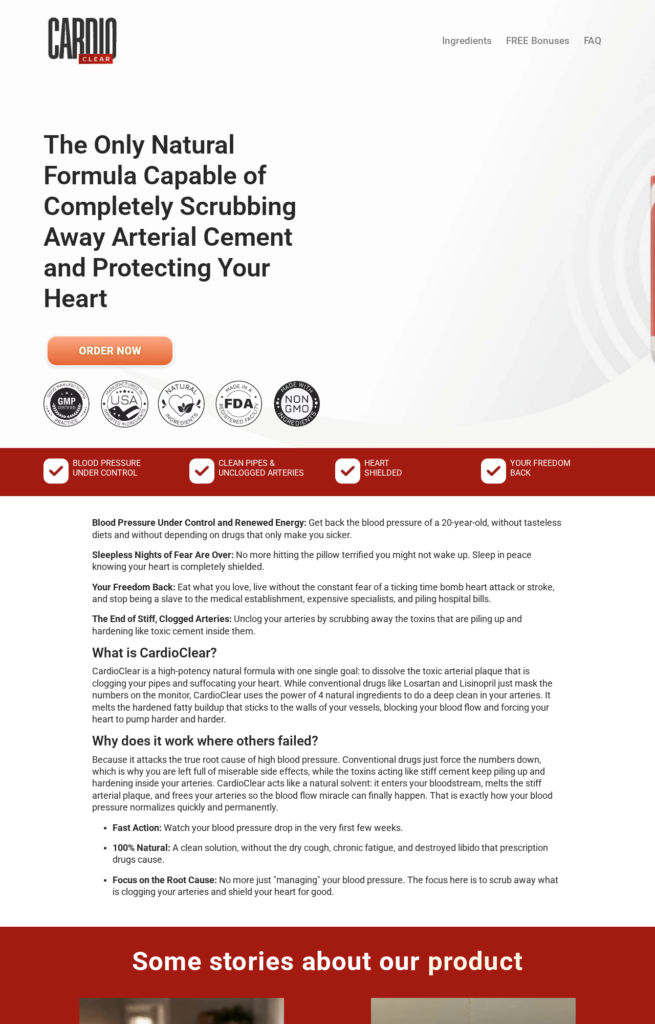
Cardio Clear is sold as a capsule formula for high blood pressure and arterial health. Its sales page says four natural ingredients can dissolve “toxic arterial cement,” unclog blood vessels, normalize blood pressure quickly and permanently, and restore the blood pressure of a 20-year-old.
The language goes far beyond ordinary wellness support. It tells visitors that Losartan and Lisinopril merely mask numbers, that prescription drugs can make them sicker, and that Cardio Clear attacks the true root cause.
The current offer displays one bottle for $89 plus shipping, three bottles for $177, and six bottles for $294. The larger cards advertise a 180-day guarantee, while the guarantee section directly below promises 90 days.
How the “Arterial Flush Ritual” Sells the Bottle
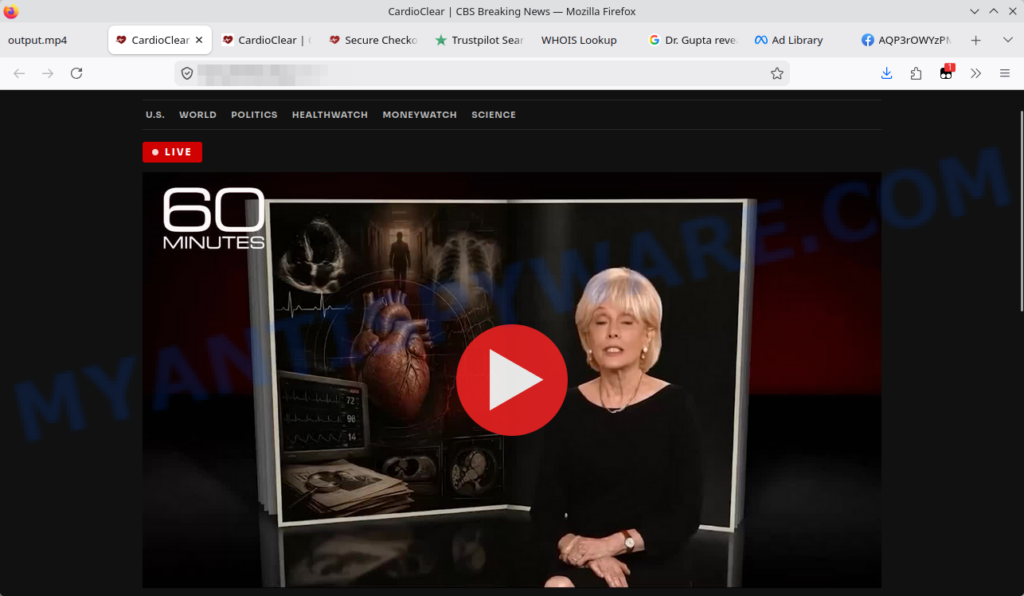
The product is only the final stop. The funnel begins with social media ads and a fake editorial page designed to resemble CBS News and 60 Minutes. It uses medical imagery, breaking-news styling, and apparent celebrity footage to make the pitch look investigated rather than advertised.
The story says an overlooked buildup is hardening inside the reader’s arteries and that a natural ritual can remove it. A conspiracy angle portrays the medical establishment as unwilling to reveal the answer.
That narrative creates fear, distrusts the reader’s existing treatment, and then positions a commercial supplement as the escape. No credible clinical trial of the finished Cardio Clear formula is presented to support those disease-treatment promises.
Our Verdict on Cardio Clear
We recommend avoiding Cardio Clear and any advertisement that uses the “Arterial Flush Ritual” story. The fake news presentation, unauthorized celebrity associations, extreme medical claims, guarantee contradiction, and opaque company information outweigh the polished design.
Cardio Clear should also not be confused with CardioClear7, an older and separate supplement offer already covered by MalwareTips. Similar names and shared “arterial flush” language do not prove the products have the same owner, formula, checkout, or refund policy.
The main warning signs are easy to summarize:
- A page on factualnews.blog imitates CBS News and 60 Minutes.
- The campaign uses apparent AI or manipulated celebrity footage.
- The product claims to dissolve plaque and reverse high blood pressure.
- The page discourages confidence in prescription medication.
- The guarantee is described as both 90 days and 180 days.
- The checkout and sales domains do not clearly identify one accountable company.
The Medical Story Is Built to Override Common Sense
“Arterial Cement” Is a Sales Phrase
The site repeatedly describes plaque as toxic cement that Cardio Clear can melt or scrub away. The imagery is vivid because it turns a complex cardiovascular condition into a household plumbing problem.
That analogy is not evidence. High blood pressure has many possible causes and risk factors, and treating it requires individual medical assessment. A capsule cannot be assumed to reverse hypertension because a sales page compares blood vessels to clogged pipes.
The page does not provide a published, controlled human trial showing that the finished formula produces the claimed changes in blood pressure, plaque, heart attack risk, or stroke risk.
The Prescription Drug Attack Is Especially Dangerous
Cardio Clear’s copy names Losartan and Lisinopril and says conventional drugs only force the numbers down while leaving the alleged root problem untouched. It also links prescription treatment with fatigue, cough, and sexual side effects.
A supplement advertisement is not qualified to decide that a person’s prescribed medication is unnecessary. Abruptly changing blood pressure treatment can carry serious risk.
Anyone who reached this page because of hypertension symptoms or an alarming reading should contact a licensed medical professional. Do not stop or reduce medication based on an advertorial, video, testimonial, or AI-generated doctor clip.
The Page Uses Fear as a Conversion Tool
The sales copy does not merely promise better circulation. It asks visitors to imagine going to sleep afraid they may not wake up, suffering a massive heart attack, or becoming paralyzed by a stroke.
Those outcomes are serious medical concerns, but the page uses them to accelerate a retail decision. It pairs fear with a countdown, a “bottles left” counter, and statements that thousands of Americans have already unclogged their arteries.
No verifiable customer population, methodology, or independent outcome data accompanies those claims. Fear can make a person click faster, but it cannot establish that the product works.
The Guarantee Contradicts the Offer Cards
The three-bottle and six-bottle packages display “180-DAYS GUARANTEE.” The dedicated guarantee section says “Our 90-Day Blood Pressure Under Control Guarantee” and repeatedly refers to 90 days.
A refund deadline must be exact. Buyers need to know whether the clock starts at purchase, shipment, or delivery; whether opened bottles qualify; which costs are excluded; and where returns must go.
The page supplies none of that operational detail near the promise. It simply says to send an email, without placing a clear legal company identity or complete refund procedure beside the offer.
Fake News Branding and Celebrity Faces Create Borrowed Trust
The Page Looks Like CBS but Is Not on CBS
The advertorial we captured uses a dark CBS-style layout, a 60 Minutes logo, a red “LIVE” marker, television navigation, and a large video panel. The browser address is on factualnews.blog, not cbsnews.com.
This is a classic credibility shortcut. Many viewers recognize the visual language before checking the domain. The page borrows the feeling of editorial review while functioning as one stage in a commercial funnel.
A real network report can be verified on the network’s own website, official social accounts, or established video channels. If the dramatic segment exists only on a disposable-looking marketing domain, treat it as advertising.
Dr. Sanjay Gupta and Dr. Oz Are Used as Hooks
Versions of the campaign have been reported as using Dr. Sanjay Gupta and Dr. Oz, along with celebrity names such as Mick Jagger and David Letterman. We found no credible evidence that these people endorse Cardio Clear or the “Arterial Flush Ritual.”
The visuals may be edited, taken out of context, generated with AI, or paired with synthetic audio. A convincing mouth movement is not proof of consent or endorsement.
Search for the exact statement on the person’s official channels. Do not rely on a video embedded inside the page that profits when you buy.
Institution Logos Do Not Validate the Formula
The bottom of the Cardio Clear page displays logos associated with the National Institutes of Health, Johns Hopkins University, the University of California San Francisco, and the University of Michigan.
The page does not establish that those institutions tested, approved, funded, or endorsed Cardio Clear. A logo placed near a product is not the same as a named study of that finished product.
The same principle applies to “FDA registered” and GMP badges. Dietary supplements are not FDA approved to treat or prevent disease. Facility registration does not mean the agency approved Cardio Clear as a hypertension treatment.
How the Cardio Clear Scam Works
Step 1: A Social Ad Creates a Medical Emergency
The first video warns about blood pressure spikes, clogged arteries, stroke, or a hidden cause that doctors allegedly miss. Familiar faces and news graphics make the message feel urgent and authoritative.
The product name may be hidden at this stage. The emotional story is more reusable than the bottle, so affiliates can swap the destination while keeping the same hook.
Step 2: A Fake News Page Mimics a Trusted Broadcaster
The click opens a page styled like CBS News, 60 Minutes, CNN, Fox News, or another familiar publisher. The real domain is unrelated to the media brand.
Navigation may be decorative, comments may be seller-controlled, and the central video drives only toward the offer. The format is designed to make an ad feel like investigative journalism.
Step 3: The Video Introduces the “Arterial Flush Ritual”
Viewers are told that a simple ritual can remove “arterial cement” and solve the real cause of high blood pressure. Prescription medication is framed as a temporary mask or part of a medical conspiracy.
The promised ritual is vague enough to sustain attention. The important information is delayed until the viewer has absorbed the fear and authority cues.
Step 4: The Free Discovery Becomes Cardio Clear Capsules
The story eventually pivots from a natural ritual to a paid supplement. The bottle is presented as the properly formulated or convenient version of the discovery.
No controlled trial of the final product is supplied. Instead, the page relies on ingredient descriptions, testimonials, badges, and the earlier television-style story.
Step 5: Bundle Pricing Pushes the $294 Cart
The single bottle costs $89, while the six-bottle package lowers the displayed per-bottle price to $49. “Best value,” bonus gifts, free shipping, a crossed-out $1,074 total, and a countdown make the larger package look like the only rational choice.
The site also says three to six months of continuous use is best. That recommendation conveniently matches the largest order before the buyer has tried one capsule.
Step 6: Checkout Options Can Change the Real Agreement
A third-party analysis of the Cardio Clear funnel reported preselected shipping upgrades and an auto-refill option at checkout. We could not independently complete a live purchase, so we are not claiming every order becomes a subscription.
The safe conclusion is narrower: inspect the final checkout for refill language, selected options, quantity, shipping, and total. The last screen and confirmation email determine what you authorized, not the promise made several pages earlier.
Step 7: Refund Confusion Appears After the Charge
If the buyer later asks for a refund, the 90-day versus 180-day contradiction becomes important. The sales page does not clearly identify the legal seller, return address, or detailed procedure beside the guarantee.
Save the version you purchased under. If support delays or changes the terms, your screenshots, confirmation, and first written cancellation request can support a card dispute.
Company, Address, and Fulfillment Checks
The Funnel Uses Several Unrelated-Looking Domains
The news-style stage appears on factualnews.blog. The product page is on cardioclearhealth.com. Purchase buttons lead to pagamento.healthylifewell.com, while another domain, usecardioclear.com, currently shows only a “Coming soon” page.
Multiple domains are not automatic proof of fraud. In this context, they make it harder to identify which entity created the ad, owns the brand, accepts the payment, ships the product, and owes the refund.
No Clear Legal Seller Appears Beside the Main Offer
The page makes strong medical and guarantee claims but does not prominently place a legal company name, physical business address, and direct support details next to the checkout buttons.
A brand name is not enough. The legal entity on the terms should match the receipt and card statement, and it should be searchable in the jurisdiction where it claims to operate.
A Fulfillment Address Would Not Prove Who Made It
If a bottle arrives from a warehouse, that location may only pack and receive orders for many online sellers. It is not automatically the manufacturer’s laboratory or corporate headquarters.
Before using the product, check the physical label for a distributor, lot number, expiration date, Supplement Facts panel, warnings, and a reachable contact. Ask who manufactured the finished formula and whether a lot-specific certificate of analysis is available.
Opaque Support Is Dangerous With a Heart-Health Pitch
This campaign is not selling a decorative item. It targets people who may be taking antihypertensive medication or experiencing symptoms that require medical assessment.
Do not accept an anonymous form as the only support route. Call and email before ordering. Ask whether refills are automatic, which guarantee period applies, whether opened bottles qualify, where returns go, and who appears on the statement.
If those answers are missing or inconsistent, do not buy. A sales funnel that claims to protect your heart should not hide the identity of the company responsible for the capsules.
What to Do if You Have Fallen Victim to This Scam
- Do not stop prescribed medication. Contact the clinician managing your blood pressure before changing treatment. Seek urgent care for severe symptoms or readings according to professional medical guidance.
- Save the fake news page and order evidence. Capture the domain, celebrity video, product claims, guarantee wording, checkout selections, confirmation, receipt, and card descriptor. Pages in affiliate funnels can disappear quickly.
- Check whether recurring billing was authorized. Read the confirmation and account portal for refill, membership, or monthly shipment language. Cancel in writing and ask for a dated confirmation.
- Request the refund in writing. Quote the guarantee shown when you purchased and ask for an RMA, legal company name, return address, eligible bottle condition, and list of nonrefundable fees.
- Contact the card issuer. If the amount, refill, or product differs from what you authorized, explain the precise issue. Ask about dispute deadlines and how to block future charges from the same merchant.
- Preserve and track any return. Photograph the bottles and parcel, use tracked shipping, retain the weight and receipt, and save delivery confirmation. Do not send it to an address that has not been confirmed for your order.
- Report deceptive health claims. Submit the ad and transaction to the FTC at ReportFraud.ftc.gov. You can also report a questionable supplement or adverse event to the FDA and contact your state attorney general.
- Protect your browser and device. Run a Malwarebytes scan if you downloaded files or passed through suspicious redirects. AdGuard can reduce exposure to deceptive ads and malicious tracking, although it cannot reverse a completed payment.
Frequently Asked Questions
Is Cardio Clear the same as CardioClear7?
No. Cardio Clear at cardioclearhealth.com and CardioClear7 are separate offers with different pages, pricing, formulas, and refund language. The similar names and arterial-health stories can cause confusion.
Did Dr. Sanjay Gupta or Dr. Oz endorse Cardio Clear?
We found no credible evidence of a genuine endorsement. Treat clips on fake news domains as unauthorized, manipulated, or AI-generated unless the statement can be verified through the person’s official channels.
Can Cardio Clear dissolve arterial plaque?
The sales page makes that claim, but it does not provide a controlled clinical trial of the finished product proving it can dissolve plaque or reverse hypertension. Do not use the claim to replace medical treatment.
Is Cardio Clear FDA approved?
Dietary supplements are not FDA approved to treat or prevent disease. A facility-registration badge or GMP claim does not mean the FDA approved this product for high blood pressure.
Does Cardio Clear include automatic refills?
A third-party investigation reported an auto-refill option in the checkout, but we did not verify universal enrollment. Read the final screen and confirmation carefully and do not leave optional recurring choices selected.
Is the Cardio Clear guarantee 90 days or 180 days?
The live sales page contradicts itself. Package cards show 180 days, while the dedicated guarantee section promises 90 days. Save both and obtain written clarification before relying on either.
The Bottom Line
Cardio Clear is sold through a fear-driven funnel that borrows the appearance of trusted news, attacks confidence in prescription medicine, and turns a vague “Arterial Flush Ritual” into a $294 supplement order.
The medical claims are unsupported by finished-product evidence, the celebrity associations are not credible, the guarantee contradicts itself, and the responsible company is difficult to identify. Do not let a fake television set make a health decision for you. Close the page, keep your current treatment plan intact, and speak with a licensed professional.








