

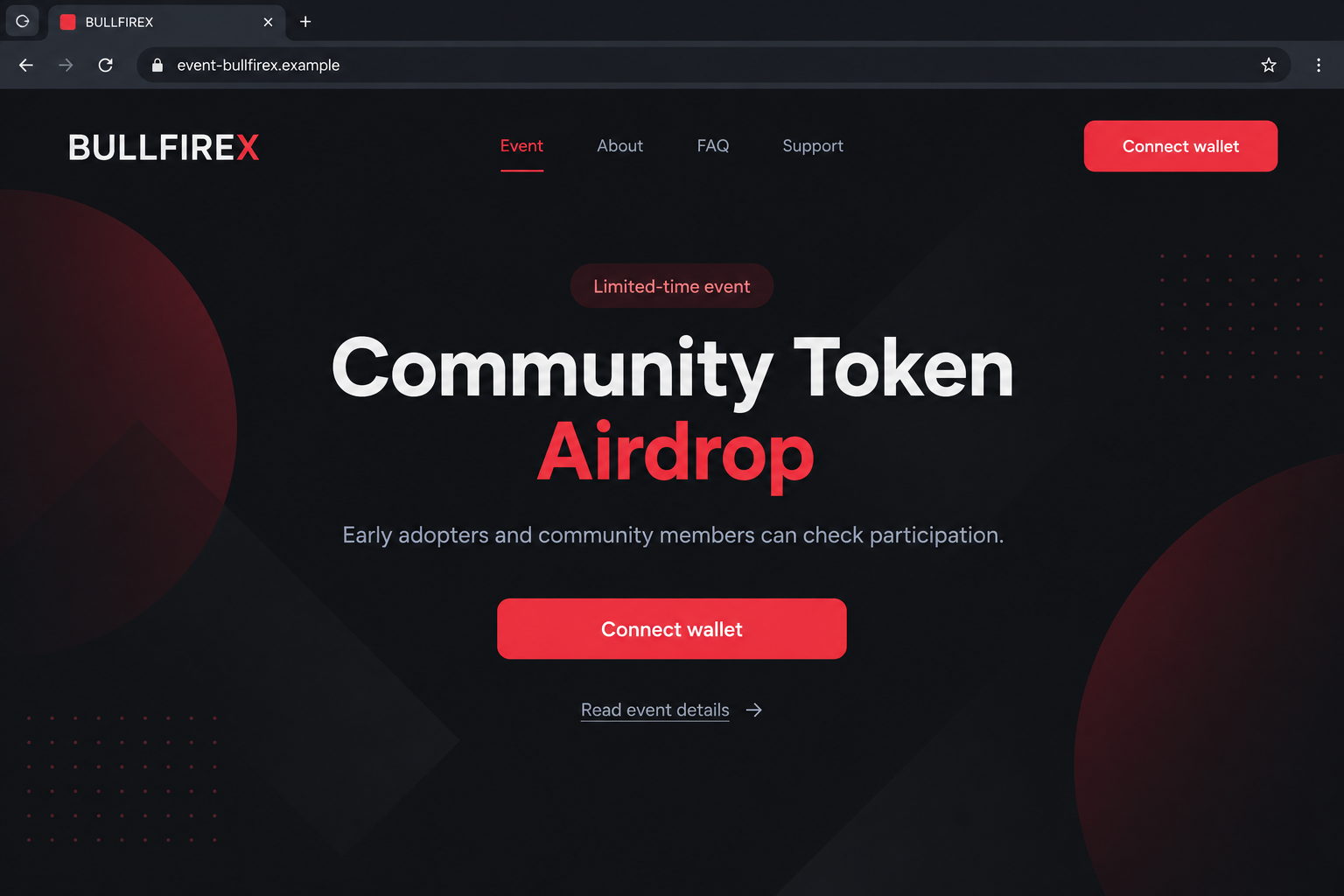
A BULLFIREX airdrop page invites early adopters to check a community token claim. The short invitation makes participation sound easier than investigating who organized it.
There is a limited-time label and a wallet button. Before treating either as an opportunity, examine what the offer establishes and what remains missing.
Overview
The reported event is not an independently verified token distribution
A BULLFIREX airdrop page documented in January 2026 appeared at event-bullfirex[.]fun. It offered early adopters and community members a limited opportunity to participate.
The recorded investigation described it as a crypto drainer. We did not reproduce its contract behavior, verify a victim’s transaction, or authenticate a distributing issuer.
That leaves an important distinction: a serious published warning exists, but this article is not an independent forensic verdict about every BULLFIREX-named project.
The practical answer is firm. Do not authorize the reported event or assume its token entitlement is real without independent evidence establishing the organizer and request.
The early-adopter claim needs an identifiable program behind it
A community label does not explain which project someone adopted, which rules apply, or who must deliver the advertised tokens.
We did not establish a verified allocation, token identifier, distribution contract, or issuer for this specific offer. A polished claim page cannot supply those facts by appearance.
- Which independently established organization authorized this exact event?
- What token and chain does it distribute?
- Which published criteria create the claimed entitlement?
- What precisely would the wallet request allow another party to do?
Until those questions have supported answers, connecting to discover more moves the investigation in the wrong direction. Verification should come before financial authority.
The illustrations show possible exposure, not a captured contract
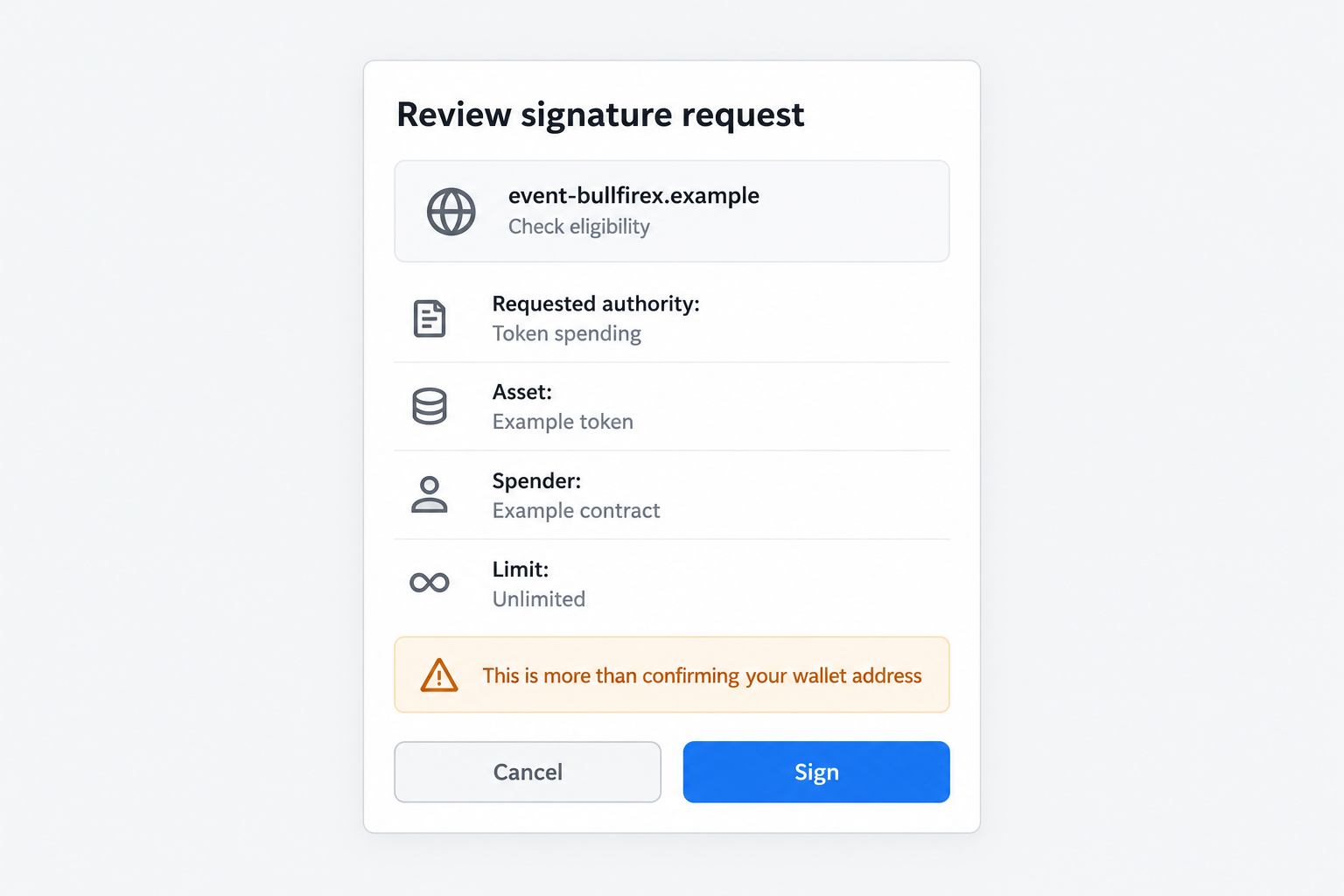
The pictures use a fictional event domain and a hypothetical signature request. They do not establish the chain or exact permission employed by the historical site.
Wallet connections, identity signatures, spending authorizations, transfers, and secret disclosure differ. Do not collapse them into a claim that every connection automatically empties an account.
This is an investigation of a previously documented offer. We are not confirming that its original page is still active or identifying a new October 2026 campaign.
If you interacted, assess your actual authorization history. The page’s description of participation is not evidence of either a genuine claim or a completed theft.
What an Early-Adopter Offer Should Explain
Participation must refer to something verifiable
Being called an early adopter can feel flattering. It suggests that your attention, membership, or activity created an opportunity unavailable to everyone else.
However, a real entitlement should have a defined basis. The organizer needs to establish what activity counts and how the program relates to its participants.
An illustrative reader might see the invitation in a group discussing new tokens. Their presence in that group does not prove the sender represents a distributing project.
Ask the identity question before the eligibility question. You cannot safely evaluate a claim when you do not know whose program is supposedly making it.
A distribution is more than a name in a headline
A token name can be copied or invented. It does not establish a unique asset, supply, chain, issuer, or commitment to transfer anything.
Likewise, a claim portal can display fields and buttons without operating a genuine distribution. Interface completeness is not evidence that the promised asset exists.
A functioning token elsewhere would not authenticate this event automatically. The event must show a verified relationship to that asset and its authorized program.
Do not make a purchase merely to test eligibility. Buying a token first can create a separate financial exposure before the original claim has been authenticated.
A deadline should not be the substitute for evidence
Limited-time wording shifts attention toward speed. The reader starts worrying about missing the event instead of examining what supports it.
We did not verify an actual distribution deadline for this offer. An urgency badge is not enough to establish when an authorized claim begins or ends.
A genuine program may have time limits. Those should be checked through the independently confirmed organizer and current terms, not accepted from an unfamiliar event page.
You have no obligation to finish an unverified process before its label changes. A missed claim is not a loss when the entitlement was never established.
How the BULLFIREX Airdrop Claim Funnel Works
Step 1: A community invitation makes the offer feel personally relevant
The recorded page addresses early adopters and community members. That wording can make a visitor feel included without describing any actual participation record.
Someone browsing token discussions may already expect announcements about allocations. The event uses that expectation as its entry point.
The available record does not establish one advertising channel for everyone. Preserve the specific post, message, or referral that introduced the offer to you.
A familiar group or profile should not finish the verification process. Community visibility can coexist with an unverified operator behind the destination.
Do not let a social introduction stand in for an issuer. Ask which established project claims responsibility for this particular distribution.
Step 2: The event page supplies the appearance of an organized claim
The historical host includes an event word and the BULLFIREX name. That can sound like a dedicated portal built for a temporary program.
A descriptive hostname does not prove the relationship it implies. The same operator controlling a page can choose reassuring words for the address and heading.
Check for an independently confirmed announcement that establishes the exact destination. A site linking to other resources is not necessarily authorized by those resources.
Read the direction of endorsement carefully. The event should be established by a verified organizer, not merely establish itself through its own statements.
The reported hostname is an indicator from an earlier record, not a link to test. New spellings would need their own verification.
Step 3: A claim or eligibility button asks for wallet involvement
The next action is presented as participation rather than payment. That framing can make a visitor overlook the distinction between revealing an address and authorizing spending.
A connection commonly enables a site to identify a wallet and propose requests. It does not universally transfer assets or grant unlimited authority.
However, an unverified application can place further requests after that step. Each one needs examination, regardless of how harmless the initial button sounded.
Do not connect simply to find out whether the event is genuine. The missing organizer and program evidence should be resolved before wallet interaction.
A recovery phrase request is not normal proof of early adoption. Never provide the controlling secret to identify a public account.
Step 4: The requested signature or permission must match your intention
The pictured example presents token-spending authority under an eligibility description. It is a hypothetical explanation of risk, not a request independently captured from this event.
Revoke.cash’s explanation of signature scams shows how signatures can carry financial authority. No transaction fee does not mean no consequential authorization.
Review the asset, recipient or spender, scope, and network. A request concerning unrelated holdings needs more explanation than “required to continue.”
Legitimate applications also use approvals. The issue is whether the operator is authenticated and the actual authority is appropriate for the action you chose.
If the request remains unreadable, reject it. You do not owe the page a signature because you already spent time exploring its offer.
Step 5: The account record determines what happened afterward
A website can describe participation as complete or pending without proving that you received an asset. Its display is not an independent wallet statement.
Inspect what was actually authorized and recorded. A refused request should be distinguished from an existing allowance, a completed transfer, or exposed secrets.
Continuing authority may outlast the browser session. Closing the page and revoking an on-chain permission are different actions.
Do not repeat an unclear request to make the promised allocation appear. An absent reward does not justify granting more authority to the same unverified destination.
If new payment conditions appear, evaluate them separately. A charge to unlock participation cannot fill the missing evidence about the event’s issuer.
Why a Security Tool’s Silence Is Not Approval
Detection lists answer a narrower question than authenticity
During research, the recorded event host was not an exact match in one public phishing list checked. That result does not authenticate the offer.
A list may have limited coverage, delayed updates, or different indicators. Absence of a warning cannot establish the organizer, promised allocation, or safety of a wallet request.
Do not turn a scan into a certificate of legitimacy. Security tools can be useful without knowing every unsafe destination.
Identity and transaction review remain necessary even when a page loads normally. A wallet dialog is not a positive endorsement from the browser or wallet provider.
A small test can still grant consequential authority
Putting little money in an account does not make an unknown signature understandable. A request can create authority whose effects are not limited by the page’s invitation.
A separate wallet reduces some exposure only when its secrets and funding are genuinely separate. It does not authenticate an issuer or prove that a token will arrive.
Do not use testing as a substitute for missing program evidence. There is no need to run this reported event to evaluate the gaps described here.
If you already attempted it, review the actual scope rather than assuming a small initial balance establishes safety for future deposits.
Do not expand the warning beyond the available record
We have not established the current operator’s identity, a legitimate underlying BULLFIREX project, or every site using the same name.
Those gaps prevent broad claims about all matching businesses or assets. They also prevent treating this particular offer as an authenticated giveaway.
The decision need not wait for a complete attribution study. An unverified event with a published drainer warning is not a suitable place to grant unexplained authority.
Keep future evaluation attached to exact domains, assets, and requests. Names alone are weak evidence in either direction.
What to Do If You Interacted With the BULLFIREX Airdrop
- Stop the event workflow.
Do not sign again, add money, or attempt a second claim. Note the destination and what actions occurred.
Keep any existing screenshots and the original invitation. There is no need to revisit the reported page to gather additional promotional wording.
- Inspect your own wallet instead of the event’s counter.
Save transaction identifiers and details of unfamiliar actions. Identify the chain, token, recipient, and authority involved where the records allow it.
If no action was authorized, do not invent a financial loss. If something was approved, assess that specific permission rather than relying on the page’s status.
- Remove unwanted access with trusted tools.
Disconnect the event and examine any spending permissions separately. Choose guidance that matches your wallet and network.
The MetaMask allowance instructions explain revocation for supported contexts. Do not use a cleanup link supplied only by the unverified event.
- Respond to phrase or key disclosure as a control problem.
If you exposed a controlling secret, establish a new wallet with a fresh secret from a secure environment. A password change alone is insufficient.
Get reliable advice when remaining positions or automated withdrawals complicate protection. Do not send the phrase to a person offering to inspect it.
- Check relevant device exposure.
Review unfamiliar extensions or files installed during the process. Updated Malwarebytes can help identify unwanted software when that risk applies.
AdGuard may reduce some deceptive advertising and malicious destinations. It cannot verify a token issuer, undo an authorization, or guarantee recovery.
- Report the records without overstating them.
Report the invitation on the platform where it appeared. If assets were lost, give the available evidence to the appropriate reporting authority.
Distinguish the page’s claims from your actual transactions. That makes the report useful without accusing unrelated entities that happen to share a name.
- Decline guaranteed reimbursement offers.
Do not pay an unsolicited helper to unlock, certify, or recover the supposed allocation. Independently establish any professional relationship before discussing sensitive information.
Keep the response centered on account protection and evidence. A promised recovery should not become another unverified claim event.
Frequently Asked Questions
Is this BULLFIREX event independently verified as a genuine airdrop?
No. We did not establish an authenticated issuer, allocation, or contract. The recorded event carries a serious published drainer warning and should not be used.
Does this article accuse every BULLFIREX-named project of fraud?
No. The investigation concerns the specific reported claim page. Names can be reused, and broad ownership or asset conclusions were not established.
Was the pictured spending signature captured from the event?
No. It is hypothetical and explains the difference between an eligibility description and financial authority. Exact historical contract behavior was not reproduced.
Does no phishing warning mean the event is safe?
No. Detection coverage is incomplete. A missing warning does not establish who issued the tokens or whether the requested permissions match a real distribution.
Is connecting the same as authorizing an unlimited transfer?
No. Review subsequent signatures, permissions, and transactions separately. Recovery depends on what you actually accepted, not merely the first button’s label.
Should I pay a small amount to test whether the claim works?
Do not use a payment to authenticate this unverified event. Resolve the organizer and program questions independently rather than adding financial exposure.
The Bottom Line
The BULLFIREX airdrop does not have the independent program evidence needed to treat the reported event as genuine. Its early-adopter wording cannot fill that gap.
Do not authorize it. If you already interacted, inspect the actual wallet actions and remaining authority rather than chasing the allocation or a stranger’s recovery promise.








