

If you’ve recently seen Facebook or TikTok ads claiming that Candy Warehouse — the popular online candy retailer — has gone bankrupt and is selling all stock at up to 90% off, you’re not alone.
Thousands of users have reported seeing these “FINAL CLEAROUT” promotions with dramatic banners shouting “BANKRUPTCY SALE,” “EVERYTHING MUST GO,” or “STORE CLOSING – 95% OFF.”
The problem?
These viral ads are not from the real Candy Warehouse. They’re part of an elaborate online scam using a real bankruptcy filing to trick shoppers into spending money on fake liquidation sites.
In this guide, we’ll unpack the truth behind the Candy Warehouse closing sale scam, explain how it works, show you how to spot the red flags, and tell you exactly what to do if you’ve already placed an order on one of these fraudulent sites.
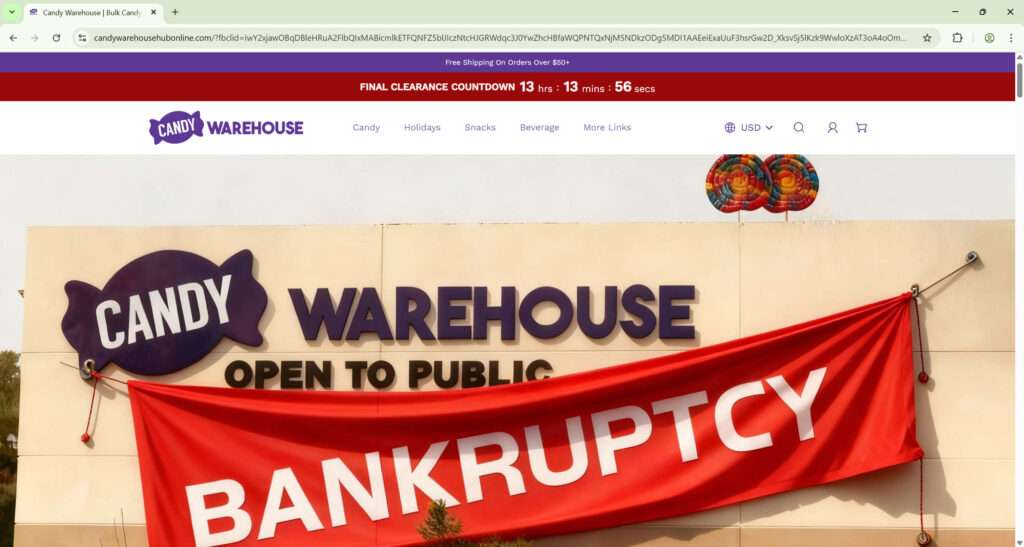
Scam Overvie
In late October 2025, legitimate news outlets reported that Candy Warehouse, a Texas-based wholesale candy distributor, filed for Chapter 11 bankruptcy.
The company’s court filing — listed in the U.S. Bankruptcy Court for the Northern District of Texas — showed assets between $100,000 and $1 million and liabilities of up to $10 million.
The Chapter 11 process allows struggling companies to reorganize their finances and continue operations while paying debts over time. It does not mean an immediate liquidation or “everything must go” sale.
However, scammers quickly capitalized on this real event to create confusion and profit from unsuspecting shoppers.
How scammers hijacked the story
Within days of the news, Facebook, Instagram, and TikTok were flooded with ads promoting a “Candy Warehouse Bankruptcy 90% Off Clearance” sale.
These ads use convincing imagery — warehouse aisles full of candy, red “BANKRUPTCY” banners, and slogans like:
🍭 FINAL CLEAROUT – EVERYTHING MUST GO!
Legendary sweets at shocking prices — up to 90% OFF or MORE!
⚠️ Once they’re gone… they’re gone forever!
👉 Shop now before it’s too late!
They often come from pages like:
- “Max Savings”
- “Close Candy Mart”
- “Warehouse Candy Outlet”
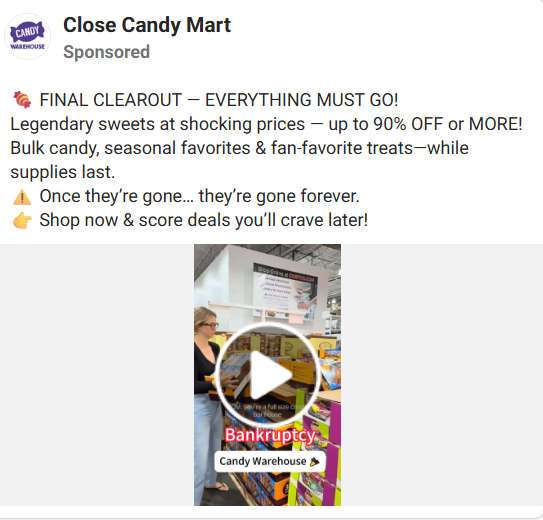
Each one features the Candy Warehouse logo, a short looping video of real candy stores or warehouse aisles, and a “Shop Now” button linking to fake domains such as:
candywarehousehubonline.comcandy-warehouseus.comcandywholesaleclearance.shopcandyoutletmart.com
Fake websites mimicking the real Candy Warehouse
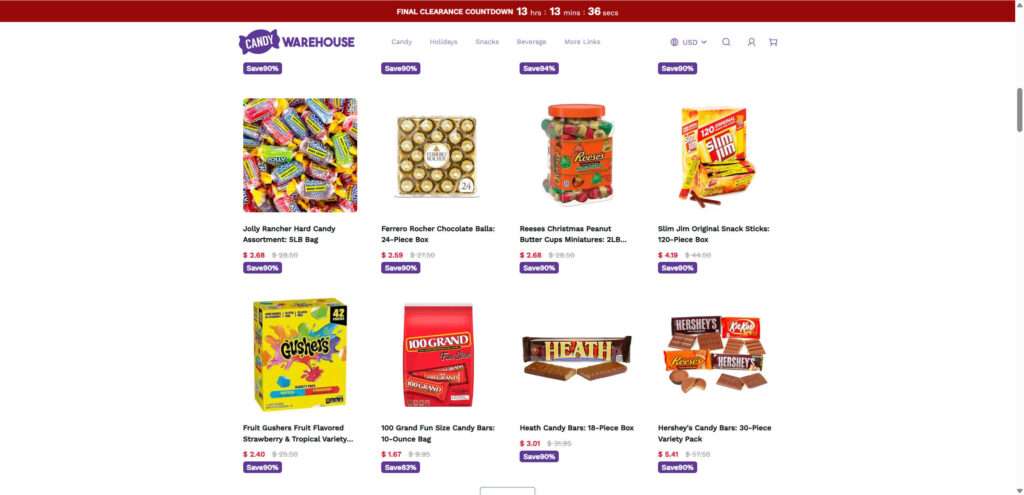
These cloned sites look strikingly professional. They feature:
- The Candy Warehouse purple logo and navigation bar.
- A countdown timer showing “FINAL CLEARANCE – 13 hrs left.”
- “Christmas Candy,” “Bulk Candy,” and “Snacks” categories.
- Candy bars from brands like Hershey’s, Snickers, KitKat, and Reese’s with impossible prices —
Snickers 48-piece box: $5.42 (was $96)
Ferrero Rocher: $2.59 (was $27.50)
M&M’s 3lb jar: $3.06 (was $32.50)
Each listing proudly shows “Save 90%” badges in purple and red.
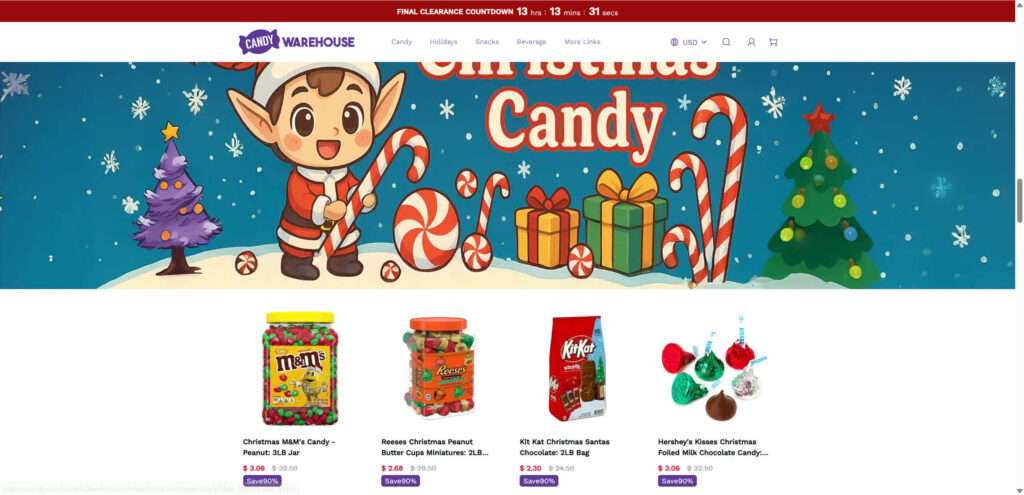
The scam is designed to look legitimate enough to make shoppers act fast. The fake countdown timer and “limited stock” messages trigger impulse purchases, while the “bankruptcy” angle adds urgency and credibility.
How the Scam Works
Step 1: Scammers create deceptive ads
Using platforms like Facebook Ads Manager and TikTok Ads, scammers set up paid campaigns under generic names like “Max Savings” or “Close Candy Mart.”
They upload short clips taken from real warehouse videos or stock footage, overlaying them with phrases such as “Candy Warehouse Bankruptcy Sale – Up to 90% OFF.”
Because these ads appear visually identical to legitimate promotional posts, users scrolling quickly through their feeds don’t realize the danger.
Each ad links to a newly created website that impersonates the official Candy Warehouse domain.
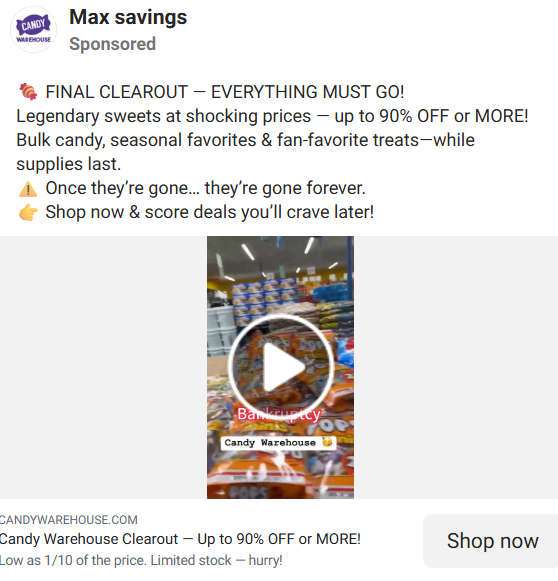
Step 2: Fake websites mimic real branding
When users click “Shop Now,” they’re sent to look-alike websites designed using the same purple logo, fonts, and design as the genuine retailer.
Common traits include:
- A URL that almost matches the real one but contains extra words or hyphens (e.g.,
candywarehousehubonline.cominstead ofcandywarehouse.com). - “FINAL CLEARANCE COUNTDOWN” banners at the top with a ticking timer.
- Product pages with hundreds of famous candies at unbelievably low prices (90–95% off).
- Fake reviews and “bestseller” badges to simulate credibility.
- Claimed “Free Shipping on orders over $50+.”
The layout is often built on Shopify or WooCommerce templates, and the product images are stolen directly from Candy Warehouse or Amazon listings.
Step 3: Shoppers place orders believing it’s a liquidation
Tempted by the prices, buyers add multiple items to their carts and proceed to checkout.
The sites usually accept only credit card payments (no PayPal or other secure methods) and show a fake confirmation screen.
Victims often receive an automated email with generic text:
“Thank you for your order! Due to high demand, shipping delays may occur. Your tracking information will be sent soon.”
But the tracking number never arrives.
Step 4: After payment, victims are ghosted
Once the scammers receive your payment, communication stops.
The “Contact Us” page usually lists a nonexistent U.S. address (often random warehouses in Texas or California) and an email like support@candywarehousehubonline.com.
Emails go unanswered, and if a phone number is displayed, it either doesn’t exist or leads to a generic voicemail box.
In some cases, a few weeks later, victims receive cheap, unrelated products — like sunglasses, keychains, or bracelets — shipped from China.
This tactic is used to create fake tracking data so that payment processors believe the item was “delivered.”
Step 5: Websites vanish after a few weeks
Once the scammers collect enough money, they shut down the fake site and create a new one with a similar name — repeating the process under a different domain.
Previous examples include:
candywarehousecloseout.comcandywarehouseclearanceshop.comcandywarehouseoutlet.store
This constant domain rotation helps scammers avoid detection and keep their ads running under fresh names.
Step 6: New victims appear daily through ads
Because Meta (Facebook and Instagram) and TikTok’s ad review systems can’t always detect cloned brands, the same scam keeps resurfacing.
Each new page runs hundreds of paid ads targeting candy fans, parents, and bargain hunters.
Common ad hooks include:
- “Warehouse Going Out of Business – 90% OFF Candy!”
- “Candy Warehouse Closing Sale – Everything Must Go!”
- “Factory Bankruptcy Clearance – Legendary Brands for Pennies!”
The ads use emotional triggers — nostalgia, scarcity, urgency, and discounts — to override skepticism.
How Scammers Exploit Real Bankruptcy News
This scam works so well because it’s based on a true event.
In October 2025, Candy Warehouse LLC indeed filed for Chapter 11 bankruptcy protection.
That news was covered by multiple outlets including The U.S. Sun and Bankruptcy Observer, noting that the company had liabilities exceeding assets.
But scammers twisted the facts:
- Reality: Chapter 11 means reorganization, not liquidation. The business continues operating while restructuring debts.
- Scammer claim: “Candy Warehouse is bankrupt — everything must go now!”
By attaching their fake sale to real headlines, the scammers add plausibility.
To the average consumer, a liquidation sale following bankruptcy sounds reasonable — especially before Halloween or Christmas candy seasons.
This tactic of blending truth with fiction is a hallmark of modern social engineering scams.
Common Red Flags of the Candy Warehouse Sale Scam
If you encounter a “Candy Warehouse Clearance” site or ad, look out for these warning signs:
1. Recently created domain
Scam sites are usually only a few weeks old.
You can check this using Whois.domaintools.com or similar services.
Example: candywarehousehubonline.com was created in October 2025.
2. Unbelievable discounts (90–95% OFF)
Legitimate retailers cannot sustainably sell brand-name candy at 90% off.
These prices are psychological bait.
3. Countdown timers and “No Restock Ever” claims
Every page features an urgent timer (“13 hours left!”) — but refreshing the page resets it.
This is a manipulation trick to push immediate purchases.
4. No verifiable contact information
Fake sites show random U.S. addresses or generic emails with no customer service team.
If you Google the address, it usually leads to unrelated businesses or empty lots.
5. No social media presence
The real Candy Warehouse maintains verified social media pages — scammers’ sites don’t.
They rely entirely on paid ads, not organic followers.
6. Copied product images and descriptions
Every product photo is stolen from the real Candy Warehouse or Amazon listings.
Text and formatting match existing stores.
7. No secure payment gateway
Scam sites usually lack SSL security details or use third-party processors tied to anonymous accounts.
8. Grammatical errors and inconsistent formatting
Typos like “bussines,” “cheep candy,” or “limiteded time” are often sprinkled throughout.
How to Verify the Real Candy Warehouse Website
The only legitimate Candy Warehouse domain is:
> https://www.candywarehouse.com
Everything else — any variant containing extra words like hub, outlet, us, or clearance — is fake.
Legitimate site traits:
- Secure HTTPS connection.
- Established online since 1998.
- Verified business address and customer service contact.
- Active social media accounts with authentic engagement.
Before purchasing, always:
- Check the domain name carefully.
- Search for online reviews.
- Avoid any site promoting “bankruptcy” or “90% off everything.”
What to Do If You’ve Fallen Victim to the Candy Warehouse Scam
If you already placed an order or entered payment details on a fake site, act immediately to protect your money and personal data.
1. Contact your bank or card issuer
Explain that you were scammed by a fraudulent online store impersonating Candy Warehouse.
Ask to dispute the charge or initiate a chargeback.
Most banks will refund if the merchant is unverified or suspicious.
2. Monitor your statements
Keep an eye on your credit card or PayPal statements for unauthorized charges.
Scammers often attempt multiple small transactions after an initial purchase.
3. Report the website
Help others avoid the trap by reporting:
- To Facebook or TikTok Ads (click “Report Ad”).
- To the FTC (Federal Trade Commission): https://reportfraud.ftc.gov.
- To IC3 (Internet Crime Complaint Center): https://www.ic3.gov.
- To Google Safe Browsing: https://safebrowsing.google.com.
4. Change your passwords
If you used the same password elsewhere, change it immediately — especially on your email and banking accounts.
5. Do not trust any follow-up emails
Some victims receive fake “customer service” replies offering refunds if they provide bank info — this is another scam.
Never share additional personal or financial details.
6. Warn others
Post screenshots or experiences on consumer forums (like MalwareTips or Reddit’s r/Scams) to raise awareness.
Real Examples of Fake Candy Warehouse Sites
Here are some confirmed scam domains used in recent months:
candywarehousehubonline.comcandywarehouseclearance.shopcandywarehouseus-outlet.comcandywholesaleclearout.comcandywarehousemart.shopwarehousecandyoutlet.com
All of these domains:
- Were registered in October–November 2025.
- Have hidden WHOIS information.
- Use Shopify or cloned WordPress templates.
- Display identical product listings and discount banners.
Why These Scams Are Spreading So Fast
- Low cost of launching ads – Scammers spend just a few dollars to reach thousands of Facebook users.
- AI-generated assets – Fake banners, product images, and even fake reviews can now be created with AI tools.
- Exploiting real headlines – By referencing Candy Warehouse’s genuine bankruptcy filing, the scam seems believable.
- Limited oversight – Meta and TikTok’s automated systems cannot detect new domains quickly enough.
- Psychological manipulation – Urgency (“final hours”), scarcity (“limited stock”), and loss aversion (“gone forever”) drive fast decisions.
How to Spot Future Versions of This Scam
After this wave ends, scammers will likely recycle the same tactic for other brands.
Stay alert for these patterns:
- Brand + “Bankruptcy” or “Clearance” or “Going Out of Business”
- Generic ad names (e.g., “Max Savings,” “Super Outlet,” “Big Mart”)
- Massive discounts across all products
- Newly registered websites with timers and fake reviews
Frequently Asked Questions
1. Is Candy Warehouse really going out of business?
No, Candy Warehouse is not closing permanently. The real company has filed for Chapter 11 bankruptcy protection, which is a financial reorganization process — not a liquidation. Chapter 11 allows a business to restructure debts and continue operating while negotiating with creditors. Unfortunately, scammers are twisting this real news story to make their fake “going out of business” sales appear believable. The legitimate Candy Warehouse is still in operation through its official website, www.candywarehouse.com.
2. What is the Candy Warehouse Bankruptcy Sale Scam?
The Candy Warehouse Bankruptcy Sale Scam is a fake online shopping scheme in which scammers create look-alike websites and social media ads claiming that Candy Warehouse is holding a massive 90% off liquidation sale due to bankruptcy. These ads often appear on Facebook, TikTok, and Instagram with titles like “Final Clearance – Everything Must Go!” and “Bankruptcy Candy Sale – Up to 95% OFF!”. Victims who click these ads are taken to cloned websites that imitate the Candy Warehouse logo and branding but are entirely fraudulent. After making a purchase, customers either receive nothing at all, or they get a cheap, unrelated item shipped from China.
3. How can I tell if a Candy Warehouse sale is fake?
There are several red flags that help identify a fake Candy Warehouse sale:
- The website domain is not www.candywarehouse.com but something similar, such as
candywarehousehubonline.comorcandy-warehouseus.com. - The site was recently created and has no verifiable contact information or business registration details.
- The discounts are unrealistically high — up to 90–95% off all items.
- The site includes a countdown timer that resets each time you refresh the page.
- Only credit card payments are accepted; PayPal and secure payment options are missing.
- The site copies all product descriptions and photos from the real Candy Warehouse store.
- There is no customer service or only an unresponsive email address.
If you spot any of these warning signs, you’re looking at a fraudulent site designed to steal money or data.
4. What happens if I order from a fake Candy Warehouse site?
Victims who purchase from scam Candy Warehouse websites typically experience one of three outcomes:
- They receive nothing – the scammers take the payment and vanish.
- They receive a random low-value item such as sunglasses, a bracelet, or a cheap keychain. This tactic is used to create fake “proof of delivery.”
- Their card information is stolen and later used for unauthorized charges.
Scammers never deliver the advertised candy products and do not provide refunds. These sites are designed solely to harvest money and payment data before disappearing.
5. What should I do if I was scammed by a fake Candy Warehouse site?
If you’ve fallen victim to this scam, act quickly:
- Contact your bank or credit card provider immediately. Explain that you made a purchase on a fraudulent site impersonating Candy Warehouse. Request a chargeback or refund for unauthorized or undelivered goods.
- Monitor your bank statements for any suspicious activity or repeat charges.
- Report the scam to the following agencies:
- Change your passwords for any accounts using the same credentials.
- Do not reply to any follow-up emails from the fake store claiming to offer refunds — they are additional phishing attempts.
Taking action immediately can increase your chances of recovering your funds and preventing identity theft.
6. Is the Candy Warehouse website with 90% off prices real?
No, the websites advertising 90% off or more are all fake. The real Candy Warehouse does not offer such extreme discounts. Genuine seasonal or clearance discounts on the official site typically range from 10% to 30%, depending on the promotion. Any website offering near-total price cuts across all products — especially combined with “Bankruptcy” or “Final Hours” messaging — is a scam designed to rush you into purchasing.
7. How can I find the official Candy Warehouse website?
The authentic Candy Warehouse domain is https://www.candywarehouse.com.
It uses a secure HTTPS connection, displays verified company information, and has a long-standing online presence since the late 1990s.
All other domains — including those with extra words like “hub,” “outlet,” “clearance,” “store,” or “us” — are fraudulent and not associated with the real company.
8. Are the fake Candy Warehouse websites using stolen branding?
Yes. These scam websites steal the Candy Warehouse logo, colors, and even product images directly from the legitimate store. They clone the layout and navigation bar to appear identical at first glance. This practice is called brand impersonation, a common scam tactic that makes fake sites look trustworthy enough to deceive shoppers into entering payment information.
9. Why are these Candy Warehouse scam ads appearing on Facebook and TikTok?
Scammers use paid ad platforms like Meta Ads (Facebook/Instagram) and TikTok Ads Manager to promote their fraudulent sites. They set up disposable pages with generic names such as “Max Savings,” “Close Candy Mart,” or “Super Discount Outlet,” then launch hundreds of targeted ads using stolen Candy Warehouse imagery. These ads can pass automated review filters because they don’t directly claim to be Candy Warehouse in their account name. The ads target bargain hunters, parents, and candy enthusiasts who are likely to respond to “90% off” offers.
10. What kinds of products are shown on these scam sites?
Fake Candy Warehouse liquidation websites display hundreds of popular brand-name candies at absurdly low prices, such as:
- Snickers Candy Bars (48-piece box) for $5.42
- KitKat Santas 2-lb bag for $2.30
- Reese’s Miniatures 2-lb jar for $2.68
- M&M’s 3-lb jar for $3.06
- Ferrero Rocher 24-piece box for $2.59
Every item shows “Save 90%” or “Save 94%” badges. These listings are copied directly from legitimate online retailers but have no real inventory behind them.
11. Why do these scam websites have countdown timers?
The countdown timers on these pages — usually reading “FINAL CLEARANCE ENDS IN 13 HOURS” — are purely psychological tricks. They reset each time the page reloads, creating false urgency. This tactic manipulates buyers into thinking they must act quickly before the sale ends, reducing the chance that they’ll research the site’s legitimacy first.
12. What risks come from entering my card details on these fake sites?
Sharing payment details with a fraudulent website exposes you to:
- Unauthorized charges on your card
- Identity theft if your personal information is sold or reused
- Data harvesting for future scams or phishing attempts
Even if no immediate charge occurs, your data may be stored and sold on underground markets. Always assume that any payment entered on these sites is compromised.
13. Why do scammers use real news about Candy Warehouse bankruptcy?
Scammers are exploiting a real bankruptcy filing to make their scam believable. Candy Warehouse filed for Chapter 11 bankruptcy protection in the Northern District of Texas in October 2025, as reported by The U.S. Sun and Bankruptcy Observer. The filing allows the company to restructure, not liquidate. Scammers, however, claim the company is “closing forever” and “selling everything at 90% off.” By mixing real news with false claims, they create a more convincing hoax that tricks even cautious buyers.
14. Can I trust any Candy Warehouse ads on social media?
You should be extremely cautious. Unless an ad links directly to the verified domain www.candywarehouse.com, assume it could be fake. Even if the ad uses Candy Warehouse logos or videos, scammers frequently run impersonation ads. To confirm legitimacy, always check:
- The domain name displayed after clicking “Shop Now.”
- The verified blue checkmark on the official Candy Warehouse Facebook or Instagram pages.
- Consistency with promotions announced on the real website.
15. Are there similar scams using other brands?
Yes. The same scam format has been used for dozens of brands. Recent examples include:
- Bath & Body Works “Warehouse Liquidation” scams
- Home Depot “Clearance Tool Sale” scams
- LEGO Factory “Bankruptcy Sale” hoaxes
- Costco “Membership Rebate” scams
These copycat operations reuse identical website templates and ad strategies, changing only the brand name. The Candy Warehouse variant is just the latest adaptation.
The Bottom Line
The “Candy Warehouse Bankruptcy 90% Off Clearout” sale is a sophisticated impersonation scam — not a legitimate liquidation.
Scammers are exploiting a real Chapter 11 bankruptcy filing to build credibility and lure shoppers with massive fake discounts.
Victims who buy from these cloned websites either receive nothing or cheap random items, with no way to get a refund.
Always verify URLs, question extreme discounts, and remember that genuine companies don’t hold surprise 90% off sales with countdown timers and anonymous checkout forms.
Stay skeptical, share warnings, and help stop the spread of these fraudulent campaigns.

Join the discussion
0 commentsShare your experience or ask a question about this article.
Discussion
Start the conversation
Have a question or something useful to share? Add the first comment.