

Celestvéra Microneedle Tanning Patches are being promoted as a cleaner, easier way to get a golden glow without self-tanner lotions, streaks, orange palms, or stained sheets. The product is sold as a quick 10-minute patch ritual that supposedly develops into a tan over the following days.
But before ordering, buyers should look carefully at how this product is being marketed, where similar patches are being sold, and why these social-media tanning patch offers carry serious red flags.
Overview
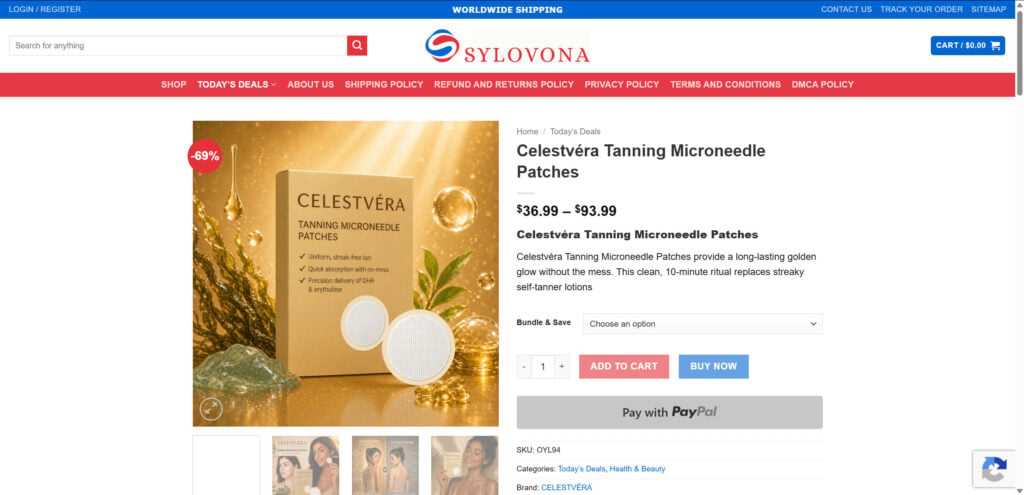
Celestvéra Tanning Microneedle Patches are sold on Sylovona.com for $36.99 to $93.99, depending on the bundle selected. The product page says the patch provides a “long-lasting golden glow” without messy self-tanner and promotes bundle options such as Buy 1, Buy 2, and Buy 3.
The sales page claims the patch uses dissolving microneedles, sea algae hydrogel, an MC1R peptide, a tyrosinase cofactor, and a hyaluronic carrier. It says users apply the patch to the inner arm or inner thigh for 10 minutes, then wait 7–10 days for the glow to develop.
That sounds advanced, but the offer raises several concerns.
This appears to fit the same pattern seen with other viral beauty patch products: a low-cost generic patch, dramatic claims, premium pricing, social media ads, bundle upsells, and difficult returns. The user-provided details also suggest these patches may be cheap $2–$3 products sourced from China and resold at a much higher price.
The biggest issue is not just the price. It is the gap between what the ads imply and what buyers may realistically receive.
A real self-tanner works by applying DHA or other tanning agents directly to the skin surface. Celestvéra’s marketing suggests a more futuristic system where microneedles deliver ingredients into the skin and help create a natural-looking glow over two weeks. The page says the patch “skips the surface dye” and delivers ingredients over a 14-day window.
That claim should be treated cautiously. The idea that a small 10-minute cosmetic patch can reliably create an even, full-body tan is questionable, especially when the patch is applied only to a small area such as the inner arm or inner thigh.
There are also public discussions questioning the science behind these microneedle tanning patches. In one Reddit discussion about DHA microneedle patches, users described the concept as a gimmick and questioned how such a patch could produce the advertised results beyond the application area.
Celestvéra also appears to be promoted across social platforms. Search results show related Facebook and Instagram promotional content, along with multiple YouTube videos reviewing whether the product is legitimate.
That kind of sudden social-media visibility is common with dropshipping beauty products. A product goes viral, ads push strong claims, several sites begin selling similar versions, and customers later discover the item may be a generic product available elsewhere for far less.
How the Celestvéra Tanning Patch Offer Appears to Work
1. The ad sells a “no-mess tanning” dream
The first hook is convenience. The product is positioned as a replacement for traditional self-tanners, which can smell bad, stain sheets, leave streaks, or turn skin orange.
This is a smart marketing angle because many people dislike the effort and mess of regular self-tanning products.
Celestvéra’s page leans into this by promising:
- No streaks
- No orange tones
- No stained sheets
- No self-tanner smell
- No sticky residue
- No long application routine
The problem is that this convenience-first messaging can make buyers ignore the bigger question: does the patch actually work as claimed?
2. The product uses scientific-sounding ingredients
The page mentions MC1R peptide, sea algae hydrogel, tyrosinase cofactor, and hyaluronic carrier. These terms make the product sound advanced and biologically precise.
But scientific-sounding ingredient names do not prove that this specific product can deliver the advertised outcome.
A common tactic in beauty product marketing is to take real skincare terms and use them to create a sense of credibility. The consumer hears “microneedles,” “peptide,” “hydrogel,” and “carrier system,” then assumes the product must be clinically validated.
That is not enough. Buyers should look for independent clinical studies on the finished product, not just ingredient buzzwords.
3. The claims suggest results that may not be realistic
The product page says the glow develops naturally over 7–10 days and lasts around two weeks. It also says one patch every two weeks is enough for a consistent ritual.
This raises obvious questions:
- How can one small patch create an even tan?
- Why apply it to the inner arm or inner thigh?
- Where is the independent proof that the effect spreads beyond the patch area?
- Are the before-and-after images real, edited, or AI-generated?
- Is the active formula clearly disclosed and tested?
Without strong evidence, these claims look more like viral beauty marketing than proven skincare science.
4. The product may be a generic Chinese patch sold at a markup
The user-provided information says the product is likely a cheap $2–$3 patch from China. That is consistent with a common ecommerce pattern.
Many viral beauty items are sourced from low-cost suppliers, relabeled, and sold through polished websites at a much higher price. The brand may appear premium, but the product itself may be generic.
This is especially common with:
- Tanning patches
- Microneedle patches
- Weight loss patches
- Collagen patches
- PDRN skincare sticks
- “Korean beauty” viral products
- Whitening or dark spot correction patches
The risk is that buyers pay $36.99 to $93.99 for something that may be available elsewhere for a fraction of the price.
5. Bundle pricing increases the risk of over-ordering
The product page uses a “Bundle & Save” option with Buy 1, Buy 2, and Buy 3.
Bundle offers are not automatically bad. But in dropshipping-style funnels, they are often used to increase the order value quickly. Some buyers may accidentally select more units than they intended or misunderstand the final quantity before checkout.
The user specifically noted that buyers risk receiving more units than they ordered. This is a frequent complaint pattern with aggressive ecommerce funnels: the checkout page, upsells, or bundle layout can lead to larger orders than expected.
Before paying, buyers should always screenshot the cart and checkout page showing the exact quantity and final price.
6. Returns may be practically impossible
Sylovona displays “Easy Returns” on the site header, but that does not automatically mean refunds are simple in practice.
Many dropshipping beauty stores make returns difficult by requiring:
- Return shipping to China or another overseas address
- Unused and unopened products only
- Return approval before shipping
- Tracking at the buyer’s expense
- Long processing times
- No refund for shipping fees
- No refunds for opened cosmetics
For a low-cost patch sold at a premium price, return shipping can cost nearly as much as the refund. That makes the return policy functionally useless for many buyers.
Why the Tanning Claims Are Suspicious
A normal self-tanner works by reacting with the outer layer of the skin. It is applied directly to the areas where color is desired. Celestvéra’s patch is different because the page suggests a small patch can trigger a tanning effect that develops later and lasts around two weeks.
That is a much bigger claim.
If the patch is applied only to the inner arm or thigh, buyers should ask how the effect would produce a visible, even tan on the face, legs, arms, or body. If the effect is only local, then the product is not a practical replacement for self-tanner. If the effect is claimed to be systemic, that raises even more safety and evidence questions.
The site includes a disclaimer saying the product is not intended to diagnose, treat, cure, or prevent disease, and says individual results may vary.
That disclaimer does not erase the aggressive cosmetic claims. It simply means buyers should be cautious and understand that the advertised results may not be typical.
Main Red Flags
- Sold through social-media-style beauty marketing.
- Claims a 10-minute patch can create a long-lasting golden glow.
- Says one patch every two weeks can maintain results.
- Uses scientific-sounding terms without clear independent product testing.
- Promoted as a replacement for messy self-tanners.
- Listed with bundle options that may increase accidental over-ordering.
- Product price ranges from $36.99 to $93.99.
- User reports suggest similar patches may cost only $2–$3 from Chinese suppliers.
- Returns may be difficult or impractical.
- Similar tanning patch offers appear across multiple sites and social media ads.
- Public discussions question whether the concept is scientifically convincing
Is Celestvéra Microneedle Tanning Patch a Scam?
Celestvéra may ship a physical product, so this is not necessarily a “pay and receive nothing” scam in every case. But that does not mean the offer is trustworthy.
The safer conclusion is this: Celestvéra Microneedle Tanning Patch appears to be a high-risk viral beauty product offer with exaggerated claims, possible generic sourcing, inflated pricing, bundle-order risks, and potentially difficult returns.
The product may be a cheap patch sold with premium branding and social media hype. Buyers should not expect dramatic, even, long-lasting tanning results from a small cosmetic patch unless the seller provides strong independent proof.
What To Do If You Already Ordered
1. Check your order confirmation
Look carefully at:
- Quantity ordered
- Total amount charged
- Shipping fee
- Any added bundle
- Any post-purchase upsell
- Merchant name on your bank statement
If you received more units than expected, save the receipt and package label.
2. Take screenshots
Save screenshots of:
- Product claims
- Checkout page
- Cart quantity
- Refund policy
- Order confirmation
- Tracking page
- Any support emails
This evidence matters if you need to dispute the charge.
3. Contact the seller quickly
Send a clear refund or cancellation request in writing. Ask for:
- Cancellation before shipment
- Confirmation of the exact quantity
- Refund for unwanted units
- A prepaid return label if the wrong quantity was shipped
- Confirmation that no future charges will occur
4. Do not pay expensive overseas return shipping without checking your options
If the seller requires return shipping to China or another international address, calculate the cost first. If the product was misrepresented or you were sent extra units, contact your card provider before paying for return shipping.
5. Watch your card for additional charges
Some aggressive ecommerce funnels add subscriptions, VIP memberships, or reorder programs. Monitor your payment method for at least 60 days.
6. File a dispute if necessary
Contact your bank or credit card company if:
- You were charged for more units than you ordered.
- The product never arrived.
- The product is not as advertised.
- The seller refuses a reasonable refund.
- The return terms were not clearly disclosed.
- You see unauthorized repeat charges.
Use clear language such as “item not as described,” “unauthorized quantity charged,” or “merchant refuses refund.”
FAQ
What are Celestvéra Microneedle Tanning Patches?
They are tanning patches sold as a 10-minute alternative to messy self-tanner. The product page says the glow develops over 7–10 days and lasts around two weeks.
Do Celestvéra patches really give you a tan?
The claims should be treated cautiously. A small patch may affect the area where it is applied, but there is no clear public proof that it can create an even, full-body tan as implied by social media-style marketing.
Is Celestvéra a scam?
It appears to be a high-risk dropshipping-style beauty offer. It may ship a product, but the claims, pricing, possible generic sourcing, and return risks are concerning.
Is the patch from China?
The user-provided information suggests the patch may be a cheap $2–$3 product from China. Similar viral beauty patches are often sourced cheaply and resold through branded websites.
Why are returns difficult?
Many dropshipping stores require customers to return products overseas at their own expense. If the return shipping is expensive, the refund may not be worth pursuing.
Can buyers receive more units than they ordered?
Yes, that is a risk with bundle-based ecommerce funnels. The Celestvéra page includes Buy 1, Buy 2, and Buy 3 bundle options. Buyers should carefully check the cart before payment.
Are the social media ads reliable?
Not necessarily. Viral beauty ads often use exaggerated claims, edited visuals, influencer-style testimonials, and urgency tactics. Ads should not be treated as proof that the product works.
Is microneedle tanning scientifically proven?
Microneedle patches exist in skincare, but the claim that a short-wear tanning patch can reliably create a natural-looking tan needs strong independent evidence. Buyers should be skeptical unless the seller provides real clinical testing on the finished product.
What should I do if I was overcharged?
Contact the seller in writing, request a refund, save screenshots, and contact your bank if the seller does not resolve it.
Should I buy Celestvéra Tanning Microneedle Patches?
Be cautious. The product appears expensive for what may be a generic patch, and the results advertised may be unrealistic.
The Bottom Line
Celestvéra Microneedle Tanning Patches are marketed as a futuristic, mess-free tanning shortcut. The sales pitch sounds appealing, but the offer has many red flags: exaggerated claims, bundle upsells, possible cheap generic sourcing, high markup, social media hype, and potentially difficult returns.
A small patch is unlikely to replace normal self-tanner in the dramatic way these ads suggest. Buyers should be careful before entering payment details, especially if the offer uses urgency, discounts, or bundle deals.








