

Cheap4Me presents shopping as unusually simple: choose an inexpensive household item, receive it quickly, and pay the courier only after the parcel arrives.
That arrangement may feel safer than entering card details. The important questions begin after examining who operates the store and how its promises fit together.
Overview
A polished storefront uses cash on delivery as its strongest trust signal
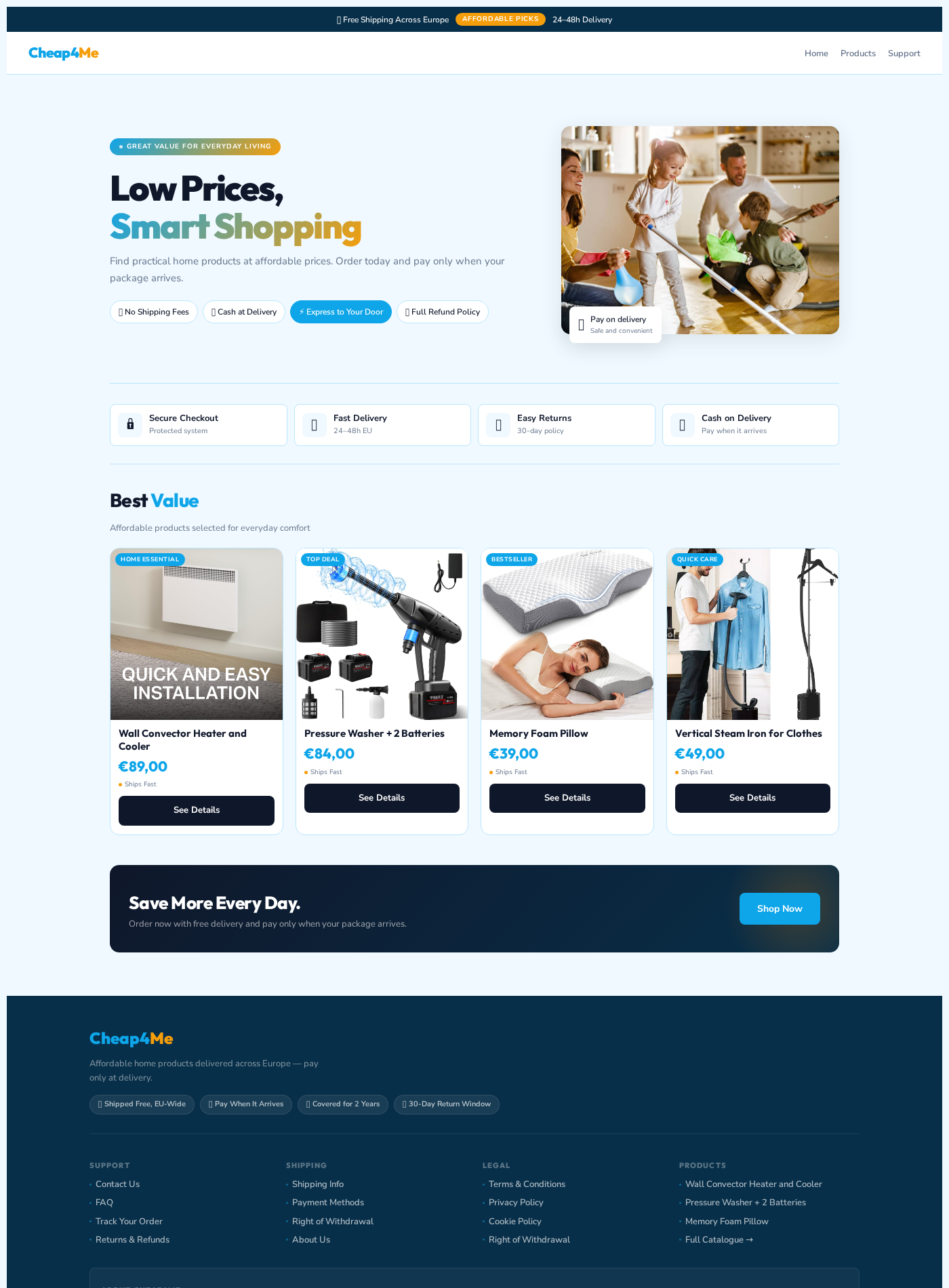
The homepage promotes free European delivery, rapid dispatch, easy returns, a two-year guarantee, and payment when the package reaches the customer.
Cash on delivery reduces one familiar fear because the seller does not collect card details or charge the order immediately.
However, the courier normally cannot wait while a buyer opens, tests, and compares every product with the advertisement.
Payment at the door therefore confirms that a parcel arrived. It does not confirm quality, safety, specifications, warranty coverage, or practical refund access.
Cheap4Me sells heaters, pressure washers, pillows, steamers, and other unrelated goods through one compact catalog with highly polished promotional photographs.
The domain and public trading history are extremely recent
Official domain records show Cheap4Me.com was registered on July 13, 2026, roughly ten weeks before this investigation.
A young domain is not proof of misconduct. New online businesses can operate honestly and develop reliable customer service over time.
The concern is that buyers cannot yet examine years of independent delivery, product, warranty, return, and complaint history for this exact website.
The store names Cheap4Me S.R.L. and publishes an Italian address and telephone number, but it does not display a VAT number or registration number.
Without those identifiers, confirming that the stated legal entity exists and accepts responsibility for these sales becomes unnecessarily difficult.
The return promises contradict one another
Several footer badges advertise a 30-day return window, and the About page promises that disappointed customers can send products back within 30 days.
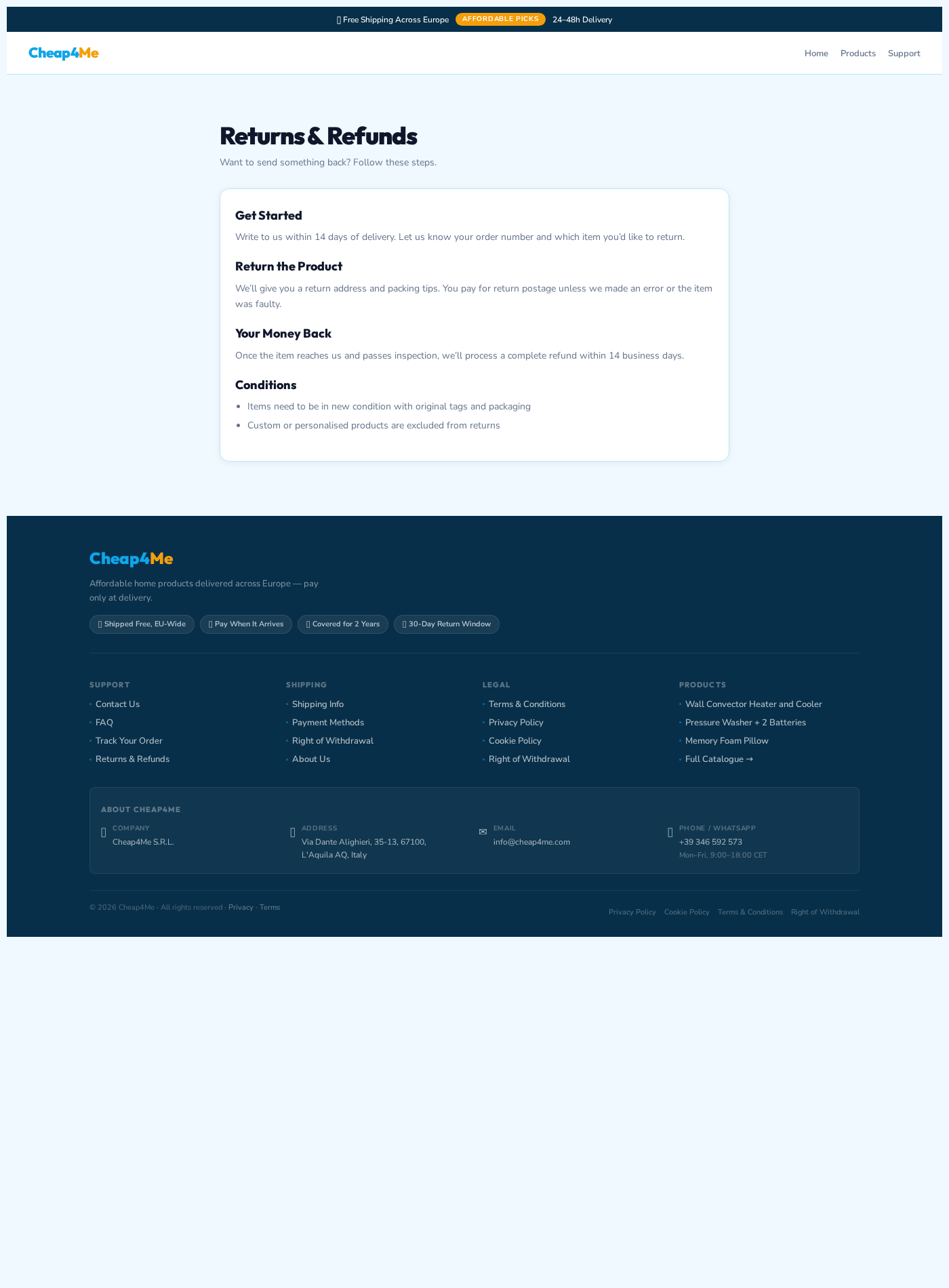
The dedicated returns page instead instructs customers to write within 14 days of delivery, cutting the visible deadline in half.
It also withholds the return destination until support approves the request and states that customers normally pay return postage.
Those details matter because bulky appliances and tools can be expensive to ship, especially if the supplied address differs from the Italian contact address.
A guarantee should tell customers one clear deadline before checkout. Competing windows create confusion precisely when a buyer needs certainty.
- Cheap4Me.com was registered on July 13, 2026.
- The site advertises cash on delivery across numerous European countries.
- The footer promises 30-day returns, while the returns page requires contact within 14 days.
- The return address is supplied only after a request is accepted.
- The buyer normally pays return shipping unless the seller made an error or the item was faulty.
- The published company disclosure lacks a visible VAT or corporate registration number.
How the Cheap4Me Cash-on-Delivery Sales Funnel Works
Step 1: A low-priced household product appears in a targeted advertisement
The journey can begin with an advertisement for a practical product that promises immediate convenience at a price below familiar retail alternatives.
Home heaters, pressure washers, pillows, and garment steamers appeal to broad audiences and require little explanation inside a short social-media video.
Advertisements can emphasize fast European delivery and payment at the door, two statements that make an unfamiliar merchant feel locally accessible.
The buyer may focus on avoiding an upfront payment while overlooking model numbers, electrical certifications, spare parts, manufacturer warranties, and return costs.
Saving the advertisement is essential because product specifications and promotional promises may not appear identically on the final order page.
Step 2: The storefront repeats reassuring promises without independent proof
Visitors encounter badges for secure checkout, fast delivery, easy returns, warranty coverage, and free shipping before seeing detailed legal information.
These visual assurances are controlled entirely by the seller. They are not certifications issued by a regulator, consumer agency, or warranty administrator.
The homepage says delivery can take 24–48 hours, while the shipping page describes an average of two to three business days.
That difference may seem small, but it demonstrates why every headline promise should be compared with the operative policy text.
Shoppers should also record the precise product, quantity, language, currency, and country selected before submitting their telephone number.
Step 3: Telephone confirmation turns a browsing session into a courier order
Cheap4Me says orders are confirmed by phone before its fulfillment process begins, making a reachable telephone number central to the transaction.
A caller may repeat the offer, verify the delivery address, recommend additional units, or describe benefits not written on the product page.
Spoken terms are harder to prove later unless the buyer immediately records the date, number, representative, quantity, price, and exact statements made.
Customers should never disclose payment-card information, online-banking credentials, one-time codes, or identity documents during an unexpected confirmation call.
A legitimate cash-on-delivery order requires enough address information for shipping, not remote access to a device or financial account.
Step 4: The courier collects payment before the buyer can properly test the goods
At delivery, the parcel itself becomes the strongest evidence that the transaction is real, creating pressure to pay and finish the handoff quickly.
Most couriers deliver sealed packages and cannot adjudicate disputes about wattage, battery performance, materials, size, accessories, or advertised functions.
An item may look broadly correct while differing in construction, instructions, plugs, safety markings, included parts, or actual operating performance.
Refusing an obviously damaged parcel may help, but customers should first photograph the package and understand how refusal affects the seller’s stated process.
When payment is made in cash, reversing the transaction can be harder than opening a conventional card dispute with documentary evidence.
Step 5: A return request reveals the shorter deadline and undisclosed destination
The buyer who relied on the 30-day badge may discover that the detailed page requires written notice within only 14 days of delivery.
Support then provides the return address and packing instructions, meaning the likely postage cost cannot be calculated before ordering.
Products must remain new, tagged, and packaged, while custom or personalized goods are excluded from the voluntary return process.
The site says refunds follow inspection and may take another 14 business days after the returned parcel arrives.
For an expensive or heavy item, outbound postage and tracking can consume much of the amount the customer hopes to recover.
Step 6: The broad guarantee becomes difficult to enforce across borders
The website markets across many European countries, but its terms provide limited detail about warranty administrators, repair routes, or country-specific consumer remedies.
The two-year coverage badge does not identify who diagnoses defects, supplies replacement parts, pays transportation, or performs repairs after the initial return period.
A seller can state that European law applies, yet practical enforcement still depends on an identifiable company and responsive support channel.
Customers should obtain the legal entity, registration, VAT details, warranty procedure, and return country in writing before accepting expensive equipment.
If those answers remain vague, the convenience of doorstep payment does not compensate for weak accountability after delivery.
What Our Cheap4Me Investigation Found
The company disclosure looks complete until verification begins
Cheap4Me lists Cheap4Me S.R.L., an address in L’Aquila, an Italian mobile number, a domain email, and weekday support hours.
Those details are more informative than the anonymous footer used by many temporary stores and should be acknowledged as a positive presentation signal.
However, an Italian limited company ordinarily has registration and tax identifiers that allow buyers to confirm its legal status and commercial activity.
We did not find those numbers displayed in the captured contact, terms, privacy, returns, shipping, or About pages.
The About page also says the company is “based in Italian,” an awkward error on a page intended to establish local credibility.
The address should not be confused with a verified return center
The contact page names Via Dante Alighieri, 35-13, 67100 L’Aquila AQ, Italy as the company address.
The return policy does not instruct customers to send products there and instead promises a destination after support approves the request.
That separation may be legitimate because offices, warehouses, repair centers, and return processors often operate at different locations.
It also prevents shoppers from calculating international postage or confirming whether the recipient routinely accepts tracked consumer parcels.
Never mail an item to a contact address without written authorization connecting that location to the order and refund process.
The catalog raises product-safety questions beyond ordinary fashion risks
A pillow that disappoints can waste money, but a heater, battery tool, charger, or pressure device can create additional safety concerns.
Buyers should check manufacturer identity, electrical conformity markings, voltage, plug type, manuals, battery chemistry, spare parts, and recall information.
Generic photographs and benefit statements cannot replace a model-specific declaration of conformity or traceable importer responsible within the target market.
Stop using any product that overheats, sparks, smells unusually strong, leaks, swells, exposes wiring, or behaves differently from its instructions.
Report dangerous goods to the appropriate national market-surveillance or consumer-protection authority, not only to the seller.
The evidence supports caution rather than a claim that every order is fraudulent
We did not place an order, speak with the published number, or inspect a product delivered through Cheap4Me’s fulfillment network.
The site may dispatch usable merchandise and resolve some customer problems successfully, particularly because payment occurs at delivery.
Our warning concerns the young domain, limited corporate verification, conflicting deadlines, unknown return destination, and sparse independent service history.
Those issues make the transaction difficult to evaluate before the courier arrives and potentially difficult to unwind afterward.
Until stronger evidence develops, buyers should favor established sellers that disclose model, importer, warranty, and return information clearly.
How to Check a Cash-on-Delivery Store Before Ordering
Verify the legal business, not just the brand name
Ask for the full registered company name, registration number, VAT number, registered office, customer-service number, and jurisdiction governing the sale.
Search official business and VAT databases rather than relying on map pins, social profiles, or a footer created by the seller.
Compare that entity with the order confirmation, courier label, receipt, warranty card, and any payment document provided at delivery.
Unexplained names may identify a logistics partner, but the seller should describe the relationship clearly before money changes hands.
Demand product-specific documentation
Request a manufacturer, model number, technical sheet, complete package contents, safety certification, warranty provider, and country of origin for electrical goods.
Use image search to locate identical products and compare specifications, marketplace prices, buyer photographs, manuals, and recall notices.
Do not assume a two-year badge means local repairs, free collection, or replacement when the policy does not say so.
A merchant selling powered equipment should answer detailed safety questions without relying on generic reassurance.
Resolve the return contradiction in writing
Ask whether the applicable change-of-mind period is 14 or 30 days and request a link to the terms controlling your exact order.
Obtain the return country, estimated postage, authorization requirements, inspection rules, refund schedule, and treatment of original delivery charges.
Keep the response alongside screenshots showing the longer public promise in case support later applies the shorter deadline.
If the seller refuses to clarify basic remedies, let the advertisement expire and purchase elsewhere.
Company, Address, and Fulfillment Checks
The named company needs independent confirmation
Cheap4Me repeatedly identifies Cheap4Me S.R.L. as the operator, which creates the expectation of an Italian registered limited-liability company.
The website does not display the registration or VAT number needed to match that exact name with an official legal record.
A logo, domain email, and self-declared company label do not independently establish corporate existence, ownership, solvency, or regulatory compliance.
Buyers should request the missing identifiers and verify them through official Italian and European databases before placing higher-value orders.
If the invoice later names another entity, preserve it and ask which company is contractually responsible for refunds and warranties.
The L’Aquila address may not handle inventory or consumer returns
The contact page gives a precise-looking address, yet the shipping page says Cheap4Me operates multiple fulfillment centers across Europe.
No warehouse names, countries, or operators are listed, and the return destination remains hidden until a request is approved.
A registered office can lawfully differ from a warehouse, but shoppers need to know where bulky goods must travel when a problem occurs.
The sender printed on the parcel may be a courier consolidator with no authority to inspect goods or issue refunds.
Only use a return address supplied in a traceable written authorization for the specific order.
The telephone channel deserves careful handling
Cheap4Me publishes an Italian mobile and WhatsApp number and says telephone confirmation occurs before dispatch.
That process can improve address accuracy, but it also shifts important representations away from permanent written product pages.
Write down every material statement and request an email confirming quantity, specifications, total cost, delivery time, returns, and warranty terms.
Never install remote-access software or share authentication codes because a caller claims they are needed to confirm or cancel an order.
If an unknown number pressures you to accept extra units, state the intended quantity clearly and end the call.
European fulfillment claims remain too broad
The shipping page says fulfillment centers across Europe route orders to fourteen listed countries within roughly two to three business days.
Those claims are operational statements from the seller, not independent evidence of warehouse leases, stock levels, or delivery performance.
Fast delivery can coexist with low-quality imports, unclear product responsibility, or expensive reverse logistics when a return becomes necessary.
Inspect packaging for manufacturer and EU-responsible-person details, particularly on electrical, battery-powered, heated, pressurized, or child-related items.
Missing safety identification should be treated as a product concern even when the parcel arrived on time.
What to Do if You Have Fallen Victim to This Scam
- Save every version of the offer. Keep the advertisement, product page, 30-day badges, 14-day policy, checkout details, phone notes, confirmation, parcel label, warranty text, and correspondence.
- Act within the shortest stated deadline. Contact Cheap4Me in writing within 14 days, even if another page promises 30 days, and preserve proof of sending.
- Document the unopened delivery. Photograph all labels and damage, then record the unboxing, package contents, model numbers, markings, accessories, manuals, defects, and differences from the listing.
- Stop using unsafe merchandise. Disconnect any item that overheats, sparks, leaks, swells, smells abnormal, exposes wiring, or lacks required safety information.
- Request precise return authorization. Obtain the recipient, full address, country, reference number, deadline, packaging rules, tracked-postage responsibility, and refund timetable before shipping.
- Keep proof of cash payment. Ask the courier for a receipt and retain order messages linking the collected amount with Cheap4Me and the delivered parcel.
- Escalate through consumer channels. Contact the courier, national consumer center, market-surveillance authority, or European Consumer Centre when delivery, safety, identity, or refund issues remain unresolved.
- Watch for follow-up contact. Ignore requests for one-time codes, remote access, gift cards, cryptocurrency, or extra fees supposedly required to unlock a refund.
- Check the device used for ordering. Run Malwarebytes if redirects or downloads occurred, and use AdGuard to reduce exposure to aggressive shopping advertisements and malicious pages.
Warning Signs Shared by Similar Cash-on-Delivery Stores
Doorstep payment is presented as complete protection
Receiving a parcel before paying feels safer, but the customer usually sees only the sealed exterior while the courier completes a delivery route.
The real dispute may concern quality, quantity, specifications, safety, or refund logistics, none of which the courier can decide.
Treat cash on delivery as one payment arrangement, not as independent verification of the seller or merchandise.
Always obtain a receipt and connect it with the exact order using screenshots and confirmation messages.
Badges promise more than the policy delivers
Fast shipping, easy returns, warranty coverage, and secure ordering can appear as icons long before details explain exclusions and customer costs.
Read the dedicated pages and compare every deadline, fee, destination, and approval requirement with the homepage language.
When two promises conflict, assume the shorter or more restrictive rule may be applied during a dispute.
Ask support to resolve contradictions before ordering rather than after opening the parcel.
A local contact page masks an unverified supply chain
A European address and telephone number do not prove that products were manufactured, stocked, tested, or returned within that country.
Supplier-fed stores can use local customer acquisition while inventory moves through unrelated logistics companies and overseas factories.
Check the legal operator, importer, dispatch location, return destination, and warranty provider as separate parts of the transaction.
Reliable sellers make those relationships understandable before customers commit money or personal data.
Frequently Asked Questions
Is Cheap4Me definitely a scam?
We cannot establish that every Cheap4Me order is fraudulent, and we did not conduct a test purchase.
The new domain, unverified corporate details, contradictory returns, hidden destination, and limited independent history justify substantial caution.
How old is Cheap4Me.com?
Official registry data shows the domain was registered on July 13, 2026.
That recent creation provides only a short period for independent customers to demonstrate dependable fulfillment, warranties, support, and refunds.
Does cash on delivery make Cheap4Me safe?
Cash on delivery reduces advance-payment exposure but does not let most buyers fully test sealed merchandise before paying.
It also offers fewer automatic dispute options than a credit-card purchase when quality or specifications are contested later.
Does Cheap4Me offer 14-day or 30-day returns?
The site displays both claims. Footer and About text advertise 30 days, while the dedicated returns page says to write within 14 days.
Buyers should act within 14 days and request written confirmation of the applicable terms.
Who operates Cheap4Me?
The website names Cheap4Me S.R.L. and publishes an L’Aquila address and Italian telephone number.
It does not visibly provide a VAT or company-registration number on the pages we captured, preventing straightforward independent matching.
What should I check when the parcel arrives?
Verify quantity, model, voltage, plug, manufacturer, importer, safety markings, accessories, warranty documents, visible damage, and advertised functions before normal use.
Record the opening and preserve all packaging until the return deadline passes.
The Bottom Line
Cheap4Me combines a new domain with persuasive local details, cash on delivery, rapid shipping, and broad guarantees. That package is reassuring until its contradictions are examined.
The unresolved company identity, conflicting deadlines, undisclosed return destination, and product-safety questions make restraint sensible. Verify everything in writing or choose an established retailer.

Join the discussion
0 commentsShare your experience or ask a question about this article.
Discussion
Start the conversation
Have a question or something useful to share? Add the first comment.