

Zephjoy looks like a cheerful general store built for quick discoveries, seasonal bargains, and low-friction international shopping.
Its strongest reassurances sit in prominent places. The information buried behind those badges tells a more complicated commercial story.

Overview
The storefront uses accreditation language without identifying the accreditor
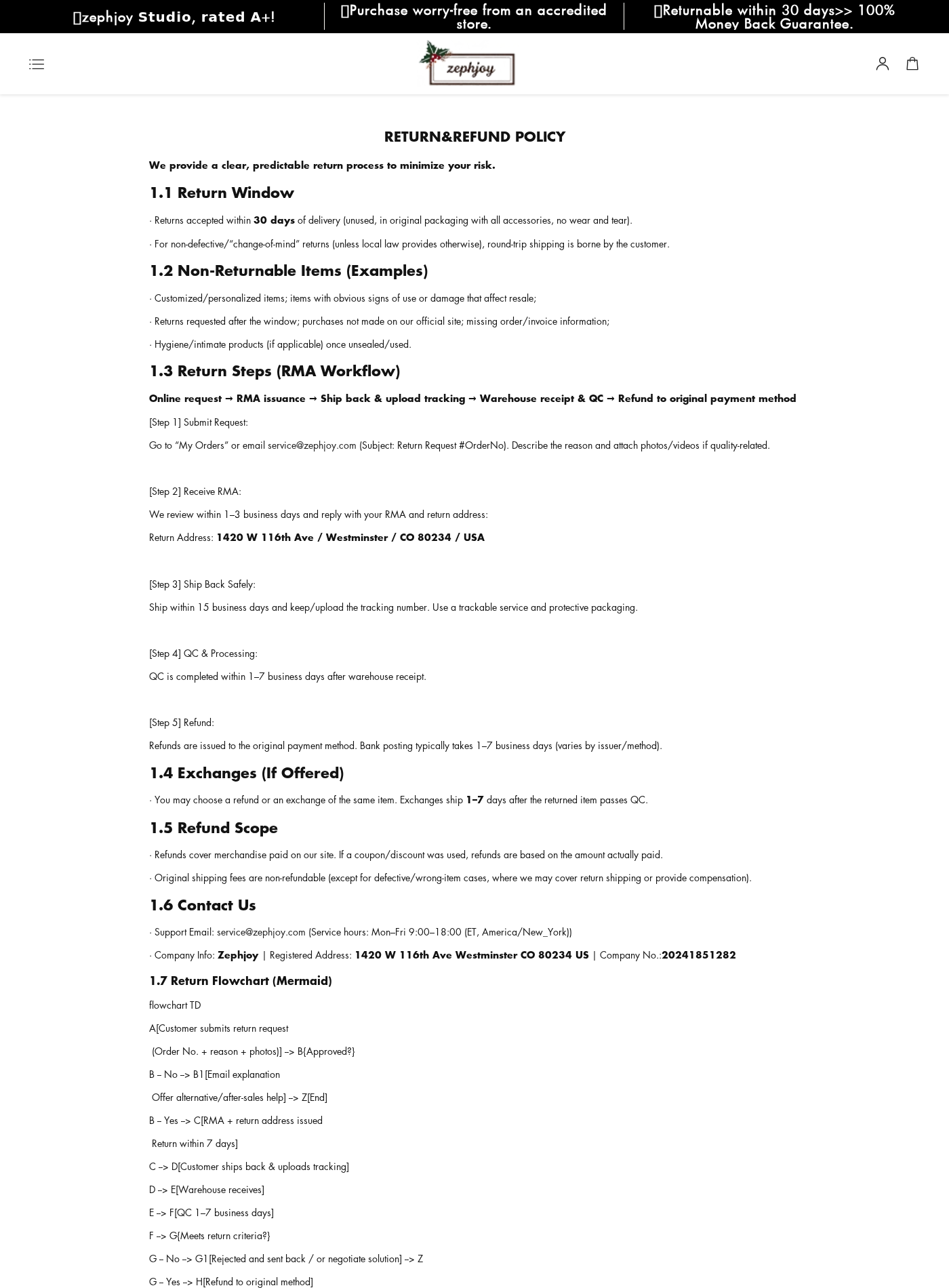
Zephjoy’s homepage says the studio is rated A+ and describes the website as an accredited store where customers can purchase worry-free.
No accrediting organization, certificate number, verification link, assessment date, or public report accompanies that statement on the reviewed page.
An A+ symbol can resemble familiar business-rating systems, even when the seller does not say which institution supposedly issued it.
Customers should never infer Better Business Bureau accreditation, government approval, or marketplace certification from a floating badge or unexplained phrase.
A meaningful accreditation must be independently searchable and tied to the exact legal entity, domain, and current status.
The published company number belongs to a differently named Colorado entity
Zephjoy lists company number 20241851282 beside a residential-looking Westminster, Colorado address in its policy pages.
Colorado-derived business data identifies that number as Stellar Illumination LLC, formed in August 2024, rather than a company named Zephjoy.
The same dataset currently describes the entity as delinquent, a status buyers should verify directly before relying on the number.
The identical number and address also appear across multiple unrelated ecommerce domains selling broad catalogs under other names.
A shared operator or service provider may explain reuse, but Zephjoy does not clearly explain the relationship where shoppers need it.
The guarantee headline becomes narrower inside the return policy
The homepage announces returnability within 30 days and a 100% money-back guarantee in confident, uncomplicated language.
The detailed policy requires unused merchandise, original packaging, prior approval, an RMA, and shipment within seven days after authorization.
Change-of-mind buyers pay return postage, and quality control can take another one to seven business days after arrival.
A generated Mermaid flowchart appears as raw policy text, signaling that the page may have been published without complete editorial review.
These restrictions do not automatically make Zephjoy fraudulent, but they make its broad guarantee far less effortless than advertised.
- Zephjoy.com was registered on December 2, 2025.
- The homepage displays an unexplained A+ accredited-store claim.
- Company number 20241851282 is registered to Stellar Illumination LLC, not Zephjoy.
- Public Colorado-derived data currently describes that entity as delinquent.
- The same company number and Westminster address appear on several unrelated online stores.
- Customers normally pay return shipping for preference-based returns.
- The return page contains unfinished Mermaid flowchart instructions visible to shoppers.
How the Zephjoy High-Trust Discount Store Funnel Works
Step 1: A broad product ad reaches shoppers through impulse-friendly channels
Zephjoy carries gadgets, seasonal items, clothing, home products, personal-care goods, and novelty merchandise rather than one specialized category.
That catalog supports many advertising angles because each product can target a different audience without building a separate established retail identity.
Short videos can demonstrate an appealing outcome while omitting maker, model, materials, dimensions, certification, compatibility, and normal market price.
A customer lands on the item page expecting to evaluate one bargain, not to investigate the infrastructure behind an international general store.
Before clicking through, save the social profile, advertisement identifier, video, comments, destination URL, stated price, and promised delivery location.
Step 2: Trust badges calm the exact doubts an unknown store creates
An A+ rating, accreditation wording, worldwide shipping, and a 100% guarantee appear to answer concerns before visitors voice them.
These statements carry psychological weight because they resemble third-party validation, even though the page does not name a validating institution.
Seller-created graphics cannot independently establish customer satisfaction, financial reliability, business standing, product safety, or refund performance.
Click every badge. A real certification should lead to a current record showing the same company, domain, and certification scope.
If a rating exists only inside the store’s own design, treat it as an advertising claim rather than outside assurance.
Step 3: Urgency and extreme benefits reduce time spent checking details
Product listings across the associated store pattern use large percentage reductions, limited-time labels, and bold outcome language to encourage immediate decisions.
A low price can make investigation feel unnecessary because the potential loss seems smaller than the effort required to verify the merchant.
However, repeated small purchases can expose payment information, create return costs, and generate larger losses through upsells or quantity mistakes.
Health, beauty, electrical, pet, and ingestible products introduce safety questions that remain important even when the checkout total looks modest.
Pause long enough to compare identical product photographs, descriptions, and prices across established retailers and manufacturer catalogs.
Step 4: The checkout relies on a brand name that is not the registered entity
A shopper sees Zephjoy throughout the buying experience, while the policy footer supplies an address and numerical company identifier.
That number resolves to Stellar Illumination LLC in public business data, creating an identity gap the website does not clearly bridge.
The invoice or card descriptor may introduce another processor, fulfillment company, or abbreviated name after payment.
Customers then struggle to determine which party advertised the item, sold it, imported it, shipped it, and owes a refund.
Ask for the full contractual seller and verify it before authorizing the charge, especially when the product carries health or safety implications.
Step 5: Delivery may involve a cross-border fulfillment network
The store speaks in global terms while publishing a Colorado address, yet that address alone does not demonstrate where inventory is stored.
Processing, transit, customs, last-mile delivery, and returns may involve different companies and countries that remain invisible during purchase.
A parcel can arrive from an unfamiliar logistics label without proving that the Colorado location handled, inspected, or even saw the product.
Record the sender, tracking origin, weight, customs description, recipient, and packaging before opening an incorrect or suspicious shipment.
Those details can show whether the item matches the size, value, and origin implied by the offer.
Step 6: The return process shifts cost and procedural risk to the customer
A dissatisfied buyer must contact support, provide an order number, explain the reason, and supply photographs before receiving approval.
Once approved, the item must be mailed to the supplied address within seven days and tracked back to the warehouse.
The buyer pays shipping when the reason is personal preference, which can erase much of a low-value refund.
Quality control may reject merchandise that no longer meets the policy’s unused, complete, and original-packaging requirements.
The 100% guarantee headline therefore does not mean every unhappy customer receives the entire payment back without conditions or expense.
The Zephjoy Company Number Problem
The number identifies Stellar Illumination LLC
Business record data tied to Colorado lists entity 20241851282 as Stellar Illumination LLC, organized on August 13, 2024.
The record uses the same 1420 W 116th Ave, Westminster, Colorado address printed in Zephjoy’s policy footer.
The matching address suggests Zephjoy did not simply mistype a random number, but it still leaves the trade-name relationship unexplained.
A transparent store could identify Stellar Illumination LLC as operator and state that Zephjoy is its trading name.
Without that sentence, consumers must reconstruct the relationship after finding the number themselves.
The entity status is an important live verification point
The Colorado-derived record available during this review characterized Stellar Illumination LLC as delinquent rather than in good standing.
Registry status can change, and third-party mirrors may lag, so buyers should confirm the current result through the official state search.
A delinquent status does not itself prove that an order will fail or that every transaction is unlawful.
It does undermine the confidence created by an unexplained accreditation claim and deserves resolution before relying on corporate accountability.
Zephjoy should publish an accurate entity name and current status instead of asking customers to connect mismatched details.
The same identity appears behind unrelated storefronts
Search results connect the identical company number and address with Shoponfly, Levasive, Rubbule, Rafterfe, and additional general stores.
These domains use different names and sell unrelated mixtures of beauty, household, garden, pet, clothing, and wellness products.
One legal operator can lawfully own several brands, and shared ecommerce service companies can also provide standard policy infrastructure.
The concern is the absence of a clear disclosure explaining ownership, customer-data sharing, returns, and responsibility across this apparent network.
Repeated templates and contact patterns also make independent reputation research harder because complaints fragment across many short brand names.
What the Zephjoy Policies Mean in Practice
Thirty days is not the only deadline that matters
The return request begins within 30 days, but an approved parcel must then be sent within the policy’s shorter seven-day window.
Damaged or incorrect goods should be reported promptly with photographs, and waiting may weaken the available evidence.
Customers should record the delivery date, first complaint date, approval date, shipment date, and warehouse receipt date separately.
A broad badge cannot replace this timeline, especially when support response time controls when an RMA becomes available.
Send requests through email so the chronology remains visible if the merchant later disputes compliance.
Customer-paid postage can make a nominal refund uneconomic
An inexpensive item may cost nearly as much to return with international tracking as the customer originally paid.
The policy does not give shoppers a public return address before approval, preventing a realistic postage estimate during checkout.
A buyer may accept a partial refund or keep an unwanted product because the formal route costs too much.
That outcome differs materially from the effortless 100% money-back impression presented near the top of the store.
Ask for the return country and responsibility for postage before purchasing, then keep the answer with the order confirmation.
Visible template debris matters because policies are operational documents
The return page displays raw Mermaid flowchart instructions, including branches and labels that were apparently intended for internal page rendering.
That coding fragment does not cause financial harm by itself and may be a harmless publishing oversight.
It does show that a critical consumer document reached production without careful proofreading or a complete presentation check.
When legal identity, accreditation, and refund conditions already require clarification, unfinished policy text reduces confidence further.
Customers should save the version in force when they ordered because hurried templates can change without personal notice.
Company, Address, and Fulfillment Checks
The legal identity does not match the storefront name
Zephjoy calls itself the company in one place, while its numerical identifier belongs to Stellar Illumination LLC in Colorado records.
The site should state whether Zephjoy is a trade name, brand, licensee, client, or unrelated user of that registration detail.
Until that relationship is documented, the number cannot be treated as straightforward proof that Zephjoy itself is registered.
Check the legal seller printed on the payment receipt and raise any unexplained identity change immediately.
The Westminster address appears throughout a storefront network
Multiple unrelated domain names publish the same Colorado address and company number while selling different broad catalogs.
The location may function as a registered office, residence, mailbox, administrative contact, or shared ecommerce identity rather than a retail warehouse.
A return center must be confirmed separately because the Zephjoy policy supplies its destination only after approval.
Never send merchandise to the Colorado address unless Zephjoy authorizes it for that exact order in writing.
The support channel uses a domain email but limited accountability
Zephjoy publishes service@zephjoy.com and weekday Eastern Time service hours, which provides a traceable written contact route.
The reviewed policy does not pair that inbox with a named officer, clearly verified telephone support, or an explained operating company.
Test the email before ordering with questions about seller identity, accreditation, fulfillment country, and return postage.
A useful reply should answer each question directly rather than sending a generic discount or policy link.
Fulfillment transparency is too weak for sensitive product categories
A novelty decoration creates different risks from a skin treatment, health device, electrical appliance, supplement, or pet product.
Broad catalogs need product-specific manufacturer, importer, testing, warning, conformity, and recall information rather than one universal guarantee badge.
Stop using any item that overheats, leaks, irritates, swells, sparks, smells unusual, or lacks expected safety labeling.
Report unsafe goods to the relevant marketplace, payment provider, and national product-safety authority with photographs and batch details.
What to Do if You Have Fallen Victim to This Scam
- Save the transaction record. Capture the advertisement, product page, accreditation language, price, quantity, checkout, guarantee, policies, confirmation, tracking, delivery label, and every support exchange.
- Write to Zephjoy promptly. Identify the precise defect or mismatch, state the resolution requested, attach clear photographs, and ask for an RMA plus the complete return destination.
- Do not rely on the homepage deadline. Track the 30-day request period and the seven-day post-approval shipment requirement while preserving timestamps for every message.
- Calculate return economics first. Request the return country, recipient, tracking standard, customs declaration, possible deductions, and written confirmation that the item qualifies before paying postage.
- Escalate with the payment provider. If the merchant is unresponsive or the product materially differs, describe the facts accurately and submit the saved advertising and policy evidence.
- Monitor the payment method. Watch for unfamiliar descriptors or additional charges, enable alerts, and ask the issuer whether card replacement is appropriate after suspicious activity.
- Reject refund manipulation. Never provide one-time codes, banking passwords, gift cards, cryptocurrency, remote computer access, or an advance fee to receive money back.
- Report unsafe merchandise. Stop using it, preserve packaging and labels, document symptoms or hazards, and notify the appropriate consumer or product-safety regulator.
- Check your device if redirects occurred. Scan with Malwarebytes after suspicious downloads, and use AdGuard to limit malicious advertising and repeated store redirects.
How to Verify Zephjoy Before Considering an Order
Ask who awarded the A+ rating
Request the accreditor’s complete name, public verification page, certificate number, assessment date, and criteria.
Visit the accreditor independently rather than using a link sent only through an advertisement or support message.
Confirm that the record names Zephjoy.com and the legal entity actually collecting payment.
If support cannot identify the organization, the rating should carry no weight in the purchase decision.
Verify the entity number at its official source
Search Colorado’s business records for 20241851282 and read the exact entity name, status, filing history, and registered agent information.
Then ask Zephjoy why the record says Stellar Illumination LLC and request documentation connecting the names.
Check whether the payment descriptor and invoice match that explanation before the dispute window begins running.
A merchant asking for trust should make this relationship easy to understand without detective work.
Investigate the specific product independently
Reverse-search product photographs and distinctive description sentences to identify original manufacturers, marketplace listings, normal prices, and existing safety information.
Compare dimensions, materials, package contents, model numbers, voltage, warnings, and delivery estimates rather than relying on visual similarity.
Look for reviews tied to the exact product and seller, not generic testimonials embedded across a rotating catalog.
Choose an established retailer when essential specifications or after-sales responsibility remain unclear.
Frequently Asked Questions
Is Zephjoy definitely a scam?
The evidence establishes serious transparency and policy concerns, but we did not test every order or determine every customer’s outcome.
Avoid treating the unexplained A+ claim as proof of reliability.
Is Zephjoy really an accredited store?
The reviewed homepage uses accredited-store language but does not identify the organization that supposedly awarded it.
Without independent verification, the claim remains a seller-controlled assertion.
What company is behind Zephjoy?
Zephjoy publishes number 20241851282, which Colorado-derived business data associates with Stellar Illumination LLC.
The website does not clearly explain the relationship between those names.
Does Zephjoy offer a 100% money-back guarantee?
The homepage advertises one, while the detailed policy imposes eligibility, approval, packaging, timing, inspection, and shipping-cost conditions.
Read the policy as the practical process rather than relying on the badge.
Why does the shared address matter?
The same address and entity number appear on several differently branded general stores.
That may reflect common ownership or infrastructure, but it weakens the impression of a standalone, easily verified retailer.
What is the safest way to pay Zephjoy?
If proceeding despite the risks, use a credit card or established payment service with clear dispute rights.
Avoid transfers, gift cards, cryptocurrency, or any payment that is difficult to reverse.
The Bottom Line
Zephjoy asks customers to trust an A+ accreditation claim, a Colorado company number, and a simple money-back guarantee.
Our checks found no named accreditor, a number belonging to differently named Stellar Illumination LLC, network reuse, and a return process carrying meaningful conditions and costs.
Those facts justify strong caution. A legitimate seller can resolve them by publishing a verified legal identity, current standing, genuine accreditation record, warehouse route, and unambiguous refund terms.

Join the discussion
0 commentsShare your experience or ask a question about this article.
Discussion
Start the conversation
Have a question or something useful to share? Add the first comment.